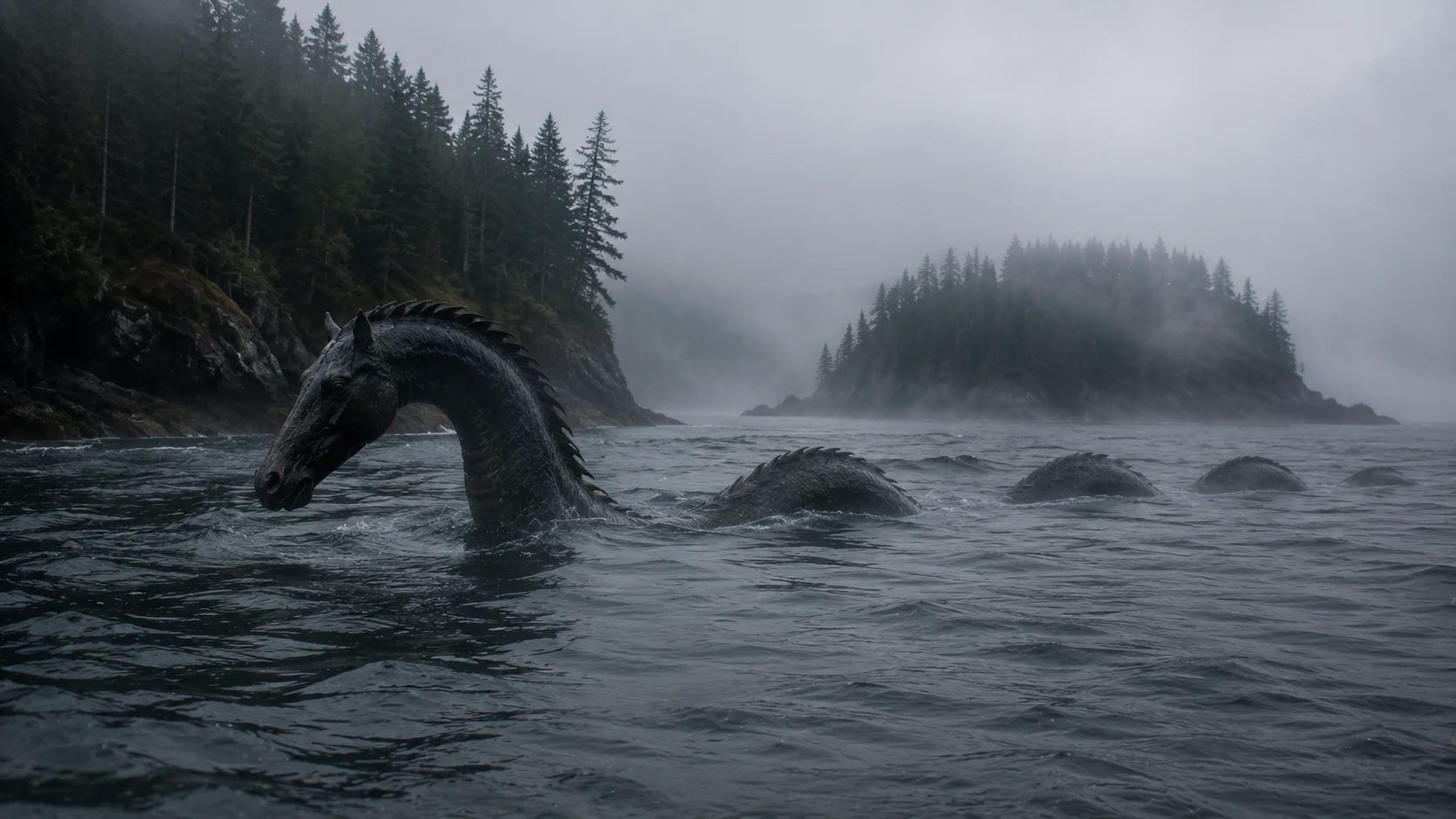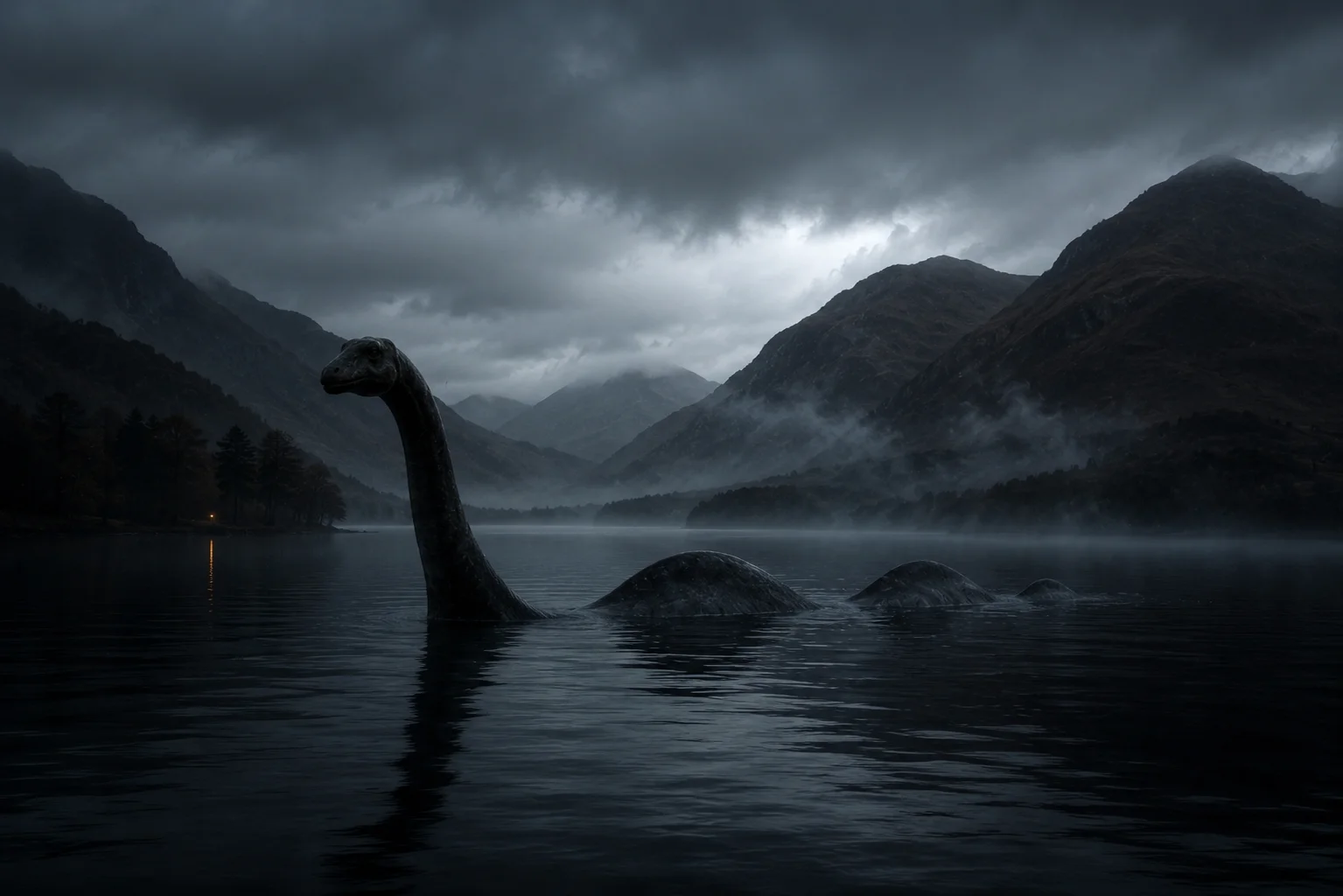
The Loch Ness Monster, affectionately known as Nessie, is the most famous lake monster in the world, a large, mysterious creature said to inhabit the deep, dark waters of Loch Ness, a great freshwater loch in the Scottish Highlands, often described as a long-necked, humped, plesiosaur-like aquatic beast.
The Monster of the Loch
The Loch Ness Monster is described as a large aquatic creature inhabiting the deep waters of Loch Ness, a long, deep, dark freshwater loch in the Scottish Highlands, one of the largest and deepest bodies of fresh water in the British Isles. Nessie is most often described as a large creature with a long neck, a bulky body, one or more humps breaking the surface of the water, and sometimes flippers and a small head, a description strongly resembling a plesiosaur. The loch itself is a formidable stage for such a legend: a narrow, glacially carved trench of a lake, its waters stained a deep peaty brown and its depths cold and lightless, well suited to a creature that reveals itself only in fleeting glimpses.
A Water Beast on the River Ness
The earliest account sometimes connected to the legend is far older than the twentieth century, and concerns a river rather than the loch itself. Adomnán's Life of St. Columba, written around 700 CE, describes Columba, in an episode set around 565, repelling a "water beast" in the River Ness that had attacked a swimmer. It is a single hagiographic source, composed roughly a century after Columba's death, and both its historical accuracy and its direct connection to the modern Nessie legend are disputed among scholars. It is best understood as a distant, uncertain echo rather than a documented origin, standing apart from the older and separate tradition of Scottish water-beast folklore, such as the kelpie or water-horse, tales of shapeshifting spirits said to haunt the lochs and rivers of the Highlands. Nessie is often loosely associated with this folklore in the popular imagination, but the kelpie and water-horse traditions form a related, distinct category of their own.
The Summer the World Took Notice
Popular interest in a creature at Loch Ness is conventionally dated to 1933. On 22 July of that year, George Spicer and his wife reported seeing a large creature cross the road near the loch, and their account was followed shortly afterward by a wave of newspaper coverage. Journalist Alex Campbell, reporting for the Inverness Courier, is often credited with popularizing the very term "monster" for the phenomenon, a choice of word that shaped public imagination for the decades to come. What had been local and occasional talk became, almost overnight, a story with international reach.
The Surgeon and His Photograph
The most famous piece of Nessie evidence is the Surgeon's Photograph of 1934, a black-and-white image attributed to Robert Kenneth Wilson, presented as showing a long-necked creature with a small head rising from the waters of the loch. For sixty years it stood as the emblem of the mystery, reproduced endlessly, treated as the nearest thing to proof the legend possessed. In 1994, researchers Alastair Boyd and David Martin uncovered confessions revealing the photograph to be a hoax: a model of a sea-monster head and neck, built and attached to a toy submarine, then photographed on the loch and passed off as the real thing. It stands today as a well-documented fraud rather than genuine evidence, though its long reign as the image of Nessie left a mark on the legend that outlasted the exposure of the fake.
Film, Sonar, and Fainter Traces
The Surgeon's Photograph was not the only purported evidence offered over the years. In 1960, Tim Dinsdale filmed footage showing a hump-like object moving across the surface of the loch, an image that fuelled fresh rounds of speculation. Various sonar surveys, including the large coordinated effort known as Operation Deepscan in 1987 and later expeditions since, have recorded unexplained underwater sonar contacts. None of this evidence, film or sonar alike, has been accepted by mainstream science as conclusive proof of a large unknown animal living in the loch. Each new trace has added to the case's folklore without ever settling its central question.
Decades of Systematic Searching
Loch Ness has drawn more than casual sightings; it has drawn sustained, organized investigation. The Loch Ness Investigation Bureau conducted surveys through the 1960s and 1970s, combining watch stations, cameras, and boat-based searches in an effort to catch the creature on record. The most thorough scientific effort came much later: a 2018 environmental DNA survey led by Professor Neil Gemmell of the University of Otago, which sampled the loch's waters broadly and systematically. The survey found no reptilian, dinosaur-like, or other "monster"-consistent DNA anywhere in the loch. It did find large quantities of eel DNA, leading Gemmell's team to float an oversized eel as one naturalistic possibility, though this remains a suggestion rather than a confirmed explanation for the sightings that inspired the search.
What Skeptics Point To Instead
Naturalistic explanations proposed by researchers over the decades cover a wide range of ordinary causes: misidentified logs and floating debris, wind-driven wave patterns known as standing waves or seiches, otters and diving birds creating misleading wakes, boat wakes catching the light, and optical or photographic artifacts. No single explanation commands universal agreement, and the skeptical consensus generally favors some combination of these mundane causes over the presence of an unknown species. The loch's changeable surface, prone to sudden wave patterns and shifting light, has proven a reliable source of illusion in its own right.
The Plesiosaur That Could Not Have Survived
Among the many theories offered for Nessie's identity, the "plesiosaur hypothesis" has always held the greatest popular appeal: the idea that the creature might be a surviving prehistoric marine reptile, a relic of the age of dinosaurs somehow persisting into the present. It is also the theory most firmly rejected on scientific grounds. Loch Ness itself is geologically young, formed only in the wake of the last glaciation some ten thousand years ago, far too recent a body of water to have hosted a continuously surviving relict population across the tens of millions of years since plesiosaurs vanished elsewhere. The biology tells against it as well: a cold-blooded reptile of that kind would be poorly suited to thriving in the cold fresh water of a Scottish loch. The image endures in illustration and imagination all the same, simply because it is the shape the legend first took.
Kin Across the World's Lakes
Within cryptozoology's own tradition, Nessie is often grouped together with other reported lake monsters from around the world, comparisons frequently drawn to Champ of Lake Champlain in North America or Ogopogo of Lake Okanagan in western Canada. These are connections made by cryptozoology writers surveying the field as a whole, not attested links within Scottish tradition itself, and the distinction matters: each of these creatures belongs to its own body of water, its own reports, and its own local history, and should not be treated as variations on a single shared legend.
A Symbol the Highlands Live By
Whatever the truth beneath its waters, the Loch Ness Monster has become a major cultural and economic symbol for the Scottish Highlands and for the Loch Ness area specifically. The legend drives significant tourism, and Loch Ness ranks among Scotland's most visited natural attractions in no small part because of it. The Loch Ness Centre and a cluster of related visitor attractions at Drumnadrochit have grown up around the mystery, turning a question no one has answered into an industry that sustains the region.
A Name Worn Lightly
Compared to older mythological figures with layers of titles and epithets, Nessie carries a name worn lightly. It is most commonly called simply "the Loch Ness Monster," or by the nickname "Nessie," which became popular in the mid-twentieth century press and has persisted ever since as the standard affectionate, colloquial term. The plainness of the name suits a legend built less on ancient reverence than on modern curiosity and newspaper coverage.
Screen, Page, and the Watch That Never Ends
The Loch Ness Monster's later cultural reception has been vast, with extensive appearances across film, television, and literature from the 1970s onward, spanning monster movies, animated features, and countless documentaries that return again and again to the same dark water. Interest has never fully receded into history; it continues in organized form through efforts such as the Loch Ness Monster Sightings Register, maintained by the volunteer group Loch Ness Exploration, which logs reports of sightings into the present day. Most of these reports, many of them single-witness or single-source accounts gathered from webcams or tourist photographs, remain unverified and are generally explained by skeptics as cases of misidentification rather than genuine encounters. They should be read as unverified anecdote rather than an established part of the case's documentary record, even as they keep the watch, and the legend, alive.
The Elusive Creature of the Deep
The Loch Ness Monster endures as the most famous lake monster in the world and one of the most famous cryptids of any kind: the elusive, long-necked, humped creature of the deep dark waters of Loch Ness, the subject of countless sightings, the famous Surgeon's Photograph and its long-delayed exposure, decades of searches and expeditions from sonar sweeps to environmental DNA, and an enduring global fascination that no negative result has ever quite managed to extinguish.
Sources & traditions
- EncyclopediaWikipedia — Loch Ness Monster
- TraditionLocal sightings, press reports and regional folklore (Scotland)
Myths change from area to area and from time to time. This chronicle follows the most widely told versions; tellings in other villages, regions and eras may differ.