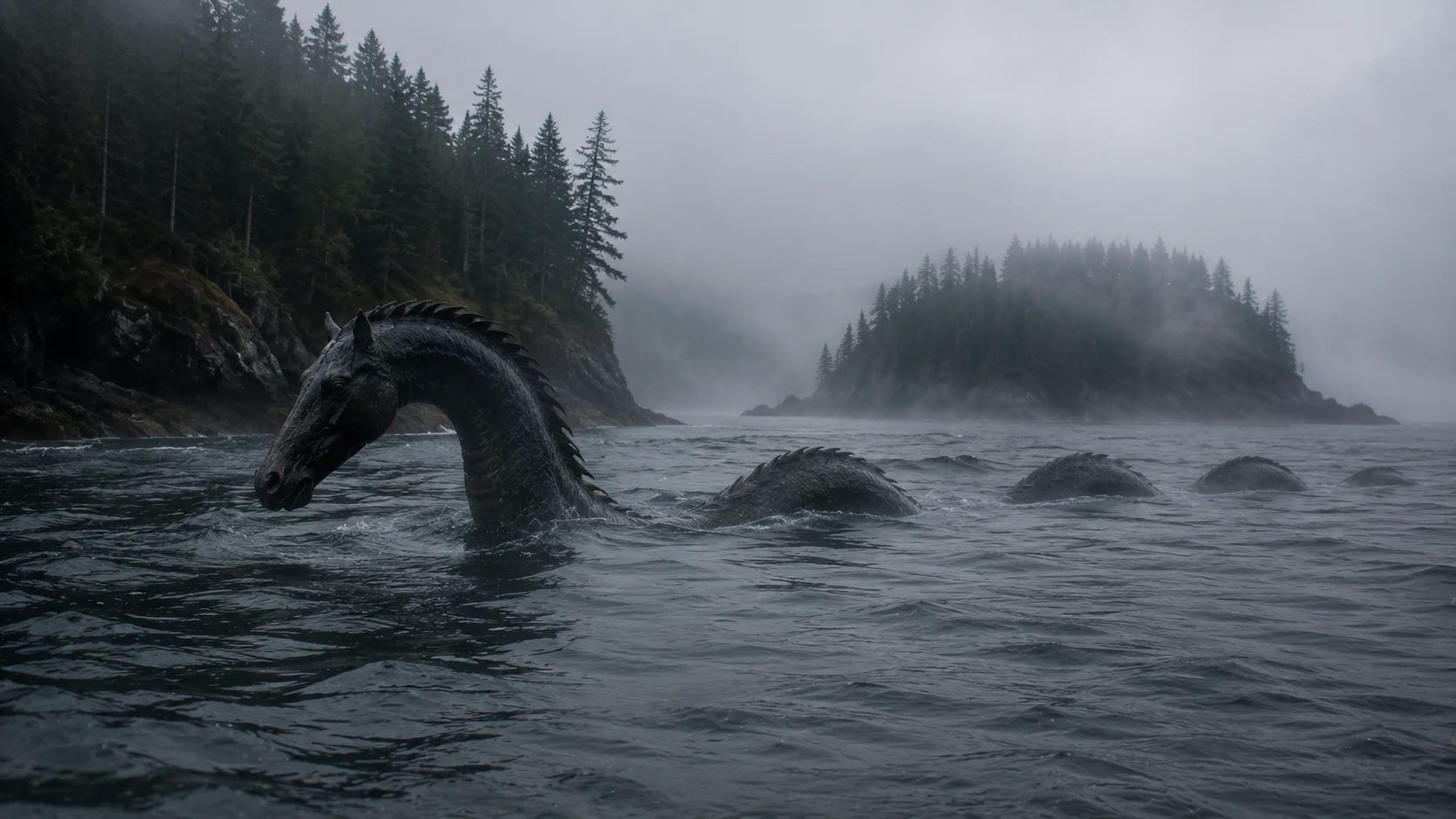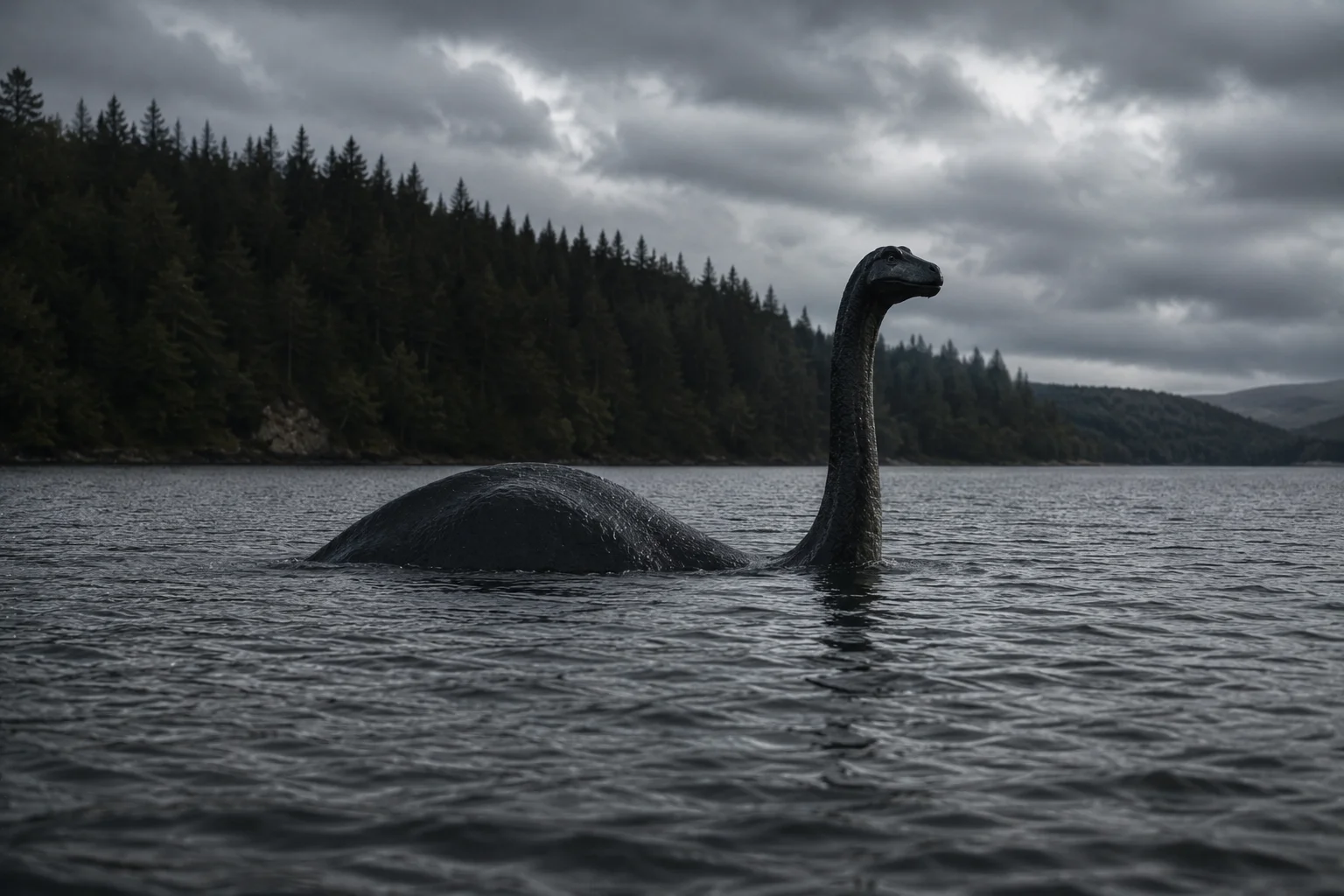
Champ (or Champy) is a famous North American cryptid, a large lake monster said to inhabit Lake Champlain, the great freshwater lake on the border of New York, Vermont, and Quebec, often described as a long-necked or serpentine aquatic creature, popularly cast as the American counterpart of Scotland's Nessie. The name itself is nothing more mysterious than the lake's own name, shortened and given a life of its own, and over roughly two centuries of scattered report and repetition it has grown from a handful of newspaper lines into one of the most recognizable folk-cryptids in the United States.
A Long Lake and Its Long Shadow
Lake Champlain is enormous by the standards of eastern North American freshwater lakes: a long, narrow, and in places quite deep body of water running north to south along the New York-Vermont border before spilling across into Quebec. Its scale is part of why Champ has proven so durable as an idea. A lake that large, that old, and that cold in its depths is easy to imagine holding something unseen, and the creature attributed to it has been described in the loosest and most variable of terms — sometimes a long-necked, humped shape breaking the surface in a manner reminiscent of a plesiosaur, sometimes a long, serpentine, multi-humped form closer to the way Canada's Ogopogo is typically drawn. There is no single fixed physical description that all accounts agree on; what unites the reports is less a consistent creature than a consistent lake and a consistent hope, or fear, of what might be moving beneath it.
A Disputed Seventeenth-Century Origin
No account of Champ is complete without the explorer for whom the lake is named. Samuel de Champlain kept a journal during his exploration of the region in the early seventeenth century, and promotional and local lore has long pointed to a 1609 passage in that journal as the earliest description of a serpent-like creature in the lake — effectively making Champlain himself the first witness to his own lake's monster. It is a tidy origin story, and it is also a contested one. Historians who have examined the passage generally read it as a description of a garfish, a large and unusual-looking but entirely mundane fish native to the region, rather than any cryptid. The Champlain attribution persists in popular retellings precisely because it is so satisfying a coincidence of name and legend, but it belongs to the realm of popularly repeated claims rather than settled history, and should be understood as such.
Older Waters, Older Stories
Beneath the European-explorer framing lies an older layer of tradition. Some accounts of Champ reference oral traditions among the Abenaki and Iroquois peoples of the Lake Champlain region describing a lake-dwelling creature or spirit, sometimes rendered in translation as a "horned serpent," associated with the lake prior to European settlement. These references come down to the present largely secondhand, preserved in later folklore compilations rather than documented in extensive primary indigenous ethnographic sources, and that gap matters: what survives is a description of a description, filtered through non-indigenous collectors and writers working after the fact. It would be a mistake to treat these traditions as simply an earlier version of the same "Champ" that appears in nineteenth-century newspapers and twentieth-century tourism branding — they belong to a separate frame of reference, describing a lake-spirit within indigenous cosmology rather than a cryptozoological specimen, and later popularizers have often flattened that distinction for the sake of a longer pedigree.
Captain Crum and the Serpent of 1819
The oldest widely cited published sighting in the modern Champ tradition dates to 1819, attributed to a Captain Crum near Port Henry, New York, who reported seeing a serpent-like creature in the lake. Like nearly all pre-modern cryptid sightings, the Crum account rests on a single source and cannot be independently verified nearly two centuries later — there is no way to cross-check the description, question the observer, or rule out a mundane explanation with any confidence. What the report does establish is how early the pattern was set: a solitary witness, a serpentine shape on the water, and a local community willing to remember and repeat the story long after the original telling.
Barnum's Bounty
By the 1870s, Champ had entered the world of popular entertainment in a very literal way. The showman P. T. Barnum is reported to have offered a substantial cash reward — commonly cited as $50,000, though the exact figure varies somewhat by source — for the creature's capture, dead or alive. Whatever the precise sum, the offer itself is telling: it marks the point at which Champ stopped being merely a local curiosity passed between witnesses and newspapers and became a piece of American showmanship, a monster valuable enough to be worth chasing for profit rather than only for folklore's sake. No one ever collected on it, and the bounty survives today mainly as a colorful anecdote in the creature's long publicity history rather than as evidence of anything captured or even closely pursued.
The Photograph That Would Not Settle Anything
The single most analyzed and most argued-over piece of Champ evidence is the so-called Mansi photograph, taken in 1977 by a tourist named Sandra Mansi. The color photograph appears to show a long-necked hump breaking the surface of Lake Champlain, and it has been examined, re-examined, enlarged, and debated by both proponents and skeptics for decades without producing a settled conclusion. Believers in the photograph's authenticity point to its consistency with long-necked descriptions of the creature; skeptics have proposed more ordinary explanations, including a floating log caught at a particular angle or an optical or wave artifact on the water's surface. Neither side has been able to definitively close the question, and the photograph's very persistence as a topic of argument is itself part of why it remains the centerpiece of the Champ case — it is the one piece of physical documentation substantial enough to sustain real analysis, even if that analysis has never converged on agreement.
Sturgeon, Logs, and Otters in a Line
Set against the sightings and the photography is a body of mundane explanation that mainstream science finds considerably more persuasive. Champ is not recognized by biology as an undiscovered species, and researchers who have looked into the reports have proposed a range of ordinary phenomena that could plausibly account for many of them: sturgeon, a large native fish capable of producing an unfamiliar silhouette at the surface; floating logs, waterlogged and drifting in ways that can mimic a hump or a neck; otters swimming in a line, whose surfacing pattern can read at a distance as a single sinuous body; and simple wave or wake effects distorting what a distant observer briefly glimpses. Scientific expeditions to the lake, including sonar surveys aimed specifically at detecting something unusual beneath the surface, have not produced confirmed physical evidence of any creature. The gap between hundreds of anecdotal reports and zero confirmed specimens is, for the scientific consensus, the whole of the matter.
A Cryptozoologist's Ledger
Champ's sighting record owes much of its shape to dedicated cryptozoological researchers, chief among them Joseph Zarzynski, who has written and lectured on the creature since the 1970s and founded organizations devoted to tracking reports around the lake. Compilations of this kind now run to several hundred alleged eyewitness accounts spanning from the nineteenth century into the twenty-first, an archive that is overwhelmingly anecdotal in character. Its value lies less in proving the creature's existence than in documenting the persistence and texture of the belief itself — how often, and in what circumstances, people around Lake Champlain have reported seeing something they could not otherwise explain.
Symbolic Protection, Real Affection
Whatever the scientific status of the creature, the civic status of Champ around Lake Champlain is unambiguous. Vermont and New York state legislatures, along with local municipalities, have passed resolutions — largely symbolic in force — declaring parts of the region Champ's habitat or otherwise protecting the creature from harm. Port Henry, New York, the town nearest to the 1819 Crum sighting, has gone so far as to brand itself the "Home of Champ." None of this legislation functions as a serious scientific claim; it functions as civic identity and tourism branding, an official nod to a story the region has decided to embrace and profit from rather than dismiss. That distinction — mascot rather than documented animal — is central to understanding what these resolutions actually mean.
Champy, the Diamond, and the Museum Case
Champ's cultural life extends well beyond legislative resolutions. The creature, sometimes affectionately called Champy, serves as the mascot of the Vault, the minor-league baseball team based in Burlington, Vermont, formerly known as the Lake Monsters — a name that made the connection to the lake's famous resident explicit. Champ also features prominently in local festivals and tourism branding around the lake, and appears in exhibits at regional historical societies and museums, where the sighting history and the Mansi photograph are treated as artifacts of regional folklore worth preserving and displaying. This is Champ's most secure legacy: not as a biological specimen under serious ongoing investigation, but as a beloved regional folk-cryptid, woven into the identity of the communities that ring the lake.
A Comparison, Not a Kinship
Champ is frequently discussed alongside other North American and international lake monsters — Canada's Ogopogo and Scotland's Nessie chief among them — as part of a broader "lake monster" phenomenon in cryptozoological literature and popular media. The comparison to Nessie in particular has become something of a fixed shorthand, with Champ routinely described as its American counterpart. It is worth being precise about what that comparison actually means: each of these cases rests on its own separate, geographically distinct sighting tradition, with its own witnesses, its own photographs, and its own local history. The grouping is a convenience of category, used in media and popular writing to make an unfamiliar regional legend legible by reference to a more famous one — it is not evidence that Champ, Ogopogo, and Nessie represent sightings of the same entity, or even of related ones, and the cases should not be conflated beyond that useful but limited shorthand.
What Endures on the Water
Two centuries after Captain Crum's report near Port Henry, Champ remains exactly what it has mostly always been: a story the lake tells about itself, sustained by a disputed seventeenth-century attribution, an older and only partially recorded indigenous tradition, a scattering of nineteenth-century newspaper accounts, a showman's unclaimed bounty, one endlessly debated photograph, several hundred uncollected anecdotes, and a scientific record that has never once produced a body. None of that has diminished its hold on the region. If anything, the very inconclusiveness of the evidence — never quite proven, never quite disproven — is what has let Champ persist as comfortably as it has, as a name painted on a minor-league jersey, carved into a small town's civic identity, and kept, gently and symbolically, safe by law in the waters it is said to call home.
Sources & traditions
- EncyclopediaWikipedia — Champ (folklore)
- TraditionLocal sightings, press reports and regional folklore (North America)
Myths change from area to area and from time to time. This chronicle follows the most widely told versions; tellings in other villages, regions and eras may differ.