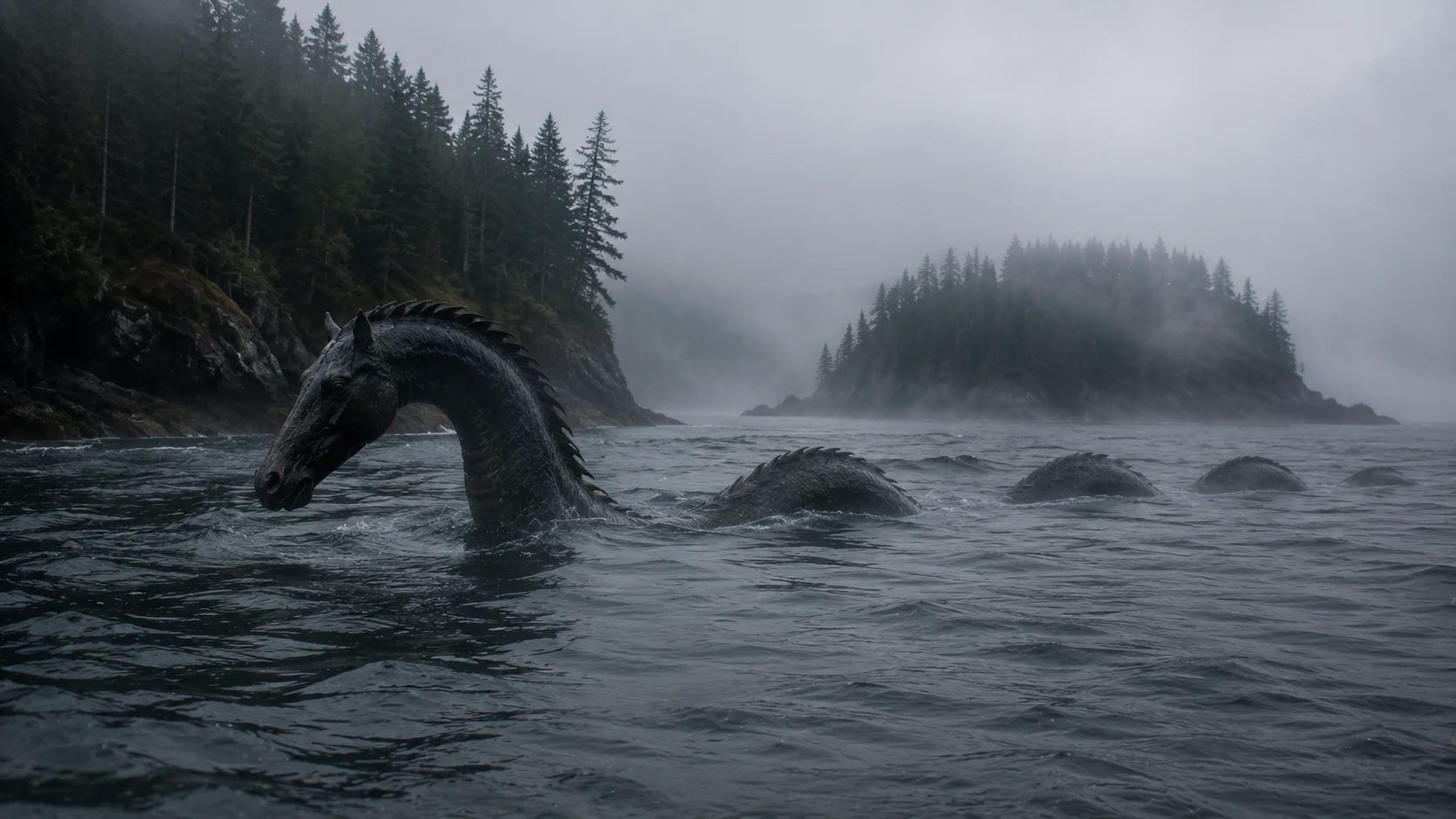
The Cadborosaurus, affectionately known as Caddy, is a cryptid of the Canadian Pacific coast, a purported sea-serpent said to inhabit the coastal waters of the Pacific Northwest, especially the waters around Vancouver Island and the Strait of Georgia. Witnesses describe a long, serpentine body, a series of humps or coils breaking the surface, a small horse- or camel-like head atop a long neck, and flipper-like appendages. Named for a small bay near Victoria, British Columbia, Caddy has become one of the most persistently reported sea-serpent cryptids of the North Pacific, a regional legend woven into the identity of the coast that produced it.
A Name Coined in a Newsroom
Unlike cryptids whose names stretch back centuries, Cadborosaurus has a documented birth. The name Cadborosaurus willsi was coined in 1933 by Archie Wills, a newspaper editor working in Victoria, British Columbia. Wills drew the name from Cadboro Bay, a small inlet near the city where sightings had been reported, giving the creature a name with a mock-scientific flourish suited to newspaper coverage. The name was popularized through the pages of the Victoria Daily Times and the Daily Colonist, the two papers most responsible for carrying Caddy from local rumor into regional celebrity. Within a matter of years, the nickname Caddy had taken hold in newspaper columns and, later, in the cryptozoological literature that grew up around the case from the 1930s onward.
Waters Older Than the Name
Though the name Cadborosaurus is a twentieth-century invention, the waters it was applied to carry older stories. Indigenous oral traditions of the Pacific Northwest Coast, including accounts sometimes associated with Coast Salish communities, speak of sea-serpent-like beings dwelling in these same coastal waters. Cryptozoologists such as Paul LeBlond have cited these pre-contact accounts as precedent for the modern reports, suggesting that something unusual in the waters around Vancouver Island has been noticed by observers for a very long time. It is worth being precise about what this connection is and is not: the identification of these older, distinct water-being traditions with the specific creature named Cadborosaurus in 1933 is an inference drawn by later researchers, not a documented equivalence asserted by the traditions themselves. Cadborosaurus, as a named and described cryptid, belongs to the modern era; the indigenous accounts belong to a separate and older frame of reference that deserves to be understood on its own terms rather than folded silently into the newspaper legend.
The Whale That Held a Secret
The single most cited piece of evidence in the entire Cadborosaurus case is the Naden Harbour carcass of 1937. That year, whalers operating out of the Naden Harbour whaling station in British Columbia caught a sperm whale and, upon opening its stomach during processing, reportedly found the remains of an unidentified creature: a long-necked, small-headed carcass unlike anything the whalers recognized. The find was significant enough that it was photographed on the spot, and that photograph remains the anchor of the entire case. What makes the Naden Harbour carcass frustrating rather than conclusive is what happened next, or rather what did not happen: the specimen itself was not preserved. It was lost, leaving researchers with only the image and the whalers' word for what they had seen. Decades of argument have followed. Cryptozoologists point to the photograph as physical, if incomplete, evidence of an unknown marine animal. Skeptics counter that a photograph of a decomposing, partially digested carcass pulled from a whale's stomach is exactly the kind of ambiguous evidence prone to misinterpretation, and that without the specimen itself, no firm identification is possible in either direction. The dispute over the Naden Harbour carcass's true identity remains open among cryptozoologists and skeptics alike, and it is precisely that unresolved status, rather than any settled conclusion, that has kept the case alive for nearly a century.
A Second Carcass at Effingham Island
The Naden Harbour find was not the only carcass to enter the Cadborosaurus record. In 1968, a carcass was discovered near Effingham Island, off the British Columbia coast. It was examined and photographed, and it, too, became part of the wider corpus of physical evidence that researchers compiling the Cadborosaurus case draw upon. As with Naden Harbour, the Effingham Island carcass has not settled the question of what Cadborosaurus might be. Skeptical observers have commonly proposed that the remains were those of a decomposed shark or some other known marine animal, its features distorted by decay into an unfamiliar shape. The carcass survives in the literature as a second data point rather than a second proof, a reminder that the Cadborosaurus case rests on a handful of ambiguous physical finds rather than any single decisive specimen.
The Oceanographer Who Took It Seriously
No figure did more to organize the scattered Cadborosaurus reports into something resembling a formal case than Paul H. LeBlond, an oceanographer at the University of British Columbia. Working alongside Edward L. Bousfield, LeBlond co-authored academic papers on the subject and, in 1995, the two published a book titled Cadborosaurus: Survivor from the Deep. The book compiled sighting reports from across the twentieth century and went further than simple compilation: LeBlond and Bousfield proposed a formal zoological description for the creature, treating it as a candidate for genuine, if undiscovered, species status. It is this proposed description that gives Cadborosaurus its scientific-sounding binomial name, Cadborosaurus willsi, honoring Archie Wills. That said, the proposed taxonomic description is not accepted by mainstream science. LeBlond and Bousfield's work represents the most serious attempt to formalize the case, but it remains outside the boundaries of recognized zoology, a minority position argued with genuine rigor rather than a settled scientific finding.
A Composite Portrait from Hundreds of Witnesses
The description of Cadborosaurus that circulates today, the long serpentine body, the humped back, the small horse- or camel-like head, the flipper-like limbs, is not drawn from a single encounter but assembled from a substantial body of witness testimony. LeBlond and his colleagues compiled several hundred purported sighting reports spanning from the nineteenth century to the present, gathered along the coastlines of British Columbia and the wider Pacific Northwest. This volume of testimony is often cited by proponents as evidence that something consistent is being observed, since independent witnesses across decades converge on broadly similar features. Critics note the opposite side of the same fact: most of these reports are anecdotal, undocumented beyond the witness's own account, and vulnerable to the ordinary distortions of memory, distance, and expectation that affect any eyewitness testimony of something briefly glimpsed on open water. The sightings cluster most heavily in the waters off Vancouver Island and the Strait of Georgia, the same waters where the name itself was born.
What the Water Might Actually Hold
Mainstream marine biology does not recognize Cadborosaurus as a species, and no type specimen or DNA-confirmed remains exist to anchor the case in verified biology. Scientists and skeptics who have examined the reports have proposed a range of mundane explanations for what witnesses may actually be seeing. Oarfish, long, ribbon-like, deep-sea fish that occasionally surface, are frequently suggested as a source of serpentine sightings. Elephant seals, with their bulky, undulating swimming motion and unusual head shape, have also been proposed as a likely candidate for some reports. Floating kelp and other debris, arranged by current into snake-like lines, offer another explanation requiring no living creature at all. Optical effects on water, the way light, wave motion, and distance can distort the appearance of an ordinary object into something serpentine, round out the list of proposed mundane causes. None of these explanations accounts for every report with equal confidence, which is part of why the case has persisted rather than collapsed under scrutiny.
Not Alone in the North Pacific
Cadborosaurus is sometimes discussed alongside other reported sea serpents from the waters of British Columbia and Washington State, informally grouped under the broader umbrella of North Pacific sea-serpent sightings. This grouping reflects a shared geography and a family resemblance in the reports rather than any claim that the various sightings describe the same animal. Cadborosaurus is treated by researchers as a distinct, named case with its own body of evidence, its own carcasses, and its own promoters, rather than as simply interchangeable with every other unexplained wake or hump reported along the coast. Care in keeping these regional cases separate is part of what has allowed the Cadborosaurus literature to develop its own internal consistency, however contested that consistency remains.
Victoria's Adopted Monster
Beyond the arguments over carcasses and identifications, Cadborosaurus occupies a distinctive cultural role along the British Columbia coast. It functions as a regional folk-monster and unofficial mascot of Victoria and the surrounding coast, embraced by local tourism and media in a spirit closer to civic affection than religious awe. The comparison most often drawn is to Scotland's Loch Ness Monster, another cryptid whose fame has become inseparable from the place associated with it. Unlike figures drawn from indigenous cosmology, Cadborosaurus is not a religious or mythological figure within any codified belief system. It is, instead, a modern legend, dating from the 1930s onward, that has been layered onto a coastline with its own older and separate traditions of water beings. Keeping that distinction clear matters: Cadborosaurus belongs to the newspaper age and the age of regional branding, not to the deeper wells of Pacific Northwest indigenous religious life.
From Local Rumor to Screen and Shelf
Caddy's fame has traveled well beyond the shores of Cadboro Bay. The creature has appeared repeatedly in popular cryptozoology television programs and books, taking its place alongside the more famous lake and loch monsters of global cryptid lore. Locally, Victoria-area branding and merchandise have kept Caddy present in everyday civic life, a friendly sea-serpent mascot rather than a source of dread. This popular afterlife has done more to spread Cadborosaurus's name than any single piece of evidence, ensuring that even those unfamiliar with the Naden Harbour carcass or LeBlond's zoological arguments are likely to have encountered Caddy in some lighter, more commercial form.
An Unresolved Case, Deliberately Kept That Way
What distinguishes Cadborosaurus from many cryptids is the presence of genuine, if incomplete, physical evidence: two separate carcasses, one of them photographed emerging from the very body of a sperm whale, and a body of witness testimony organized with real scholarly effort by a working oceanographer. None of it amounts to proof. The Naden Harbour specimen was lost before it could be examined properly; the Effingham Island remains are more plausibly explained as a known animal in decay; the hundreds of sighting reports remain, by their nature, anecdotal. Cadborosaurus survives today not as a settled question but as a genuinely open one, a fringe cryptozoological claim resting on real photographs and real testimony that mainstream science has examined and declined to accept, argued most seriously by researchers who took the coast's own stories seriously enough to go looking for the animal behind them.
Sources & traditions
- EncyclopediaWikipedia — Cadborosaurus
- TraditionLocal sightings, press reports and regional folklore (Canada)
Myths change from area to area and from time to time. This chronicle follows the most widely told versions; tellings in other villages, regions and eras may differ.