Bigfoot, also known as Sasquatch, is the most famous cryptid in North America and one of the most famous in the world — a large, hairy, ape-like creature said to inhabit the forests and wilderness of North America, especially the Pacific Northwest, walking upright on two legs like a man, leaving behind the enormous footprints from which it takes its name. The forest giant of North America, the elusive hairy hominid of the deep woods, Bigfoot is the great cryptid of the American wilderness, the subject of countless sightings, footprints, blurry films, and an enduring fascination, the hidden ape-man of the forests.
The Forest Giant
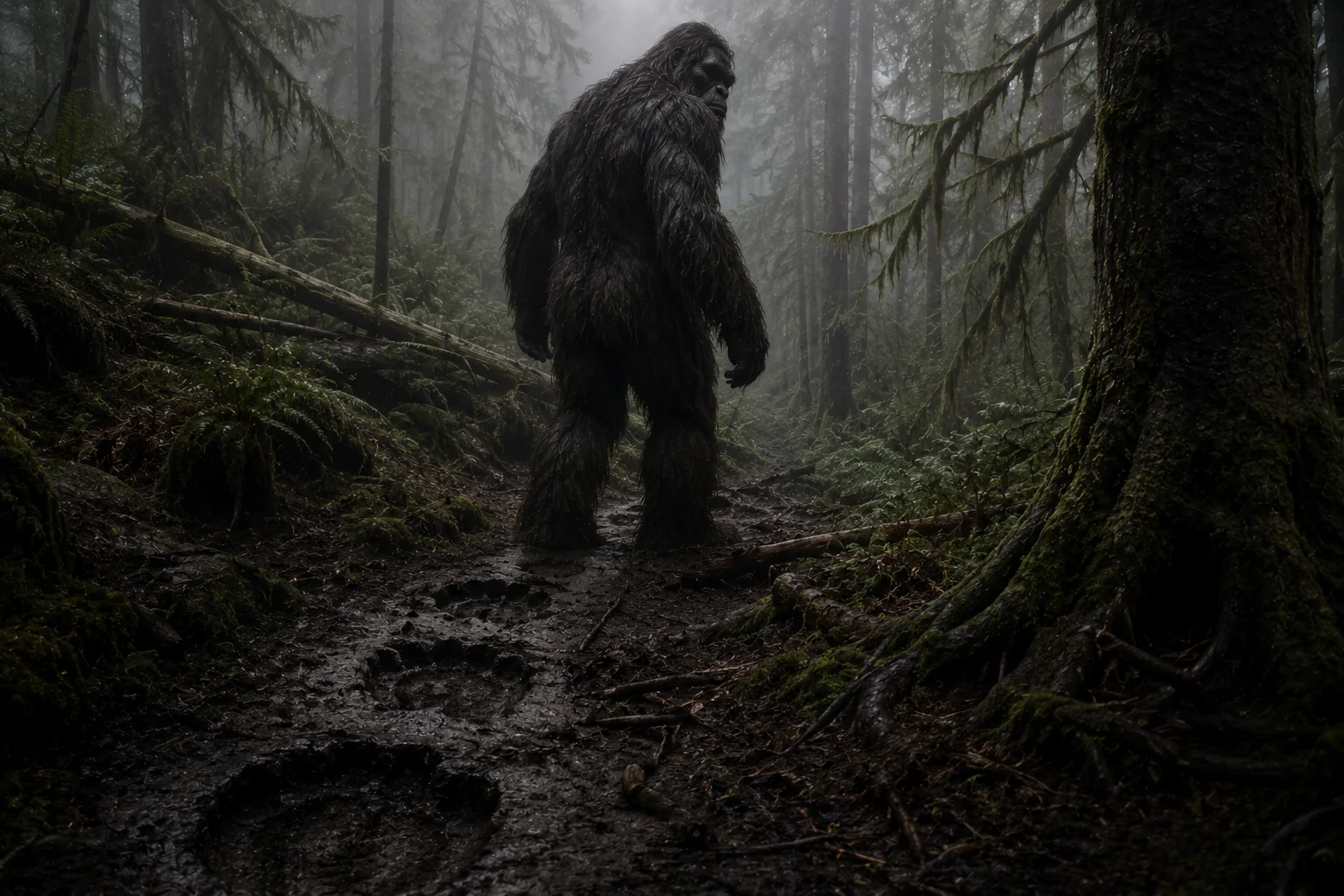
Bigfoot is described as a large, powerful, hairy, ape-like or man-like creature — a great bipedal hominid, standing anywhere from seven to ten feet tall or more, covered in dark (brown, black, or reddish) hair or fur, with a broad, powerful, muscular body, long arms, and a generally ape-like or man-like form, walking upright on two legs in the manner of a human. It is said to have a strong, often foul smell, to be elusive and shy of humans (avoiding contact, fleeing from people, dwelling in the deep and remote wilderness), and to be powerful, agile, and well-adapted to the forest and the wild. Its most famous feature is its enormous footprints — the giant, human-like (but far larger) footprints, often sixteen inches or more in length, from which the creature takes its name “Bigfoot,” the great tracks found in the mud, snow, and earth of the wilderness, the sign of the passing of the forest giant. As the forest giant, the great hairy ape-like hominid of the North American wilderness, Bigfoot is the elusive, powerful, shy creature of the deep woods, known by its sightings, its enormous footprints, and its enduring mystery.
Sasquatch and the Native Traditions
The creature now famous as Bigfoot has deep roots in the traditions of the indigenous peoples of North America, who long told of large, hairy, man-like wild beings of the forests and mountains. The name Sasquatch — another and equally famous name for the creature — derives from a word (sasq’ets or similar) from the Halkomelem language of the indigenous peoples of the Pacific Northwest, meaning “wild man” or “hairy man,” the name of the wild, hairy, man-like being of the forests in the traditions of the Coast Salish and other peoples. Many of the indigenous peoples of North America — especially the peoples of the Pacific Northwest, where Bigfoot sightings are most numerous — had traditions of large, hairy, wild, man-like beings of the forests and mountains, the wild men and hairy giants of the wilderness, under various names; and the modern Bigfoot/Sasquatch draws on these deep and ancient traditions of the wild, hairy man of the forests. As Sasquatch, the wild man of the indigenous traditions, Bigfoot has deep roots in the folklore of the peoples of North America, the hairy wild man of the forests known long before the modern era.
The Sightings, the Footprints, and the Film
Bigfoot is the subject of an enormous body of sightings, footprints, and evidence — the countless reported sightings of the creature in the forests and wilderness of North America, the enormous footprints found and cast, the hair, sounds, and other purported traces, and, most famously, the films and photographs claimed to show the creature. The most famous piece of Bigfoot evidence is the Patterson-Gimlin film — the short, grainy 1967 film, shot in northern California, that purports to show a large, hairy, bipedal Bigfoot walking across a clearing and glancing back at the camera, one of the most famous and debated pieces of footage in the history of cryptozoology, endlessly analysed, debated, defended, and dismissed as either genuine evidence of the creature or an elaborate hoax (a man in an ape suit). The footprints, the sightings, the film, the hair and sound recordings — the body of Bigfoot evidence — have been the subject of intense interest, investigation, debate, and controversy, the believers holding them as evidence of a real, undiscovered creature, and the skeptics dismissing them as hoaxes, misidentifications, and wishful thinking. As the subject of countless sightings, footprints, and the famous film, Bigfoot is the great cryptid of evidence and debate, the elusive creature known by its many purported traces and the enduring controversy over their meaning.
The Great American Cryptid
Bigfoot is the great cryptid of North America and one of the central figures of cryptozoology — the study and search for “hidden” or unconfirmed animals, the creatures claimed to exist but not recognised by mainstream science. As the most famous North American cryptid, Bigfoot is the subject of an enormous popular fascination, a vast body of investigation and lore, organisations and expeditions devoted to its search, and a pervasive presence in popular culture (in film, television, advertising, and the popular imagination, where Bigfoot is an iconic and beloved figure). It belongs to a worldwide family of similar cryptids — the large, hairy, wild, man-like or ape-like beings of the wilderness reported around the world, including the Yeti (the “Abominable Snowman”) of the Himalayas, the Yeren of China, the Yowie of Australia, the Orang Pendek of Sumatra, and the other wild men and hairy hominids of the world’s wildernesses — the global phenomenon of the hairy wild man of the wilderness. Mainstream science regards Bigfoot as a creature of folklore and misidentification rather than a real, undiscovered animal, the evidence being explained as hoaxes, misidentified bears and other animals, and the human tendency to see patterns and creatures in the wild; but the believers continue to search, and the fascination endures. As the great American cryptid, the central figure of North American cryptozoology and one of the most famous cryptids in the world, Bigfoot is the elusive forest giant of the popular imagination, the hidden ape-man of the wilderness.
Legacy
Bigfoot endures as the most famous cryptid of North America and one of the most famous in the world, the elusive, hairy, ape-like forest giant of the North American wilderness, the subject of countless sightings, enormous footprints, the famous Patterson-Gimlin film, and an enduring popular fascination, the great cryptid of cryptozoology and the popular imagination. As the North American forest giant — Bigfoot, Sasquatch, the large, hairy, bipedal ape-like hominid of the forests and wilderness, the wild man of the indigenous traditions and the great cryptid of the modern age, known by its footprints, sightings, and films — Bigfoot stands as the iconic cryptid of the American wilderness and one of the most famous hidden creatures in the world, the elusive forest giant whose enormous footprints and shy, powerful presence have captivated the imagination and endured as the great mystery of the North American woods.
The Bulldozer, the Plaster Cast, and the Word
Bigfoot is one of the very few monsters with a birthday. In the late summer of 1958 a road crew was pushing a logging track up the drainage of Bluff Creek, in the redwood country of Humboldt County, northern California. On the morning of 27 August a bulldozer operator named Jerry Crew walked back to his machine and found it ringed by enormous bare footprints — human in shape, close to sixteen inches long and seven wide, driven deep into the graded dirt. Crew did what a practical man does: he borrowed plaster, took a cast, and carried it into the office of the local paper. The photograph that ran in the Humboldt Times — a lean man in work clothes holding a white plaster foot nearly as long as his forearm — went out on the wire services, and with it travelled the name the crew had already given whatever made them: Big Foot. It was a columnist, Andrew Genzoli, who put the story on his front page that October and closed the two words into one.
That is the moment the modern creature was assembled. Before it, North America had a scatter of unrelated stories — indigenous beings, prospectors’ tall tales, newspaper filler about hairy giants. After it, all of them had a single name to be filed under, and a single image to be measured against. It is worth sitting with how strange that is. The most famous animal never proven to exist was named by a road gang for the only thing it had left behind, and fixed in the language by a columnist with a front page to fill.
The coda is equally strange. Ray Wallace, the contractor who held the Bluff Creek road job, died in 2002; his family then told reporters that he had faked those first tracks, and produced a set of carved wooden feet to prove it. Sceptics treat this as the whole story collapsing at its foundation. Believers point out, not unreasonably, that one man’s carved feet in one canyon in one year cannot account for prints cast a thousand miles away by people who had never heard of him. Both are true, and the argument has continued ever since — which is, in miniature, the entire history of the subject. Bluff Creek, incidentally, is also where Roger Patterson and Bob Gimlin would run their camera nine years later. Of all the forest in the west, the film was shot in the same creek bed that had produced the name.
The Beings the Name Replaced
The word Sasquatch is an anglicisation of sásq’ets, from Halkomelem, a Coast Salish language of the lower Fraser Valley in British Columbia. It reached English readers through J. W. Burns, a schoolteacher and Indian agent on the Chehalis reserve, whose 1929 article for Maclean’s gathered up the accounts his neighbours had told him. Burns needed one word for a magazine audience. He chose that one, and it stuck to everything.
What it stuck over is far richer than the cryptid it became. For the Sts’ailes people of the Harrison River, the sásq’ets is not a specimen awaiting confirmation but a being with standing — a spiritual figure who looks after the territory and the people in it. Sasquatch Days are still held each summer at Harrison, hosted jointly by the Sts’ailes and the village, with war canoe races drawing crews from across the province; the figure still appears in the community’s art and self-representation. This is a living tradition, spoken of in the present tense, and it is not a claim about zoology at all.
Further up the coast the beings are different again. Among the Kwakwaka’wakw, Dzunuk’wa is the giant wild woman of the woods — black, naked, half-blind, her lips pursed to make the long call that gives her away, a basket on her back for the children who wander too far. She is a terror to frighten children away from the treeline, and simultaneously a bringer of wealth: her mask is worn by a chief to announce a potlatch and brought out again to signal its close, and to inherit her is to inherit privilege. Alongside her stands Bukwus, the wild man of the woods, who keeps an invisible house in the forest and draws to it the spirits of the drowned, and whose ghost food the living must refuse. Neither of these is Bigfoot. They belong to systems of kinship, ownership, ceremony and moral instruction that a plaster footprint cannot express.
The honest thing to say is that the twentieth century performed a translation, and translations lose. A great many distinct beings from a great many distinct nations were gathered under one Halkomelem word, stripped of their ceremonial and territorial meaning, and reissued as a single North American animal that might one day be shot and catalogued. The stories were older than the cryptid, and they were never about the same question.
The Wild Man Arrived With the Settlers, Too
The people who read Jerry Crew’s photograph were not encountering a new idea. Europe had carried the hairy wild man for centuries, and carried him across the Atlantic in the luggage. The medieval woodwose — the wild man of the woods, naked but for his own pelt of hair, a club or an uprooted sapling in his fist — is carved into misericords and church porches, painted into the margins of manuscripts, and held up as a supporter on coats of arms across northern Europe. In parts of the Alps he still comes down out of the mountains in midwinter, in costume, in processions that draw crowds to this day.
He is older than that. One of the oldest long poems that survives anywhere, the Epic of Gilgamesh, brings on in its first tablet Enkidu — made in the wilderness, hairy all over, who eats grass with the gazelles and fills in the trapper’s pits until the city sends a woman out to tame him. Something near four thousand years later a bulldozer operator in California photographed a footprint, and the same figure walked back into the frame.
What the wild man has always been is a measurement. He is a human being with civilisation subtracted, and every age uses him to work out what civilisation was actually adding. In the medieval carvings he is what you become without law and sacrament. In the Enlightenment he becomes the noble savage, uncorrupted. And in the Pacific Northwest of the mid-twentieth century — precisely as logging roads were being cut into the last of the old growth, by men with chainsaws and D8s, at a rate that would have astonished their fathers — he became something shy, retreating, and possibly the last of his kind. The monster took on the mood of the people looking for him.
The Regional Cousins
Bigfoot is a national figure, but the local variants have their own characters and their own home ground.
- The Skunk Ape of the Florida cypress swamps, defined more by its reported stench than its outline.
- The Fouke Monster of southern Arkansas, whose 1970s notoriety produced a docudrama that played in drive-ins across the South and gave the creature a permanent tourist industry.
- Momo, the Missouri monster, a summer panic of 1972 in the small town of Louisiana on the Mississippi.
- The Grassman of eastern Ohio and the Wood Booger of the Virginia mountains, both firmly Appalachian. Norton, Virginia has gone so far as to declare a stretch of its parkland a Woodbooger sanctuary, and throws a festival in the creature’s honour.
Earlier still is Ape Canyon, on the south-eastern flank of Mount St Helens, named for a story out of July 1924: a party of gold prospectors reported that their cabin had been besieged through the night by hairy giants hurling rocks. The men were real, the cabin was real, and the newspapers were delighted. A game warden pronounced the whole thing bunk at the time; rangers showed how easily the tracks around the cabin could be faked, and a nearby summer camp later supplied a likelier culprit in the form of teenagers with a habit of rolling stones down the slope. One of the miners, Fred Beck, insisted on his version to the end of his life. Whether anything came down off the mountain that night, nobody can now establish — but the place-name outlived every man who argued about it, which is how folklore usually wins.
The Giant Ape That Really Existed
The most respectable argument ever made for Bigfoot begins in a Hong Kong apothecary’s shop. In the 1930s the palaeontologist Ralph von Koenigswald began buying “dragon teeth” — fossil teeth sold as medicine — and found among them molars far too large for any known ape. He named the animal Gigantopithecus. It is real, it is not in dispute, and it was enormous: on the evidence of its jaws it may have stood some three metres tall. It lived in southern China and Southeast Asia, and it survived until a few hundred thousand years ago, which is recent enough that early humans in Asia would have shared a landscape with it.
The anthropologist Grover Krantz spent much of his career arguing that a surviving population could have crossed the Bering land bridge into North America. Jeff Meldrum, an anatomist who studies primate locomotion, has built the most technical case from the footprint casts themselves, arguing that some show a flexible mid-foot unlike a human’s and unlike an easily faked wooden board. Earlier, the primatologist John Napier examined the whole business seriously and came out in an uncomfortable middle: unconvinced by the film, unwilling to dismiss every footprint.
The trouble is that Gigantopithecus is a poor fit for the role assigned to it. It is known almost entirely from teeth and a handful of jawbones — there is no skeleton to reconstruct a gait from — and the molecular evidence places it as a close relative of the orangutan, a heavy forest animal very unlikely to have walked upright across a continent. The candidate exists. The application is the problem.
The Body That Never Turns Up
Every argument about Bigfoot eventually arrives at the same silence. There is no skeleton. There is no tooth. In more than sixty years of continental road traffic, hunting seasons, wildfires, logging, and hikers, there is no carcass and no roadkill. Believers answer that forests consume the dead quickly and that bears are rarely found dead either — a fair point as far as it goes, though bears leave bones in caves, in middens, and in the fossil record, and a breeding population of very large primates would need to number in the thousands to persist at all.
Genetics has been the cleanest test, because it does not care what anyone believes. When the Oxford geneticist Bryan Sykes put out an open call for hair from purported anomalous primates and sequenced what arrived, the results came back as black bear, brown bear, cow, horse, raccoon, sheep, porcupine and dog. Two Himalayan samples produced a genuinely interesting bear result — a match to an ancient polar bear sequence, which the authors suggested might sit somewhere under the yeti legend — and nothing more. Meanwhile, statistical work comparing the geography of sighting reports with the distribution of American black bears finds the two track each other closely: adjusting for human population and forest cover, the more bears a region holds, the more Bigfoot reports it generates. A black bear standing on its hind legs at dusk, at forty metres, in timber, seen by someone with adrenaline in their blood, is a very persuasive hominid.
None of this proves a negative, and honest sceptics do not claim it does. What it establishes is the shape of the burden: the creature can only be confirmed, never disconfirmed, and so the search can never end. That is not a flaw in the belief. It is the engine of it.
A Monster With Legal Protection
One detail captures the peculiar affection North America holds for this animal better than any sighting report. On the first of April 1969 the commissioners of Skamania County, Washington — a jurisdiction of deep timber on the Columbia River — passed an ordinance making the wilful slaying of a Sasquatch a felony, punishable by a five-figure fine and five years in the county jail. In 1984 it was softened to a misdemeanour, and the same amendment declared the county a Sasquatch refuge. Whatcom County, further north, followed in 1991 with a resolution naming its whole territory a Sasquatch protection and refuge area. British Columbia has a Sasquatch Provincial Park, in the country of the Sts’ailes.
Whatever the drafters privately believed — and the date on the first of them invites a certain suspicion — the instinct behind those ordinances is telling. The counties were not legislating against a hazard. They were legislating against the moment some visitor with a rifle settles the question — and the possibility that the answer would be a body on a flatbed truck, and no mystery left in the mountains at all.
Why the Forest Keeps Him
Almost every monster is a fear given a body. Bigfoot is the rare one that most people would prefer to be true. Nobody hopes there is a vampire; a surprising number of otherwise sensible adults quietly hope there is something in the woods.
The reason is that he is not really a claim about primatology. He is a claim about the map. Bigfoot exists in the gap between the last road and the ridge you cannot see over, and every year that gap gets smaller. He is the argument that the wilderness has not been fully inventoried — that a continent surveyed, logged, photographed from orbit and cut into parcels still has something in it that has not been catalogued and cannot be sold. That the woods still know something we do not.
Note, too, what happened to his temperament. The wild man of the older stories was dangerous: Dzunuk’wa took children, the woodwose carried a club, the Ape Canyon giants threw rocks at a cabin. The modern Bigfoot does none of this. He runs away. He is shy, sad-eyed, endangered, possibly the last of his line — a creature we now imagine ourselves protecting rather than fearing. Somewhere in the twentieth century the monster and the humans changed places, and the thing in the trees stopped being what threatened us and started being what we threatened.
That is why the footprints still matter to people who know better. A footprint is the shape of something that was there a moment ago and is not there now. It is the perfect artefact for a creature whose whole function is to be just out of frame — the last unmapped thing, still walking away from us, still leaving evidence, still refusing to be caught.
Sources & traditions
- EncyclopediaWikipedia — Bigfoot
- TraditionLocal sightings, press reports and regional folklore (North America)
Myths change from area to area and from time to time. This chronicle follows the most widely told versions; tellings in other villages, regions and eras may differ.