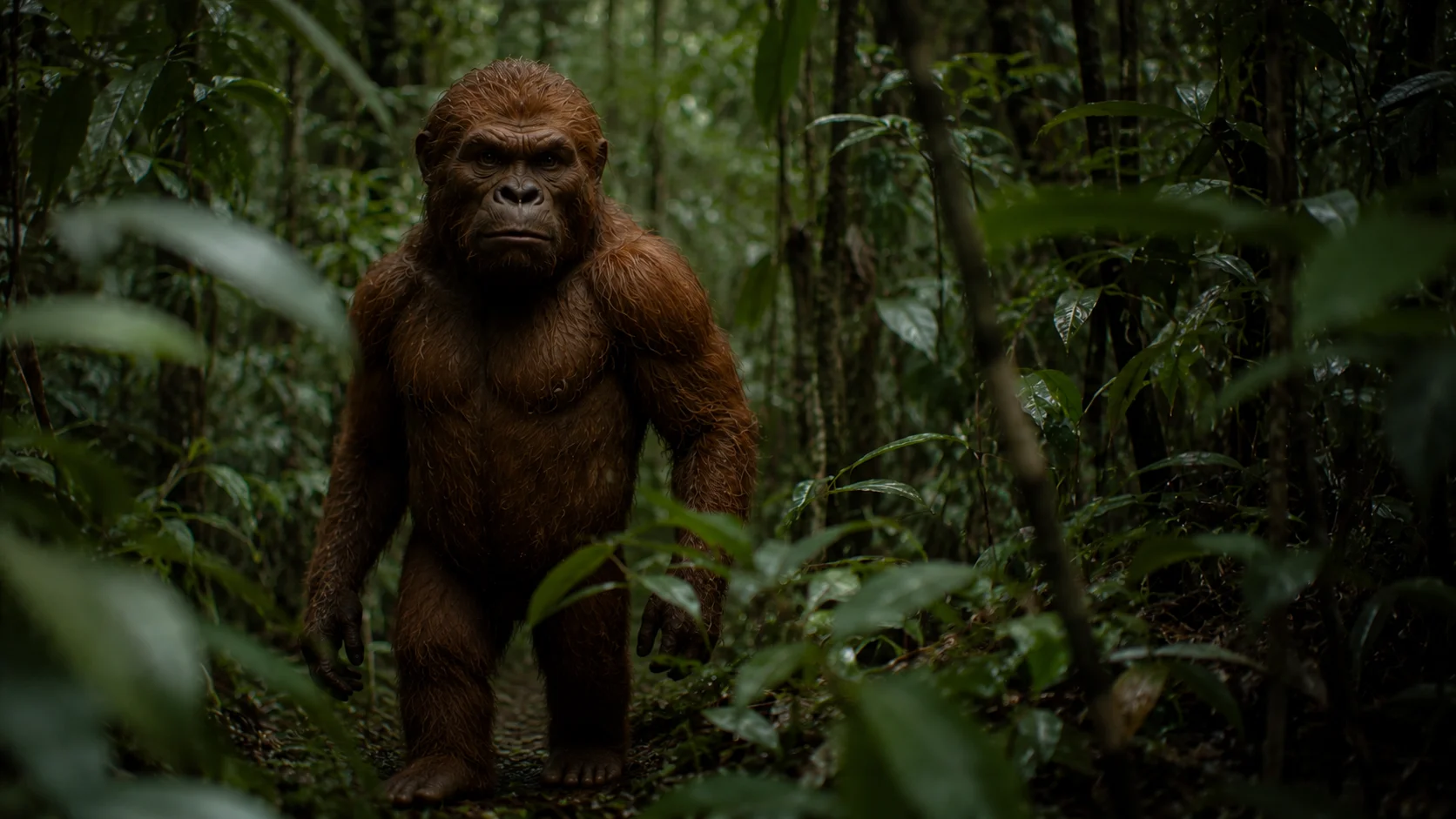
The Orang Pendek, the short person or short man, is a famous cryptid of Indonesia, a small, upright-walking, ape-like or man-like creature said to inhabit the remote rainforests of Sumatra, a small hairy hominid reported by local people and Western witnesses alike.
A Small Shape Between the Trees
Orang Pendek is Indonesian and Malay for short person, and the name is meant literally: witnesses across Sumatra describe a bipedal figure standing only 80 to 150 centimetres tall, far shorter than Bigfoot in North America or the Yeren of China, its body covered in dark brown to grayish-black hair. What sets the reports apart from other hairy-hominid traditions is the face. Where Bigfoot and the Yeti are usually described with heavy, ape-like brows and muzzles, the Orang Pendek is consistently described as having a face more human than simian, and witnesses frequently note that it appears to have no visible tail, walking fully upright rather than in the knuckle-dragging gait of a great ape.
Kerinci Seblat, the Deep Green Country
The creature's reported range is not vague jungle-in-general but a specific, named wilderness: the mountainous rainforest of Sumatra, and above all Kerinci Seblat National Park, straddling the Jambi and West Sumatra provinces. This is dense, steep, volcanic country, laced with ridgelines and river valleys that see few human visitors beyond local villagers, rangers, and the occasional research expedition. It is also, notably, the same island that is home to a real, confirmed great ape, the orangutan, and to rainforest fauna that has not been exhaustively catalogued even in the present day, a fact that cryptozoologists have long pointed to when arguing the region is not implausible ground for an undiscovered animal.
Sedapa, Gugu, Uhang Pandak: A Name That Shifts With the Valley
Orang Pendek is the name that reached the outside world, but it is not the only one used locally, and the local naming is not fully standardized from village to village. In some Kerinci-area dialects the creature is called Sedapa, sometimes rendered Gugu, and elsewhere it has been recorded locally as Uhang Pandak. These are not necessarily three separate beings but regional variants in how Sumatran communities refer to the same reputed animal of the forest, a reminder that the creature's identity was assembled by outsiders from a scatter of local testimony rather than handed down as a single fixed legend.
A Dutch Settler's Letter, 1917
The written record in Western sources reaches back to the colonial era. Among the earliest documented references is a 1917 letter to a Dutch colonial journal written by a settler named Van Heerwaarden, describing an encounter with a small, upright, hair-covered figure in the Sumatran forest. Accounts of this kind, from the 1910s through the 1920s, are treated by researchers as early attestations of a persistent local claim rather than confirmed sightings in any scientific sense, but they establish that the Orang Pendek was already circulating as a distinct, named figure among both Sumatran locals and Dutch colonists more than a century ago, long before the age of camera traps and DNA testing.
Debbie Martyr and Years in the Field
No investigation into the Orang Pendek has been more sustained than that of Debbie Martyr, a British researcher who led field work in Kerinci Seblat from the early 1990s through the 2000s. Over those years she and her collaborators gathered numerous purported footprint casts and collected eyewitness testimony directly from villagers and park rangers who lived and worked in the forest, people with daily, practical familiarity with the terrain and its animals. Martyr's work is widely regarded as the most extensive documented investigation into the creature to date. It produced a substantial body of testimony and physical trace evidence, but for all its rigor and duration it did not produce a physically verified specimen, and the Orang Pendek's status as a confirmed animal was no closer to settled at the end of that long effort than at its beginning.
Hair, Casts, and Inconclusive Laboratories
Purported hair samples and footprint casts attributed to the Orang Pendek have been submitted for scientific analysis on multiple occasions, particularly during the concentrated cryptozoological interest of the 1990s and 2000s. The results have not settled the question either way. In several documented cases, samples were matched to known Sumatran animals, including tapir and sun bear, undercutting specific pieces of evidence even as the broader body of testimony persisted. No sample submitted in this period has been scientifically confirmed as belonging to an unknown primate. The picture that emerges from decades of testing is one of genuine, unresolved dispute rather than either vindication or debunking: some evidence explained away, much of it simply inconclusive, and no single decisive result in either direction.
What the Villagers Say
Running through the local testimony collected across Kerinci Seblat is a consistent thematic thread that distinguishes the Orang Pendek from more menacing wild-man figures elsewhere in the world: villagers generally describe it as shy, reclusive, and non-aggressive, an animal that avoids human contact rather than seeking it out. This consistency, appearing independently across many separately gathered accounts rather than in a single retold story, is part of what researchers like Martyr have pointed to as lending the Sumatran reports a particular internal coherence, whatever one concludes about the creature's actual existence.
A Zoological Claim, Not a Spirit
Within its own Sumatran cultural context, the Orang Pendek occupies a notably different place than many of the world's forest-dwelling cryptids. Rather than functioning as a mythic or spiritual figure, it is generally treated by local people as a cryptozoological or folk-zoological claim: a real, physical, undiscovered animal of the forest, not a supernatural being. This distinguishes it sharply from spirit-based entities in the same broader Indonesian and Malay cultural landscape, and it is why the creature's local defenders speak of it in the same register they might use to describe a rare, elusive, but entirely physical species of animal rather than a ghost or a guardian spirit.
Not to Be Confused With the Orang Bunian
Popular accounts sometimes conflate the Orang Pendek with the Orang Bunian, a spirit-being of Malay and Sumatran folklore, but no scientific or cultural basis establishes them as the same figure. The Orang Bunian belongs to a tradition of hidden, spirit-natured folk distinct from the physical, animal-like Orang Pendek, and researchers and local tradition alike generally treat the two as separate lines of belief. That the conflation persists in some popular retellings is itself a documented point of dispute among those who study the material, not a settled equivalence, and the two figures should not be treated as interchangeable.
A Minority Hypothesis: The Relict Hominoid
Among cryptozoologists working within the fortean literature of the 1990s and 2000s, one hypothesis holds that the Orang Pendek represents a surviving relict hominoid, or an unclassified population of ape distinct from the known orangutan, persisting in Sumatra's less-explored highland forests. This remains explicitly a minority position within cryptozoology itself, not a hypothesis that has gained traction in mainstream primatology or zoology, and it should be understood as one interpretive frame among researchers who take the testimony seriously, rather than as an accepted explanation for what witnesses have described.
From Jambi Province to the World's Screens
The Orang Pendek's later cultural life extended well beyond the villages of Jambi and West Sumatra. Western cryptozoology television and print coverage carried the creature to an international audience, including expeditions and writing by Richard Freeman of the Centre for Fortean Zoology, who led investigative trips to Sumatra in the 2000s and helped popularize the case in books and documentary segments. Through this coverage, a regionally specific piece of Sumatran testimony became one of the more recognizable names in the broader, worldwide catalogue of hairy-hominid cryptids, discussed alongside far more famous figures despite its comparatively modest stature and its origin in a single mountain range on a single Indonesian island.
A Century of Reports, No Specimen
What has not changed, across more than a hundred years of intermittent reports stretching from a Dutch settler's 1917 letter through Debbie Martyr's decade of fieldwork to the present day, is the absence of anything mainstream science can point to as proof. No physical specimen, no bone, and no universally accepted photograph or video has ever been produced. Mainstream primatology and zoology do not recognize the Orang Pendek as a confirmed species, and its status remains, formally, that of an unverified cryptid: a consistent, geographically specific body of testimony from a mountainous corner of Sumatra, resting alongside inconclusive samples and unresolved questions, with the forests of Kerinci Seblat still holding whatever answer there is to find.
Sources & traditions
- EncyclopediaWikipedia — Orang Pendek
- TraditionLocal sightings, press reports and regional folklore (Indonesia)
Myths change from area to area and from time to time. This chronicle follows the most widely told versions; tellings in other villages, regions and eras may differ.