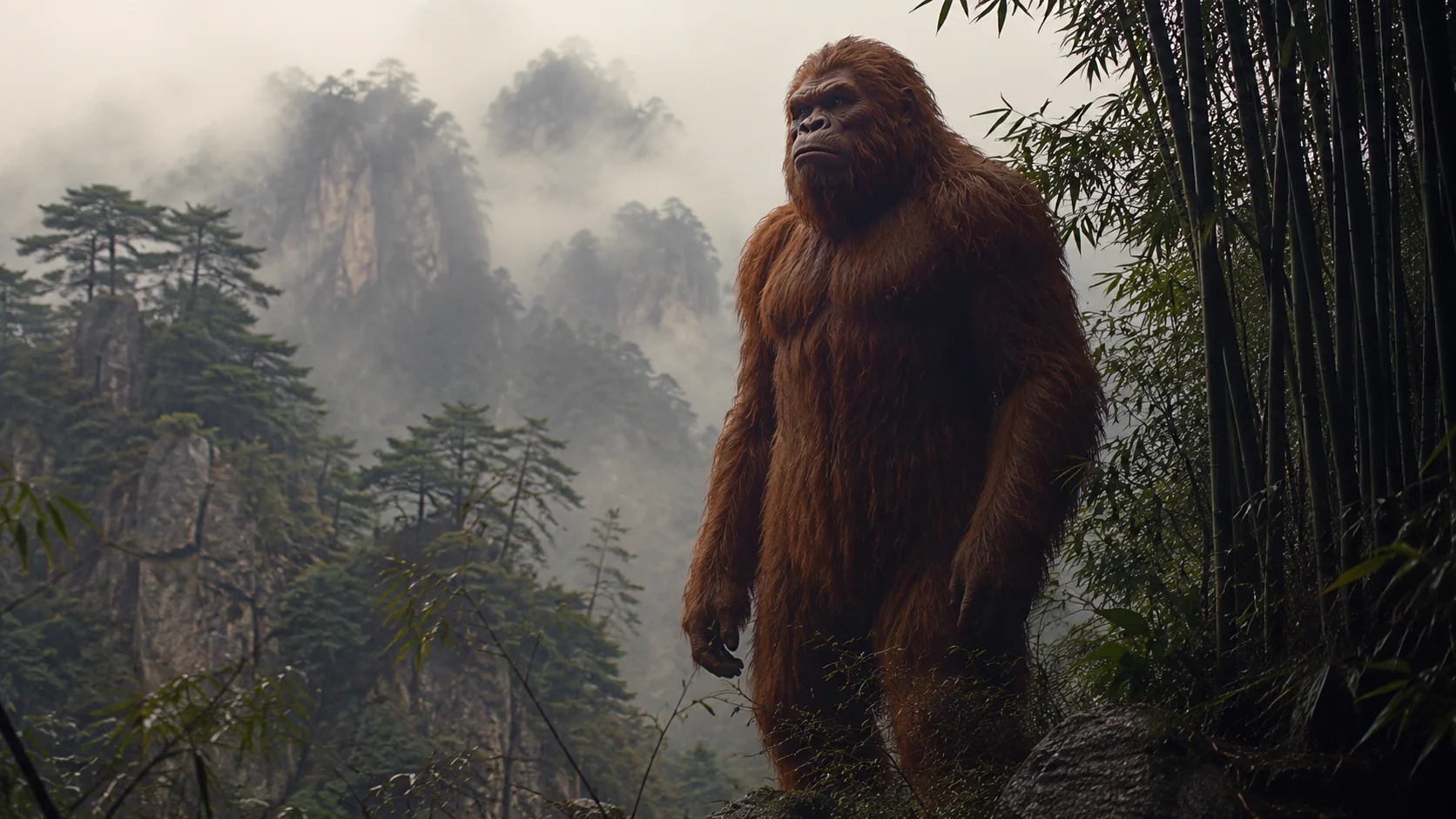
The Yeren — literally the "Wild Man" or "wild person" — is China's most enduring hairy-hominid cryptid, a large, bipedal, ape-like or man-like being reported chiefly from the remote forested mountains of the Shennongjia region in Hubei Province. Standing by most accounts taller than a man, covered in reddish-brown or dark hair, and moving with a distinctive stooped gait, the Yeren has been sought by hunters, scholars, and government-organized expeditions alike, and remains, after decades of searching, entirely unproven.
A Name Carved from the Forest
The term Yeren translates plainly as "wild man" or "wild person," a name that says less about what the creature is than about where it is presumed to live: the deep, difficult, half-explored mountain forests beyond the reach of ordinary settlement. In some regions the being is known instead as Xiong Ren, "Man-Bear," a regional variant that hints at how reports have sometimes blurred the line between an unknown hominid and a known, simply unfamiliar animal. Western cryptozoological writers have long drawn a comparison between the Yeren and Bigfoot or Sasquatch of North America, and further afield, the Almas reported from Central Asia. This is a comparison of category, not of claimed kinship — cryptozoologists group these figures together because they share a reporting pattern, not because any evidence links them to a common origin.
Echoes in the Old Texts
Long before any twentieth-century expedition set out with cameras and plaster casts, hairy wild-man figures already moved through Chinese literature. The Chu Ci poem "Summoning the Soul," attributed to the Warring States period around the third century BCE, mentions a mountain-dwelling being called the xiao. Later, the Classic of Mountains and Seas — the Shan Hai Jing, that vast catalogue of the strange and the marvelous — describes hairy, hominid-like creatures inhabiting distant wild places. Scholars are careful, however, not to read these passages as early zoological field notes. They are literary and mythological references, products of a very different kind of text, and the thread connecting them to the modern Yeren reports of Shennongjia is disputed rather than settled. The old texts establish that wild-man imagery has a long life in Chinese letters; they do not establish that the Yeren of today is their direct descendant.
An Early Witness in Shaanxi
One of the most frequently cited pieces of testimony predates the modern Shennongjia craze by decades. In 1940, the Chinese biologist Wang Zelin reported an encounter near Bao Chi, in Shaanxi, where local hunters described to him a dead "wild man" body. Wang's account is often invoked precisely because he was a trained scientist rather than a villager repeating folklore — an "expert witness," in the language cryptozoology likes to use. But the account is second-hand: Wang did not examine physical remains himself, and no specimen, photograph, or preserved material from the case survives to be independently assessed. It stands as testimony, not evidence, however credentialed the person offering it.
The Night the Cadres Saw Something
Modern interest in the Yeren surged after a sighting near Shennongjia in 1976, one of the most cited cases in the creature's entire history. A group of Chinese officials — cadres — traveling together by vehicle at night reported seeing a large, reddish, hairy, bipedal creature at close quarters. The status of the witnesses mattered enormously to how the report was received: this was not an isolated hunter's tale but a shared observation among several officials, filed through channels that could not easily be dismissed as rural superstition. Like Wang Zelin's account thirty-six years earlier, though, it produced no specimen, no photograph, nothing beyond description — and it remains, formally, unverified.
Science Goes Looking
The 1976 sighting helped push the Yeren from local legend into a matter the state itself was willing to investigate. In 1977 the Chinese Academy of Sciences organized a large-scale official expedition into Shennongjia specifically to pursue Yeren reports — a substantial commitment of scientific manpower and resources to a cryptid search, rare anywhere in the world. The expedition collected footprints, hair samples, and feces attributed to the creature. What it did not produce was conclusive evidence of an unknown hominid. The samples were real; what they proved was, and remains, another question.
What the Hair Actually Said
Hair samples attributed to the Yeren have been analyzed on more than one occasion, most notably in a well-known analysis conducted in the 1980s. The results were inconclusive at best, and where conclusions were reached, they tended to point not toward an undiscovered primate but toward animals already known to inhabit the region — the golden snub-nosed monkey, the goral, and various species of bear. None of this proves the Yeren does not exist; it simply means that the physical traces gathered so far, when tested, have not held up as evidence of something new. Skeptical scholarly review has treated this pattern — striking testimony paired with mundane laboratory results — as one of the central features of the whole Yeren file.
A Consistent Shape, an Absent Body
What makes the Yeren compelling to those who study it is less any single report than the consistency across many of them. Described heights cluster between six and ten feet. The hair is reddish-brown or dark. The gait is bipedal but stooped, not the fully upright walk of a person. A strong odor is frequently mentioned. Taken together these details sketch a creature with real coherence as an idea — and yet, after decades of both government-backed and independent searching, no physical type specimen, no bone, no widely accepted photograph or video has ever been produced. A consistent description is not the same thing as a confirmed animal, and the gap between the two is exactly where the Yeren has lived for half a century.
What the Forest Blamed Before Science Arrived
Long before any academy sent an expedition into Shennongjia, local folk tradition in Hubei already had a name for what happened in its deepest woods. Wild-man legends served, as similar figures have served in wild-man traditions elsewhere in China, as an explanation for otherwise unaccountable events at the edge of the forest — a strange encounter on a mountain path, disturbed or missing livestock, a person who went into the trees and did not come back the way they should have. The function of the legend predates the modern cryptid investigation by a considerable margin; the Yeren of the scientific expeditions inherited an explanatory role the forest had already assigned to something.
The Leading Skeptical Case
Not every Chinese researcher who has studied the Yeren file has treated it as an open question leaning toward the unknown. Zhou Guoxing and other scholars have published skeptical assessments arguing that the great majority of Yeren sightings are misidentifications — of golden snub-nosed monkeys, of bears, or of ordinary humans, including hermits living in the remote forest who would themselves be startling and easily misread at a distance or in poor light. This view is widely cited in cryptozoology literature as the leading mainstream explanation for the phenomenon, not as a fringe dissent from it. It does not claim to explain every report in isolation, but it offers a coherent account of why a forest already home to large, sometimes bipedal, thickly furred animals — and to the occasional reclusive person — would generate exactly this kind of testimony without requiring an undiscovered hominid.
Where the Search Stands
Mainstream primatology and zoology do not accept the Yeren as a documented species. Every expedition, official or independent, across the decades since the 1977 academy investigation, has returned with description, testimony, footprints, and hair — and never with a specimen that survived rigorous examination. The creature's classification has not moved: it remains a cryptid, a subject of investigation and folklore rather than a confirmed animal on any zoological register. That the search has continued so long, backed at points by state science itself, says something about how seriously the reports were taken even as the physical case for them kept dissolving under analysis.
Shennongjia's Second Life
Whatever the laboratory results say, the Yeren has become something else entirely for the region that hosts it: a cultural and economic symbol in its own right. The Shennongjia Nature Reserve has built tourism, museums, and signage around its association with Yeren sightings, turning decades of inconclusive expeditions into a durable regional identity. Visitors come in part for the forest and in part for the legend the forest is famous for harboring, and the two draws have become difficult to separate. The Yeren has also been absorbed into a broader, global current of wildman and Bigfoot-adjacent cryptozoology — documentaries, cross-cultural cryptid comparison lists, and popular media that place the Chinese reports alongside those from other continents. It is worth holding that absorption at arm's length rather than treating it as evidence of a single unified tradition: Chinese source material and Western cryptozoological framing carry different reporting standards and different motivations, and folding them together risks manufacturing a coherence the original accounts never claimed.
A Search Without an End
Half a century after officials in a vehicle reported something large and reddish crossing their path at night, and nearly as long after the Chinese Academy of Sciences sent scientists into Shennongjia to look for it, the Yeren remains exactly where it started: a strong, consistent description; a long literary and folk pedigree stretching back to the Chu Ci and the Shan Hai Jing; testimony from witnesses ranging from hunters to trained biologists to government cadres; and, at the center of all of it, no body. The forests of Hubei keep their reputation regardless — as the place where, if the wild man exists anywhere, he has always been said to live.
Sources & traditions
- EncyclopediaWikipedia — Yeren
- TraditionLocal sightings, press reports and regional folklore (China)
Myths change from area to area and from time to time. This chronicle follows the most widely told versions; tellings in other villages, regions and eras may differ.