The Skunk Ape is an American cryptid, a large, hairy, ape-like creature akin to Bigfoot, said to inhabit the swamps, forests, and Everglades of the American South, especially Florida, and famous above all for its overpowering, foul, skunk-like stench, from which it takes its name. Also known as the Myakka Ape, or by regional nicknames such as the Louisiana or Florida Bigfoot, it occupies a distinct niche within the wider North American wild-man tradition: a swamp-dwelling, foul-smelling cousin to the forest giants reported farther north and west.
A Creature of the Sawgrass and Cypress
The Skunk Ape is chiefly a creature of Florida, reported most often in the swamps and forests of the Everglades and in the wetlands around Myakka River State Park in Sarasota County. Its range is not confined to a single county or park, however; witnesses across the Southern states, including Georgia, Louisiana, and Arkansas, have described encounters with similar hairy, upright figures moving through wet, densely wooded terrain. These reports sit alongside separately named regional cases, among them the Honey Island Swamp Monster of Louisiana and the Fouke Monster of Arkansas. The Skunk Ape, the Honey Island creature, and the Fouke Monster belong to the same broad tradition of Southern ape-cryptids, but they are treated by researchers and by local tradition alike as distinct, separately documented figures, each tied to its own place and its own body of sightings, and none should be folded into another under a single name.
The Stench That Names It
More than any single physical trait, it is a smell that defines the Skunk Ape in the accounts of those who claim to have encountered it. Witnesses describe an overpowering, foul odor, most often compared to rotten eggs, to raw methane, or to a wet skunk, arriving ahead of or alongside any glimpse of the animal itself. This stench is reported with more consistency than the creature's height, its color, or the shape of its face; where physical descriptions vary from witness to witness, the smell recurs again and again, and it is this recurring detail, not any photograph or footprint, that gave the creature its common name.
A Body Built for the Wetlands
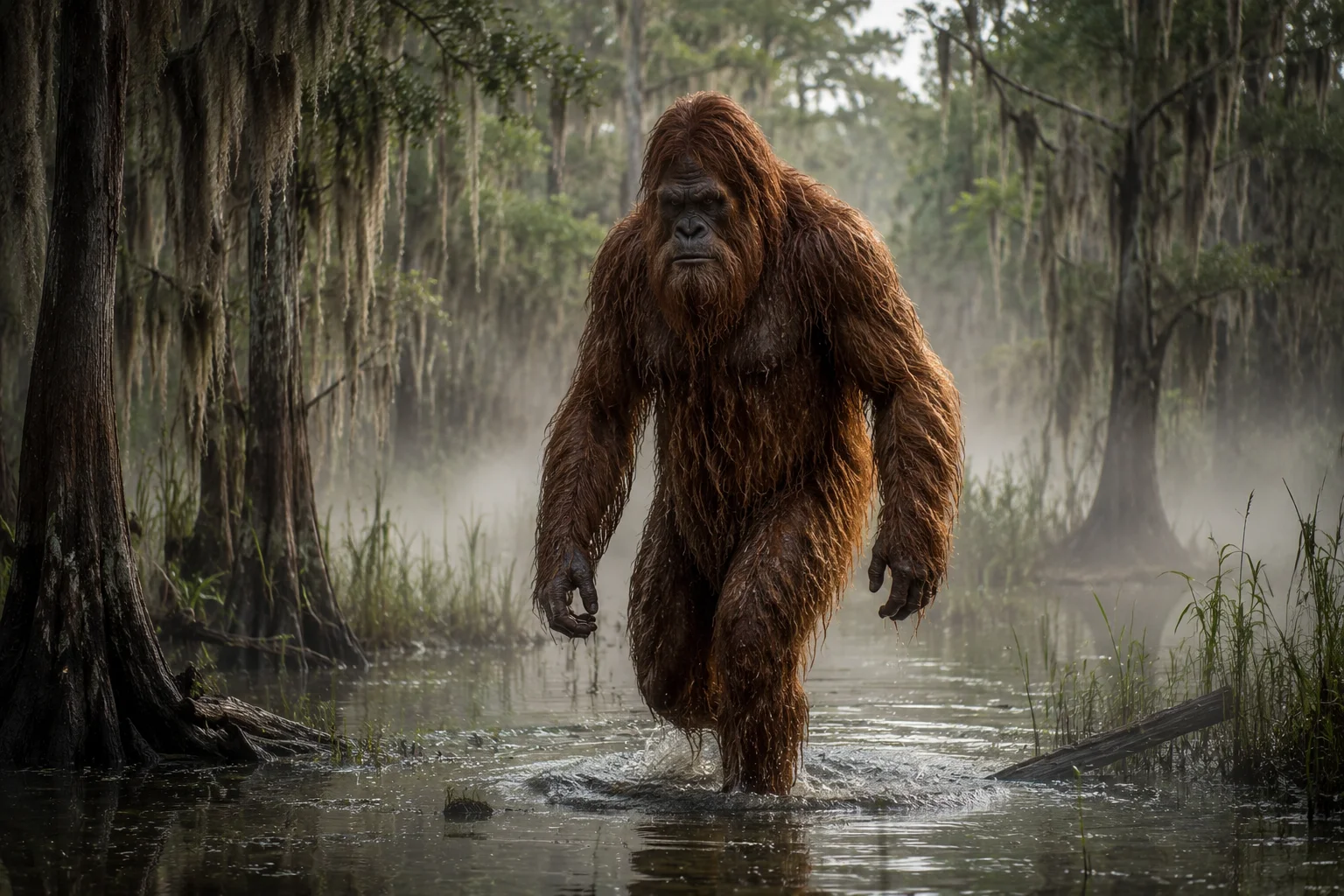
Eyewitness descriptions converge on a bipedal, ape- or orangutan-like animal standing roughly five to seven feet tall, its body covered in shaggy hair usually described as reddish-brown or dark. Compared to the classic Bigfoot of the Pacific Northwest, witnesses in Florida and the surrounding Southern states more often describe a creature with a more prominent, rounded head and noticeably shorter arms. Some researchers who study these reports argue that this consistent difference in proportion points to a distinct regional type of ape-cryptid rather than simply a Southern sighting of the same animal reported elsewhere in North America, though this remains an interpretation rather than a settled classification.
Newsprint and the Rise of a Local Legend
Widespread popular attention to the Skunk Ape dates largely to the 1970s, when Florida newspapers began running stories under that name, turning a scattering of local encounters into a recognizable, named legend with a wide readership. Unlike some cryptids whose modern fame traces back to one dramatic incident, the Skunk Ape's legend crystallized gradually, through years of newspaper coverage rather than a single, well-documented originating event. No single "first sighting" date is agreed upon by researchers, and any specific claim of an original encounter circulating today should be treated as unverified unless it can be traced to a genuine primary source.
Dave Shealy and the Roadside Headquarters
No single person has become more publicly associated with the Skunk Ape than Dave Shealy of Ochopee, Florida, a self-styled cryptozoologist who founded the Skunk Ape Research Headquarters near the Big Cypress National Preserve. The Headquarters remains a roadside attraction to this day. Shealy's decades of public advocacy, interviews, and tours have done more than any single sighting to keep the Skunk Ape in the popular imagination, cementing Ochopee and the surrounding Big Cypress country as ground zero for Skunk Ape tourism.
The Myakka Photographs
The single most famous piece of purported physical evidence is the pair of photographs known as the Myakka Ape photographs. In 2000, they were mailed anonymously to the Sarasota County Sheriff's Office, accompanied by a letter from a woman who claimed to have taken the pictures in her own backyard as the animal ate apples off her porch. The photographs have circulated widely ever since and remain a touchstone of Skunk Ape lore, but they are explicitly disputed: skeptics have proposed that the images show a costumed animal, or a misidentified bear, and the claim behind them rests on a single anonymous, uncorroborated source. They are best understood as widely known and widely debated, not as settled proof.
Roads, Riverbanks, and Uncorroborated Encounters
Beyond the Myakka photographs, the Skunk Ape's file is built largely from individual, largely uncorroborated sighting reports rather than any single citable case. Motorists have reported the animal crossing rural Florida roads; hunters and hikers moving through the Everglades and the Big Cypress Swamp have described brief, startling encounters at close range; and the Myakka River area saw a notable cluster of reports in the early 2000s, around the time the anonymous photographs surfaced. None of these individual accounts has been independently verified by physical evidence beyond photographs and plaster casts, and they are best treated collectively, as a body of local testimony, rather than as a chain of confirmed incidents.
Casts, Bears, and the Skeptical Explanation
Over the decades, cryptid researchers have produced purported plaster casts of footprints attributed to the Skunk Ape, but none has been peer-authenticated as belonging to any unknown primate species. Mainstream wildlife biologists offer a simpler explanation for the great majority of sightings: the Florida black bear, Ursus americanus floridanus, which can rear up onto its hind legs and, at a distance or in poor light, present a bipedal, roughly man-shaped silhouette. This misidentification hypothesis does not require any single sighting to be dishonest; it only requires that a startled or hurried witness, catching a brief glimpse of a standing bear in dense brush, come away with an impression of something more humanlike than what was actually there.
A Modern Legend, Not an Ancient Spirit
Within cryptozoological writing, the Skunk Ape is generally classified as a regional variant of the broader North American wild-man and Bigfoot-Sasquatch tradition, rather than as a figure drawn from a distinct indigenous mythological source. This sets it apart from Sasquatch, which carries a documented pre-20th-century presence in Native American oral tradition; the Skunk Ape has no comparable, clearly documented source predating its 20th-century newspaper fame. Claims that link the creature to older Southeastern folklore circulate informally but should be treated as unverified rather than established fact. The Skunk Ape, in other words, is a modern legend built on modern reports, not a survival of an ancient story.
Tall Tales and Tourist Trade
The Skunk Ape's cultural role in Florida is overwhelmingly one of regional folklore and roadside-attraction tourism rather than sacred or ritual significance. It is a fixture of Florida tall tales and a recurring subject of local news coverage during "silly season," when a good swamp-monster story finds an audience. It has also become a branding fixture in its own right, printed across T-shirts and souvenirs and built directly into the identity of attractions like the Skunk Ape Research Headquarters, where the legend is as much a part of the local economy as it is a piece of storytelling.
Cameras in the Cypress
Television has carried the Skunk Ape's reputation well beyond Florida's borders. The creature has appeared repeatedly in popular cryptozoology programming, including History Channel's MonsterQuest and Animal Planet's Finding Bigfoot, both of which sent investigators into the Florida swamps to search for physical evidence. Neither series produced conclusive proof of the creature's existence; their Florida episodes instead added to the long record of field investigations that have gathered testimony, environmental recordings, and casts without ever settling the question, keeping the Skunk Ape's status exactly where it has stood for decades: unresolved, but never short of interested searchers.
The Swamp's Answer to Bigfoot
Set beside its Pacific Northwest cousin, the Skunk Ape reads as a distinctly Southern answer to the same broad idea: a large, hairy, upright figure moving unseen through wild country at the edge of human settlement. Where Bigfoot belongs to dense mountain forest, the Skunk Ape belongs to sawgrass, cypress, and standing water, and where Bigfoot's reputation rests mostly on its size and its footprints, the Skunk Ape's rests on its smell. The two figures are cousins within the same wider hairy-hominid tradition, but the differences in habitat, build, and defining trait are consistent enough, across enough decades of reports, that Florida's swamp ape has never simply been read as Bigfoot with wet feet. It is its own regional legend, rooted in its own landscape.
Sources & traditions
- EncyclopediaWikipedia — Skunk ape
- TraditionLocal sightings, press reports and regional folklore (North America)
Myths change from area to area and from time to time. This chronicle follows the most widely told versions; tellings in other villages, regions and eras may differ.