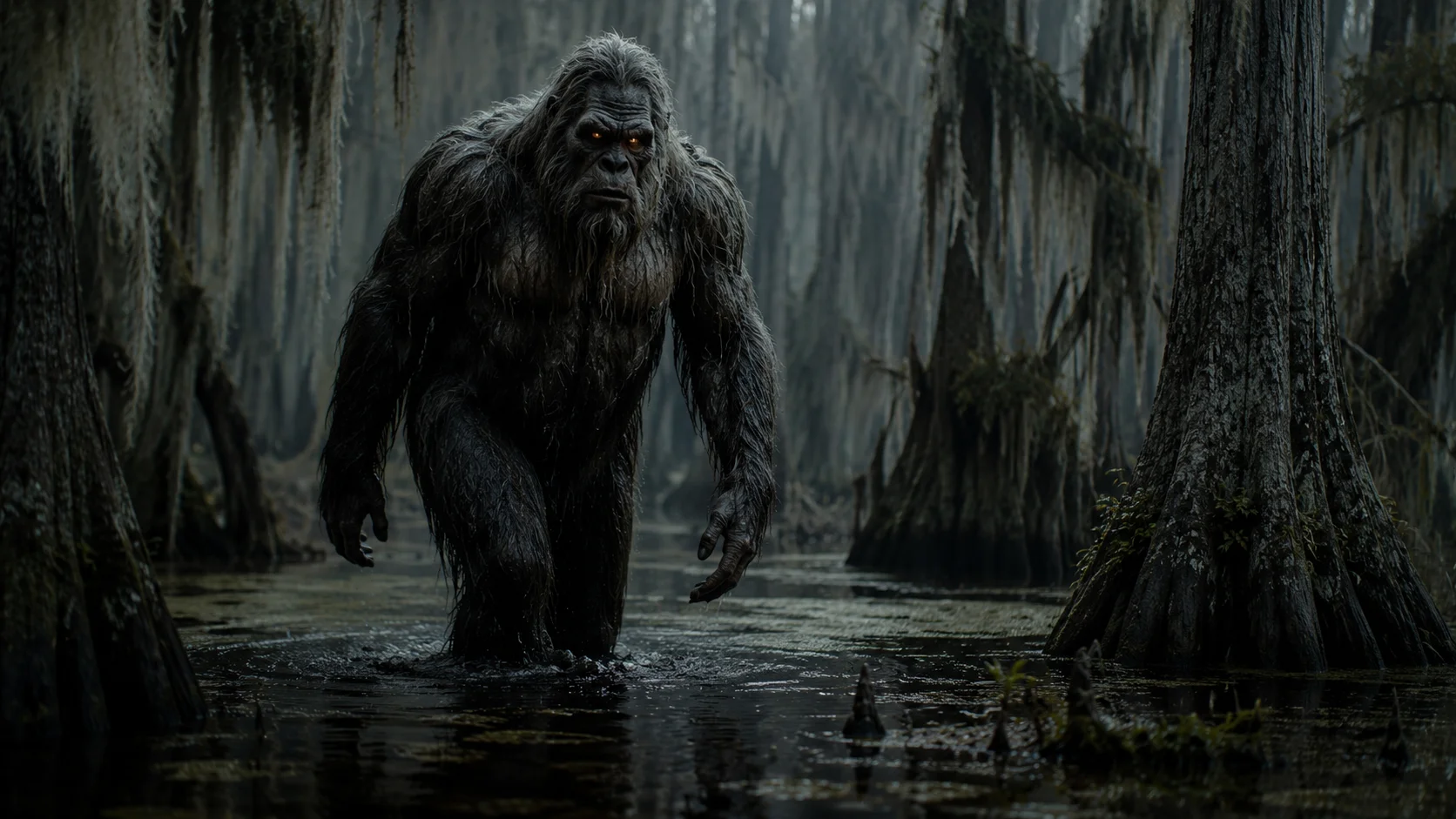
The Honey Island Swamp Monster, sometimes called "Letoot" or the "Southern Sasquatch," is an American cryptid, a large, hairy, bipedal creature said to inhabit the Honey Island Swamp along the Pearl River in southeastern Louisiana, near the Louisiana-Mississippi border. A Bigfoot-type figure with grey or dark hair, amber or yellow-brown eyes, and a strong swamp musk, it is known chiefly through a foundational 1963 sighting and a set of distinctive three-toed footprint casts, and it has become one of the most recognizable regional cryptids of the American South.
A Shape Glimpsed in the Cypress
Witnesses describe the Honey Island Swamp Monster as roughly seven feet tall, bipedal and ape-like in build, with a powerful frame covered in grayish or dark hair. Its eyes are usually given as amber or yellow-brown, and reports consistently mention a strong, musky odor said to precede or accompany a sighting, the kind of detail that recurs across swamp-cryptid accounts throughout the American South. Encounters typically describe a large hairy figure glimpsed at a distance through dense vegetation, sometimes accompanied by alleged vocalizations and signs of disturbance in the undergrowth, rather than any close-range or conclusive observation.
The Wilderness That Gave It a Name
The Honey Island Swamp itself is one of the least-altered wetland wildernesses in the United States, a vast, wild expanse of cypress, tupelo, and backwater channels straddling the Pearl River basin between Louisiana and Mississippi. Its remoteness and near-impassability have long made it the kind of place where a story like this could take root and persist: dense enough to hide a great deal, and visited by few enough people that any given claim is hard either to confirm or to dismiss outright. The swamp's identity and the cryptid's are now largely inseparable in regional memory.
Harlan Ford and the Alligator With Its Throat Torn Out
The case that made the creature famous dates to 1963, when retired air-traffic controller Harlan Ford and his hunting companion, given as Billy Mills or, in some tellings, Ray Mills, were in the swamp and came upon a dead alligator with its throat torn out. Nearby, they reported finding unusual footprints unlike those of any known animal. That single discovery, an alligator killed in a manner the two men could not explain and tracks they could not identify, became the seed of everything that followed: decades of interest, investigation, and retelling centered on what, or who, had been responsible.
Casts Taken From the Mud
Harlan Ford took plaster casts of the footprints he found in the swamp, most often dated to around 1963 with his interest and activity continuing into the 1970s. The casts are the case's most concrete physical evidence, and their most distinctive feature is a three-toed, webbed-looking print, a track shape that sets the Honey Island creature apart from the standard five-toed footprints reported for Bigfoot elsewhere in North America. Whether that difference points to an unknown animal adapted to wetland travel, an alteration of ordinary tracks, or something else entirely has been argued ever since, but the three-toed cast remains the detail every account of the case returns to.
A Photograph Half-Hidden by Reeds
An alleged photograph attributed to the case, dated variously to 1963 or 1964, shows a hairy creature partially obscured by swamp vegetation. Its authenticity has never been settled. Skeptics widely regard the image as inconclusive at best, and as a probable misidentification or hoax at worst, and it has never carried the same evidentiary weight in the case as Ford's footprint casts. It nonetheless became one of the most reproduced images associated with the legend once the case reached a wider audience.
A Claim of Fabrication After Ford's Death
Harlan Ford died in 1980, and in the years afterward, some investigators, including individuals connected to the Ford family estate, raised the possibility that the famous photograph had been staged or fabricated rather than genuinely captured in the swamp. That suggestion surfaced specifically in retrospective cryptozoology reporting rather than at the time of the original claim, and it complicates any simple reading of the case: the footprint casts and the photograph do not necessarily stand or fall together, and the doubts raised about one do not automatically extend to the other.
Told to a Wider Audience
The case moved beyond regional word of mouth in the 1970s and 1980s, when Harlan Ford's footprint casts and swamp tracking claims were featured on television, including a segment on the program "In Search Of..." and later coverage on cable documentary and cryptid programs. That exposure did more than any local retelling to fix the Honey Island Swamp Monster in the wider American cryptid landscape, carrying a story rooted in one specific stretch of Louisiana wetland out to a national audience that had never set foot near the Pearl River.
Circus Chimpanzees and Alligators: A Folk Explanation
Alongside the Ford case, a separate and distinct thread of local lore offers its own origin story: that the creature descended from chimpanzees that escaped a circus train wreck, or a traveling circus, and interbred with local alligators. This account circulates as popularized regional folklore rather than as any documented event, and it is treated as speculative even by those otherwise inclined to credit the broader legend, cryptozoology proponents included. It survives less as a claim anyone expects to be verified than as a piece of storytelling that has attached itself to the mystery, explaining the inexplicable in the swamp's own colorful terms.
Kin Without Common Ancestry
The Honey Island Swamp Monster is generally classed within the broader North American category of regional Bigfoot or "wood ape" cryptids, and it is often mentioned alongside other Southern swamp-cryptid cases, such as the Louisiana and Texas wood ape reports or the Fouke Monster of Arkansas. These are separate, distinctly named regional legends, each rooted in its own place, its own witnesses, and its own specific claims, and the family resemblance between them, a hairy bipedal figure in a Southern wetland, should not be mistaken for a shared origin or a single connected case.
No Bone, No Blood, No Verified Track
No physical remains, no verified DNA, and no evidence accepted by mainstream science exists for the Honey Island Swamp Monster. The prevailing skeptical assessment treats the footprint casts as either a hoax or a misidentification, alligator tracks or another animal's prints altered or misread in the mud rather than any authentic mark of an unknown hominid. The case, in this view, rests on what one man found and cast in a remote swamp more than sixty years ago, and on how that discovery has been retold ever since, rather than on evidence that has accumulated or strengthened with time.
A Legend the Swamp Now Markets
Whatever the scientific verdict, the Honey Island Swamp Monster has become a fixture of Louisiana regional tourism and folklore in its own right. Swamp boat tours operating in the Pearl River and Honey Island area market themselves in part around the legend, folding the creature into the cultural identity of the wetland itself. That commercial and cultural life runs somewhat separately from the original cryptozoological claim: visitors taking a boat tour through the cypress are engaging with a piece of regional identity and storytelling as much as with any expectation of an actual encounter.
What Endures in the Reeds
More than sixty years after Harlan Ford found a dead alligator with its throat torn out beside a set of tracks unlike anything he recognized, the Honey Island Swamp Monster remains one of the most durable cryptid legends to come out of the American South. It is a story built on a small, specific body of evidence, plaster casts of an unusual three-toed print, a disputed photograph, one man's sworn account, and it has outlasted the scrutiny brought against every piece of that evidence individually. The swamp that gave it a name is still there, still wild, still largely unaltered, and the legend it produced has settled as firmly into Louisiana's sense of itself as the cypress and the tupelo.
Sources & traditions
- EncyclopediaWikipedia — Honey Island Swamp monster
- TraditionLocal sightings, press reports and regional folklore (North America)
Myths change from area to area and from time to time. This chronicle follows the most widely told versions; tellings in other villages, regions and eras may differ.