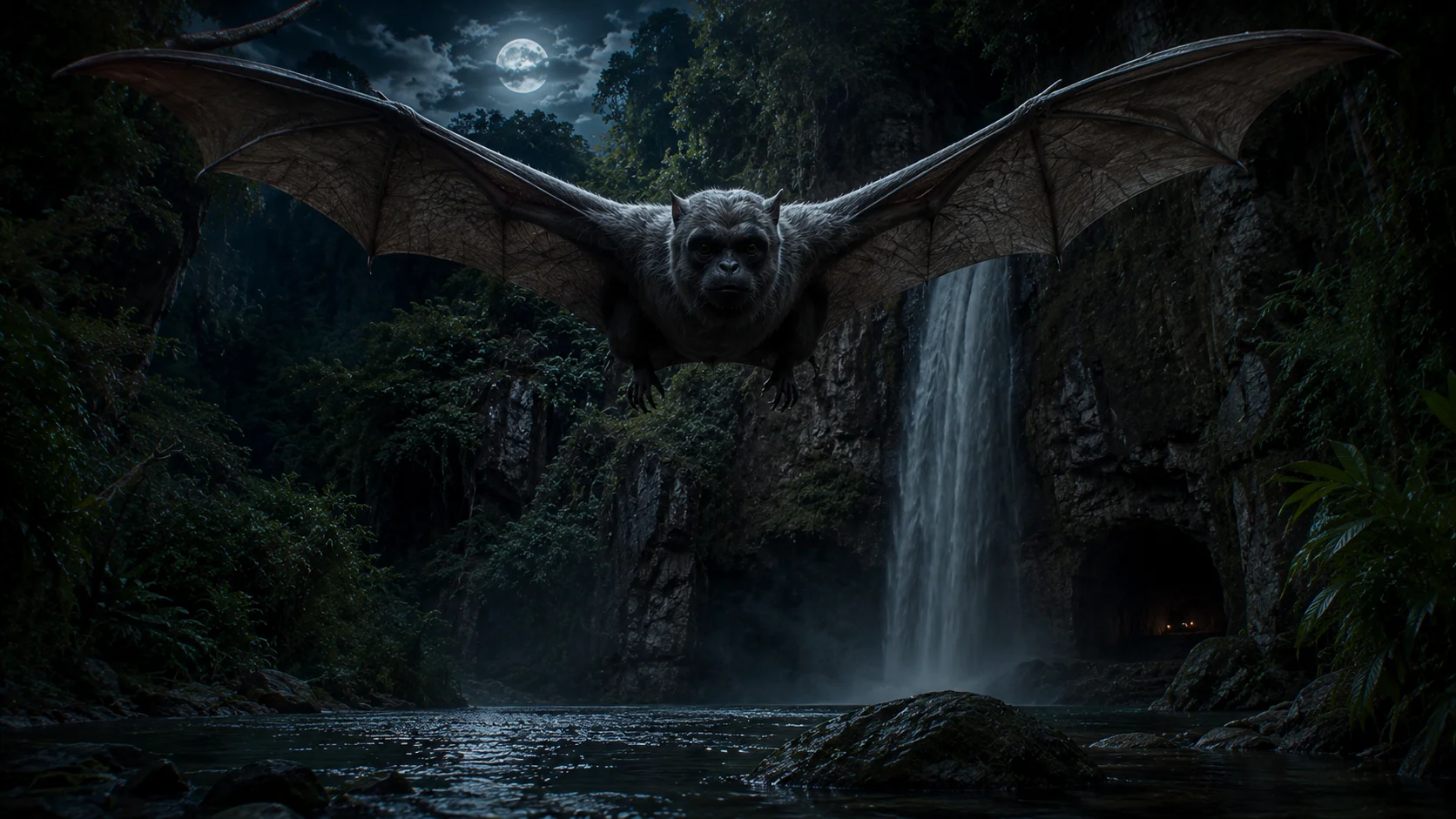
The Ahool is a cryptid of Indonesia, a giant bat or bat-like flying creature said to inhabit the rainforests of Java, with an enormous wingspan, a monkey-like or flat face, large dark eyes, and a cry from which it takes its name. The giant bat of Java, the great winged creature of the Indonesian rainforest, the Ahool is one of the more famous giant-bat cryptids on record, a monstrous shape reported moving through the deep jungle by night.
A Name Taken From the Dark
Unlike a mythological being carrying an inherited title or an honorific passed down through scripture and ritual, the Ahool has no epithet tradition at all. It is known simply, flatly, by the sound it is said to make. Witnesses describe a call ringing out across the jungle canopy as something close to "a-hool" or "ahool," two falling syllables repeated into the dark, and cryptozoological writers took the sound itself as the animal's name. There is no deity's title here, no honorific to render with care, because the Ahool was never folded into a religious or cosmological system that would have given it one. It is a name born of an onomatopoeia and nothing more, which is itself worth sitting with: an entire cryptid identity built from four heard syllables and never anything else.
Mount Salak's Reported Shape
The descriptions that have accumulated around the Ahool sketch a creature unlike any catalogued bat. Reports speak of a wingspan reaching some three meters, roughly ten feet tip to tip, a figure that dwarfs even the largest confirmed bat species alive today. The body is described as bulky, roughly the size of a large monkey or a small child, wrapped in grey fur rather than the sparser covering of known bats. The face is the detail that recurs most often and unsettles most: not the elongated muzzle of a typical bat but something flatter, more ape-like, with forward-facing eyes rather than eyes set to the sides of the skull. Large claws are mentioned alongside broad leathery wings. It is, on the page, a hybrid impression — bat in silhouette, primate in face — and that hybrid quality is exactly what later classifiers seized on.
Ernest Bartels on the Mountain
The creature's presence in cryptozoological literature traces back overwhelmingly to one source: the naturalist and explorer Ernest Bartels, who described encountering it while exploring Mount Salak in West Java during the 1920s. Bartels's account functions as the foundational report — essentially the single witness testimony from which the entire modern Ahool legend descends. Later retellings, compilations, and cryptid catalogs draw on that one mountain, that one explorer, that one decade, expanding and repeating the description but rarely adding an independent sighting of comparable weight. This matters for understanding what kind of legend the Ahool actually is: not a folk tradition accumulated across generations of local testimony, but a modern cryptozoological case built largely on a single originating claim and its subsequent circulation.
The Rainforest of West Java
The setting given to the Ahool is specific and consistent: the dense rainforest surrounding Mount Salak, a mountain in West Java, Indonesia. Popular retellings place it roosting in caves, in the deep folds of the jungle, sometimes said to lurk near waterfalls and to range over rivers and forest canopy under cover of darkness. The geography lends the legend its texture — Java's rainforest is real, dense, and genuinely capable of concealing large fauna from casual observation, which is part of why the claim has proven durable rather than being dismissed outright. A remote, humid, densely canopied mountain forest is precisely the kind of landscape where an unverified sighting can persist for a century without either confirmation or refutation.
No Bone, No Photograph, No Specimen
For all the description, the physical record is empty. No type specimen has ever been produced. No photograph exists. No bone, tooth, or scrap of preserved tissue has been catalogued by any zoological institution. In the century since Bartels's report, nothing has surfaced that would let a taxonomist assign the Ahool a genus, a species, or even a tentative scientific name. It holds no recognized status in zoological taxonomy whatsoever — it exists exclusively as description, testimony, and the accumulated retelling of both. This absence is not a minor caveat tacked onto an otherwise solid case; it is the central fact governing everything else that can honestly be said about the creature.
A Category Built by Cryptozoologists, Not Zoologists
The informal grouping that gave the Ahool its intellectual home was the work of cryptozoologists rather than mainstream biology. Ivan T. Sanderson, among others, folded the Ahool into a loose category sometimes called "flying primate" or giant-bat cryptids — creatures reported as bat-shaped but bearing primate-like facial features, forward-set eyes, or an unsettling intelligence to their described behavior. This categorization placed the Ahool alongside the Orang Bati of the Moluccas and other giant-bat legends reported from the region, treating them as variations on a shared cryptid archetype rather than as isolated, unrelated curiosities. It is worth being precise about what this classification is: an organizing framework invented within cryptozoology's own literature, not a scientific taxon and not evidence that the reports describe a genuine biological lineage connecting these separate sightings.
What the Skeptics Point To
Mainstream cryptozoological compendiums and skeptical commentators have generally converged on a small set of mundane explanations. Java is genuinely home to large bats — flying foxes of the genus Pteropus reach substantial size and roost and forage in exactly the kind of forest terrain the Ahool is reported from. A large flying fox glimpsed briefly at night, wings spread against a darker sky, could plausibly be misremembered or exaggerated into something far larger than it actually was. A large nocturnal bird has also been proposed as an alternative candidate. None of these explanations claims certainty — the honest position is that no one has definitively resolved what, if anything, Bartels and later witnesses saw, only that known Southeast Asian fauna offers a plausible, unspectacular candidate that does not require inventing a new class of animal.
A Legend Without a Local Cult
Here the Ahool differs sharply from the deities and spirits of genuine Javanese and Sundanese tradition. It is not documented as carrying the kind of indigenous religious or folkloric standing that a figure like Nyai Roro Kidul holds in Sundanese belief — no shrine, no ritual observance, no place in a recognized cosmology has been recorded for it. Whether local witness accounts existed independently of Bartels's writing, and how much of the Ahool's currency was shaped by Western cryptozoological interest rather than pre-existing Javanese storytelling, remains genuinely uncertain and under-documented rather than settled in either direction. It would be a mistake to assert flatly that the Ahool has deep native roots; it would be an equal mistake to assert flatly that it does not. What can be said plainly is that its documented life is primarily as a twentieth-century cryptozoological case, catalogued and circulated through Western writers working from local witness reports rather than through an established indigenous religious tradition comparable to the region's genuinely worshipped spirits.
A Structural Mismatch Worth Naming
Approaching the Ahool with the same categories used for a mythological figure — parentage, cosmological role, relationships to other named beings within a shared tradition — simply does not work, and forcing it to work would mean inventing material that is not there. The Ahool has no parents, no divine genealogy, no assigned place in a pantheon or cosmic order, because it was never part of a religious system that would have given it one. It has no documented relationships to Sundanese deities or spirits; none should be assumed or implied. This is not a gap in the record to be filled with plausible-sounding connections — it is a difference in kind. A cryptid built from a single twentieth-century witness account belongs to an entirely different category of legend than a god with an inherited myth cycle, and the honest account treats that difference as structural rather than papering over it.
Company in the Dark Sky
The Ahool is far from alone in its category. Cryptid literature groups it with other reported giant flying creatures from around the world — the Ropen of Papua New Guinea and the Olitiau of Africa are cited alongside it as members of the same loose family of unverified giant-bat and winged-cryptid reports. What links them is not a shared origin or a documented relationship between the creatures themselves, but a shared pattern in how they were reported and received: isolated witness testimony, a striking and consistent physical description, no corroborating specimen, and eventual absorption into the broader canon of cryptozoological literature. The Ahool's place in that lineup is as one giant-bat case among several, cited for comparison rather than for any claimed connection.
From Field Report to Stock Entry
In the decades since Bartels's account, the Ahool has settled into cryptozoology's standard reference works — the writings of Bernard Heuvelmans and Ivan T. Sanderson, and later compendia such as Loren Coleman's cryptid catalogs, all carry an entry for it. From there it has migrated into documentaries, cryptid-themed books, and games, where it appears as a stock "giant bat" figure. In these later appearances it is generally presented on its own terms — a giant bat of the Javanese rainforest — rather than tied to any specific religious or cosmological narrative, which is consistent with the fact that no such narrative was ever documented for it. The trajectory is a familiar one for legends of this type: a single field report, absorbed into specialist literature, then diffused outward into popular cryptid culture, gaining retellings but not gaining evidence.
What Endures
What remains, a century on, is a description rather than a case: an enormous grey-furred, bat-winged shape with an ape-like face and forward-facing eyes, said to haunt the rivers and caves around Mount Salak, named for the two-note call it is supposed to make in the dark. No specimen has ever confirmed it. No photograph has ever caught it. Its documented history runs almost entirely through one explorer's report and the long chain of retelling that followed. Whether it is an undiscovered animal, a startled memory of an ordinary flying fox seen wrong in poor light, or simply a story that outgrew its origins, the Ahool persists as one of the more evocative entries in the catalogue of the world's unproven giants — a call heard once in the jungle night, and never definitively explained since.
Sources & traditions
- TraditionLocal sightings, press reports and regional folklore (Indonesia)
Myths change from area to area and from time to time. This chronicle follows the most widely told versions; tellings in other villages, regions and eras may differ.