Mothman is a famous American cryptid — a large, winged, humanoid creature with glowing red eyes, said to have terrorised the town of Point Pleasant, West Virginia, in the years 1966–67, and famously connected, in legend, to the disaster that followed. A great winged man-creature with burning red eyes, an omen of disaster and a figure of dread, Mothman is one of the most famous and eerie of the modern American cryptids, the winged terror of Point Pleasant, the harbinger of catastrophe.
The Winged Man of Point Pleasant
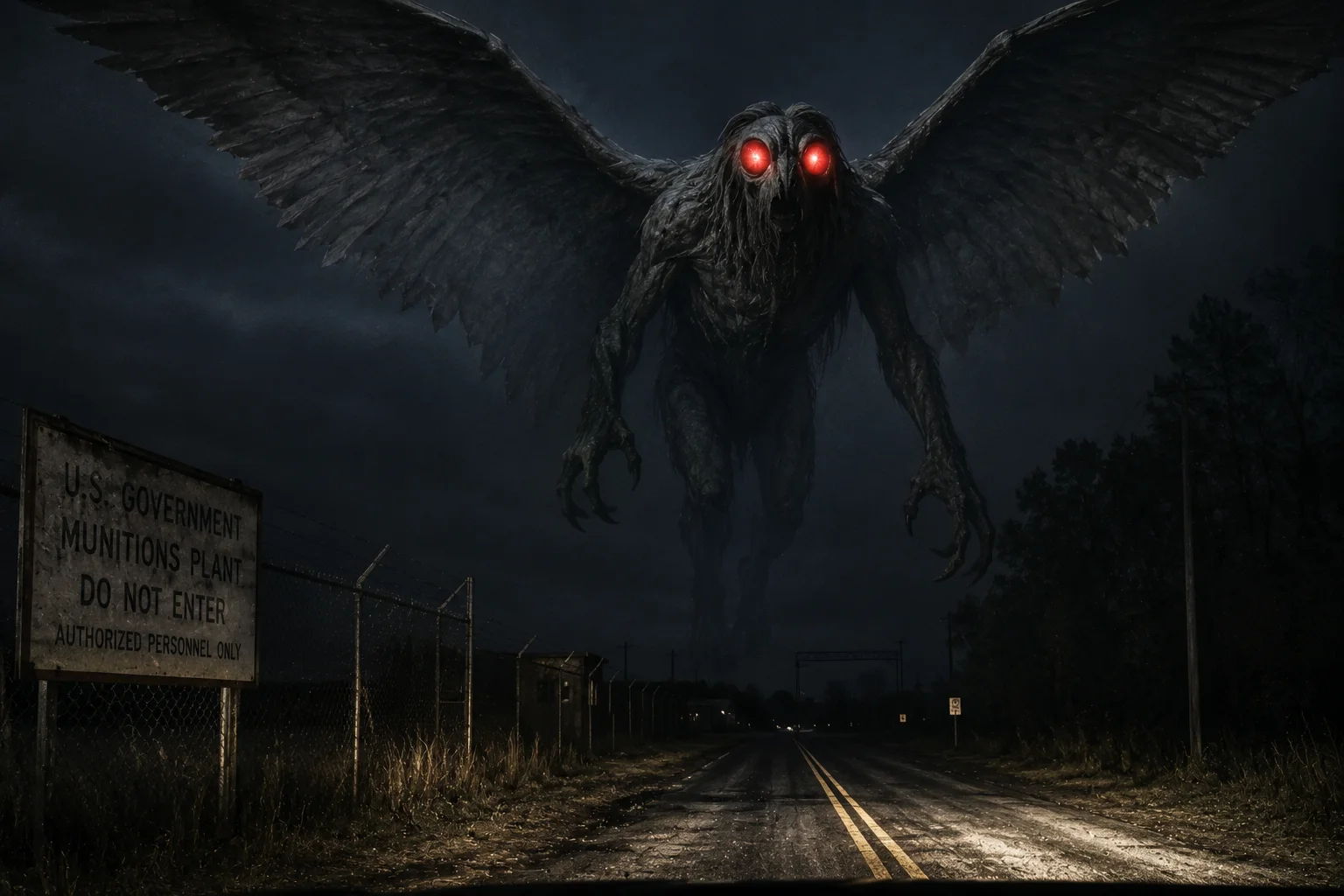
Mothman is described as a large, winged, humanoid creature — a great man-like or man-sized (or larger) creature, standing upright like a man but with great wings (large bat-like or bird-like wings), and, most strikingly, with large, glowing red eyes (the burning red eyes being the creature’s most famous and terrifying feature). It was described as grey or dark, man-shaped but winged, with the great glowing red eyes set in or above the chest or where a face would be, and as capable of flight (flying, gliding, or rising into the air on its wings, sometimes pursuing cars at high speed). The creature appeared, in the famous sightings, in and around the town of Point Pleasant, West Virginia, in 1966–67 — first reported by witnesses near an old abandoned munitions site (the “TNT area”) outside the town, and then in a wave of sightings around Point Pleasant over the following months — the winged, red-eyed creature seen flying, pursuing cars, and appearing around the town, terrifying the witnesses with its size, its wings, and above all its burning red eyes. As the winged man of Point Pleasant, the great winged humanoid with the glowing red eyes, Mothman is the eerie, terrifying winged creature of the famous West Virginia sightings.
The Sightings and the Silver Bridge
The Mothman sightings of 1966–67 around Point Pleasant became famous, and the legend of Mothman is inextricably bound up with the disaster that followed — for in December 1967, near the end of the period of the Mothman sightings, the Silver Bridge (a bridge over the Ohio River at Point Pleasant) collapsed, killing forty-six people, one of the worst bridge disasters in American history. The collapse of the Silver Bridge, coming at the end of the Mothman sightings, led to the famous legend that Mothman had been an omen or harbinger of the disaster — the winged, red-eyed creature appearing as a warning, a portent, or even a cause of the coming catastrophe, the harbinger of doom whose appearances foretold the disaster of the bridge collapse. This connection — the mysterious winged creature appearing in the months before a great disaster, and being seen, in retrospect, as its omen and harbinger — transformed Mothman from a local cryptid sighting into a famous and eerie legend of prophecy and doom, the winged harbinger of catastrophe. (The bridge collapse was, in fact, caused by a structural failure — a flawed eyebar in the bridge’s structure — and had no connection to any creature; but the legend of Mothman as the omen of the disaster endures.) As the harbinger of the Silver Bridge disaster, the winged creature whose appearances foretold the coming catastrophe, Mothman became the famous legend of the winged omen of doom.
The Legend and the Prophecies
The legend of Mothman was greatly amplified by the book The Mothman Prophecies by John Keel (and the later film based upon it), which wove together the Mothman sightings, the Silver Bridge disaster, and a range of other strange phenomena (UFO sightings, men in black, strange phone calls, prophecies, and the paranormal) into a famous and influential account of the Mothman events as part of a web of strange, paranormal, and prophetic phenomena. This account — connecting Mothman to UFOs, the paranormal, prophecies, and the strange events around Point Pleasant — transformed Mothman into a famous figure of the paranormal and the prophetic, the winged creature bound up with a web of strange phenomena and the prophecy of doom. The legend of Mothman thus grew beyond the original sightings into a famous and influential account of the paranormal, the prophetic, and the eerie, the winged harbinger connected to UFOs, the paranormal, and the prophecy of catastrophe. As the figure of The Mothman Prophecies and the legend of the paranormal and the prophetic, Mothman became one of the most famous and influential figures of modern American cryptid and paranormal lore.
The Modern Legend
Mothman has become one of the most famous and beloved of the modern American cryptids, a figure of enduring fascination, popular culture, and local pride — the town of Point Pleasant embracing its famous cryptid with a Mothman statue, a Mothman museum, and an annual Mothman Festival, the winged terror become a beloved local icon and a draw for tourists and enthusiasts. Mothman is a pervasive presence in popular culture — in books, films, television, games, and the popular imagination, where the winged, red-eyed creature is an iconic and eerie figure — and it stands among the most famous of the modern cryptids and figures of the paranormal. Skeptics have offered various explanations for the original sightings (misidentified large birds, such as a sandhill crane or a barn owl, with the red eyes being eyeshine; hoaxes; and the power of suggestion and panic), and mainstream opinion regards Mothman as a creature of misidentification, legend, and the paranormal imagination rather than a real creature; but the legend endures, beloved and famous. As the modern American legend — the winged, red-eyed terror of Point Pleasant, the harbinger of the Silver Bridge disaster, the figure of The Mothman Prophecies and the paranormal, the beloved local icon and famous cryptid — Mothman stands as one of the most famous and eerie of the modern cryptids, the winged creature of dread, prophecy, and enduring fascination.
Legacy
Mothman endures as one of the most famous and eerie of the modern American cryptids, the great winged, red-eyed humanoid creature of the famous Point Pleasant sightings of 1966–67, the harbinger of the Silver Bridge disaster, the figure of The Mothman Prophecies and the paranormal, and a beloved local icon and famous figure of popular culture, the winged terror of dread, prophecy, and fascination. As the winged terror of Point Pleasant — Mothman, the great winged humanoid with the glowing red eyes, the eerie creature of the famous West Virginia sightings, the harbinger of catastrophe and the figure of the paranormal and the prophetic — Mothman stands as one of the most famous and haunting of the modern cryptids, the winged harbinger of doom, the eerie creature of Point Pleasant, the winged terror that flew into the American imagination and never left.
The Night of 15 November 1966
It began with a car, four young people, and a road that should have been empty. On the night of 15 November 1966, two newly married couples from Point Pleasant — Roger and Linda Scarberry, Steve and Mary Mallette — drove out to the abandoned munitions works north of town, the stretch of woodland everyone locally called the TNT area. It was where you went when there was nowhere else to go. What they described seeing there, near the ruin of the old power plant, was a grey figure the size of a man or larger, shaped like a man, with wings folded flat against its back and two red discs where a face should have been. They were insistent afterwards on that last detail: they had seen no head at all, only the eyes, which Roger Scarberry compared to automobile reflectors throwing back his headlights. It did not flap so much as rise. Then it followed their car down Route 62 towards town at a speed he put at close to a hundred miles an hour.
They drove straight to the sheriff’s office. Deputy Millard Halstead took the statement and went back out with them to look; he found nothing but wind and concrete. The next day the Point Pleasant Register ran the story under a headline that remains the most honest sentence ever written about the case: “Couples See Man-Sized Bird…Creature…Something.” The entire legend that followed is already present in that exhausted final word. Something. Nobody had a category for it, so the reporting invented one on the spot.
How a Creature Got Its Name
None of the witnesses called it Mothman. The name was manufactured on a newspaper copy desk within days of the first report, and it was manufactured as a joke. In the autumn of 1966 the single most saturated image in American popular culture was a man in a cape with wings: the Batman television series had premiered that January and was, briefly, everywhere. A copy editor reaching for a headline word gave West Virginia its own winged man, and the name stuck the way nicknames stick in small towns — permanently, and against the wishes of nearly everyone involved.
It is worth pausing on what that naming accomplished, because it accomplished a great deal. A “man-sized bird” is a wildlife report; it belongs to the county extension office and the ornithology department. Mothman is a character. The instant the thing had a name with man in it, it acquired a silhouette, a personality, and the capacity to mean something — and only a creature that can mean something is capable of being a warning. The word arrived a full year before the omen did, and quietly made room for it.
The Ground It Was Seen On
The TNT area is not incidental background. It is arguably the whole story. During the Second World War the federal government built the West Virginia Ordnance Works in the flat country north of Point Pleasant, a plant that manufactured TNT on an industrial scale and stored it in scores of concrete igloos — half-buried domes, grassed over on top, scattered through the woods and linked by service roads that now go nowhere. When the war ended the plant was abandoned. Much of the land became the McClintic Wildlife Management Area: ponds, hardwood, marsh, and a protected population of birds.
So the sightings took place inside a nature reserve that is also a derelict bomb factory. The explosive residues left in the soil eventually earned the site designation as a federal Superfund clean-up area, its groundwater carrying the chemistry of a war that had ended two decades earlier. Consider what that terrain does to a person standing in it after dark: rows of man-made burial mounds containing nothing, roads that stop mid-forest, water you are told not to drink. Then consider what it does to a bird. A protected wetland astride a migratory corridor will occasionally receive a very large visitor far outside its normal range — and a bird nobody in the county has ever seen before is, functionally, not a bird at all. It is a something.
A Town That Was Already Haunted
Point Pleasant had a reputation for calamity long before 1966. It sits at the confluence of the Kanawha and the Ohio, which made it strategically valuable and therefore repeatedly violent. In 1774 it was the site of the battle that ended Lord Dunmore’s War, fought between Virginia militia and a Shawnee and Mingo force — a battle West Virginians have argued about for two centuries, some claiming it as the opening engagement of the Revolution.
Cornstalk (Hokoleskwa), the Shawnee leader who had commanded at that battle, came to Fort Randolph at Point Pleasant three years later, in 1777, to warn the garrison that his people were being driven towards a war he had tried to prevent. He was detained as a hostage. He and his son Elinipsico were then shot dead by militiamen avenging the killing of a comrade elsewhere. This is documented history rather than folklore, it was condemned as a disgrace by officials at the time, and it is remembered by the Shawnee today as a murder committed against a man who had come in peace.
The local tradition that Cornstalk laid a two-hundred-year curse on the ground appears to be a considerably later accretion; nothing in the 1777 record supports it, and the story seems to have grown in the telling across the twentieth century. But the curse is worth knowing about for one reason: when the bridge fell in 1967, a good number of people in Point Pleasant reached for Cornstalk before they reached for Mothman. The town already possessed a grammar for explaining its own misfortune. The winged creature simply arrived in time to be conjugated in it.
What John Keel Actually Argued
Keel is usually filed as a UFO writer, which he would have disputed with some heat. His central and genuinely strange position was that the extraterrestrial hypothesis — visitors from other planets in nuts-and-bolts craft — was a modern folk misreading of a phenomenon far older and far less friendly. He proposed instead what he called ultraterrestrials: intelligences native to this world, or to some adjacent register of it, which manifest in whatever costume a given century finds plausible. Fairies for one era, airship pilots for another, saucer occupants for the next. On this reading Mothman was not a new animal at all but an old visitor in contemporary dress.
He paired this with the idea of window areas — particular patches of geography that produce anomalous reports generation after generation, disproportionately and unaccountably. The Ohio valley around Point Pleasant was his exhibit A. It is a genuinely useful concept even for a sceptic, because window areas are demonstrably real as social facts: once a place acquires a reputation for strangeness, its residents look harder, report more readily, and interpret ambiguity in the direction the reputation points.
Keel spent long stretches in Point Pleasant during the flap, working closely with Mary Hyre, the local correspondent who covered the sightings for the Athens Messenger across the river in Ohio and who became, in effect, the clearing house for every witness in the county. Her death in 1970 is part of why the affair acquired its aftertaste of doom. It should also be said plainly that the 2002 film adaptation is not the book: it moves the story into the present day, invents its protagonist’s bereavement, and converts Keel’s sprawling, sceptical, faintly deranged reportage into a tidy supernatural thriller. Most people who think they know the Mothman story know the film.
The Bridge, and What the Bridge Changed
Forty-six people died on 15 December 1967, in the dark, in traffic, ten days before Christmas. That is the fact around which everything else in this article orbits, and it deserves to be stated without atmosphere.
The Silver Bridge opened in 1928 and carried US Route 35 across the Ohio River. It was not an ordinary suspension bridge. Instead of spun-wire cables it used an eyebar chain: long steel links pinned together, two links per joint, carrying the whole deck. A conventional cable contains thousands of wires, so the failure of any one of them is absorbed by the rest. An eyebar chain of that design has no such redundancy. If a single link parts, the load has nowhere to go.
That is precisely what happened. A crack formed in one eyebar, driven by corrosion working slowly on steel under sustained stress, in a location no inspector could have examined without dismantling the joint. The link failed during the evening rush. The chain unzipped, and the bridge went into the river in under a minute with more than thirty vehicles on it.
The consequence was not supernatural but it was enormous. The federal investigation that followed established that the United States had no systematic idea of the condition of its bridges, and out of it came the national bridge inspection standards that still govern how every highway bridge in the country is examined and rated. A replacement span opened downstream in 1969. If you want a genuine legacy for the events at Point Pleasant, it is this: every routine bridge inspection carried out in America since is a descendant of that evening, and an unknown number of people are alive because of it. The dead are named on a memorial in the town, a few streets from the statue of the creature.
A Prophecy Assembled Backwards
Here is the detail that the legend cannot survive contact with, and which makes it far more interesting rather than less: nobody warned anybody about the bridge.
Not one witness in the thirteen months of sightings said that the winged figure was a portent of collapse, or of anything at all. They said they were frightened. They said it was fast, that it was grey, that its eyes threw back their headlights. The prophecy is entirely retrospective. It was assembled after 15 December 1967 out of materials that had been lying around since the previous November, and it was assembled because the alternative — that forty-six people died because of an invisible flaw in a piece of metal, on an ordinary Friday, for no reason and with no notice whatever — is close to unbearable.
This is not a failing peculiar to Point Pleasant. It is the standard human method for processing catastrophe, and it operates after every earthquake, every crash, every diagnosis. The mind searches the preceding weeks for a sign it should have read, and the mind is extremely good at finding one, because the preceding weeks of any life are full of unexplained things. Mothman is what happens when a whole town performs that search simultaneously and finds the same sign. The creature’s real function is not to predict disaster. It is to make disaster narratable — to convert a random structural failure into a story with foreshadowing, and therefore into a story that can be told at all.
The Older Bird at the Window
The winged harbinger is one of the oldest fixtures in European and Mediterranean folklore, and the Mothman legend slotted into a groove worn smooth centuries before West Virginia existed. Roman writers describe the strix, a night bird of ill fortune that was said to enter houses after dark and prey on infants in their cradles — a creature whose name survives in the Romanian strigoi and in the scientific naming of owls. In the traditional English renderings of scripture, the ruined and desolate places are staffed by owls. Across a great deal of British and Irish folk tradition an owl calling at a window, or a bird entering a house, is read as a death in the family; the belief was still being reported from rural communities within living memory.
Mothman also belongs to a well-populated folkloric category: the omen-being, whose entire purpose is to appear before a death rather than to cause one. The banshee of Irish tradition wails for a family, she does not kill it. The black dog of English lanes is seen and then someone dies. The corpse candle of Welsh belief travels the road the coffin will later take. None of these are predators. They are announcements. What is remarkable about Point Pleasant is that a twentieth-century American industrial town, in the age of television and Project Blue Book, spontaneously reproduced the omen-being — and gave it a name borrowed from a superhero show.
The Company It Keeps
West Virginia had form. In September 1952, in Braxton County, a group of boys and one mother reported a towering figure with a glowing face in a hillside pasture — the Flatwoods Monster, another entity that arrived in a state of national anxiety and never quite left the state.
Mothman’s more interesting relatives are the ones that came afterwards, because they show the template being applied. In 1976, at Mawnan in Cornwall, children reported a large winged figure over a church tower; the case was promoted enthusiastically as an English answer to Mothman and named, inevitably, the Owlman. That same year the Rio Grande Valley in Texas produced a flap of “big bird” reports — sightings that arrived already braided with la lechuza, the owl-witch of Mexican and Tejano tradition, a figure still spoken of seriously in families across the borderlands and not to be mistaken for a curiosity. Older still, a rash of newspaper reports from Van Meter, Iowa, in 1903 described a winged thing with a light on its head, generations before anyone had a word for cryptid.
What these share is not a species. It is a shape the mind reaches for in the dark: upright, watching, winged, and lit at the face. The consistency is telling us something reliable about human perception, and nothing at all about zoology.
Why It Will Not Leave
Mothman has had a strange second life. It moved from local terror to civic mascot — a chrome statue, a museum, an annual September festival that fills the streets — and then, in the internet decades, into something odder still: a figure of genuine affection. Online cryptid culture adopted it as a friend rather than a threat, an outsider with wings, and the tone shifted from dread to something close to tenderness. A generation encountered it first as a creature haunting the West Virginian ruins of Fallout 76 rather than as a newspaper report. Very few monsters survive that transition. Fewer still are improved by it.
The endurance has a harder root, though. The anxiety underneath Mothman is not fear of the woods. It is the modern, specifically industrial fear that the structures we stand on are decaying invisibly and on a schedule nobody is reading. A bridge is the purest form of trust a person extends to strangers: you drive onto a thing you cannot inspect, built by people you will never meet, maintained by an authority you assume exists. In December 1967 that trust was found to be misplaced by one link out of hundreds, and forty-six people went into a winter river.
Mothman is the shape of the wish that such a flaw would announce itself — that decay would have a face and eyes and the decency to stand in the road in front of you. The creature is not a warning that was ignored. It is the warning we retroactively insist we were given, because a universe that sends omens, however terrifying, is still a universe that is paying attention. That is why the winged man of Point Pleasant will not leave. He is not haunting the town. He is consoling it.
Sources & traditions
- EncyclopediaWikipedia — Mothman
- TraditionLocal sightings, press reports and regional folklore (North America)
Myths change from area to area and from time to time. This chronicle follows the most widely told versions; tellings in other villages, regions and eras may differ.