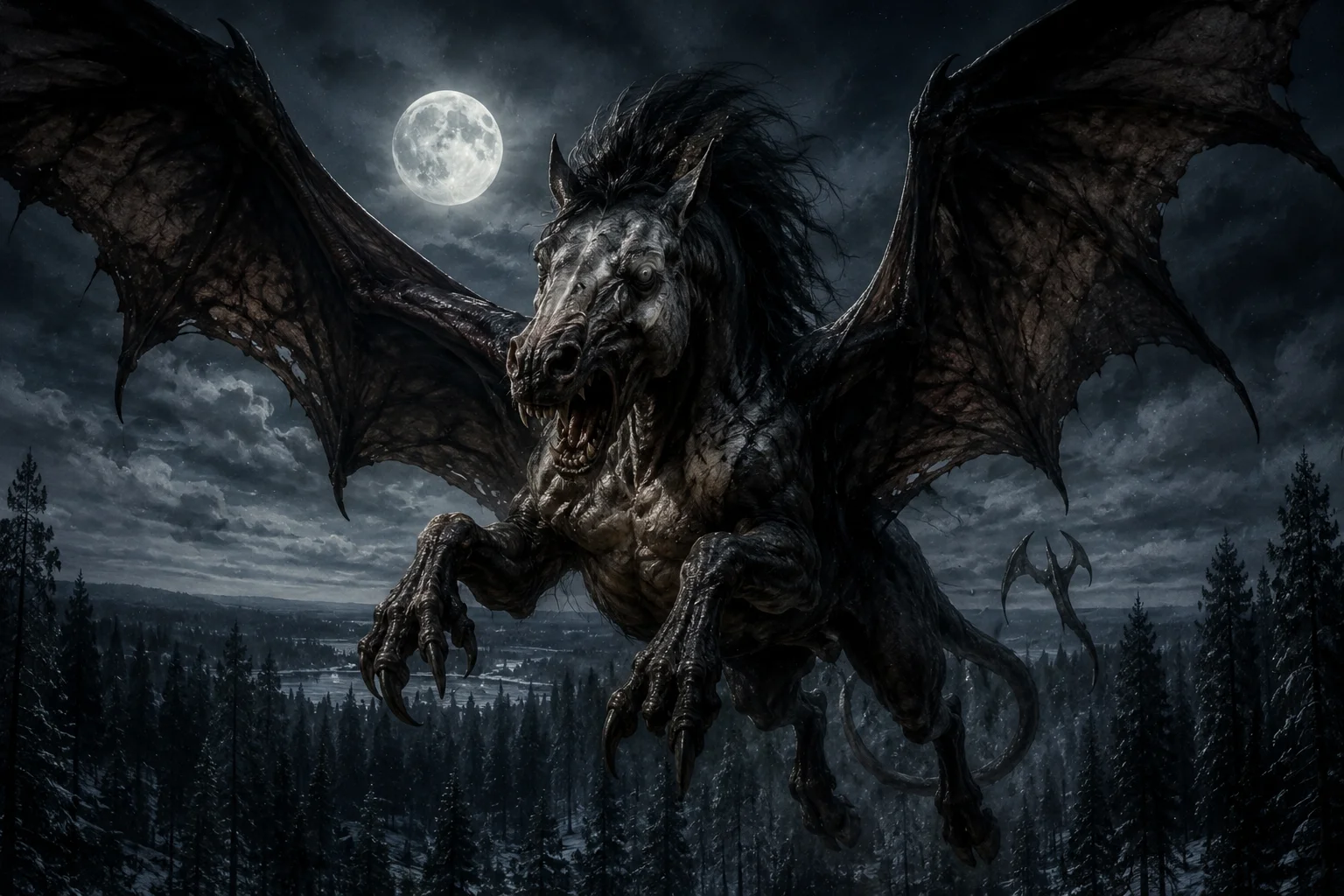
The Jersey Devil is one of the most famous cryptids in American folklore, a winged, hooved, monstrous creature said to haunt the Pine Barrens of southern New Jersey. Described with the head of a horse or a goat, leathery bat-like wings, a forked tail, and cloven hooves, it is said in legend to have been born the cursed thirteenth child of a Pine Barrens mother, transforming at birth into a devil and fleeing into the forest, where storytellers say it has dwelt ever since.
A Shape Out of the Pines
Accounts of the Jersey Devil's form vary from telling to telling, but a classic composite has taken hold over two centuries of retelling. It is usually given the head of a horse or a goat set on a long neck, leathery bat-like wings sprouting from a body sometimes described as kangaroo-like or serpentine, clawed hands or forelegs, cloven hooves, and a long, forked tail that lashes behind it in flight. It is said to move between running on all fours and taking to the air on those wide, membranous wings, letting out a piercing, unearthly cry that many accounts single out as the first sign of its presence, before the creature itself is ever seen.
Its home is given as the Pine Barrens, the vast, sparsely settled forest and wetland wilderness of southern New Jersey, a landscape of scrub pine, cedar swamp, and sandy soil that has long lent itself to stories of things half-glimpsed at the treeline. The creature is bound to that geography in a way few American cryptids are bound to theirs; it is not a wanderer of the wider countryside but a native of one particular wilderness, said to range out from the Pines only rarely, and even then not far.
Mother Leeds and the Thirteenth Child
The creature's origin is fixed, in the most widely told version of the legend, to a single figure: a Pine Barrens woman remembered as Mother Leeds. She is said to have already borne twelve children when she found herself pregnant with a thirteenth, and in her exhaustion and despair to have cried out that this child might as well be the Devil himself. The birth that followed, in the telling, honored the curse to the letter. The child is said to have come into the world looking ordinary, only to transform almost at once into a creature with hooves, a goat-like or horse-like head, bat wings, a forked tail, and claws. It let out a scream, the story goes, and flew up the chimney and out into the Pine Barrens, never to return as anything but a shadow glimpsed by lantern light or a cry heard across the marsh.
Local telling most often places this birth in Leeds Point, a small settlement on the edge of the Pine Barrens, and dates it to 1735, though the year shifts depending on who is telling the story and when. What stays constant across versions is the shape of the tale itself: a mother's curse, a child born whole and transformed within moments, and a single, sudden flight into the wilderness that swallows the creature for good.
The Name Behind the Name
The Leeds surname attached to the legend is not an invention of folklore alone. It ties to a real historical figure, Daniel Leeds, a colonial almanac publisher whose almanacs carried astrological and occult symbolism, including a dragon-like crest that later generations may have folded into the image of a monstrous offspring. One scholarly account, advanced by the historian Brian Regal, holds that the legend as we know it grew out of a political and religious feud between Daniel Leeds and Quaker leaders of his day, among them Benjamin Franklin, who mocked the Leeds family in print. On this reading, the Jersey Devil began less as a creature of the woods than as a piece of character assassination that outlived the argument that produced it, taking on a life of its own once it passed into oral tradition. It remains a documented hypothesis rather than a settled fact, but it offers a rare case where a monster legend can be traced, at least in part, back to a real family name and a real quarrel in print.
For a long stretch of its history the creature was not called the Jersey Devil at all. Pine Barrens tradition knew it as the Leeds Devil, a name that endured in oral and regional storytelling long before the twentieth century settled on Jersey Devil as the standard form. The older name is sometimes still used by those who trace the story back to its Leeds Point roots, and the creature is occasionally called, informally, the Devil of the Pine Barrens.
A Cannonball and a Commodore
Among the older anecdotes attached to the legend is a story involving Commodore Stephen Decatur, the naval officer, who is said to have fired a cannonball directly at the creature while testing ordnance at the Hanover Mill Works foundry, only to see the shot pass through it without effect. The tale is one of the most frequently repeated pieces of Jersey Devil lore, but it rests on a single, anecdotal telling rather than any independent corroboration, and it belongs to the same oral tradition that carried the Mother Leeds story forward rather than to any documented record of the event.
A second early anecdote places Joseph Bonaparte, brother of Napoleon Bonaparte, at the edge of the legend. Living in exile at Bordentown, New Jersey, Joseph is said to have witnessed the creature himself while out hunting. Like the Decatur story, this account circulates as popular legend in a single-source style, repeated often enough to have become part of the standard telling without ever being verified beyond the telling itself. Together, the two anecdotes show how the Jersey Devil legend gathered notable regional figures to itself over the eighteenth and nineteenth centuries, using their names to lend the story a weight that oral tradition alone could not supply.
The Phenomenal Week
The Jersey Devil's most famous chapter unfolded in a single week in January 1909, an episode still remembered as the Phenomenal Week. Over the course of about seven days, hundreds of sightings were reported across South Jersey and into neighboring Pennsylvania and Delaware. Strange tracks turned up in the snow, livestock and property were disturbed, and the creature itself was reported flying and prowling by numerous witnesses. Contemporary newspapers in Philadelphia and Trenton gave the wave of sightings extensive coverage, and the reporting fed a genuine regional panic: schools and factories in affected areas closed as the story spread, and for a brief span the Jersey Devil was less a folk legend than a matter of immediate, anxious public attention across three states.
The scale of the 1909 episode is what separates the Jersey Devil from most regional cryptids. It is not simply a story handed down through generations of Pine Barrens residents; it is a documented public event, recorded in the newspapers of the day, with a describable beginning, a describable geography, and a describable end, even if the creature at its center remains as unverified as ever.
A Kangaroo in a Museum Window
The panic of 1909 was not left to run its course untouched by commerce. A group of Philadelphia businessmen offered a reward, commonly cited at ten thousand dollars though the figure is unverified and appears to have been more promotional than binding, for the capture of the creature. Into that charged atmosphere stepped Norman Jefferies, who exhibited a hoaxed "Jersey Devil" at the Ninth and Arch Museum in Philadelphia: a kangaroo fitted with fake wings and claws, presented to paying crowds as the genuine article. The stunt is now well documented as a hoax, one of the clearer instances in American folklore of an entrepreneur manufacturing physical "proof" of a legend already primed by press coverage and public fear to accept almost anything offered to it.
What the Skeptics Propose
Historians and cryptozoology commentators who have examined the 1909 panic and the wider legend have offered a handful of naturalistic explanations rather than a single one. Sandhill cranes, rare in the area and startling in flight and call, are frequently proposed as a likely source for at least some sightings, their long necks, harsh cries, and broad wingspans matching pieces of the classic description more closely than any known native animal. Escaped kangaroos are floated as another possible source, particularly given the Jefferies hoax's choice of animal, which suggests the idea of a kangaroo-shaped mystery beast was already circulating. Beyond any single animal, mass hysteria and simple hoax reporting are cited as major contributors to the scale of the 1909 wave, with competing Philadelphia and Trenton newspapers driving coverage that encouraged further sightings even as it reported on the ones already claimed.
A Legend Among the Pine Barrens' Own
The Jersey Devil is often invoked in the same breath as other Pine Barrens folklore, most notably the region's ghost lights, phenomena said to hover and drift through the same cedar swamps and pine flats that the Devil is said to haunt. The two traditions share a landscape and a habit of being mentioned together in regional storytelling, but they are not merged legends; the Jersey Devil's origin in Mother Leeds and its documented 1909 panic stand apart from the separate tradition of the lights, and the two are traditionally kept distinct even as they are traded back and forth in the same conversations about the Pines after dark.
From Folk Tale to Franchise Name
Few American cryptids have crossed as fully into mainstream cultural life as the Jersey Devil. The clearest marker of that crossing came in 1982, when the National Hockey League's New Jersey Devils were founded and named directly after the legend, giving the creature a permanent place in the state's sporting identity alongside its older place in Pine Barrens folklore. The legend has also appeared repeatedly in American paranormal television, including programs such as MonsterQuest and Lost Tapes, and it remains a fixture of regional tourism and Halloween season programming throughout New Jersey, where it functions less as a source of fear than as a piece of shared local identity.
Footprints That Keep Returning
Sightings of the Jersey Devil have never fully stopped since 1909. Isolated local reports have surfaced intermittently through the twentieth and twenty-first centuries, scattered across the decades rather than clustered into anything resembling the scale of the Phenomenal Week. None of these later reports has produced anything close to the documented breadth of the 1909 panic, and nearly all remain anecdotal, unverified, and confined to the same Pine Barrens region the legend has always called home. That pattern, a steady trickle of small, unconfirmed claims against the single towering exception of 1909, is itself part of what has kept the legend alive, offering just enough fresh material each generation to renew a story otherwise two and a half centuries old.
What Endures in the Pines
Across the shifting details of its many tellings, the Jersey Devil has held its essential shape: a winged, hooved, horse- or goat-headed creature born of a mother's curse, first known as the Leeds Devil and later fixed in the public mind by a single extraordinary week of sightings in January 1909. It survives today as one of the oldest and most recognizable cryptids in American folklore, claimed as a piece of regional identity by the very state whose wilderness it is said to still call home, carried forward equally by campfire retellings, newspaper archives, a hockey team's name, and the occasional fresh report from the edge of the Pine Barrens.
Sources & traditions
- EncyclopediaWikipedia — Jersey Devil
- TraditionLocal sightings, press reports and regional folklore (North America)
Myths change from area to area and from time to time. This chronicle follows the most widely told versions; tellings in other villages, regions and eras may differ.