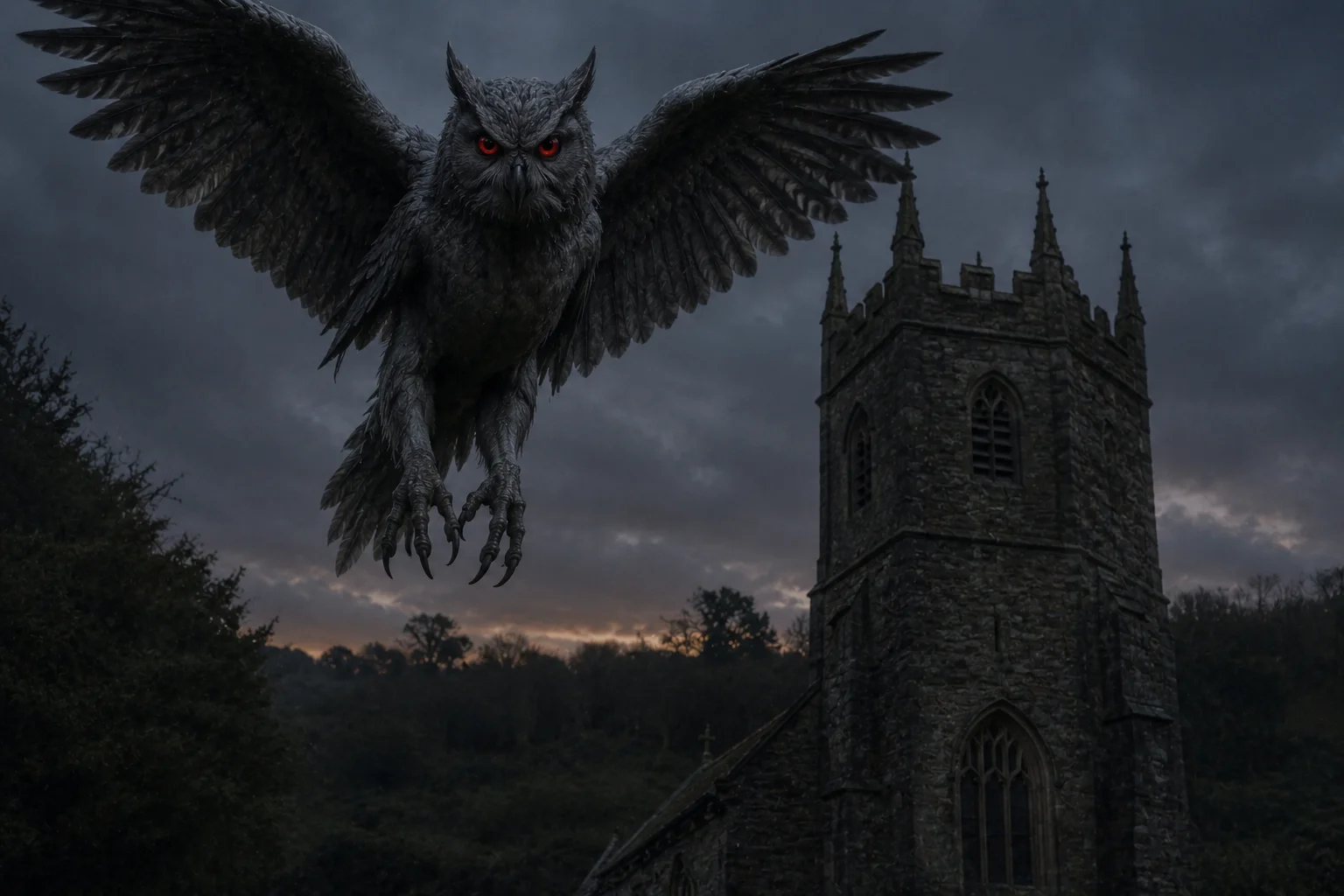
The Owlman (or the Owlman of Mawnan) is an English cryptid — a large, winged, owl-like humanoid creature said to have been sighted around the village of Mawnan in Cornwall, England, in the 1970s, often described as a giant owl-like or man-owl creature with glowing eyes, pointed ears, and clawed feet, the English counterpart of America’s Mothman. The winged owl-creature of Cornwall, the man-owl of Mawnan, the Owlman is England’s famous winged cryptid, the owl-like terror of the Cornish woods.
The Owl-Man of Mawnan
The Owlman is described as a large, winged, owl-like humanoid creature — a great man-sized creature with the features of a giant owl: a large owl-like or man-owl body, large wings, glowing or red eyes, pointed or feathered ears, clawed or pincer-like feet or talons, and a covering of feathers or grey fur — a giant owl-man, a winged owl-like humanoid. It was reported around the village of Mawnan in Cornwall, England — especially around the old church of Mawnan and the wooded area nearby — in a series of sightings beginning in 1976 (with the first famous sighting reported by two young girls who saw a great winged creature hovering over the church tower) and continuing in further sightings over the following years. The creature was seen flying, hovering, perching in trees, and appearing in the woods around Mawnan, terrifying the witnesses (often young people) with its great size, its wings, its owl-like features, and its glowing eyes. As the owl-man of Mawnan, the great winged owl-like humanoid of the Cornish woods, the Owlman is the eerie winged creature of the famous Mawnan sightings.
The English Mothman
The Owlman is often compared to, and called the English counterpart of, America’s famous Mothman — for both are large, winged, humanoid creatures with glowing red eyes, appearing in waves of sightings and terrifying their witnesses, the winged man-creatures of cryptid lore. The Owlman, like Mothman, is a great winged humanoid with glowing eyes, appearing in a famous wave of sightings (the Owlman around Mawnan in Cornwall, Mothman around Point Pleasant in West Virginia), the winged terror of the woods. The comparison — the Owlman as the English Mothman, the two winged, glowing-eyed humanoid creatures of English and American cryptid lore — is often drawn, the Owlman being England’s famous winged cryptid as Mothman is America’s. As the English Mothman, the winged, glowing-eyed humanoid creature of the Cornish woods, the Owlman is the English counterpart of America’s famous winged cryptid, the winged owl-creature of England.
The Cornish Legend
The Owlman became a famous figure of English and Cornish cryptid lore, the winged creature of Mawnan and the Cornish woods. The Owlman sightings of the 1970s — and later reported sightings — brought the creature to fame as England’s winged cryptid, the owl-man of Cornwall, a famous figure of cryptid lore and the popular imagination. The legend is associated with the eerie, wooded, ancient landscape around Mawnan — the old church, the woods, the Cornish countryside with its deep folklore and eerie atmosphere — the perfect setting for the legend of the winged owl-creature. Skeptics have offered various explanations — misidentifications of large owls (such as the eagle owl, a large owl that can appear startling and owl-man-like, especially to frightened witnesses), hoaxes, and the power of suggestion and legend (some suspecting the whole affair to be a hoax or a piece of deliberate myth-making by those involved in its promotion) — and the reality of the Owlman is much doubted; but the legend endures as England’s famous winged cryptid. As the Cornish legend — the winged owl-creature of Mawnan, England’s famous winged cryptid, the owl-man of the Cornish woods — the Owlman is the eerie winged creature of English cryptid lore, the man-owl of Cornwall.
The Winged Cryptid
The Owlman belongs to the family of winged humanoid cryptids — the large, winged, man-like creatures with glowing eyes reported around the world, of which Mothman is the most famous, and which include the Owlman of Cornwall, the Mothman of West Virginia, and the various winged humanoid creatures of cryptid lore (and which connect, more broadly, to the winged beings, bird-men, and winged terrors of folklore and myth around the world). The Owlman is the English, owl-like member of this family — the winged owl-humanoid of Cornwall, distinguished by its owl-like features (the owl-man as opposed to the moth-man), the English winged cryptid. As the winged cryptid, the owl-like winged humanoid of England, the Owlman is one of the famous winged humanoid creatures of cryptid lore, the man-owl of Cornwall, the English counterpart of Mothman, the winged owl-creature of the Cornish woods. As the winged owl-creature of Cornwall — the Owlman, the great winged owl-like humanoid of Mawnan, the English Mothman, the winged cryptid of the Cornish woods — the Owlman stands as England’s famous winged cryptid.
Legacy
The Owlman endures as England’s famous winged cryptid, the large, winged, owl-like humanoid creature of the Mawnan sightings of the 1970s in Cornwall, the English counterpart of America’s Mothman, a famous figure of English and Cornish cryptid lore and the popular imagination, the winged owl-creature of the Cornish woods. As the man-owl of Mawnan — the Owlman, the great winged owl-like humanoid of Cornwall, the English Mothman, the winged cryptid of the Cornish woods — the Owlman stands as one of the famous winged humanoid cryptids of the world and England’s most famous winged cryptid, the eerie owl-man of Cornwall, the winged terror of the Mawnan woods.
From a Frightened Family to a Famous Case
What turned a single fright into a legend was not a photograph — none has ever surfaced, in fifty years of retelling — but a child’s drawing. The first reported encounter came on 17 April 1976, when June and Vicky Melling, aged twelve and nine and on holiday in Cornwall with their family, said they had seen a great winged shape hovering above the tower of Mawnan church. Their father, Don, cut the holiday short by three days and would not allow either girl to be interviewed. What left the family instead was a sketch June had made of the thing she saw, and it was that sketch, rather than any statement from the witnesses themselves, which carried the story outward. The setting did the rest of the work: a low granite church ringed by trees on a wooded headland above the Helford estuary, the kind of place a story attaches to and does not let go. On 3 July 1976 two fourteen-year-olds, Sally Chapman and Barbara Perry, camping in the woods nearby, reported a similar creature; asked to draw it separately, they produced images alike enough to satisfy the man collecting them. Further reports followed in 1978 and 1979, and at intervals into the 1980s and 1990s. Not one produced physical evidence. Every account, first to last, rests on testimony and on pictures drawn afterwards from memory.
Doc Shiels and the Shadow of Showmanship
No honest account of the Owlman omits the man who named it. Tony “Doc” Shiels — a painter, stage magician and self-styled wizard living at Ponsanooth, a few miles from Mawnan — was the figure to whom the Melling drawing was brought, the one who coined the creature’s name, and the one who carried it to the press. He was not a neutral recipient. In that same year he was staging theatrical “monster-raising” rituals for photographers on the Cornish coast, invoking Morgawr, the sea serpent said to haunt Falmouth Bay, and reaping the national coverage that followed. The year after Mawnan he produced a photograph purporting to show the Loch Ness Monster — an image of such implausible clarity, and so conspicuously free of any disturbance in the water around that long neck, that sceptics christened it the Loch Ness Muppet. That a working illusionist with a professional stake in monsters should stand behind Britain’s best-known winged cryptid is why Mawnan is treated as a case study in how a legend can be shaped as much by its promoter as by its witnesses. Sceptics have pressed the point harder, observing that the early witnesses were either Shiels himself or people with some connection to him; even investigators sympathetic to the case, among them Jonathan Downes, have conceded that Shiels could simply have invented it, while maintaining that later witnesses had no link to him at all. None of this proves the Melling girls saw nothing, or that their fear was anything but genuine. It does mean that the Owlman which reached the public was never folklore passed quietly from mouth to mouth. From its first months, it had a press agent.
Older Wings: The Owl as Omen
Long before Cornwall had a name for its winged terror, Europe already dreaded the owl. The Romans told of the strix, a screech-owl said to turn by night into a blood-drinking horror that preyed on sleeping infants. Ovid set the belief down in his Fasti, describing the rites performed over a threatened cradle: the doorposts struck three times with a branch, the threshold sprinkled with water, and a spray of whitethorn set in the window to keep the creature out. In Wales, the Fourth Branch of the Mabinogi tells how Blodeuwedd — a woman conjured out of oak blossom, broom and meadowsweet to be a hero’s bride — betrayed her husband and was overtaken by the magician Gwydion, who struck her with his wand and made her an owl, condemned never to show her face in daylight and to be set upon by every other bird that saw her. English rural belief carried the same current into living memory: an owl calling near a sickroom, or screeching over a house at night, was long read as a sign that death was coming for someone inside. Set against that inheritance, the fear that met a hovering shape on a church tower in 1976 was not a new fear at all. It was one of the oldest in the European repertoire, simply given claws and a human outline.
The Other Owl: Athena’s Bird
Curiously, the same creature that haunted Rome and rural England was, to the Greeks, a mark of favour rather than dread. The little owl, Athene noctua, was sacred to Athena, and appeared on Athenian silver in such quantities that the coins themselves were nicknamed “owls” across the ancient Mediterranean. Plutarch, in his life of Themistocles, records that as the Athenian commander argued for battle an owl flew through the fleet from the right and settled in the rigging — a sight the men read as the goddess’s blessing, and which helped decide them for the fight at Salamis. The split is instructive: the same bird, the same silent flight and forward-facing stare, read in opposite directions by two civilisations on either side of the same sea. The Owlman descends from the darker lineage. Nothing in its lore has ever reached for Athena’s calm authority.
Why the Owl Wears a Human Face
There is a reason owls unsettle people in a way hawks and crows do not, and it has little to do with folklore. Owls are among the very few birds with forward-facing eyes set into a flat, disc-shaped face — the same basic arrangement that makes a face read as a face to the human brain. Add a head that can rotate through roughly two hundred and seventy degrees, feathers structured for near-silent flight, and a nocturnal habit that ensures most human encounters happen exactly when the mind is primed to imagine the worst, and the ingredients for a monster are already sitting in the hedgerow before any legend touches them. It is worth adding that a barn owl on a church tower is not an exotic sight but an ordinary one, and that a Eurasian eagle owl — a bird whose wingspan can approach six feet — is easily large enough to astonish anyone who meets one unprepared in failing light. The Owlman completes what nature had already half-built: take a creature with an almost-human face, scale it to the size and wingspan of a man, and the small uncanny jolt that unsettles a night walker who glimpses an owl on a fence-post becomes, at Mawnan, a fully formed monster.
A Creature of Its Decade
The Owlman did not appear in isolation. The late 1970s and the 1980s produced a wave of British mystery-animal reports — phantom big cats prowling the moors chief among them — and Cornwall itself would give England the Beast of Bodmin Moor, whose sightings gathered from the late 1970s onward and burst into national news in the following decade. Seen against that backdrop, the Owlman looks less like an isolated apparition and more like one especially vivid entry in a national mood: a country hungry, in the television age, for home-grown monsters of its own. That hunger may be the truest thing the case reveals. The woods around Mawnan did not need to hide anything unusual for the legend to take hold. They only needed to be dark, old and Cornish, at exactly the moment enough people wanted something to be watching from the trees.
Sources & traditions
- EncyclopediaWikipedia — Owlman
- TraditionLocal sightings, press reports and regional folklore (England)
Myths change from area to area and from time to time. This chronicle follows the most widely told versions; tellings in other villages, regions and eras may differ.