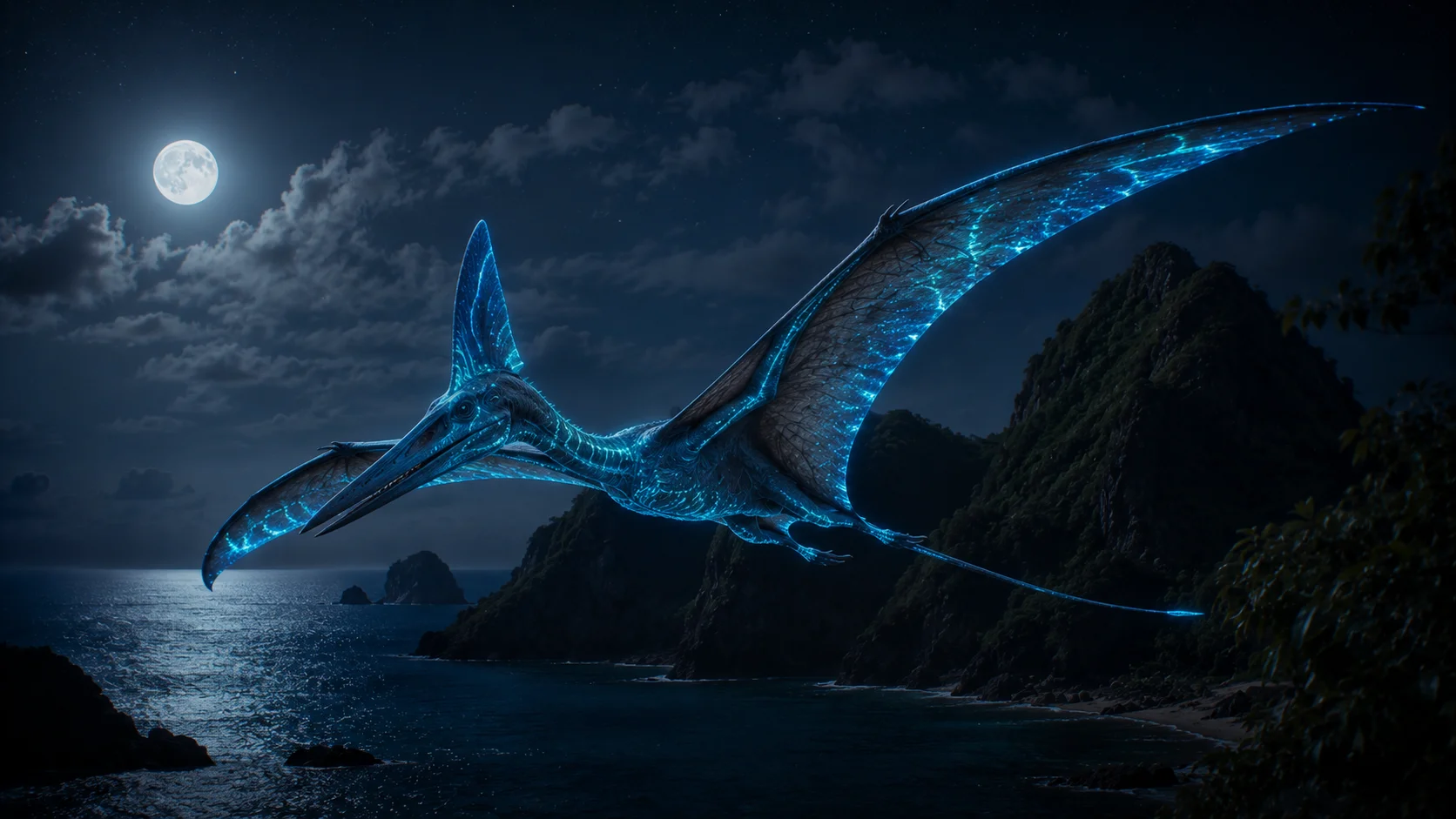
The Ropen is a cryptid reported from Papua New Guinea, particularly around Umboi Island and the neighboring Siasi Island group, described by local islanders as a large flying creature resembling a pterosaur, with leathery wings, a long tail ending in a diamond- or vane-shaped flap, and a body said to glow at night. Its fame outside Papua New Guinea rests almost entirely on the work of Western cryptozoology investigators, chief among them the American creationist researcher Jonathan Whitcomb, who from the early 2000s onward gathered islander testimony and presented the ropen as evidence that pterosaurs might have survived into the present day. No specimen, bone, or verified photograph has ever been produced.
A Name Carried Only by Testimony
The word "ropen" is drawn from the Umboi Island term used by Kovai-speaking islanders, but its precise meaning is not settled. Translations offered for the name come from the cryptozoology investigators who collected it in the field, not from professional linguists, and different accounts have rendered it differently. Because no independent linguistic survey has confirmed a single, agreed etymology, the origin of the word itself has to be treated as disputed and resting on a single line of sourcing — the investigators' own transcriptions of what islanders told them, rather than a documented, cross-checked record of Kovai vocabulary.
Wings Over the Reef and the Mountain
The creature described in islander accounts is large and airborne, built along lines that Western investigators have consistently likened to a pterosaur: membranous wings rather than feathers, a long tail, and — in many tellings — a distinctive flap or vane at the tail's end shaped like a diamond. Sightings are placed over Umboi's interior mountains and along the coastline near Drecords Reef, with witnesses describing a shape crossing the night sky and, in a number of accounts, a light accompanying it. The geography is consistently Umboi and the nearby Siasi Islands; the ropen is not a figure reported broadly across Papua New Guinea but one anchored to this particular corner of it.
A Glow With No Explanation Offered
Among the most distinctive elements of the local testimony is bioluminescence: witnesses describe the ropen as emitting a glow from its body or from its tail as it flies at night. Investigators have connected this detail to separate, longstanding reports of unexplained lights seen over Umboi's reef and mountain areas, suggesting the two phenomena might be the same thing seen from different vantage points. This connection, like the sightings themselves, rests entirely on witness testimony — no instrument has recorded the light, and no explanation for a bioluminescent flying vertebrate has been offered from within biology. It remains a claim carried by the people who say they saw it, and by the investigators who wrote down what they said.
The Graveyard Association
A recurring and specific motif in the collected local lore ties the ropen to graveyards and to corpse-eating behavior, with islanders reportedly describing the creature as drawn to the smell of decaying bodies. This is not a peripheral detail invented for atmosphere; it appears repeatedly across the testimony gathered on Umboi and gives the ropen a concrete, practical danger in local understanding — a nocturnal animal associated with the dead, to be avoided rather than revered. It is worth being precise about what kind of claim this is: it is a piece of reported local belief about the creature's habits, not a documented behavioral observation, and it should be read and repeated as testimony rather than established fact.
Duane Hoffman's Night Sighting
One of the individual cases most often cited in the ropen literature involves Duane Hoffman, a missionary and teacher, whose 1994 account describes encountering the creature at night on Umboi. Alongside Hoffman's report, Whitcomb's later fieldwork compiled statements from Umboi residents including Gideon Koro, who likewise described a ropen flying over the island after dark accompanied by a light. These names recur through the popularized ropen literature as its most frequently cited primary witnesses, and their accounts form much of the evidentiary backbone that later writing built upon — evidentiary in the sense of testimony collected and published, not evidentiary in the sense of physical proof.
Searches That Found Nothing to Hold
The ropen has not gone uninvestigated on the ground. Garth Guessman, among other researchers, conducted on-site expeditions to Umboi Island, including a documented search in 2004, specifically intending to locate physical evidence of the creature. These searches did not produce a body, a bone, a verified photograph, or any other physical trace. What survives from this on-site work is testimony gathered from islanders and the investigators' own field notes and impressions — not specimens, and not imagery that has withstood scrutiny. The absence of physical evidence after targeted, on-the-ground searching is itself part of the ropen's documented history, not a gap in it.
A Case Built for an Argument
The ropen occupies a particular and unusual place within cryptid literature because of who has most enthusiastically promoted it: young-earth creationist writers, who have invoked reports of the ropen and similar "living pterosaur" cryptids as purported evidence that pterosaurs did not go extinct at the end of the Mesozoic but persisted into the present. This is an explicitly advocacy-driven interpretation, developed to serve an argument against the mainstream scientific timeline, rather than a conclusion arrived at independently through zoological or paleontological method. It should be identified as such wherever it appears, because the ropen's popularization is inseparable from this specific motive.
Where the Mainstream Declines to Follow
Neither mainstream cryptozoology nor mainstream zoology accepts the living-pterosaur interpretation of the ropen. Even within the broader, already-marginal field of cryptid research, the ropen's creationist framing is treated as a fringe position rather than a representative one. No scientific body, museum, or peer-reviewed biological description has ever addressed the ropen as a real organism, because there has never been physical material for such a description to be based on. The entirety of the evidentiary record consists of anecdotal witness testimony gathered by amateur investigators — a record that can be reported faithfully, but that carries no scientific weight of its own.
Names That May or May Not Be the Same Animal
Popular cryptid media has sometimes folded the ropen together with other reported "flying dinosaur" cryptids from Papua New Guinea, such as the duwas and the seklo-bali, treating all three as different names for one creature. The investigators who documented these names describe the situation more cautiously: duwas and seklo-bali may represent distinct local terms or regional variants rather than confirmed synonyms for the ropen. Any equivalence drawn between them is unverified, and collapsing them into a single figure overstates what the fieldwork actually established. Each name belongs, at most, to its own local reporting tradition until shown otherwise.
A Predator, Not a Legend of the Old Kind
Within the testimony collected on Umboi, the ropen does not function as a deity, a spirit, or a symbolic figure in the way many mythological creatures do. It is described and treated by islanders as a real, physically present nocturnal animal — one to be feared and avoided, and one that serves, in local explanatory terms, to account for unexplained lights and for disturbances at grave sites. Its role is closer to that of a cryptid explanatory-legend than a classical myth: a named answer to specific, recurring, unexplained experiences, rather than a figure carrying moral or cosmological weight.
From Umboi's Coast to American Television
The ropen's move from local island testimony to international recognition happened through a specific and traceable channel: the visits and published fieldwork of Whitcomb and associated investigators beginning in the early 2000s, followed by increasing attention in American cryptozoology television and creationist literature from the mid-2000s onward, including segments tied to so-called "Live Pterosaurs" expeditions. That popularization has not been matched by any corresponding interest from mainstream herpetological or paleontological literature, where the ropen receives little to no attention beyond occasional dismissal — most commonly as a misidentification of large fruit bats or flying foxes, animals genuinely native to the region and large enough to account for a startling night silhouette.
What the Evidence Actually Amounts To
Stripped to what can be verified, the ropen's record consists of a cluster of islander testimonies centered on Umboi and the Siasi Islands, a handful of named individual accounts including Hoffman's and those compiled from Koro and other residents, targeted expeditions that found no physical trace, and a Western popularization driven substantially by an advocacy interest in defending a living-pterosaur claim against mainstream science. Every distinctive detail — the bioluminescence, the graveyard association, the diamond-tipped tail — comes from witness description rather than physical specimen. The ropen persists in cryptid discussion not because the evidence for it has grown stronger, but because the testimony behind it has been carefully collected, repeatedly retold, and consistently unaccompanied by anything a laboratory or a museum could examine.
Sources & traditions
- TraditionLocal sightings, press reports and regional folklore (Papua New Guinea)
Myths change from area to area and from time to time. This chronicle follows the most widely told versions; tellings in other villages, regions and eras may differ.