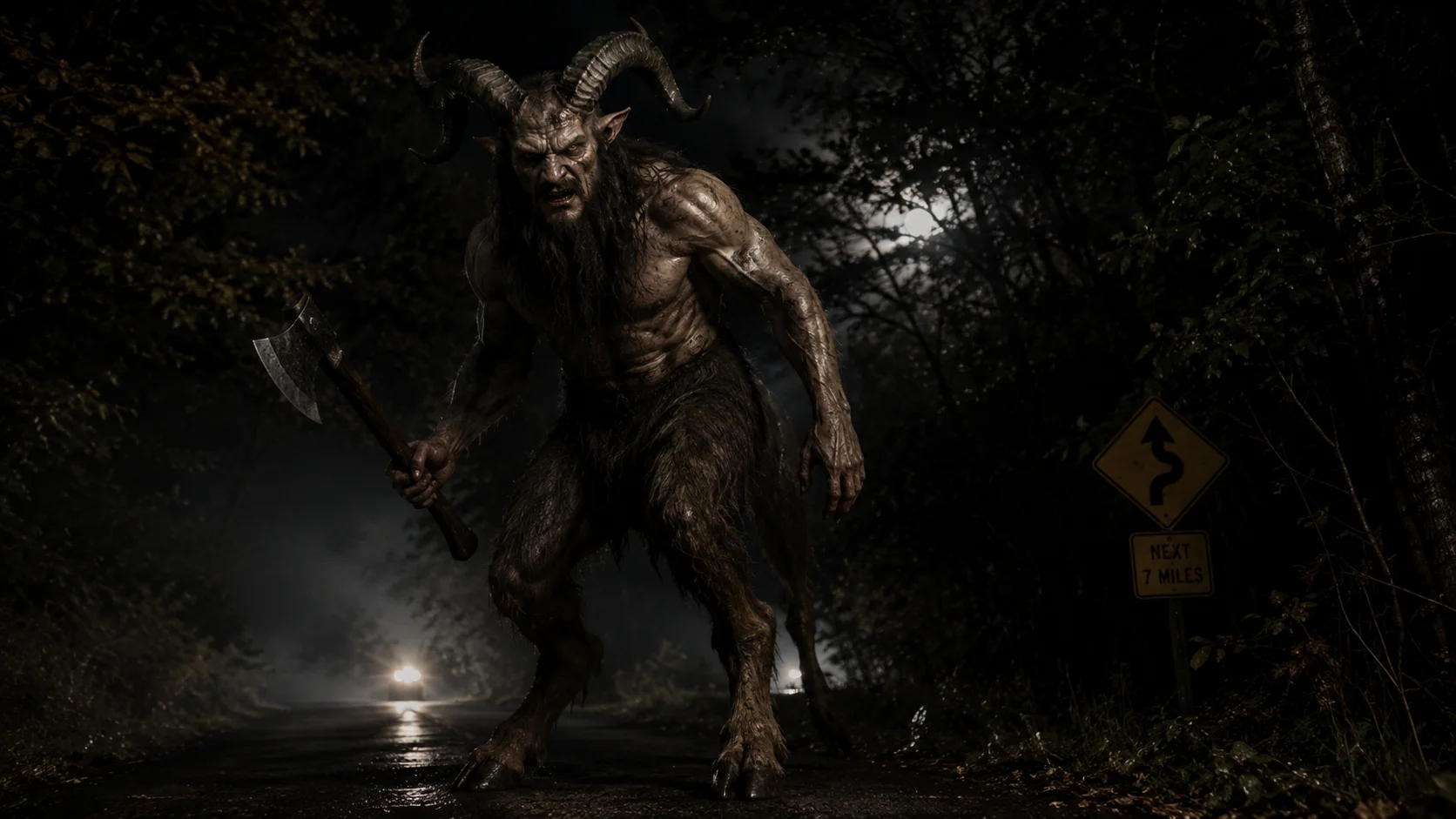
The Goatman is an American cryptid and figure of urban legend — a monstrous half-man, half-goat creature (a horned, hooved, hairy humanoid with the features of a goat), said to haunt the woods, back roads, and lonely places of various parts of the United States, especially Maryland and Texas, attacking cars, animals, and the unwary. The horned half-goat man of American legend, the hooved humanoid terror of the back roads, the Goatman is one of the famous American cryptids and urban legends, the goat-headed monster of the lonely places.
The Half-Man, Half-Goat
The Goatman is described as a monstrous half-man, half-goat creature — a hairy, humanoid creature with the features of a goat: a goat-like or horned head (with horns), hooved feet or goat legs, a hairy body, and a generally goat-man or satyr-like appearance, sometimes wielding an axe — a horned, hooved, hairy half-goat man. It is said to haunt the woods, back roads, bridges, and lonely places of various parts of the United States — especially Maryland (the Maryland Goatman, the most famous, said to haunt the woods and back roads of Prince George’s County and beyond) and Texas (the Lake Worth Monster or Goatman of Texas), as well as other regions — the goat-man of the back roads and lonely places. As the half-man, half-goat, the horned, hooved, hairy humanoid of the back roads, the Goatman is the goat-headed monster of the American lonely places.
The Legends of the Goatman
The Goatman is the subject of various legends and origin-stories across the regions where it is reported. In the Maryland legend, the Goatman is variously said to be the result of a scientific experiment gone wrong (a scientist experimenting on goats who became, or created, the goat-man, the experiment-gone-wrong origin), or a hermit or a madman who haunts the woods, or simply a monstrous creature of the woods and back roads. The Goatman is said to attack cars (leaping out, striking cars with an axe, the axe-wielding Goatman attacking vehicles on the back roads), to kill animals and pets, to haunt “lovers’ lanes” and lonely back roads (a classic figure of the “teenagers parking on a lonely road” urban legend), and to terrify the unwary. These legends — the experiment-gone-wrong origin, the axe-wielding attacks on cars, the haunting of the lovers’ lanes and back roads — make the Goatman a classic figure of American urban legend as well as a cryptid, the horned half-goat man of the scary stories and the lonely roads. As the subject of the legends of the Goatman, the figure of the experiment-gone-wrong, the axe-wielding attacks, and the lovers’-lane terror, the Goatman is the famous half-goat monster of American urban legend.
The Goat-Man of Legend and Cryptid Lore
The Goatman is both a cryptid and a figure of urban legend, bridging the two — a reported creature (the half-goat man seen and encountered in the woods and back roads) and a figure of urban legend and scary story (the axe-wielding goat-man of the lovers’ lanes and the experiment-gone-wrong). It belongs, more broadly, to the ancient and worldwide tradition of the goat-man, satyr, and horned half-man — the half-goat, half-man beings of folklore and myth around the world (the Greek satyrs and Pan, the fauns of Rome, the horned and goat-legged beings of folklore, and the Devil himself, often depicted with goat-like horns and hooves), the goat-man being a deep and ancient figure of the human imagination. The American Goatman draws, in part, on this deep tradition of the goat-man and the horned half-man, the half-goat being of folklore and myth, made into a modern American cryptid and urban legend. Skeptics explain the Goatman as a creature of urban legend, scary story, hoax, and misidentification rather than a real creature; but the legend endures, famous and frightening. As the goat-man of legend and cryptid lore, the half-goat monster of American urban legend and cryptid lore, drawing on the ancient tradition of the goat-man, the Goatman is the horned half-goat man of the American lonely places. As the half-man, half-goat of American legend — the Goatman, the horned, hooved, axe-wielding half-goat man of the woods and back roads — it stands as one of the famous American cryptids and urban legends.
Legacy
The Goatman endures as one of the famous American cryptids and figures of urban legend, the monstrous half-man, half-goat creature of the woods, back roads, and lonely places of the United States, especially Maryland and Texas, drawing on the ancient tradition of the goat-man and the horned half-man, a famous figure of American cryptid lore and scary stories. As the horned half-goat man of American legend — the Goatman, the half-man, half-goat creature with horns and hooves, the axe-wielding terror of the back roads and lovers’ lanes, drawing on the ancient goat-man tradition — the Goatman stands as one of the famous American cryptids and urban legends, the goat-headed monster of the lonely places, the half-goat man of the American back roads.
The Cases That Started the Flap
Long before anyone called it folklore, someone called the police. Two documented flaps — clusters of sightings concentrated in one place and season — did more to build the Goatman than any storyteller could have. In the small hours of 10 July 1969, John Reichart and his wife Linda were parked by the shore of Lake Worth, northwest of Fort Worth, Texas, when something, by their account, leapt from a tree onto the car. Reichart showed officers an eighteen-inch scar down the side of the vehicle; two other couples were with them that night. The same day the Fort Worth Star-Telegram ran the story on its front page, under a headline that has outlived every other detail of the case: “Fishy Man-Goat Terrifies Couples Parked at Lake Worth.” The creature was described as half man and half goat, covered in fur and scales. Through the rest of July the sightings clustered around Greer Island, and crowds drove out after dark to look, some of them armed. Nothing was ever caught and the reports thinned within weeks, but the case survives in unusual detail precisely because it was written down as it happened — a monster panic recorded in real time by a daily paper rather than reconstructed from memory decades later.
Maryland’s turn came two years afterwards, and the sequence matters more than the scare does. On 27 October 1971 the Bowie-based Prince George’s County News published a piece by Karen Hosler drawing on the University of Maryland Folklore Archives, where the Goatman was already filed among the creatures said to haunt the woods near Fletchertown Road. Two weeks later Hosler followed it with a second article, headlined “Residents Fear Goatman Lives: Dog Found Decapitated in Old Bowie.” The Edwards family’s puppy, Ginger, had gone missing after April Edwards reported seeing a large creature in the yard; the dog’s head was found the next morning. No attacker was ever identified. The order of those two articles is the whole point. The archive entry came first, which means the newspaper did not invent the Goatman — it printed a name already moving through the county by mouth, and printing it fixed the thing in place. That is the moment folklorists watch for, when an oral tradition acquires a date.
Cousins on the Back Roads
The Goatman did not grow up alone. American back-road folklore of the same vintage produced several other half-animal figures — separate traditions, easily blurred together because they share a decade, a habitat and a weapon.
In Fairfax County, Virginia, the Bunny Man occupies almost identical ground. The documented incidents number exactly two, both in October 1970 and both on Guinea Road in Burke: an Air Force Academy cadet named Robert Bennett and his fiancée reported a man in a white suit with rabbit ears who put a hatchet through their car window, and ten days later a construction security guard reported a similarly costumed man chopping at the porch post of an unfinished house and warning him away. Police closed both cases for want of evidence. He is not a goat, and the two legends arose independently, but the shared period and the axe-or-hatchet iconography mean they are perpetually confused in retelling. The confusion runs deeper than the creature, too: the bridge now universally known as Bunny Man Bridge — the Colchester Overpass near Clifton — had nothing to do with either 1970 report. The story migrated there later, which is a small lesson in how a legend acquires an address it was never originally given.
Kentucky’s Pope Lick Monster is the closer cousin in shape: part man, part goat or sheep, said to live beneath a railway trestle in the Fisherville area of Louisville, where a Norfolk Southern line crosses Floyds Fork near the creek that lends the legend its name. In most tellings it draws the curious out onto the tracks, mimicking a voice in distress or using something closer to hypnosis. This is the one strand of goat-man lore with a genuinely grim footnote. The trestle is not abandoned — freight trains cross it daily — and over the decades people who climbed it looking for the monster have died there, struck by trains or falling from the span. Between the legend and the real danger on these back roads there is sometimes no distance at all.
Texas offers a second goat-man entirely, unrelated to the Lake Worth creature: the Goatman’s Bridge attached to the Old Alton Bridge near Denton. The story holds that a Black goat farmer named Oscar Washburn was seized by the Klan in 1938 and hanged from the bridge, and that when his killers looked down from the rail the rope was empty — and that something wearing his shape has kept the crossing ever since. Researchers have searched census records, county death records and newspapers without turning up any trace of Washburn, or of a lynching at the bridge that year. What historians do note is that the region’s real history of racial violence is not in question, and that the legend reads as a displaced memory of it. The honest description is a powerful piece of place-based storytelling, not a documented event.
The Goat as the Shape of Evil
Long before Maryland teenagers had a name for what they feared, Western art had already settled what a frightening goat-man should look like, and the Goatman inherited that image rather than inventing it. Medieval and Renaissance artists gave the Christian Devil the horns, cloven hooves and shaggy hindquarters that antiquity had given to Pan and the satyrs — a demotion of the old pastoral gods that left the goat’s silhouette permanently on the wrong side of the moral ledger. The occult revival then handed the shape a second life. In 1856 the French occultist Eliphas Lévi published his Baphomet: a goat-headed, winged, androgynous figure with a torch burning between its horns, intended as an emblem of reconciled opposites and not as a portrait of the Devil at all. The image escaped its author almost immediately. In 1897 Stanislas de Guaita reduced it to a goat’s head inscribed in an inverted pentagram, and Anton LaVey’s Church of Satan, founded in 1966, took that design as its sigil — which is how an emblem of balance became the most recognizable visual shorthand for the diabolical in modern popular culture.
That inherited dread is not the only use the shape has been put to, and it is worth setting a living tradition beside a symbol. In the Alpine regions of Austria, Bavaria, South Tyrol and neighboring parts of central Europe, Krampus still appears each December as the dark companion of Saint Nicholas — horned, cloven-hooved, hung with chains and carrying birch switches, abroad on Krampusnacht, the eve of the saint’s day, to frighten badly behaved children while Nicholas rewards the rest. Krampuslauf processions still run through those towns today, torch-lit and loud, an unbroken custom rather than a museum piece. Krampus and the Goatman share a silhouette and almost nothing else — one is a disciplinary figure inside a religious calendar, the other a roadside terror with no ritual and no season — but both rest on the same very old idea, that a goat’s shape carrying a man’s posture is where a culture puts whatever unsettles it.
Why the Story Stays on the Back Road
Every culture puts its monsters at the edge of the map, and by the middle of the twentieth century the American edge was the back road. A county line, an unlit bridge, a dead-end lane past the last streetlight: these are the thresholds where the folklore of the 1960s and ’70s consistently set its creatures, because a threshold is exactly where a community’s control ends and a stranger’s imagination begins. The choice of a lovers’ lane is not incidental either. A monster that punishes teenagers specifically for driving somewhere secluded after dark is doing the oldest work a cautionary tale has, dressed as horror so that no parent has to speak the lesson aloud. The 1969 headline had already framed its witnesses that way — couples, parked — before the legend got around to it.
The failed-experiment origin carries its own freight. It descends from the atomic-age creature features of the 1950s, in which the monster was reliably the by-product of a laboratory or a test site, and it channels a real, era-specific unease about what was being done out of public sight. A half-goat thing loose in the woods because somebody’s experiment went wrong and was quietly buried dramatizes that suspicion far more efficiently than an editorial could. It also marks the Goatman as a modern figure rather than an inherited one. The werewolf’s dread is ancient and internal, the beast that might be inside you. The Goatman’s is external and distinctly American: not what your own body may become, but what somebody else’s ambition, botched and covered up, may have turned loose on the road home.
Sources & traditions
- EncyclopediaWikipedia — Goatman (urban legend)
- TraditionLocal sightings, press reports and regional folklore (North America)
Myths change from area to area and from time to time. This chronicle follows the most widely told versions; tellings in other villages, regions and eras may differ.