The Night the Herds Fell Silent
Sometime near the start of June 1764, in the wooded hill country around the hamlet of Les Hubacs in the old province of Gévaudan — the rough, sparsely peopled uplands that today straddle the Lozère and Haute-Loire departments of south-central France — something began killing people rather than livestock. Later accounts name a young woman, often given as Jeanne Boulet, among the earliest to die, though the historical record is not perfectly clean on who was struck first; parish books and local reports from the period do not agree on every particular. What is not in dispute is the pattern that followed: an animal, or animals, that did not behave the way the wolves of the region were expected to behave, and that kept killing for three years.
Between roughly June 1764 and June 1767, Gévaudan endured a sustained run of wolf-like attacks on human beings, concentrated but not confined to a compact stretch of rugged, forested terrain that made pursuit difficult and made isolated farms, herders, and children easy to reach. Historians differ sharply on the final toll, in large part because eighteenth-century parish and administrative records were kept unevenly across different jurisdictions, but the commonly cited range runs from about sixty to well over a hundred killed, with a further, harder-to-count number wounded and left to carry the scars. Whatever the precise figure, the scale and duration of the killing were unusual enough that the affair stopped being a local misfortune and became a matter of national concern.
Portrait of an Uncertain Predator
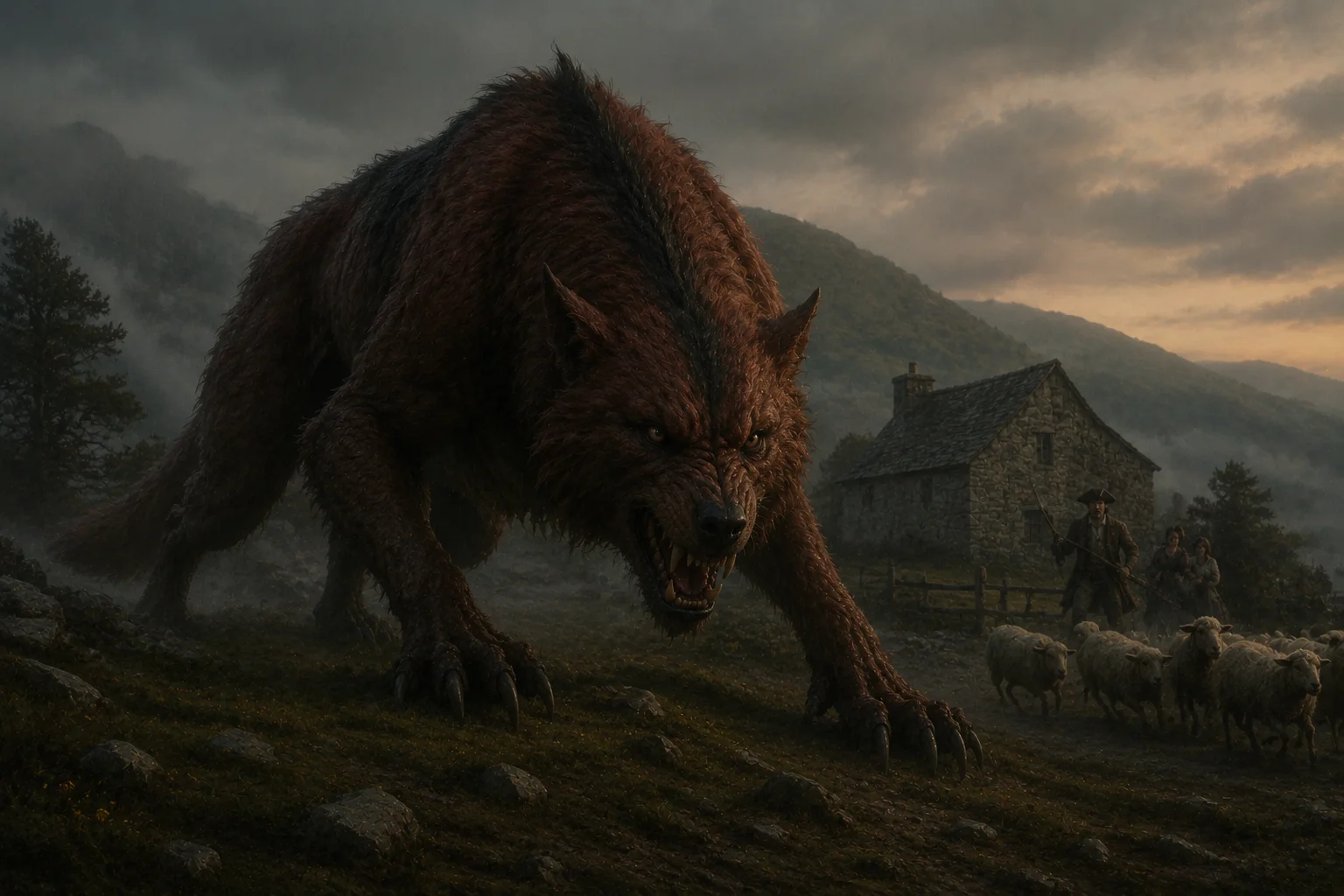
No two accounts of the creature's appearance line up exactly, which is itself part of why the case has endured. Witnesses across the affected parishes described something larger than an ordinary wolf, with an oversized head set on a powerful body, a coat that ran reddish or dark along the back, and a paler, almost whitish underside. Many descriptions gave it a long tail, sometimes said to end in a distinct tuft. Beyond size and coloring, survivors and onlookers spoke of a creature that seemed unusually bold — willing to approach and attack in daylight, to press an assault against people who fought back, and to keep returning to areas that had already been hunted. No carcass, skeleton, or preserved specimen has ever been produced that indisputably matches these descriptions, which has left the Beast's exact physical nature an open question rather than a settled fact.
Prey Chosen With Terrible Consistency
Contemporary reports repeatedly note that the killings fell disproportionately on women, children, and those tending livestock alone in the fields — the people most likely to be outdoors, unarmed, and unaccompanied in a rural economy built around exactly that kind of solitary labor. It was this pattern, together with the boldness of the attacks and their willingness to target humans directly rather than sheep or cattle, that unsettled contemporaries more than the raw death toll alone. A wolf preying on a flock was a familiar hazard of provincial life; a predator that seemed to prefer people was something else, and it read, to those living through it, as a violation of the natural order they thought they understood.
Word Reaches Versailles
News of the killings traveled far enough, and lasted long enough, that it reached King Louis XV himself, who took a direct personal interest in ending the crisis. The crown's involvement marked Gévaudan's terror as a matter of state rather than merely local misfortune, and it produced one of the more extraordinary demonstrations of royal reach into a remote, difficult province during the final decades of the Ancien Régime. For a rural population that often felt at the edges of royal protection, the sight of the king's own hunters arriving in Gévaudan was itself a notable event, separate from whatever they might or might not accomplish against the Beast.
The first royal response arrived in 1765 in the form of Jean-Charles-Marc-Antoine Vaumesle d'Enneval and his son, professional wolf-hunters summoned specifically for the task. The d'Ennevals brought experience and a reputation built on tracking dangerous wolves elsewhere in France, and their arrival raised hopes that the killings would soon end. Despite their skill, the attacks continued through their time in the province, and the d'Ennevals did not produce the decisive kill that Gévaudan and the crown were waiting for.
Antoine de Beauterne's Wolf of Chazes
The king's response to the d'Ennevals' unsuccessful campaign was to send François Antoine, known as Antoine de Beauterne, his own arquebus-bearer, to take up the hunt. In September 1765, Antoine's party killed a large wolf, which was presented to the court and the public as le Loup de Chazes — the Wolf of Chazes — and officially declared to be the Beast responsible for the killings. The declaration brought an end to direct royal involvement in the affair; the wolf's body was reportedly sent to Versailles and displayed there before it decomposed, though its ultimate fate and final resting place were not well recorded and remain unclear. For a time, Gévaudan could believe its ordeal was over.
The Killing That Would Not Stop
It was not over. Despite the official declaration and the end of the crown's active hunt, attacks matching the pattern of the previous year continued, carrying the terror into a further wave of killings that stretched into 1767. For the people of Gévaudan, the gap between the state's proclamation that the danger had ended and the continued disappearance and death of their neighbors must have been its own kind of horror — an authority they had waited on now looking elsewhere, while the killing went on regardless.
Jean Chastel and the Sogne d'Auvers
The event popularly remembered as the true end of the Beast of Gévaudan came on 19 June 1767, when a local hunter named Jean Chastel killed a large wolf at the Sogne d'Auvers. Chastel was not a royal appointee but a man of the region, and his kill has become, in popular memory, the climactic close of the affair — though historians are careful to note that this ending owes at least as much to folklore and the human need for a clean resolution as to documented certainty. The attacks are generally understood to have ceased after this point, but the record of Chastel's hunt itself is thinner than the legend built upon it.
The Silver Bullets That Never Were
Among the details that attached themselves to Chastel's story, none is more famous, or more unfounded, than the claim that he loaded his weapon with bullets cast from silver, blessed beforehand as though the Beast were less a wolf than something that only sacred metal could kill. This detail has no solid documentary basis from the eighteenth century itself; it is almost certainly a later embellishment, layered onto the story as it passed into popular retelling. It survives not because it is true but because it fits so neatly with the sense, already present among contemporaries, that this had never been an ordinary predator.
One Beast, or Many Hands
The persistence, boldness, and geographic concentration of the attacks led some observers at the time, and many since, to wonder whether a single animal could really account for everything attributed to the Beast. Proposed explanations have included more than one animal operating across the same territory, a wolf that had been trained or deliberately directed by a human hand, or even a human killer using an animal, or the fear of one, as cover for murder. None of these hypotheses has won scholarly consensus; they remain competing possibilities rather than established fact, kept alive by the same inconsistencies in eyewitness testimony that make the Beast's physical description so unstable.
A Case Read Instead of Believed
Modern historians of the phenomenon, notably Jean-Marc Moriceau, a leading French scholar of wolf attacks on humans, have generally situated Gévaudan within a much broader and well-documented history of wolves and wolf-dog hybrids preying on people in early modern France, rather than treating it as a case that demands a cryptid explanation. On this reading, Gévaudan was extreme in scale and duration but not fundamentally different in kind from other, less remembered incidents across the country — an explicable, if severe, instance of a real historical danger, rather than proof of an unclassifiable monster. The popular "mystery beast" framing nonetheless persists alongside this scholarship, each account living a somewhat separate life.
What the Records Actually Hold
Few purported monster cases from any era are as thoroughly documented as this one. The affair generated an unusually extensive contemporary paper trail — parish registers recording the dead, royal correspondence tracking the hunts, and reports in early gazettes carrying the story to readers well beyond Gévaudan itself. It is precisely this density of surviving material that makes the case a reference point in both historical and cryptozoological writing: there is enough documentation to argue over, which is rarer than it sounds for events of this age and this kind.
A Name for Fear Itself
In French collective memory, the Beast of Gévaudan became something larger than the sum of its attacks — a byword for terror, for the reach and limits of royal authority, and for the vulnerability of a remote rural province left largely to fend for itself. Some historians read the episode as a window onto contemporary anxieties that went beyond any single animal: fear of wolves as a real and constant hazard of provincial life, fear of banditry and disorder in isolated country, and an uneasy awareness of how far royal protection actually extended once one left the roads that led to Versailles. Cryptozoology writers have also drawn comparisons, cultural rather than genealogical, between Gévaudan and other French loup-garou, or werewolf, legends of the period — parallels of mood and meaning, not attested connections within any shared body of lore.
From Provincial Terror to Screen Legend
The Beast's afterlife has been long and varied, inspiring numerous books and documentaries and, most famously, the French film Brotherhood of the Wolf (Le Pacte des Loups, 2001), which reimagines the events with supernatural elements and conspiracy plotting that have no basis in the historical record. Such adaptations belong to the realm of creative reinterpretation rather than to the documented case itself, but they have done much to keep the Beast present in popular imagination long after the parish registers that first recorded its victims fell silent, ensuring that a story rooted in a specific, terrible three years in a specific corner of France continues to be told, and reshaped, far from Gévaudan.
Sources & traditions
- EncyclopediaWikipedia — Beast of Gévaudan
- TraditionLocal sightings, press reports and regional folklore (France)
Myths change from area to area and from time to time. This chronicle follows the most widely told versions; tellings in other villages, regions and eras may differ.