The Hodag is an American cryptid of the North Woods — a fanged, spine-ridged, frog-headed beast said to haunt the timber country around Rhinelander, Wisconsin. Unlike almost every other creature in the cryptid canon, the Hodag's origin is not a matter of speculation or debate. It was invented, on purpose, by one man, and he eventually admitted it. That confession has not diminished the beast in the slightest — if anything, it is the reason the Hodag still grins from water towers, letterheads, and gymnasium walls across Oneida County more than a century later.
A Frog-Headed Ox With a Lumberjack's Sense of Humor
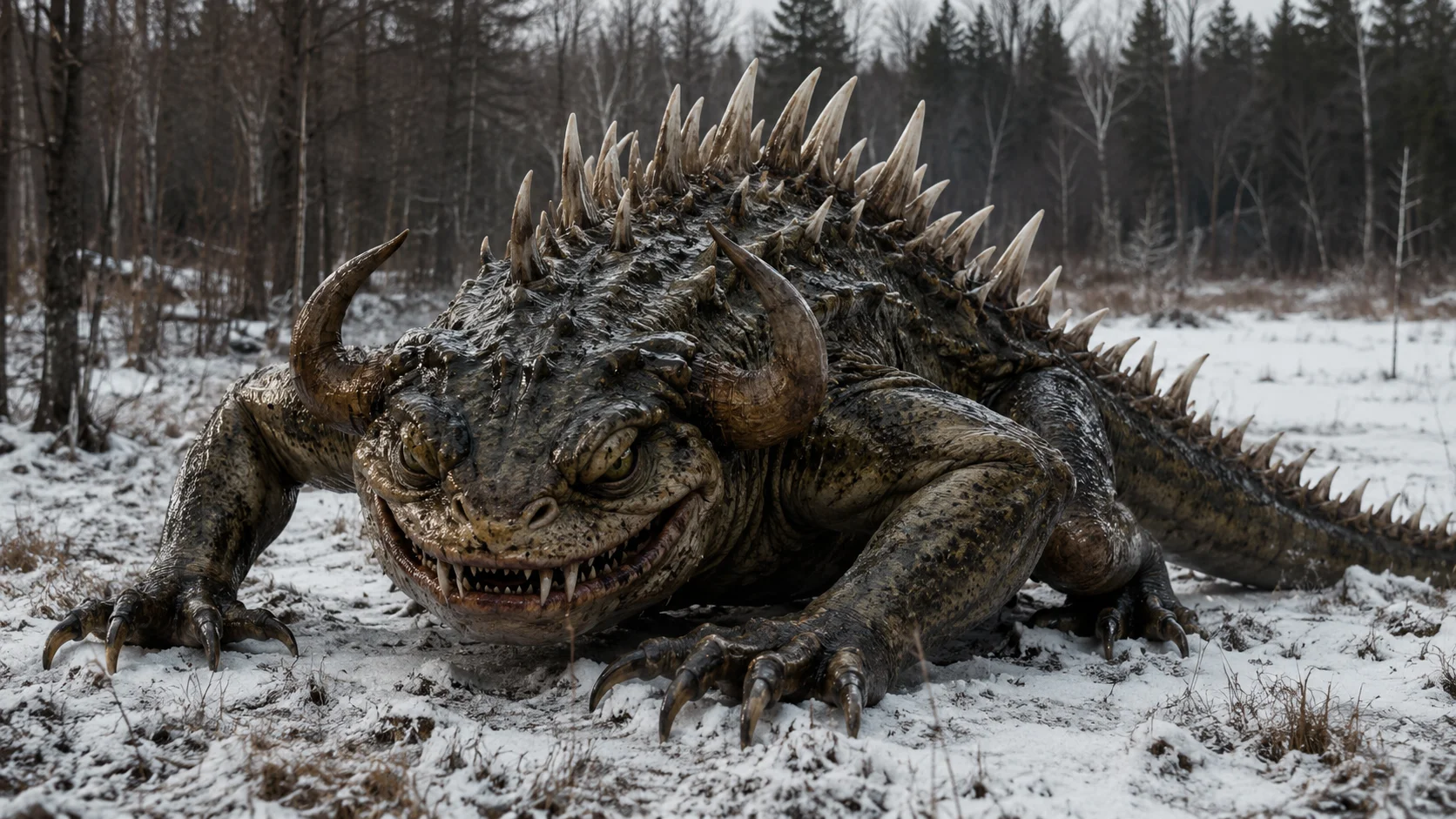
As first described, the Hodag was roughly the size of a large dog or a bear: a thick, low, muscular body carried on stout, short legs, a long tail, and a broad, grinning, frog-like head bristling with fangs. A row of bony spikes ran the length of its spine from skull to tail-tip, and heavy horns crowned its head. It was, by design, a composite — part bull, part ox, part reptile, part amphibian — assembled from the stock imagery of lumberjack-camp tall tales rather than drawn from any single animal. That composite quality was the point. The Hodag was built to look like exactly the kind of thing a logger might swear he'd glimpsed at the tree line after a long season in camp: plausible enough to unsettle a newcomer, outlandish enough to make the old hands laugh once the story landed.
Eugene Shepard, Timber Cruiser and Incorrigible Prankster
The man behind the beast was Eugene Simeon Shepard (1854–1923), a Rhinelander timber cruiser and real-estate broker with a well-earned local reputation as a prankster. Timber cruising meant Shepard spent his working life walking the forest, assessing stands of pine and hardwood for logging companies — exactly the kind of solitary backcountry work that lent credibility to a claim of having stumbled onto something no one else had seen. In 1893, Shepard announced that he had encountered the Hodag while out surveying near his home. It was not his first tall tale and would not be his last; Shepard was a documented serial hoaxer who authored other lumberjack-folklore fabrications in the same vein over the years. But the Hodag became, by a wide margin, his best-documented and most enduring creation.
The Dynamite and the Photograph, 1893
Shepard did not simply describe the creature; he staged its death. He organized a group of local lumbermen who supposedly tracked the Hodag through the woods and killed it with dynamite — a fittingly outsized, backwoods method for dispatching an outsized, backwoods monster. A photograph was then taken of the beast's charred remains and circulated to newspapers. It worked exactly as intended: the image and the story spread well beyond Rhinelander, drawing regional and then national press attention to a creature that had existed, up to that point, only in one timber cruiser's account of a single afternoon in the woods.
A Second Act: The Living Hodag Goes on Display
The blast-and-photograph hoax might have been the end of it, but around 1896 Shepard staged a far more elaborate follow-up: he claimed to have captured a live Hodag. What he actually produced was a fabricated exhibit — a taxidermied, mechanical creature built from carved wood, ox hides, and animal horns, rigged with hidden wires and pulleys so that handlers offstage could make it twitch and lurch for onlookers. This constructed Hodag was put on public display, including an appearance at the Oneida County Fair, where paying visitors filed past to see the fearsome beast of the North Woods for themselves. As spectacle, it succeeded even more thoroughly than the photograph had: a moving, snarling monster was a far more convincing draw than a still image of scorched remains, and word of the captured Hodag carried the legend further still.
Scrutiny From Washington
The performance came to an end when it drew attention from people equipped to test it properly. Scientists from the Smithsonian Institution announced plans to travel to Rhinelander to formally examine the exhibited Hodag. That was scrutiny of a different order than curious fairgoers and credulous newspapermen, and Shepard could not have withstood it: a mechanical contraption of wood, hide, and wire is not built to survive expert inspection. Facing that prospect, Shepard confessed. He acknowledged that the creature was a hoax, built exactly as it in fact had been — carved wood, ox hides, and horns worked by pulleys and wires to fake the illusion of a living animal. The Smithsonian never needed to make the trip; the story had already unraveled from the inside.
An Openly Documented Fabrication
What sets the Hodag apart from most entries in the American cryptid tradition is not that a hoax is suspected, but that the hoax is a matter of settled local historical record. Shepard's own confession and the mechanical construction of the exhibit are documented facts, not inferences drawn from missing evidence or unconvincing photographs. Most cryptids carry an open question mark; the Hodag carries a closed case file. That distinction matters for how the creature is remembered: rather than lingering in the ambiguous territory of "maybe a hoax, maybe not," the Hodag has always been able to be discussed as consciously invented folklore, with the who, when, and how all on record.
Products of the Same Logging-Camp Imagination
The Hodag belongs to a broader American folk category known as "fearsome critters" — a body of tall-tale monsters invented and swapped around the logging camps of the Upper Midwest in the late nineteenth and early twentieth centuries, the jackalope among its more famous cousins. These were campfire creatures, born of loggers entertaining each other and, often enough, testing the gullibility of greenhorns, rather than figures drawn from any deeper mythological or spiritual tradition. It is worth stating plainly what the Hodag is not: standard sources do not attribute it to Ojibwe oral tradition or to any other Indigenous belief system of the Wisconsin region, and it should not be folded into or confused with genuinely Indigenous legendary beings native to that same landscape. The Hodag's lineage runs through Eugene Shepard and the lumber camps, not through older, unrelated traditions that happen to share the same North Woods geography.
From Hoax to Hometown Icon
What happened next is the part of the story that keeps the Hodag alive: rather than fading once exposed, it was formally adopted as Rhinelander's civic symbol. The city took up the Hodag as its mascot and branding icon, and Rhinelander High School's teams compete today as "the Hodags." The creature's grinning, horned likeness turned up in the names of local businesses and became shorthand for the town itself. This is an unusual afterlife for a debunked cryptid. Most creatures whose hoax origins come to light are quietly retired from serious discussion; the Hodag instead moved, deliberately and publicly, from claimed cryptozoological fact to embraced local folklore — a shift the town seems to have made with open eyes and no small amount of civic affection for the joke Shepard had played on it.
Where the Beast Still Grins
The Hodag is commemorated today at Rhinelander's Pioneer Park Historical Complex, where the town's museum keeps the legend and its history on display for visitors. The creature also lends its name to the Hodag Country Festival, a music event that carries the beast's identity out to audiences who may know nothing of Eugene Shepard or the Oneida County Fair but recognize the name all the same. Between the museum, the high school teams, the festival, and the statues and signage scattered through town, the Hodag functions less as a cautionary tale about an old hoax than as a piece of civic personality — the North Woods' way of keeping its favorite joke in circulation.
A Fixture of the Cryptid Shelf Despite the Confession
Even with its fabrication fully documented, the Hodag remains a recurring subject in American cryptid and fearsome-critters compendiums. Its appeal there is a little different from the appeal of a creature whose reality is still argued over: readers return to the Hodag not to weigh evidence for or against its existence, but for the story of the hoax itself — a timber cruiser's dynamite, a wired-together wooden beast at a county fair, and a Smithsonian inquiry that finally brought the curtain down. No alternate names or epithets attach to the creature; in every telling, from Shepard's original account to the modern festival marquee, it is simply the Hodag, the fearsome, spine-ridged beast of Rhinelander that everyone involved has always known, eventually, to be make-believe.
Sources & traditions
- EncyclopediaWikipedia — Hodag
- TraditionLocal sightings, press reports and regional folklore (North America)
Myths change from area to area and from time to time. This chronicle follows the most widely told versions; tellings in other villages, regions and eras may differ.