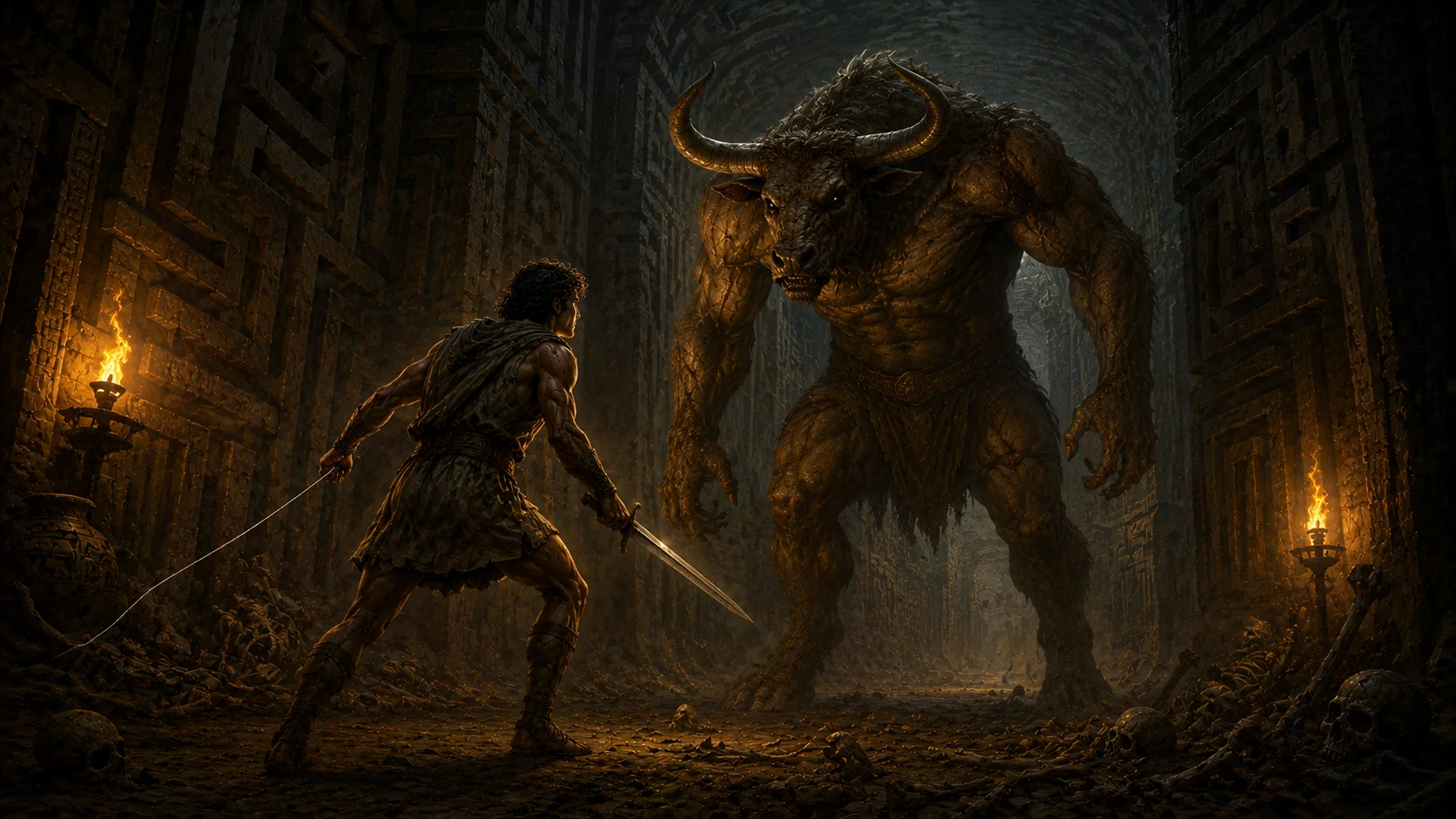
Deep beneath the palace of Knossos, in a maze so cunning that no one who entered could ever find the way out, something waited in the dark: the Minotaur, a creature with the body of a man and the head of a bull, hungry for human flesh. It is one of myth's most primal nightmares — the monster at the centre of the labyrinth, and the children sent into the dark to feed it.
Born of a Curse
The Minotaur's origin was a divine punishment. King Minos of Crete had refused to sacrifice a magnificent white bull to Poseidon, so the god cursed Minos's wife, Pasiphae, with an unnatural passion for the animal. From their union was born the Minotaur — named Asterion — a shameful, monstrous child that was neither beast nor man. Unable to kill it and unable to bear the sight of it, Minos had the master craftsman Daedalus build the Labyrinth: a maze so complex that the monster could never escape, and neither could anyone sent in to it.
The Tribute of Flesh
To feed the beast — and to punish Athens for a past wrong — Minos demanded a horrific tribute: every nine years, seven youths and seven maidens of Athens were sent into the Labyrinth to be devoured. It is one of the cruellest images in Greek myth: innocents walking into the dark, the door sealing behind them, the thing waiting at the heart of the maze.
The Thread in the Dark
The hero Theseus volunteered as one of the tributes, determined to end it. Minos's own daughter Ariadne, fallen in love with him, gave him a ball of thread to unwind as he went, so he could find his way back. Deep in the maze Theseus found the Minotaur and killed it with his bare hands (or a hidden sword), then followed the thread back to the light. The monster fell — but the deeper terror, the maze itself, is the part we never forget.
We still speak of being “lost in a labyrinth,” and of the thread that leads us out — both gifts of this single, shadowed myth.
The Bull's Long Shadow
Before Theseus ever set foot in the Labyrinth, he had already killed a bull of the Minotaur's own blood. Poseidon's white bull — the one Minos refused to sacrifice, the one that fathered the monster on Pasiphae — did not disappear once its work was done. In the account gathered by the mythographer Apollodorus, the beast kept rampaging across Crete until Heracles arrived to capture it alive as the seventh of his twelve labours, wrestling it into submission and shipping it, still roaring, to King Eurystheus at Mycenae. Shown off there, it was let go free. It wandered through the Peloponnese and across the Isthmus into Attica, where it settled near Marathon and became a local terror known ever after as the Marathonian Bull.
It was this same bull — the Minotaur's own father, in this telling — that killed Androgeus, King Minos's son, after Athens sent him out against it. Minos never forgave the city for his son's death. The tribute of seven youths and seven maidens, sent every nine years into the Labyrinth, was Crete's answer to a killing this same bloodline had already caused. Years later, not long before he volunteered for that very tribute, Theseus went to Marathon and took the bull himself, driving it through the streets of Athens and sacrificing it to Apollo. He had ended the father without knowing it. The son was still waiting for him, in the dark, at the end of the same road.
Three Generations of Bulls
The Minotaur did not arrive from nowhere; he is the third bull in a family that could never keep the animal and the divine apart. It began with Zeus, who took the shape of a magnificent bull to carry the Phoenician princess Europa across the sea to Crete — their son was Minos. A god's disguise produced a king; a king's pride produced the Minotaur. Around that shame stood a whole household of siblings who were entirely, painfully human: Ariadne and Phaedra, both of whom would go on to love and be ruined by the same family of Athenian men; Androgeus, whose death set the tribute in motion; and Glaucus, Catreus and Deucalion, who inherited crowns and quarrels long after their brother was sealed in the maze. Of all Minos's children, the Minotaur was the only one who never once got to leave the palace grounds.
The Mistress of the Labyrinth
Long before any poet wrote the word "Minotaur," someone at Knossos was already leaving offerings for a "Mistress of the Labyrinth." A Linear B clay tablet excavated from the ruins of the palace, inscribed centuries before the earliest Greek epic we possess, records a jar of honey given over to that unnamed lady of the maze. No bull is mentioned, and no monster. But the palace itself, once Arthur Evans began digging in 1900, turned out to be an actual architectural labyrinth: well over a thousand interlocking rooms, corridors that double back on themselves, long magazines lined with storage jars standing in the dark. Evans went on to apply the name "Minoan" to the whole vanished civilisation, after the king in the myth, before he had a shred of proof that Minos had ever existed. The story told him what he had found before the evidence did.
Horns on Every Rooftop
Whatever the Minotaur eventually came to mean, the bull itself was sacred on Crete for centuries before anyone imagined putting a man's body beneath its head. The palace walls at Knossos carried the famous Toreador Fresco, a painting of young acrobats vaulting over the back of a charging bull — a scene most scholars read as ritual rather than sport. Stone "horns of consecration," carved in the shape of a bull's horns, stood on rooftops and altars across the island, and the double-headed axe, or labrys, was cut into the stone of the palace itself. Some scholars trace the very word labyrinth back to that axe: on this reading, the maze was never named for its twisting corridors at all, but simply meant "house of the double axe" — a real Minoan shrine whose name later curdled, in Greek retelling, into a monster's prison.
A Maze You Could Hold in Your Hand
On Greek pottery the Minotaur keeps roughly the shape the story gives him — a man's body, a bull's head, sometimes a bull's tail besides — locked in combat with Theseus in scenes that black-figure and red-figure painters returned to for generations. Knossos itself later minted silver coins stamped with the meander pattern of the Labyrinth, turning the maze into a civic emblem small enough to carry in a coin-purse, long after the palace that supposedly inspired it had burned. Few Greek monsters have both a surviving "portrait" and a surviving address; it is part of why the Minotaur has never quite stopped feeling like something that actually happened.
Guardian of the Seventh Circle
Dante moved the Minotaur somewhere worse than Crete. In Canto XII of the Inferno, he and Virgil come upon the creature crouched at the shattered cliff that drops into the circle of violence — "the infamy of Crete," biting at its own flesh in a blind rage. Virgil taunts it with the memory of Theseus, and the bull-man, too consumed by fury to notice, lets the two poets slip past while it is still raging at nothing. Dante keeps the shame of the creature's birth intact but turns its old hunger into something closer to pity: a monster so trapped inside its own violence that it fails to see its prison door standing open.
The House Asterion Never Left
Not every later writer treated the monster as something owed a death. In 1947 the Argentine writer Jorge Luis Borges published a short story, The House of Asterion, narrated entirely from inside the Labyrinth by the monster himself — lonely, gentle, baffled by his own reputation, and almost relieved when a stranger finally arrives to end things. Around the same years Pablo Picasso made the Minotaur one of the great private obsessions of his career, drawing and etching the figure again and again through the 1930s — designing the cover of the first issue of the Surrealist journal Minotaure in 1933, and producing the 1935 etching Minotauromachy — using the bull-headed man as a stand-in for his own tangled instincts, violence and desire and shame folded into one animal head on a human body. A story once told to justify walling a monster away had, some twenty-five centuries later, become a story about what it feels like to be the one walled in.
Why We Keep Building Him a Maze
The Minotaur endures because he may be the only monster in Greek myth guilty of nothing except being born. He did not choose the curse on his mother, did not design the trap he was kept in, did not ask to be fed on the children of a city he never saw. Every other figure in this story made a decision — Minos to refuse the sacrifice, Pasiphae to desire the bull, Daedalus to build the maze, Athens to send its youths, Theseus to pick up the sword — and the Minotaur simply absorbed the consequences of everyone else's choices, at the dead centre of a labyrinth he never once got to see from the outside. That is the fear underneath the myth, once the horns and the hunger are stripped away: that a family's shame, a father's pride and a city's grief for one dead son can all be walled up together and left to somebody who never had a vote in any of it.
Sources & traditions
- EncyclopediaWikipedia — Minotaur
- TraditionGreek texts, inscriptions and later retellings (Greece)
Myths change from area to area and from time to time. This chronicle follows the most widely told versions; tellings in other villages, regions and eras may differ.