Theseus was the great hero and founder-king of Athens — the city's favourite son, slayer of the Minotaur, and the figure the Athenians held up as the model of the clever, civilising hero. Where Heracles conquered by strength, Theseus conquered by intelligence, daring, and a king's sense of justice, and later ages would even call him a second Heracles for the string of road-clearing feats that opened his story.
A Father in Two Houses
Even his birth refused to settle into a single, tidy account. Theseus grew up believing himself the son of Aegeus, king of Athens, and was raised as such by his mother Aethra in her home city of Troezen. Yet the older storytellers — Plutarch chief among them, drawing on even earlier tradition — record that Aethra lay with Aegeus and with the sea-god Poseidon on the very same night, leaving Theseus's true paternity deliberately unresolved rather than decided. The ambiguity was not a gap to be filled in; it was part of the myth itself, letting Theseus claim both a mortal king's throne and a god's blood without either claim cancelling the other.
The Stone at Troezen
Before leaving for Athens, Aegeus is said to have hidden a sword and a pair of sandals beneath an immense boulder in Troezen, telling Aethra that if their son ever grew strong enough to roll the stone aside and recover the tokens, he was to bring them to Athens and be acknowledged as the king's own. Theseus, reaching manhood, lifted the boulder without difficulty, took up the sword and sandals, and set his face toward the city that did not yet know him.
The Road of Bandits
He could have sailed to Athens in a few safe days by sea. Instead he chose the long, perilous land route around the Saronic Gulf, deliberately courting the monsters and highwaymen who infested it — a young man's way of announcing himself before he ever spoke a word in the city. He killed Periphetes the club-bearer and took his weapon; he caught Sinis the pine-bender, who had killed travellers by tying them between two bent pines and letting the trees snap them apart, and gave him the same death he had dealt so many others. He slew the murderous Sciron, who kicked guests from a cliff into the sea, and the savage Crommyonian Sow that terrorised the countryside near Crommyon. Cruelest of all was Procrustes, who offered travellers a bed and then stretched or hacked them to fit its exact length — Theseus fitted him to his own bed in turn. By the time he reached Athens the road behind him was clear, and the manner of each killing — turning a villain's own method back upon him — had already marked him as a hero who answered violence with a kind of rough justice rather than mere slaughter.
Recognition at the Palace
Theseus arrived in Athens as a stranger, sandals and sword concealed, and Aegeus did not know his own son at first sight. It was only when the tokens were recognised that the king acknowledged him publicly, and Theseus stepped into his place as heir to the Athenian throne — a homecoming that had cost him a road strewn with the bodies of bandits to earn.
The Tribute of Crete
Athens at that time lived under a bitter obligation: every so often, the city was compelled to send seven youths and seven maidens across the sea to Crete, to be given over to the Minotaur — a monster with a bull's head and a man's body — confined within the Labyrinth, an inescapable maze built to hold it. Theseus, seeing his city's grief at the sending of its young people, volunteered himself as one of the tribute, determined to end the horror at its source.
Ariadne's Thread
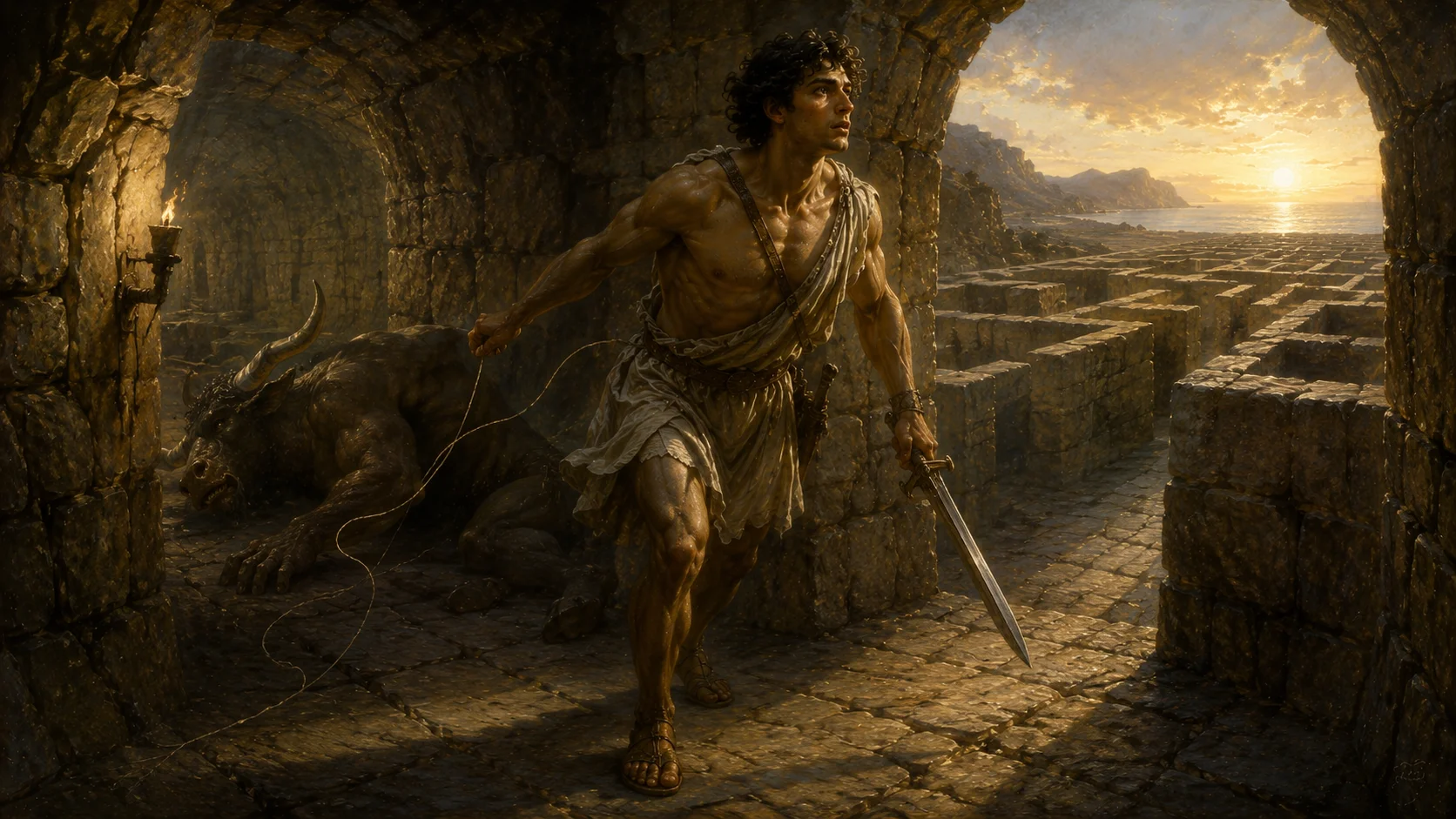
On Crete, Ariadne, daughter of King Minos, saw Theseus and loved him, and gave him a ball of thread so that he could unwind it as he advanced into the Labyrinth and follow it back out again once his task was done. Guided by that single thread, Theseus went to the heart of the maze, killed the Minotaur, and retraced his own path to daylight — the only tribute-victim in the story's telling ever to enter the Labyrinth and come out alive.
Left on Naxos
Sailing home in triumph, Theseus put in at the island of Naxos — and there, in the tellings that have come down from antiquity, he left Ariadne behind. Why he did so is not something the tradition agrees on: some accounts say he simply forgot her, others that a god commanded he leave her, since she was destined to become the bride of Dionysus, and others frame it more plainly as desertion. The ancient sources themselves hold these explanations apart rather than resolving them into one, and no single motive can be claimed as the truth of it.
The Black Sails
His triumph carried a private tragedy home with it. Theseus had promised his father that if he survived Crete, he would hoist white sails on his return, and leave the ship's black sails up only if he had died. In the joy and disorder of the homeward voyage, he forgot to make the change. Aegeus, watching from the heights above Athens and seeing black sails on the approaching ship, believed his son dead and threw himself into the sea — the grief that is said to have given the Aegean its name. Theseus came home a conquering hero and, in the same hour, a king, the throne passing to him at the cost of his father's life.
Weaver of a Single City
As king, Theseus was credited with the synoikismos — the political unification of Attica's many scattered towns and villages into one Athenian state, with Athens itself at its head. Later writers, Thucydides among them, treated this act of unification as something close to real history rather than pure legend, and it became the foundational civic story of Athens: the hero who did not merely slay monsters but built the very shape of the polis, turning a landscape of separate communities into a single people.
Beside Meleager and Atalanta
Theseus's life was not confined to Athens and Crete. He joined the great gathering of heroes summoned for the Calydonian Boar Hunt, standing alongside figures such as Meleager and Atalanta in the pursuit of the monstrous boar ravaging Calydon — one of the few times the era's scattered heroes are remembered as having stood shoulder to shoulder in a single company.
Companion of Pirithous
Among Theseus's closest bonds was his friendship with Pirithous, king of the Lapiths. Together they fought in the Centauromachy, the violent battle against the Centaurs that broke out at Pirithous's own wedding feast. Their companionship led them, later, into far greater danger: the two resolved to descend into the Underworld itself so that Pirithous might carry off Persephone. The attempt failed disastrously — both men became bound fast to the Chair of Forgetfulness, unable to rise or leave. Heracles, passing through the Underworld on a labour of his own, was able to free Theseus, but in most versions of the story Pirithous remained trapped below, unable to be freed even by Heracles's strength.
The Taking of Helen
In another episode bound up with Pirithous, the two abducted the still-young Helen — later of Troy — and hid her away at Aphidnae in Attica. Her brothers, the Dioscuri Castor and Pollux, answered the abduction by invading Attica themselves and recovering their sister, a retaliation that Plutarch records as one of the costs of Theseus's friendship with Pirithous.
Phaedra and the House Undone
Theseus later married Phaedra, sister of the same Ariadne he had left on Naxos years before. It was a match that carried its own sorrow forward: Phaedra's love for Theseus's son Hippolytus — born to the Amazon Antiope, sometimes called Hippolyta — set in motion a chain of grief that Euripides would dramatise in his tragedy Hippolytus, a story of a household undone from within rather than by any outside monster or war.
The Bones Brought Home
Long after his own lifetime, Theseus remained Athens's great civic symbol — the hero whose cleverness, daring, and city-building stood for the values Athens wished to see in itself, later understood as an emblem of its democracy and unity. Centuries on, in the fifth century BCE, the Athenian statesman Cimon is said to have recovered Theseus's bones and brought them home to Athens, where they were enshrined in the Theseion, a resting place built to honour the man Athens had made into the very shape of its own identity.
Athens claimed him as the hero who proved a city is built not only by strength, but by justice and wit — a claim made whole by a life that ran, without contradiction, from a boulder in Troezen to a throne he never lived to see his father hand him.
Sources & traditions
- EncyclopediaWikipedia — Theseus
- TraditionGreek texts, inscriptions and later retellings (Greece)
Myths change from area to area and from time to time. This chronicle follows the most widely told versions; tellings in other villages, regions and eras may differ.