Illuyanka is the serpent of the oldest surviving dragon-combat myth of Anatolia: a creature that, in the Hittite tablets of the second millennium BCE, defeats the Storm-god and is then undone by trickery, drink and a rope. The story is told twice on the same tablet, in two quite different versions, and it was not recited as entertainment: the text presents itself as part of the spring festival called Puruli. Because it is the only complete dragon-slaying story to come down from the Hittite world, it has been pressed into service by every comparative school, from those who see in it a seasonal ritual of renewal to those who find in it a verbal formula inherited from Proto-Indo-European poets. The religion that told it is extinct; what follows says what the tablets contain, and marks the places where scholars disagree.
Name and etymology
The word illuyanka- is not a personal name. It is a Hittite common noun meaning “serpent” or “snake,” and Gary Beckman, whose 1982 edition is the standard treatment, took it as such. Modern writers use it as if it were a proper name because the text speaks of the serpent so. It is probably a compound of two old words for “snake”: an element reconstructed as *h₁illu-, which is the root behind English “eel,” and *h₂engwʰ-, behind Sanskrit ahi; the same two elements, in reverse order, appear in Latin anguilla, “eel.” This etymology is disputed and the laryngeal notation varies from author to author.
The god it fights is the Storm-god, written in Hittite texts with a logogram and in this myth identified by many modern accounts as Tarhunna, the Hittite form of the weather deity whose Hurrian counterpart is Teshub. Older popular accounts say Teshub, and the two names refer to the same type of god; the texts themselves use the Hittite writing.
The sources
The myth is known from clay tablets found at Boğazköy, the site of the Hittite capital Hattusa. It is catalogued as CTH 321, and it exists in a group of manuscripts designated A to J, nine pieces in all, each of them incomplete. The best preserved, Text A, has 30 of an estimated 36 paragraphs. The editors read two consecutive versions of the myth on the tablet, and the second is generally taken to be an alternative that the ritual offered after the first. Beckman’s article “The Anatolian Myth of Illuyanka,” in the Journal of the Ancient Near Eastern Society for 1982, gave the first full treatment, and Harry Hoffner’s Hittite Myths made an English translation widely available.
The tablet opens with an introductory formula, which a recent short conference paper by Petra Goedegebuure takes as naming the speaker as Killa (also written Kella), the anointed priest of the Storm-god of Nerik. The paper is brief and its readings should be taken as provisional. It argues that the myth is in fact about the Weather-god of the Sky, not the local Storm-god of Nerik. Nerik, a sacred city of the Hattian north, is known as a centre of the storm-god’s cult, and the myth is generally described as belonging to the Hattian stratum of Hittite religion, that is, to the older, pre-Indo-European population of central Anatolia, and not to the Hittite kings’ own tradition.
The first version
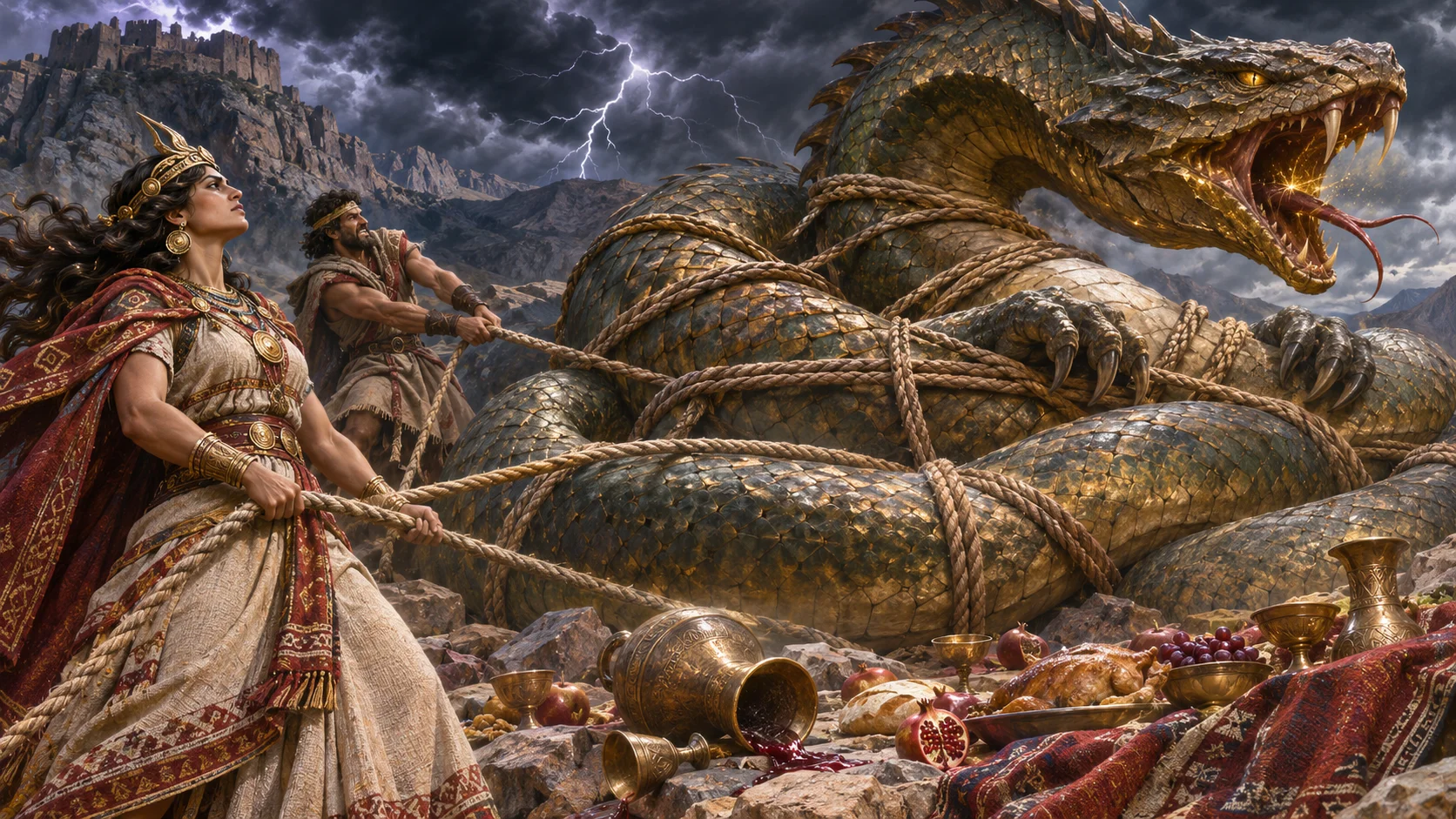
In the first telling, the Storm-god and the serpent meet in battle at Kiskilussa, and the serpent wins. The Storm-god turns to the goddess Inara, a daughter of the Storm-god who is associated in other texts with the wild creatures of the steppe, and she devises a ruse. According to the commonly cited summary she prepares a great feast with a lavish supply of drink; the sources name wine and two kinds of beer. Summaries differ on whether the Storm-god asks Inara to hold the feast or whether she offers it herself, because the opening of the text is broken.
First, though, she needs an ally who is mortal. She approaches a man called Hupasiya, from the town of Zigaratta, and his price is that she sleep with him. He agrees, and she then summons the serpent and its children, who come up from their hole and eat and drink until they are so swollen that they cannot get back down. Hupasiya ties them with a rope, and the Storm-god, with the other gods, kills the serpent.
The tale does not end with the victory. Inara builds a house for Hupasiya on a cliff at Tarukka and sets him in it, forbidding him to look out of the window. He disobeys, and sees his wife and children, and begs to be allowed to go home. At this point the tablet is damaged, and what happens to him is unknown. Suggestions include that Inara punishes him for disobedience, or that she lets him go back to his family. These are conjectures and they should not be set down as the content of the myth.
The second version
The second version has a different logic. Here the serpent defeats the Storm-god and takes his heart and eyes, leaving him without them. The god takes the daughter of a poor man as a wife, and she bears a son, whom many modern accounts name Sarruma. When the son is grown he marries the daughter of the serpent. Following his father’s instruction, he asks for the heart and eyes as a wedding gift, and they are given to him; he carries them back to his father, who is made whole.
The Storm-god then goes out and fights the serpent again, and this time overcomes it. But the story takes its last turn with the son. He asks his father to include him in the killing, and the Storm-god kills the serpent and his own son together. The result is bleak in a way the first version is not: the god is restored, the monster killed, but the price is the child who had been his instrument. A relief from Malatya, dated to between 1050 and 850 BCE and now in the Museum of Anatolian Civilizations at Ankara, shows a god killing a dragon with a second figure behind him, and it is often cited as an illustration of this narrative; the identification of the scene, and of the second figure as the son, is a modern interpretation, and the relief comes from the Neo-Hittite period, several centuries after the tablets.
The festival and its meaning
The text declares itself a piece of the Puruli, a spring festival, and the work of Theodor Gaster made it the classic exhibit of the “seasonal pattern”: the dragon of winter or chaos is overcome by the god of storm and fertility, and the recitation guarantees the renewal of the land. This reading was influential, and it lies behind the assertion, common in popular books, that the myth is an Anatolian version of the New Year contest, comparable to the Babylonian Akitu and the Canaanite Baal cycle. One reference work states that the Puruli was celebrated at Nerik; the identification of the festival with the city rests on the opening formula and the priest’s title as given above.
More recently the seasonal reading has been questioned. Goedegebuure, in a paper titled “The Illuyanka Myth: A Hittite Saturnalia?,” notes that the festival is celebrated when everything already prospers, a joyful occasion and not a crisis, and she reads the text’s reversals as a kind of festival inversion: a goddess ends up subordinate to a mortal lover, the other gods give the Storm-god no help in the first round, and the usual exchange between gods and humans, do ut des, is turned upside down. Her proposal is a hypothesis, and it should be set beside the seasonal reading, not in place of it.
Language and the Indo-European dragon
Calvert Watkins made the myth central to his book How to Kill a Dragon: Aspects of Indo-European Poetics (Oxford, 1995), which won the American Philological Association’s Goodwin Award of Merit in 1998. His thesis is that the languages of the family inherit a poetic formula, which he writes as HERO SLAY SERPENT, built on the root *gʷhen-, “strike, slay,” and a word for “serpent.” Its best-known reflex is the Vedic ahann ahim, “he slew the serpent,” of the hymns to Indra. The Hittite evidence is the sentence in which the storm-god kuenta, “killed,” the illuyankan, the serpent, the verb standing at the end of the clause as Hittite word order requires. Watkins saw here what may be the oldest written form of the formula.
The thesis has been influential and also debated. A shared poetic formula and a shared myth are different claims: the former concerns wording, the latter plot and meaning.
Comparative debate: Typhon, Python and the combat myth
The Hittite text was first set beside Greek material by Walter Porzig in 1930, who compared the storm-god’s fight with the serpent to Zeus’s battle with Typhon in the Bibliotheca attributed to Apollodorus. In that late Greek account the monster overpowers Zeus and takes his sinews, which have to be stolen back; the loss and recovery of vital organs resembles the heart and eyes of the second version. Few accepted the parallel at the time. Later, when the Hurrian cycle became known, the Typhon comparison was revived in some quarters, and the climax of the Song of Ullikummi has likewise been compared with Zeus’s battle with Typhon.
Other comparisons are made on the level of type and not of descent. The slaying of the serpent by a champion of order is found in Marduk and Tiamat, Baal and Yam, Indra and Vritra, and Apollo and the Pythian serpent at Delphi. To list these is not to prove a single ancestry. The motif of a victory of order over a watery or serpentine disorder has been called a chaos-battle, and Piotr Taracha used the term for the victory of Teshub over Kumarbi’s allies, but the Hittite story is unusually concrete: its serpent lives in a hole in the ground, is defeated by drunkenness and a rope, not by thunder, and wins first. Nothing in the text says that the world was made or unmade by the contest.
Kindred figures
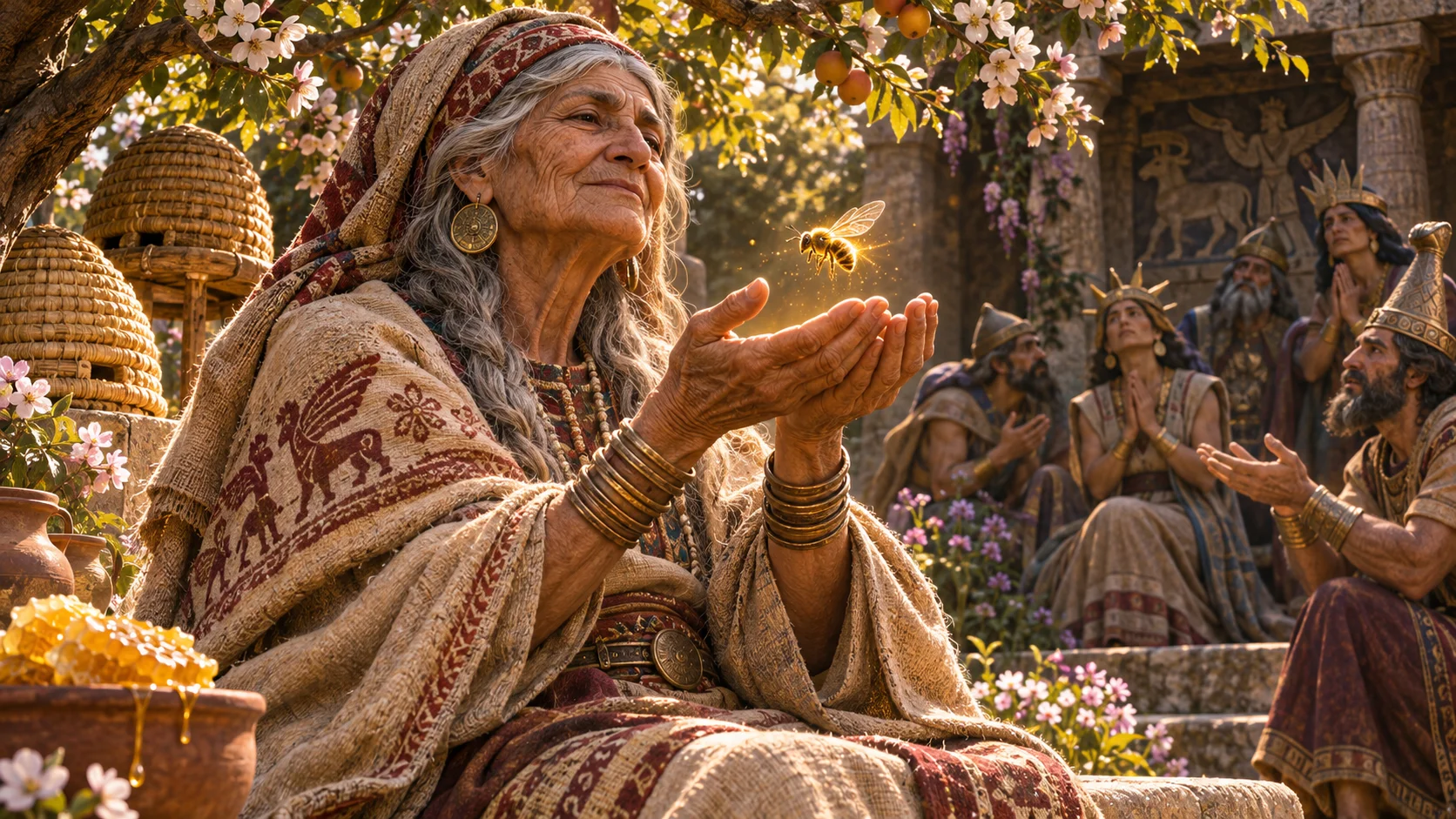
Within the Hittite corpus, Illuyanka is a distant relation of the monsters that Kumarbi raises against Teshub: the sea-serpent Hedammu and the stone giant Ullikummi. Inara appears again in a myth in which she vanishes and the mother goddess Hannahanna and a bee are called on, so that she belongs to the group of vanishing-deity stories that includes Telipinu. Sarruma, the name many accounts give the doomed son in the second version, is a god of the Hurrian-influenced world, where he is the son of the Storm-god. The Hittite tradition, in other words, held the serpent-slaying story in the same cluster of ritual narratives as the stories of departure and return.
Closing reflection
What makes the Illuyanka myth unusual among dragon stories is how much of it is left over once the dragon dies. The serpent is dispatched in a sentence; the telling lingers on a mortal who is promised a goddess and then forbidden a window, and on a boy who is a bridegroom, a thief and a sacrifice at once. The ritual that preserved the story seems to have wanted both the victory and the cost. We cannot now say how a Hittite audience heard it, and the scholars who have tried disagree about whether it was an anxious charm for a returning spring or a licensed moment of festival laughter. The tablets are broken at the places where the answer would be, and that is where the reading has to stop.
Sources & traditions
- EncyclopediaWikipedia — Illuyanka
- TraditionHittite texts, inscriptions and later retellings (Anatolia)
Myths change from area to area and from time to time. This chronicle follows the most widely told versions; tellings in other villages, regions and eras may differ.