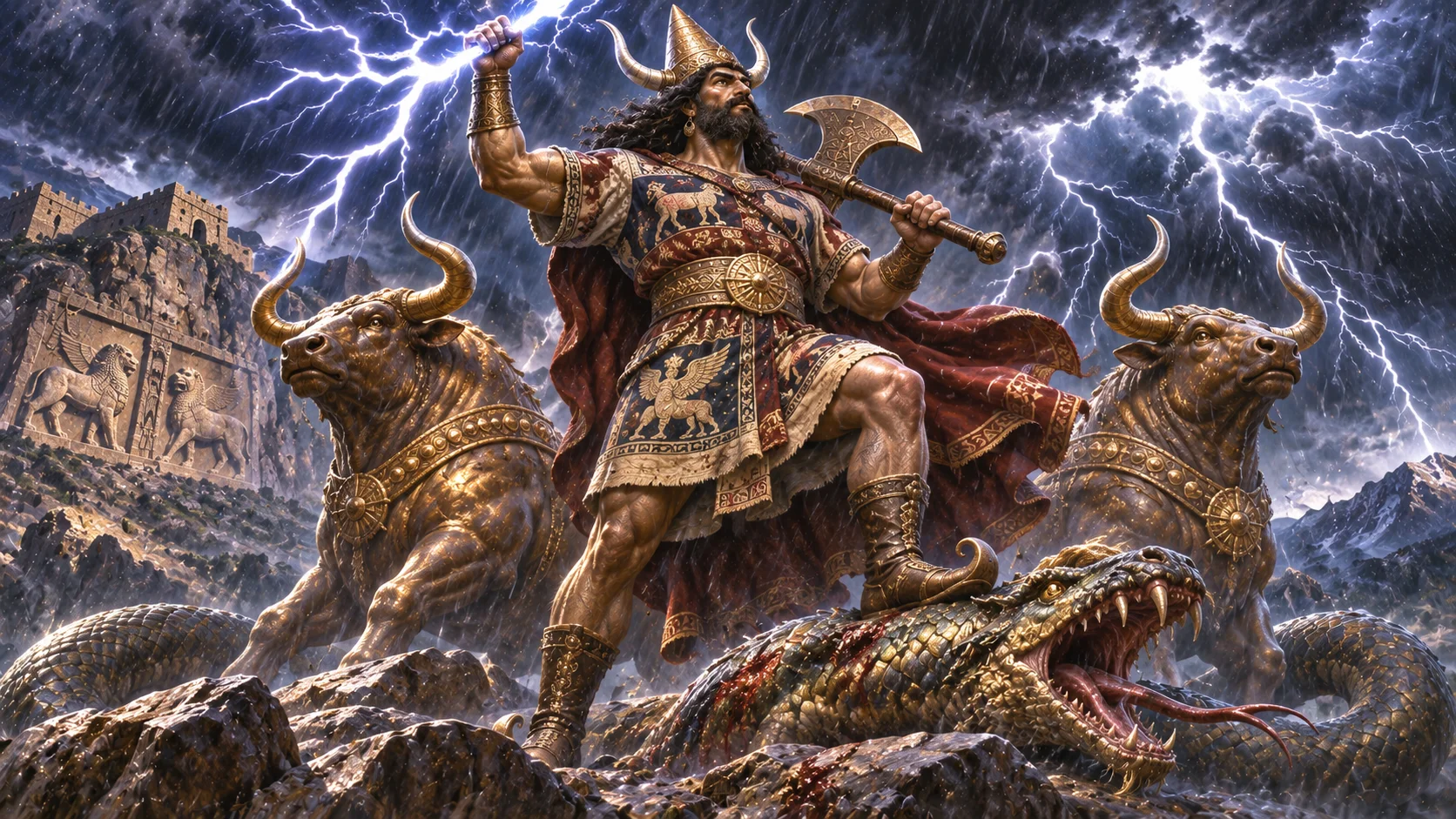
Teshub (written Teššub, Tesup or Teshup in modern books) was the Hurrian god of storm and weather, and the head of the Hurrian pantheon. He was a bearded warrior with a lightning bolt, a king among the gods, and the lord to whom the rulers of Mitanni appealed in their letters to Egypt. Over the course of the Late Bronze Age his cult spread from the Hurrian lands of northern Mesopotamia and Syria into Anatolia, where the Hittite royal house adopted him and set him at the head of its dynastic pantheon. He must not be confused with the Hittite storm god Tarhunna, an older Anatolian deity with whom he was eventually blended, but who was never simply the same god under another name.
Almost everything we know of him comes from clay tablets: Hurrian and Hittite myths, offering lists, treaties and the letters of kings. He is therefore best understood as a figure of the written record, seen through scribes who were often Hittite, not Hurrian, writing about a Hurrian god. Where scholars disagree, this article says so.
Name and etymology
The name is Hurrian and is spelled in cuneiform in many ways; modern authors write it Teššub, Tešub, Teššop or Teshub. No agreed meaning exists. Volkert Haas proposed a link with the Hurrian word teššai, “high”, but Daniel Schwemer rejects the idea, and the etymology remains unresolved. In the first millennium BCE the kingdom of Urartu, in the highlands around Lake Van, worshipped a storm god named Teišeba, whose name is plainly the same word, though it is attested only in sources of that later age.
In texts the god is very often not spelled out at all. Scribes wrote the Sumerian sign for the storm god, which Akkadian readers pronounced Adad and Hittite readers Tarhunna, and left the reader to supply the local name. This habit is the root of many modern confusions: when a Hittite tablet says only “the Storm God”, the scholar must decide from context whether the Hurrian or the Anatolian deity is meant, and in some cases the question cannot be answered.
The sources
The earliest evidence is slight. Personal names containing the god’s name are attested from about the end of the third millennium BCE, the age of the Third Dynasty of Ur. In the following centuries Hurrian names built on Teshub turn up across the Near East: on the Tikunani prism, at Nuzi, at Tell al-Rimah, at Ugarit. By the time of the Mitanni kingdom he was a god of royal courts, and the bulk of our evidence for his myths comes from a later period still, the Hittite archives of the capital Hattusa, where Hurrian poems were copied and translated for a court deeply interested in Hurrian religion. Some copies are bilingual, with Hurrian and Hittite side by side. Several of the original compositions are thought to be much older than the surviving manuscripts.
Other windows on the god are the treaty of the Mitanni king Shattiwaza with the Hittite king Suppiluliuma I, which names the gods of Mitanni as witnesses; the letters of Tushratta of Mitanni to the pharaoh, preserved in the Egyptian archive at Amarna; offering lists from Ugarit on the Syrian coast; and the rock sanctuary of Yazilikaya near Hattusa, where Teshub himself is carved in stone.
The god of the storm
Teshub was a weather god in the full sense: thunder, rain, rivers and the vegetation that depends on them were his gift, and flood and ruin were his threat. He was both destructive and protective. In carvings and descriptions he is bearded and armed, with a three-pronged lightning bolt and sometimes an axe. He is shown riding a chariot drawn by two bulls, called in the texts Sheri and Hurri. Whether those names carry a meaning, such as the “Day” and “Night” once offered by popular books, is not firmly established, and it is safest to treat them simply as the names of his animals.
He is also a god of mountains. At Yazilikaya he stands upon two figures that represent mountain gods, usually read as Namni and Hazzi. Hazzi is generally identified with Jebel Aqra on the Syrian coast, the mountain the Greeks called Kasios; in the texts it is a divine peak, and Teshub’s battles with the sea are associated with it. A god who strides over the summits and who sends the clouds that gather on them is a very natural figure in the highland world in which the Hurrians lived.
His family and his court
The Hurrian offering lists, which are formal catalogues of the gods in order of rank, give Teshub a full household. His wife is Hepat, the goddess of Aleppo. Their children are the god Sharruma, a protective deity often shown as a bull or in human form beside his father, and the goddesses Allanzu and Kunzishalli. His siblings are Shaushka (the Ishtar of Nineveh of the Mesopotamians), Tashmishu, whom Piotr Taracha calls his twin and divine vizier, and Aranzah, the Hurrian name for the river Tigris. The court that attends him includes the two bulls and the mountain gods Namni and Hazzi.
His parentage is told in the myths. He is the son of Anu, the sky, and of Kumarbi, the father of the gods, in a story in which Kumarbi, having bitten off and swallowed the sky god’s manhood, becomes pregnant with the storm god. One isolated, wholly logographic text (KUB 33.89+) names the moon god Kushuh as his father instead, and a hymn calls Anu his father and Kumarbi his mother; the variants show the tradition was not fixed.
The Song of Emergence and the kingship in heaven
The poem usually called the Song of Emergence, or the Song of Kumarbi, is the most important Hurrian myth of divine succession, and it explains why the storm god is king. In it, rulership in heaven passes through a sequence of divine kings: Alalu first, then Anu, then Kumarbi. Kumarbi attacks Anu and bites off his genitals; the sky god escapes into the heavens, but the act leaves Kumarbi pregnant. Several gods are born from him, Teshub among them. The tablet is broken and mended badly around the birth itself, and the ancient scribes seem to have disagreed about just how the storm god left his father’s body, so no single account of it should be treated as certain.
The best-preserved tablet was written by a scribe named Ashhapala, whom Amir Gilan (2021) places in the reign of a king Tudhaliya (read as Tudhaliya I); its colophon refers to an older, damaged exemplar, so the composition is older still. The Hittite text is an adaptation of a lost, probably Hurrian, original. The text is fragmentary, and the details of the quarrels among the gods are partly lost. Still, the pattern is clear: a young storm god supplants an older line of divine kings, and the victory is won by violence and cleverness alike.
The similarity to the Greek story of Ouranos, Kronos and Zeus has been noticed since the cycle was recovered, and it is a staple of comparative study. Gary Beckman has called the theme of conflict over kingship in heaven a “theological areal feature”, a motif shared by the cultures of the region, rather than a borrowing by the Greeks from one specific text. Jenny Strauss Clay and Amir Gilan (2014) have argued that the Greek poet’s unusual use of the verb “to emerge” for giving birth has a close parallel in the Hittite Song of Emergence, and that this may point to more direct contact than was once assumed; one suggestion for a setting is performances of the song near Mount Hazzi on the Syrian coast. How, and whether, the story reached Hesiod remains an open question.
Kumarbi’s challengers
The kingship won, it has to be defended. Modern scholars group several poems as the Kumarbi cycle, in which the deposed father produces rivals for his son; some scholars would rename it the Teshub cycle because the storm god is the constant, and others prefer a title about kingship in heaven. Which texts belong to it is debated, and the order of the songs is conventional rather than certain.
- The Song of LAMMA is very fragmentary; it concerns a contest over kingship in which the tutelary god LAMMA is involved, and Shaushka is addressed in it as Teshub’s sister.
- In the Song of Silver Kumarbi fathers a son called Silver on a mortal woman and so produces a further rival for the storm god. The text is fragmentary and the place of this song in the cycle is disputed.
- In the Song of Hedammu Kumarbi fathers a sea monster on a daughter of the Sea. Shaushka, with her attendants Ninatta and Kulitta, takes the lead in subduing him.
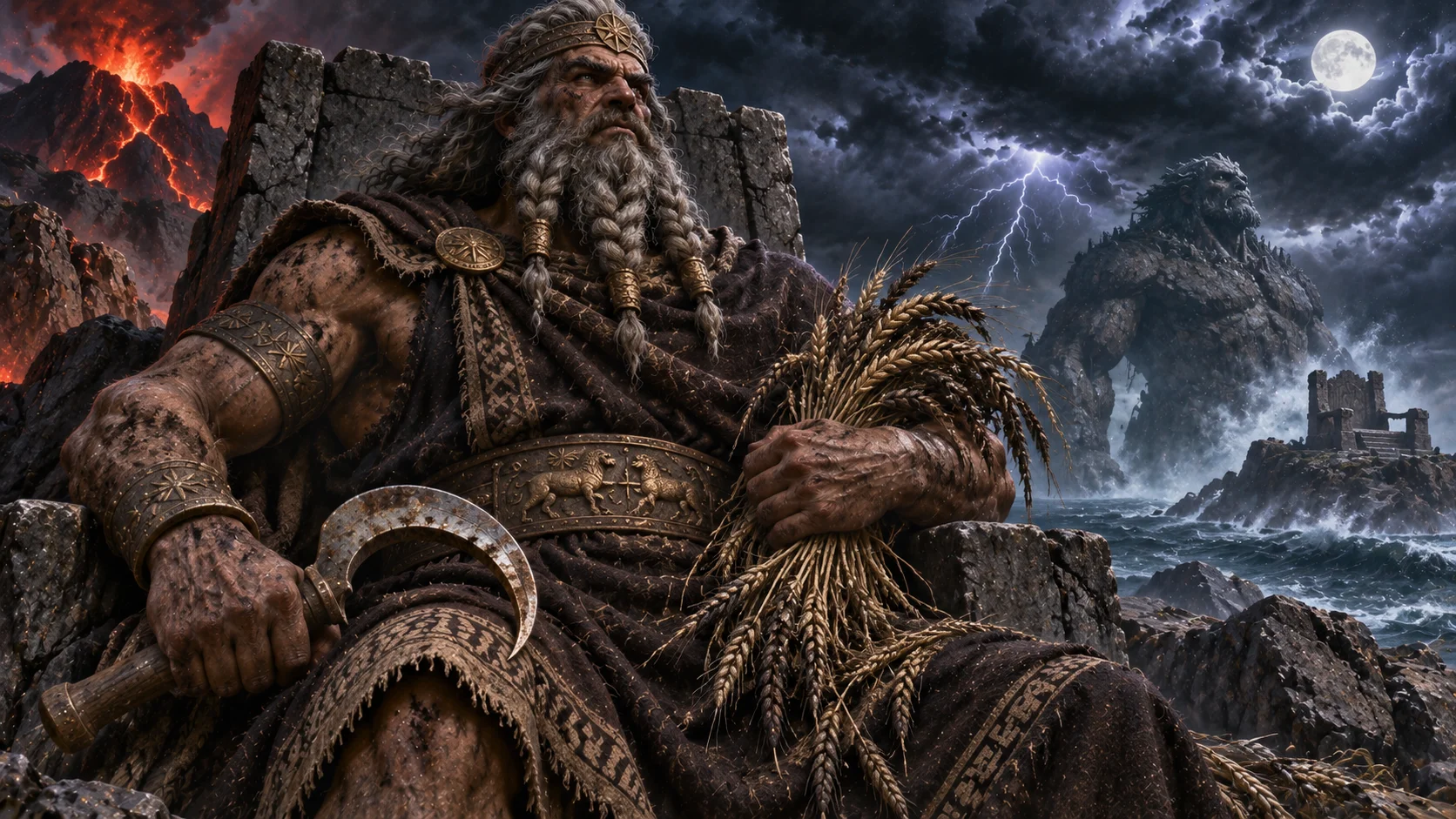
- In the Song of Ullikummi Kumarbi begets a stone monster, deaf and blind and growing without end, which is set on the shoulder of the giant Upelluri, who does not notice it. Teshub’s storms cannot harm the stone; he is forced to flee, and Ea cuts the monster from its base with an old copper tool. The ending is lost, and scholars assume the monster was defeated.
The last of these has often been set beside the Greek story of Typhon, the monster who defeated Zeus before the god recovered his power. Other texts, such as the Song of the Sea, the tale of Ea and the Beast, and the story of Appu, are sometimes counted among the related material.
A different poem, the Song of Release, shows the god in another light. In it Teshub demands, through a messenger, that the king of Ebla free the people of a town called Igingalliš, who are held there, and threatens the city if he refuses. The Hittite copies are bilingual Hurrian-Hittite tablets from Hattusa, and some scholars have linked the tale to the fall of Ebla, though this is uncertain. The interpretation of the poem, and of the god’s meetings with the goddesses Ishara and Allani, is disputed.
A god of kingdoms and cities
Teshub was never one deity of one city but a god who took local forms. The cult place that Hurrian sources treat as his chief seat was Kumme, a holy city whose location is uncertain and which is last mentioned in Neo-Assyrian sources. At Arrapha, the site of modern Kirkuk, a kingdom whose rulers bore names built on his, his worship was prominent. At Aleppo, which had belonged for centuries to the Syrian weather god Adad, Hurrian influence put Teshub alongside and over the older god; there he and Hepat were the divine couple of the city. In Kizzuwatna, the Hurrianized kingdom of southeastern Anatolia, he was worshipped at the city of Kummanni.
In Mitanni, the great kingdom of the Hurrians in the later second millennium, the Shattiwaza treaty names forms of Teshub at Kahat (modern Tell Barri, the main Teshub centre of the Mitanni heartland), Wassukkanni (the royal capital), Uhushumani and Irride, whose locations are partly uncertain. The same treaty calls on the Indo-Aryan gods Mitra, Varuna, Indra and the Nasatyas, a famous trace of an Indo-Aryan element in the Mitanni elite. Tushratta, in his letters to Amenhotep III and to his son, names Teshub and Shaushka and writes of sending the statue of Shaushka of Nineveh to Egypt.
On the Syrian coast the Hurrian gods were received at Ugarit in the thirteenth century BCE. A study by Wilfred van Soldt (2016) counted seventy persons at the city with names built on his. There he coexisted with the local weather god Baal, and the relationship is debated; van Soldt suggests that the name may at times stand for Baal, while Mary Buck (2019) concludes that the two gods existed side by side.
Teshub among the Hittites
The Hittites, who lived in central Anatolia, already had a weather god, Tarhunna, and there is no evidence that Teshub was worshipped in the capital in the earliest period of the kingdom. The Old Kingdom king Hattusili I mentions seizing a weather-god statue from the city of Hassuwa, but that is not yet the cult of Teshub in Hattusa. How the Hurrian god arrived is debated: Piotr Taracha ties his introduction to a new dynasty that came from Kizzuwatna, while Alfonso Archi suggests that he first entered Hittite lands under Suppiluliuma I. Under Queen Puduhepa some decades later, the effort to harmonise the Hurrian and Hittite pantheons was pushed further, and the great state prayers show gods of both traditions invoked together.
In Hattusa itself a temple of the Hittite storm god Taparwashu was assigned to Teshub of Aleppo and his consort Hepat, and the cult there kept a Hurrian character, with thirteen festivals celebrated in their honour, perhaps monthly with an extra festival in leap years. In the treaty of Suppiluliuma with Shunashshura of Kizzuwatna, Teshub of Aleppo and Hepat follow the main Hittite divine triad. Local forms of the god are known at Shapinuwa, Katapa, Arinna, Ankuwa and elsewhere.
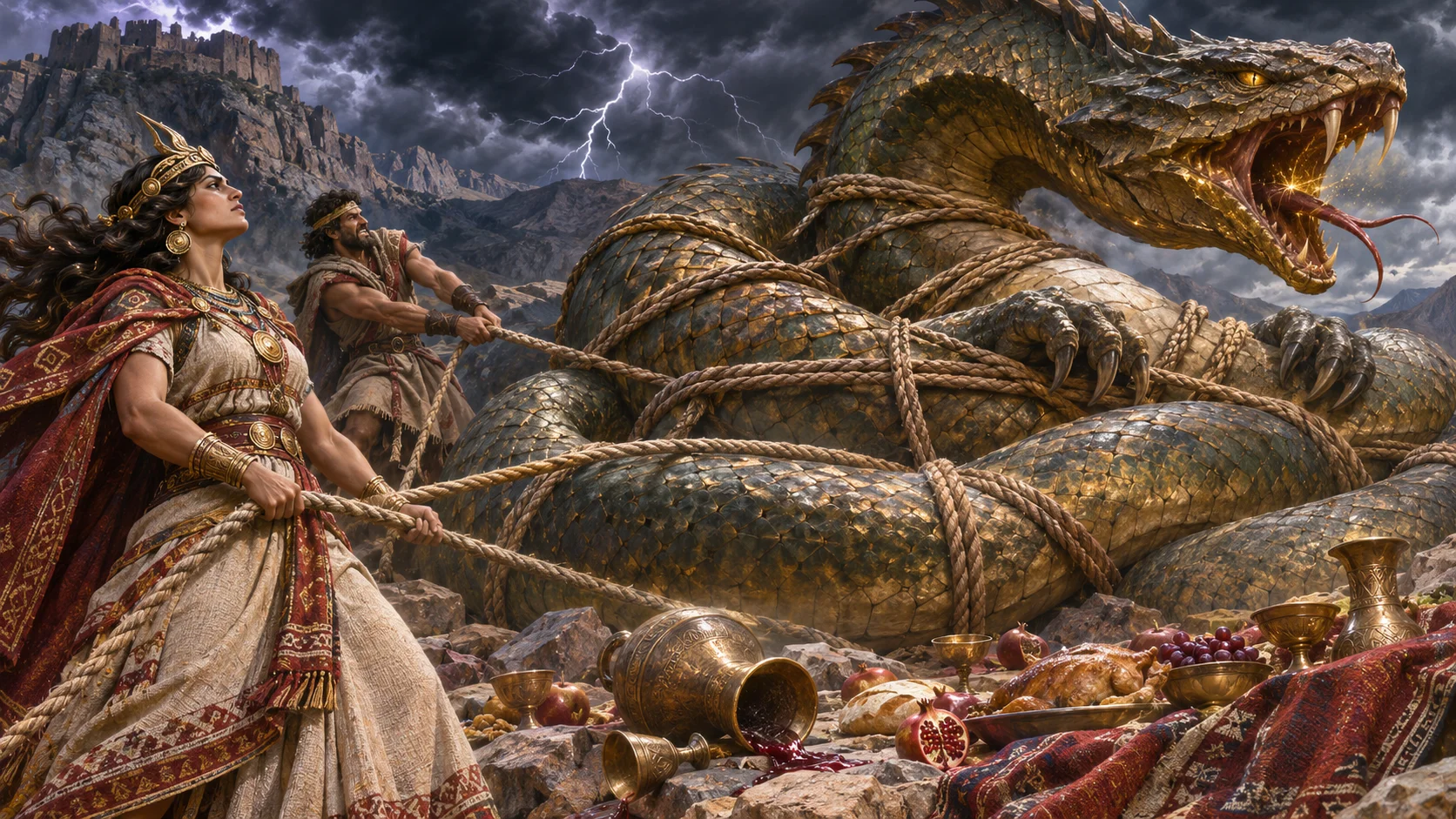
This is also the place to correct a common over-simplification. Older summaries describe Teshub as chief god of the Hittite state religion and as the slayer of the dragon Illuyanka at the spring festival, and that mixes two figures. The hero of the Illuyanka story is the Hittite storm god, written with the Sumerian sign for the weather god and read as Tarhunna in Hittite; the myth is tied to Nerik and the Hattian tradition and belongs to the spring festival of the purulli, and Ian Rutherford has cautioned that a mention of the serpent in the text of Ea and the Beast does not clearly refer to it. In its first version the dragon defeats the god and is tricked by the goddess Inara with the help of a mortal, Hupasiya; in its second the dragon takes the god’s heart and eyes, and the god’s son marries the dragon’s daughter in order to recover them. Whoever calls this god Teshub is using the later, blended identification, and should say so.
Yazilikaya
Near Hattusa lies Yazilikaya, whose name means “inscribed rock”, a sanctuary of two open-air chambers in the rock. Most of the carving belongs to the late thirteenth century BCE, in the age of Tudhaliya IV and of his son Suppiluliuma II, though the site was in use earlier. In the larger chamber a procession of some sixty gods meets at the end wall: males, in kilts and horned caps, on the left, and goddesses, in tall crowns and long dresses, on the right. At the meeting point the storm god, labelled in Hieroglyphic Luwian with his Hurrian name, stands on the two mountain gods, facing Hepat, who stands on a leopard. Behind her come her children Sharruma, Allanzu and Kunzishalli, and the procession of goddesses follows the order of the Hurrian offering lists.
The reading of the whole sanctuary is still disputed. Some scholars see a festival of renewal or a divine wedding, some a model of the cosmos, and some a calendrical device. A relief in the smaller chamber, showing Sharruma embracing Tudhaliya IV, is widely understood to show the god as the personal protector of that king.
Later centuries
When the Hittite empire collapsed around 1200 BCE, the god did not vanish. In the Neo-Hittite and Aramaean states of Syria and southern Anatolia in the first millennium, Teshub was identified with the local Luwian storm god Tarhunz and worshipped with Hepat, Sharruma and Allanzu. An inscription at Til Barsip by Hamiyata of Masuwari lists Teshub among the gods who loved him. In Urartu Teisheba stood at the head of the pantheon. In Assyrian sources the old holy city of Kumme is last mentioned. Eventually the name fades from the record.
Rediscovery
The modern recovery of the god began with the ruins at Bogazkoy, noted by Charles Texier in 1834 and excavated from 1906 by Hugo Winckler, who recovered thousands of tablets that now make up the Hittite archive. The poems of the Kumarbi cycle were pieced together in the following decades. The comparison of the Illuyanka and Typhon stories was proposed by W. Porzig in 1930, when few agreed with him, since the Kumarbi texts were not yet understood. The great modern surveys of the storm gods of the ancient Near East, by Daniel Schwemer and others, have set Teshub in the wider family of weather gods. Many fragments remain unplaced, and some of the stories are lost.
Kindred gods
Teshub has counterparts in nearly every culture of the region. He is the Hurrian equivalent of the Mesopotamian Adad, the Ugaritic Baal and the Luwian Tarhunz; the Hittite Tarhunna, who was partly blended with him, kept a separate identity; and the Urartian Teisheba is his later namesake. The most distant comparison is the Greek Zeus, whose succession story and whose fight with Typhon resemble the Hurrian poems closely enough to have started a century of debate.
What remains most striking in the Hurrian evidence is the way a single god could be both ordinary and exalted: the god invoked by a king writing to a pharaoh, the lord of a pair of mountain peaks, and a husband and father whose household is catalogued like a human court. He is a storm god who is also, throughout, a king, whose power was always described as having been won and then defended against a series of challengers.
Sources & traditions
- EncyclopediaWikipedia — Teshub
- TraditionHittite texts, inscriptions and later retellings (Anatolia)
Myths change from area to area and from time to time. This chronicle follows the most widely told versions; tellings in other villages, regions and eras may differ.