Telipinu was a god of the Hittites of Bronze Age Anatolia, a deity of farming and growth, son of the weather god and of the Sun Goddess of Arinna, and the protagonist of the best-preserved of the Hittite “vanishing god” myths. In that story he flies into a rage and goes away, and with him go grain, fertility, and the ordinary processes by which the world continues. Fields stop bearing, animals and people cannot conceive or give birth, and famine threatens gods and mortals alike. A search is organised, a bee finds the sleeper, and a goddess of magic draws the anger out of him and locks it away below the earth. He returns, and life resumes.
The religion in which he was worshipped has been dead for more than three thousand years. What we know comes from tablets found in the Hittite capital, and the myth survives not as free literature but as the spoken part of a ritual. That fact shapes the whole subject: Telipinu is first a god one performed for, and only afterwards a character in a tale.
Name, origin and family
Telipinu is a Hattian god. The Hattians were the people of central Anatolia before the Hittites arrived and imposed their Indo-European language on the ruling class, and the Hattic form of his name is given as Talipinu or Talapinu, which scholars gloss as “exalted son” (the form Telepinu occurs in the older books). The Hittites took the god over with his name in a Hittite form. Gary Beckman’s long entry on the god in the standard reference work of Assyriology is the main modern treatment.
His parents were the weather god Tarhunna and the Sun Goddess of Arinna, the royal pair at the head of the Hittite pantheon. His siblings, in the same family tradition, included Mezulla and the weather gods of the towns of Nerik and Zippalanda. His wife is named as Hatepuna, and at certain cult centres he is paired with other goddesses, Sepuru and Katahha among them. The tradition of relationship was not uniform, and one source of confusion is that a god of this kind appears in many local forms.
What kind of god he was
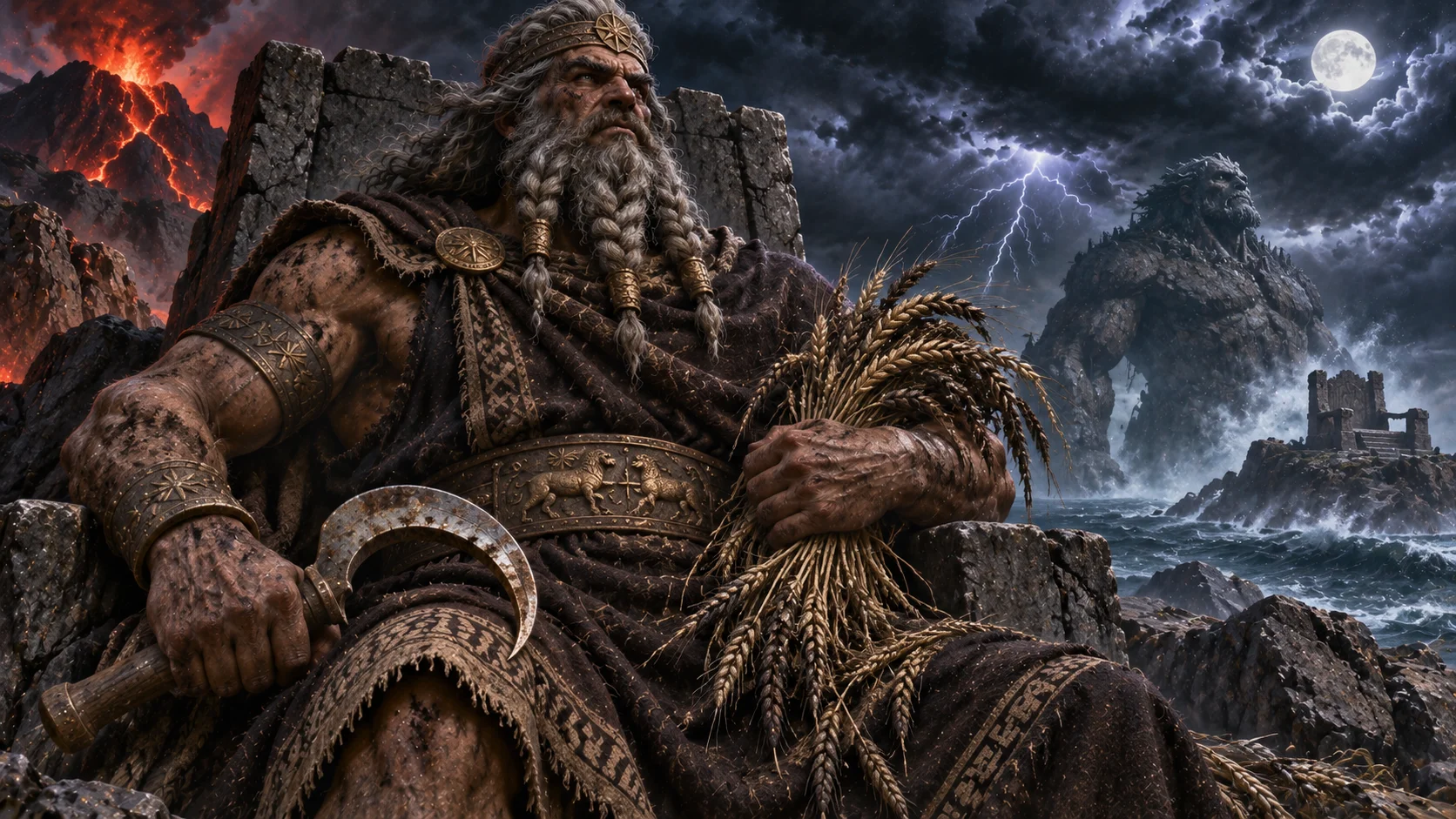
The usual description is that he was a god of agriculture, a patron of fields, harvests and the fertility of herds. That is probably right, but it is an inference, since the texts do not say it in a single sentence. Some scholars have proposed instead that he was a storm god of a secondary kind or the embodiment of the crops themselves. The difficulty is that the story of his disappearance, which is the chief source for his character, belongs to a type: there are comparable myths about other deities that are unconnected with him, such as the goddesses Anzili and Zukki, and one entry in the reference works concludes that little can be learned about the nature of Telipinu from this story alone. We should be careful about reading too much into it.
The sources
The Hittite archive of Hattusa (modern Bogazkoy), found by Hugo Winckler from 1906, holds some thirty thousand tablets, and it is from there that the Telipinu texts come. The principal text, the Disappearance of Telipinu, is catalogued as CTH 324, and it is the best preserved of several vanishing-god compositions. Fragments of other versions exist. The beginning of the main tablet is damaged, and so the reason for the god’s anger, which the text must once have given, is lost to us. Anyone who writes confidently of why he went away is guessing.
The texts are in Hittite, but the setting is Hattian. In the archive one finds Hattic words embedded in the ritual formulas, the sign of an older layer of religion that the Hittite scribes preserved without fully translating.
The myth of the vanishing god
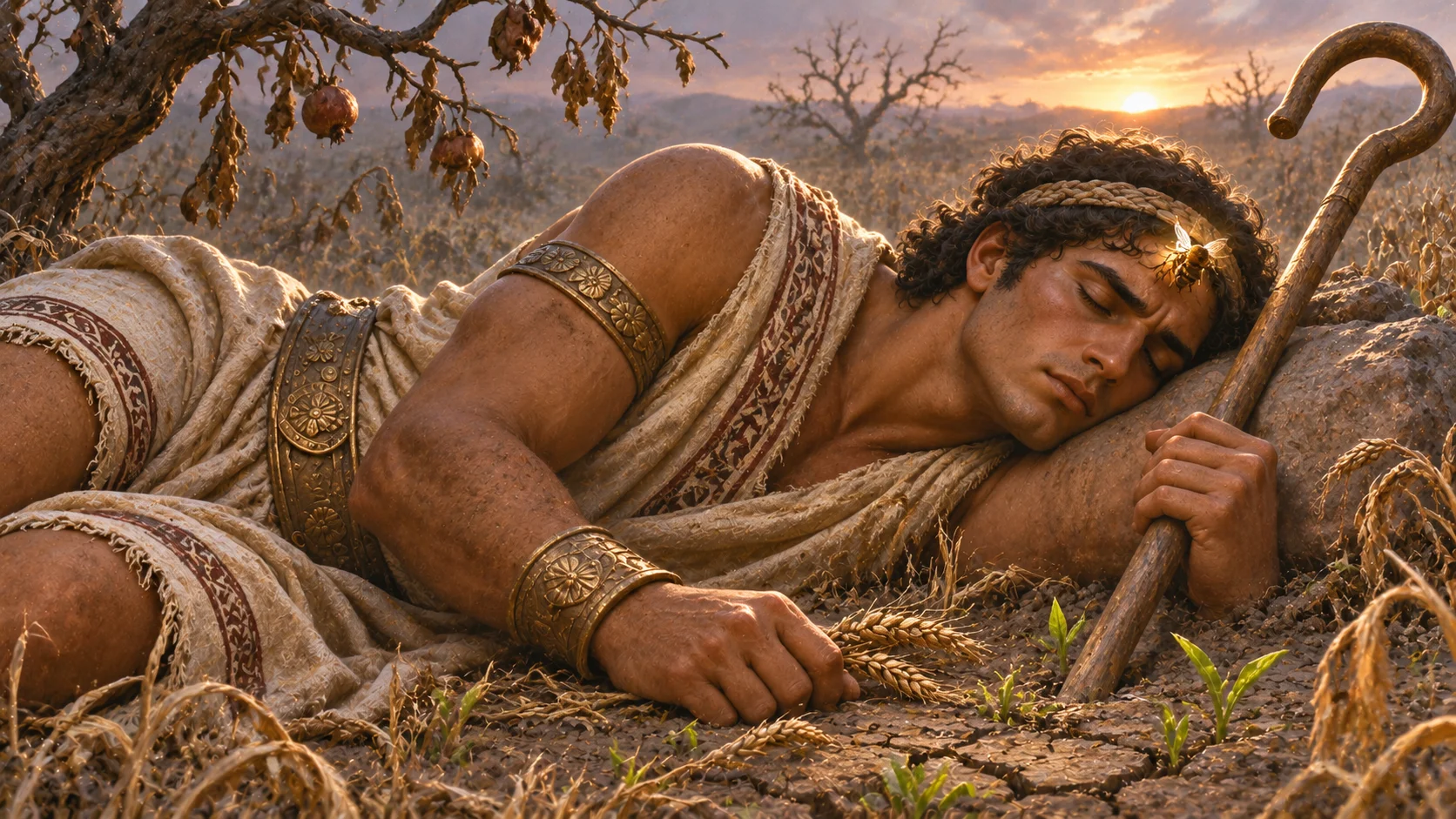
The story, as far as the damaged tablet allows it to be reconstructed, runs as follows. Telipinu becomes angry and leaves. In some translations of the opening, in his haste he puts his shoes on the wrong feet. He takes with him the grain, the fertility of the herds, growth, abundance and satiety, and goes into the wilderness, where he lies down in a meadow and falls asleep. Mist covers the windows and smoke fills the house. The fire in the hearth is smothered; the gods on their altars are stifled; the sheep in the fold are stifled and so are the cattle in the pen. The ewe turns from her lamb and the cow from her calf. Barley and wheat do not ripen, and gods and men starve.
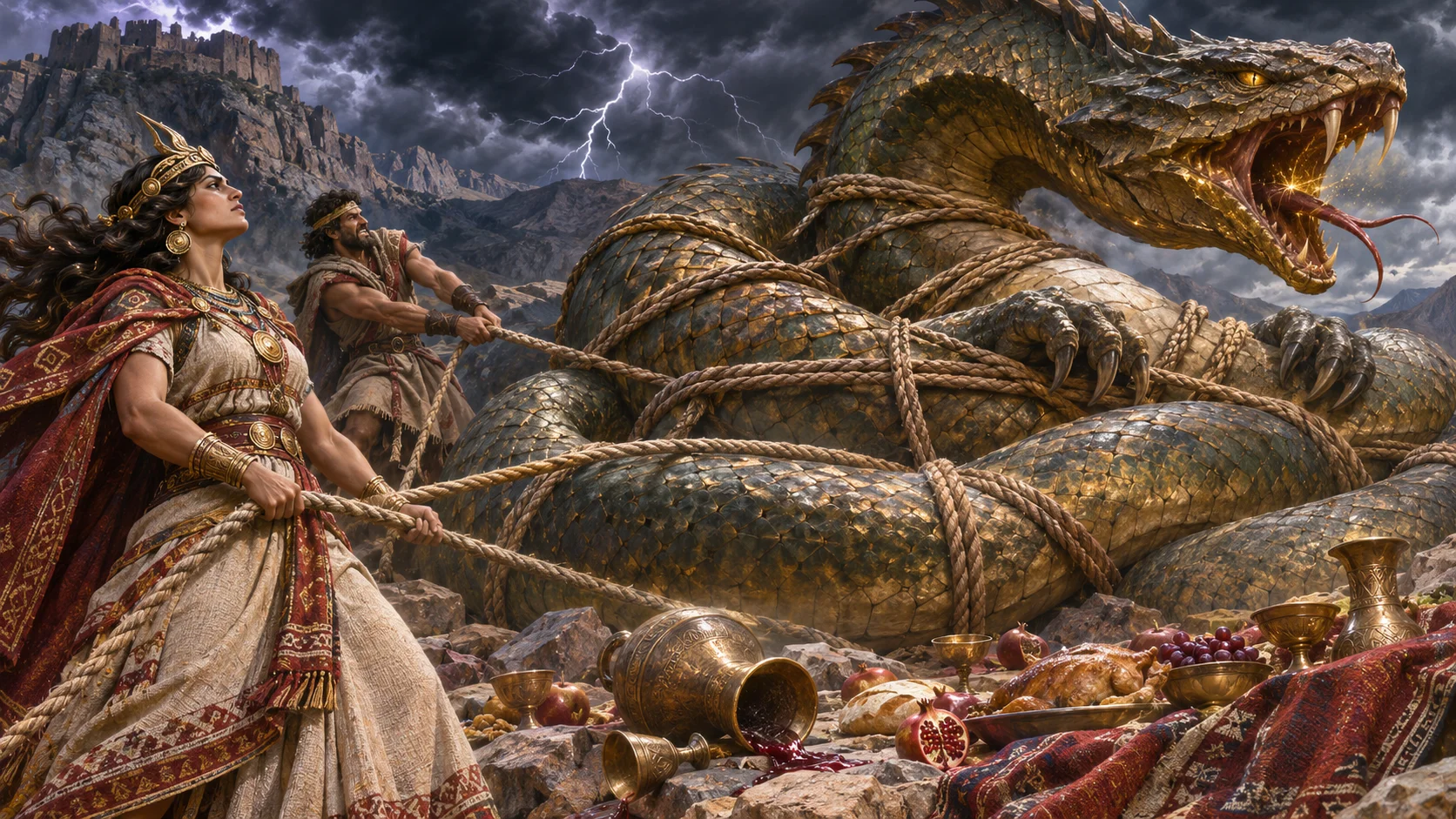
The gods search. The Sun god sends an eagle, and the eagle returns without having found him. The Storm god, who is his father, also turns to the search and gives up. The mother goddess Hannahanna, whose name means “grandmother”, then sends a bee. Hoffner’s translation has the gods sceptical that so small a creature can succeed where the greater gods have failed; the bee goes, finds Telipinu asleep, and stings his hands and feet to wake him, and wipes his eyes and feet with wax to purify him. Sources vary as to the exact sequence of who consults whom, and a translation should be checked against the tablet itself.
The sting does not please the god. Awake, he is angrier than before and begins to destroy: he wreaks havoc on the land. It is the goddess Kamrusepa, the Hittite goddess of magic and healing, who does what the gods have not been able to do, by ritual. Her procedure calls for twelve sheep from the Sun god’s flock to be brought to Hapantali, a shepherd goddess of Luwian origin. The anger of Telipinu is then drawn out and sent below: the doorkeeper of the Dark Earth opens the seven doors and draws back the seven bolts, and down in the earth stand bronze vessels with lids of lead, and whatever goes into them does not come out again. The anger is sealed there. In another version (as given in Pritchard’s anthology), it is a mortal priest and not the goddess who prays that Telipinu’s wrath may go into the bronze containers of the underworld.
When the rage has gone, the god comes home, to his own house and his own land, and with his return life is restored. The ritual that frames the story is concerned in the end with the well-being of the king and queen and of the land, which were the true subject of the performance.
Other vanishing gods
The Hittites told the same story of other gods, and the pattern is among the most distinctive features of their religion. The mother goddess Hannahanna herself disappears in a fragmentary myth: in her anger she goes away, cattle and sheep suffocate, and mothers, human and animal, neglect their young; her anger is banished to the Dark Earth, and she returns, and mothers care for their children again. The goddess Inara is missing in another text, and the Storm god also vanishes. Some of the texts are in short form, in which the vanishing is mentioned only briefly before the ritual. Together they make up a small genre, whose function in each case is the same: to supply the myth that a ritual for calling back an angry or absent god should recite.
A separate fragmentary text has Hannahanna advise the storm god to pay the bride price to Aruna, the Sea, for the Sea’s daughter, so that she may marry Telipinu; its full course is not clear.
Cult and festivals
The god had a cult of his own and an important one. According to Gary Beckman’s summary, texts describe an autumn festival, held every nine years at the towns of Hanhana and Kashha, in which a thousand sheep and fifty oxen were sacrificed and the symbol of the god, an oak tree, was replanted. The detail of a great quantity of animals, and the replanting of the tree, point to a festival of renewal on a large scale. Telipinu was also invoked in a daily prayer formula for the king in the reign of Mursili II, which shows his place in royal devotion as well as in the agricultural cycle.
The vanishing-god ritual may not have been tied to a fixed calendar. It belonged to the practical side of the religion. The Hittite kings and their ritual specialists reacted to crisis: plague, drought, military defeat or illness. When the order of things went wrong, the explanation was that a god was angry or absent, and the remedy was a ritual of soothing and recalling. Telipinu’s myth is the model of such an episode, in which the offended god is first found, then restrained by his own indignation, and finally appeased.
Kamrusepa and the bee
Two minor characters deserve a note. Kamrusepa is a goddess attested in the oldest texts, from Kanesh, and she remained known through the Hittite period; her standing was high in Luwian religion, and she is especially well attested in the incantations of Kizzuwatna. Her name may mean something like “spirit of the clouds” or “spirit of smoke”, though that is possibly folk etymology. She was credited with the invention of ritual procedures that were then passed on to humans, and in some sources she appears as a divine midwife. Her attribute was an iron throne, and she travelled in a horse-drawn chariot.
The bee is the most remembered figure of the story. That the least of creatures should accomplish what the eagle and the storm god could not is a motif which appears in the folklore of many peoples. The Hittite scribes were not concerned with the moral; the bee works because its sting and its wax are the elements of a purification. Even so, it is the bee that is the first to move the god, and the story admits that this movement was not a cure but a provocation which called for the more skilled hand of the goddess of magic.
Not the king: a note on names
The name Telipinu was also given to men. A Hittite king called Telipinu, who ruled in the Old Kingdom some time in the sixteenth century BCE, is known above all for the edict now called the Telipinu Proclamation, which sets out a history of the dynasty and rules for succession to the throne. This is an entirely different person and has no part in the myth. The king bore the god’s name, as rulers elsewhere were named after deities. Readers who meet “Telipinu” in an account of Hittite law or politics will be reading about the king.
Comparisons, and their limits
It has long been the practice to place Telipinu beside other gods who disappear and return, among them the Mesopotamian Dumuzi, the Canaanite Baal and the Greek Persephone and her mother Demeter. The comparison is natural, but it should be handled with care. Telipinu does not die; he does not descend into the netherworld, and he is not mourned. He is angry and absent, and the problem is not his death but his refusal to be present. A closer structural parallel is found in the Hittite Hannahanna myth, and in Anzili and Zukki. A further suggestion, that the Greek hero Telephus preserves the name of the god, and that a Caucasian figure called Telepia is related, has been offered, but the identification is uncertain.
Decline and rediscovery
When the Hittite kingdom ended, around 1200 BCE, the cult of Telipinu ended with it. The tablets lay in the ruins of Hattusa until the late nineteenth and early twentieth centuries, when the site was recognised and then excavated, and when the Hittite language was shown to be a member of the Indo-European family. The myth of Telipinu was read and published in the decades that followed, and it is among the best preserved of the Hittite myths. Translations by Harry Hoffner and Gary Beckman, among others, have made it generally available.
A closing reflection
The story of Telipinu says something about how the Hittites understood their world. Abundance is not a natural state but a favour; the gods are present only so long as they are content; and the proper response to disaster is neither argument nor fighting, but patient search, purification and the careful sealing away of anger. It is a calm theology of crisis, and its central image, a god asleep in a meadow while a whole land goes hungry, has a force that does not depend on knowing the religion that produced it.
Sources & traditions
- EncyclopediaWikipedia — Telipinu (mythology)
- TraditionHittite texts, inscriptions and later retellings (Anatolia)
Myths change from area to area and from time to time. This chronicle follows the most widely told versions; tellings in other villages, regions and eras may differ.