Arinniti, the “Arinnian”, is the name by which the Hittites invoked the Sun Goddess of Arinna, the chief goddess of their state religion and the companion of the weather god Tarhunna. Together the two stood at the head of the pantheon, and kings and queens who addressed her in prayer called her mistress, queen of all the lands and, in the case of the king, mother. She is a rare and arresting figure among the great deities of the Bronze Age: the supreme solar power of a major kingdom was female, and her cult was older than the Hittites themselves, since she had been worshipped by the Hattian people of central Anatolia before the speakers of Hittite arrived.
Her tradition is a dead one, known to us almost entirely from the archives of the Hittite capital Hattusa. She is therefore described here as history, in the past tense, with attention to what the tablets actually say and to the points on which scholars still disagree.
Names and etymology
The Hittites knew the goddess under several names, and their layering reflects the layering of the people who lived in the land. In the Hattian language of the pre-Hittite population she was Estan, the word for the sun. A Hattian epithet of hers, Wurunshemu (the spelling varies, Wurusemu or Wuru(n)semu in the books), is sometimes interpreted as meaning something like “mother of the land”, though the sense is not secure. The Hittites turned the Hattian forms into Ishtanu and Urunzimu in their own spelling, and they called her Arinitti, Arinniti, or “she of Arinna”, after the city that was the chief seat of her cult.
The identification of the solar deities is hard, because the tablets very often write the name with only the Sumerian sign for a sun deity, and the reader has to decide from context which sun is meant. Earlier scholars read Ishtanu as a male Sun god of Heaven, but Jörg Klinger holds that the name refers only to the goddess, and Maciej Popko argues that there was no male solar deity in the early northern Hittite sphere. Volkert Haas distinguishes a male Ishtanu, the day-star, from a female Wurunshemu, who spends her nights in the underworld. The matter is not settled.
Where we meet her: the sources
Hattusa, the capital, near modern Bogazkoy in Turkey, was noticed by Charles Texier in 1834 and excavated from 1906 by Hugo Winckler, who recovered thousands of cuneiform tablets. The archive that resulted holds some thirty thousand tablets, and it is from these that the religion of the Hittites is reconstructed. It does not contain a canon of scripture, theology or private devotion; the texts are mostly administrative and practical: rituals, temple inventories, festival schedules, oracle reports, treaties, royal annals and prayers. The Sun Goddess of Arinna appears in all these kinds of text, but only a little in myth. She is a goddess known above all from the ritual and the royal petition.
Two further kinds of evidence deserve mention. The first is the long lists of divine witnesses at the end of state treaties, in which the gods of Hatti are called on in order of rank to see that oaths are kept; the Sun Goddess of Arinna stands near the head of them. This is the context for the Hittite phrase of “the thousand gods of Hatti”, a way of saying that the divine assembly was numberless and included the local gods of every town the kings controlled. The second is the sanctuary at Yazilikaya outside Hattusa, where a great procession of deities is carved in stone, and where the figures of the central scene give a visual record of the pantheon as it was understood in the thirteenth century BCE.
The queen of Hatti
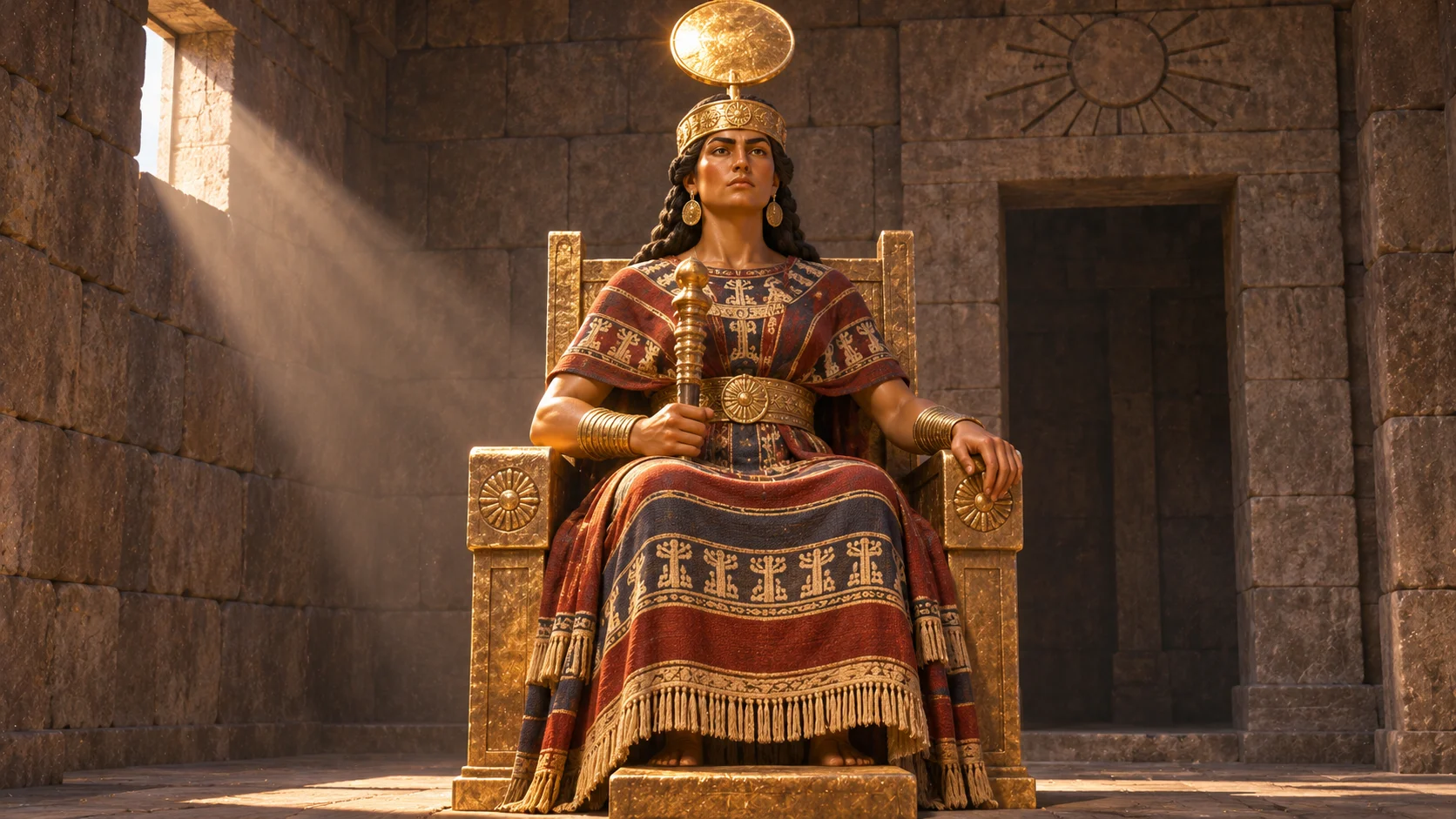
In the formulas of the royal prayers the goddess is the queen of the land of Hatti, indeed of all lands, and she is the mother of the king. From the Old Kingdom onward she took part with Tarhunna in legitimising kingship: the ruler held his throne by the favour of these two. In the New Kingdom the king was understood to be her priest and the queen her priestess. Queens made dedications to her, among them solar discs venerated at the town of Tarhurpa. The oldest known prayer to her is the work of Arnuwanda I, and the best known is the one composed by Queen Puduhepa, discussed below.
The kings of the late fourteenth century especially cultivated her. Mursili II addressed her as his lady in his prayers, among them a prayer devoted to her. In the following century the same relationship is visible in the royal inscriptions of Hattusili III and in the prayers of his wife Puduhepa.
Her nature and her attributes
Her character is more complex than the label of a sun goddess suggests. In the ritual texts she is a goddess of the land and of the underworld as well as of the sky. In the standard Hittite view there were three solar deities: the Sun god of Heaven, the Sun goddess of the Earth who belonged to the underworld, and the Sun Goddess of Arinna, who is held to be the most important of them. Haas believed that the goddess he called Wurunshemu spent her nights below. At the same time, she was the divine sovereign who judged and protected, and from whom the kings sought justice for their land.
Her symbol was the solar disc, and the deer was an animal sacred to her. Puduhepa promised her many deer. Some scholars connect golden figurines of deer from the Early Bronze Age, found on the Kizilirmak river, with her cult, which would take the roots of her worship far back before the age of the Hittite kings; this is a belief rather than a demonstrated fact.
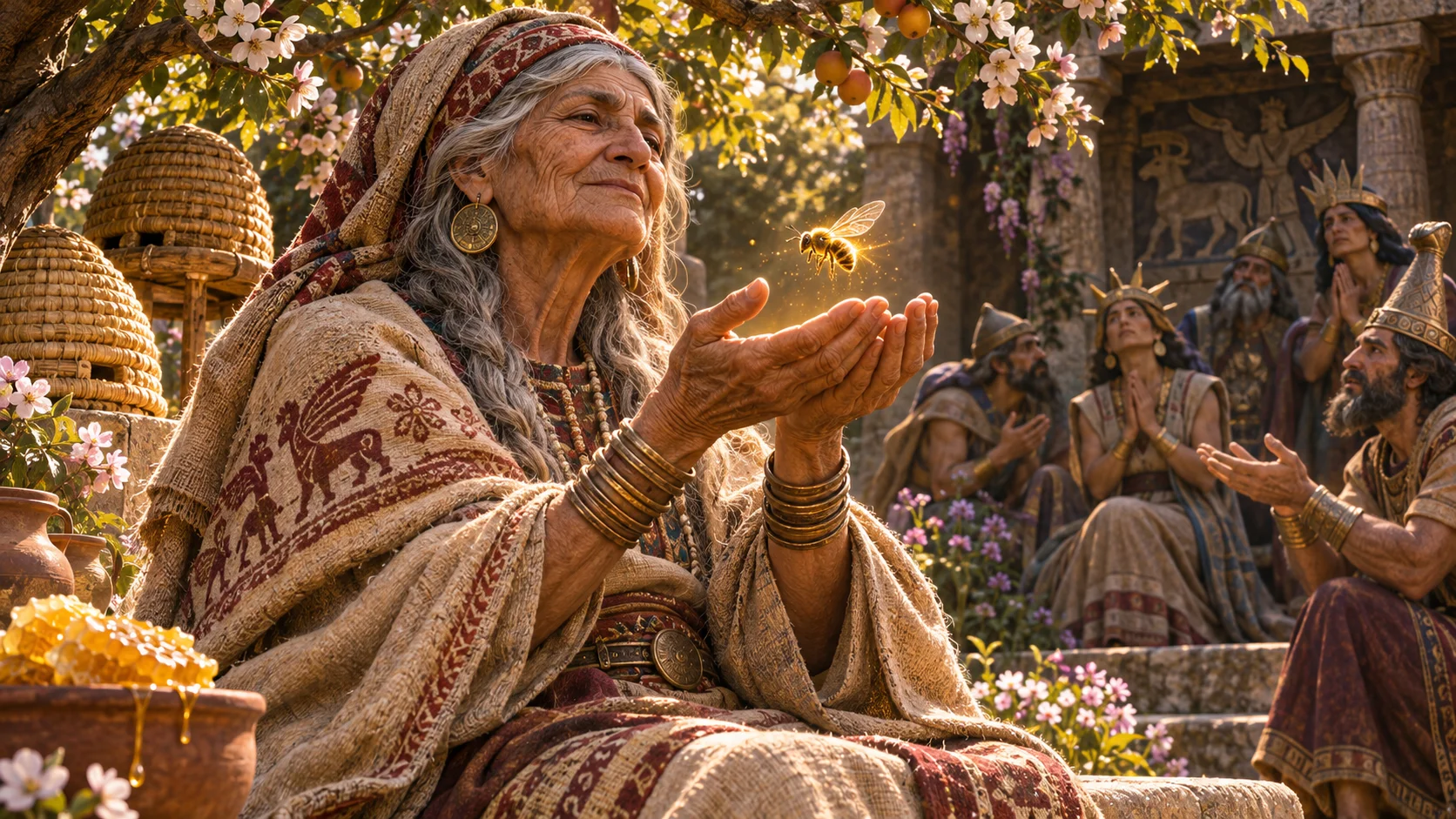
In myth she plays a small part. A Hattian fragment mentions her house at the town of Lihzina, and another describes her decorating an apple tree beside a well. These scraps preserve the sense of a deity with a household and a range of local concerns, but they do not add up to a full story.
Husband and children
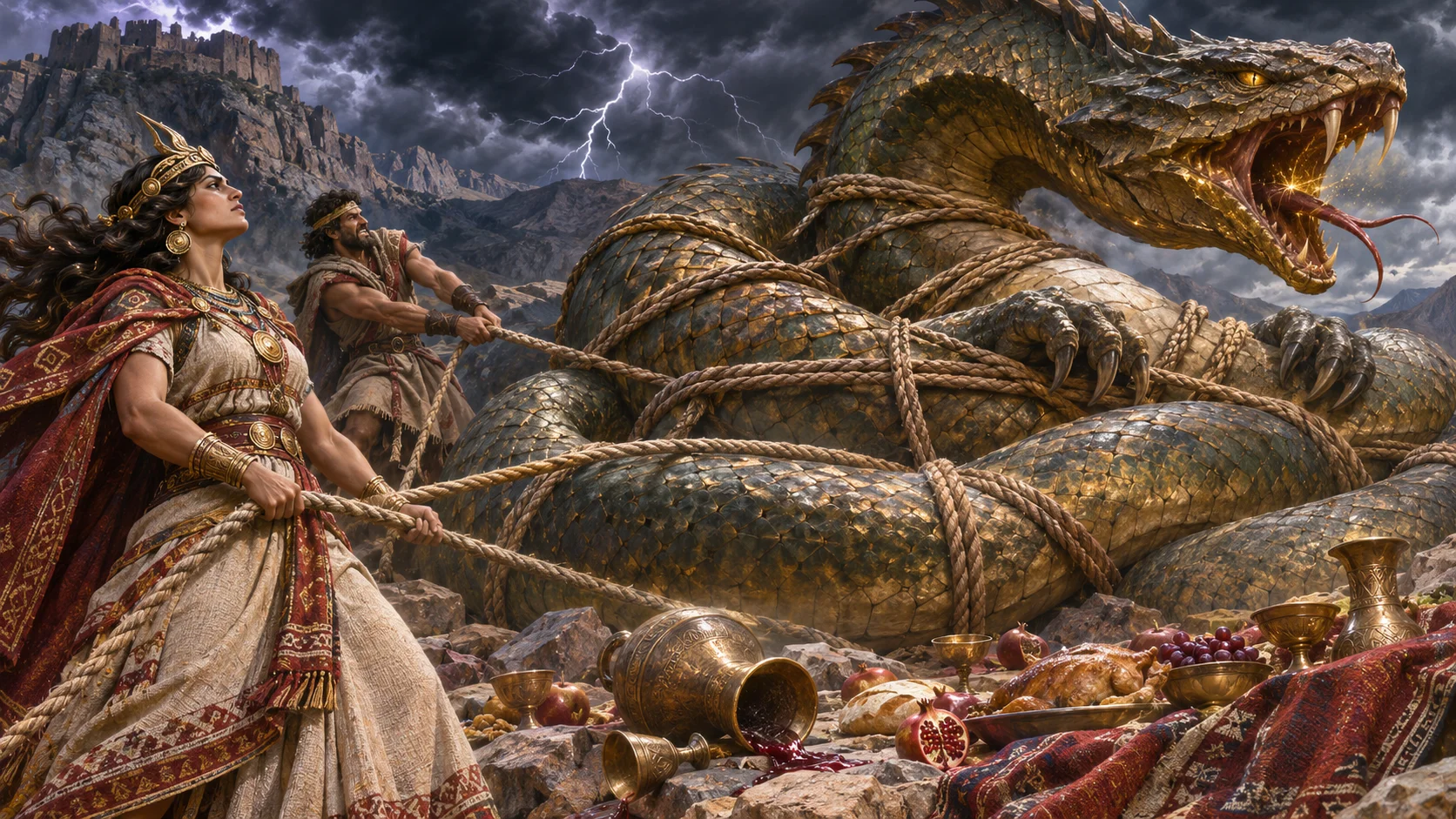
Her partner was the weather god of the Hittites, Tarhunna, and the pair is reckoned to have held the highest rank in the state pantheon. Their children are named in the sources. They include the daughter Mezulla (whose own daughter was Zintuhi), the weather gods of the towns of Nerik and Zippalanda, and the vegetation god Telipinu, whose disappearance is the subject of a famous myth. The tradition is not consistent, and different towns told it in different ways.
There is one remarkable consequence of this family arrangement. The goddess, a native Hattian deity, is the mother of a number of other native gods, and she shares her cult places with them. The national religion of the Hittites, which absorbed Luwian, Hurrian and Mesopotamian gods as it grew, was built upon this old Hattian core, with a mother, a father and children at its centre.
Arinna, the holy city
Arinna was her principal cult place and one of the holy cities of the kingdom, and festival texts have the king travel there. Where exactly Arinna lay, however, is not certain. Candidate mounds in the Hittite heartland have been proposed, Alaca Hoyuk among them, but none is an accepted identification, and archaeology has not yet fixed the place.
The cult was maintained in a manner characteristic of the Hittites. The god and goddess were provided with offerings of bread, drink and animals; their statues were washed, dressed and carried in processions; and the kings brought tribute. Ulmi-Teshub, who ruled at Tarhuntassa, is recorded as pledging a disc of gold, silver and copper to the goddess every year, together with a bull and three sheep. Such yearly gifts, recorded in the texts, are a reminder that the divine economy was a real part of the kingdom’s economy.
The prayer of Puduhepa and the question of Hepat
Puduhepa was a queen of the thirteenth century BCE, the wife of Hattusili III, who came from Kizzuwatna in southeastern Anatolia and whose father was a priest of the Hurrian goddess Shaushka at Lawazantiya. She was a powerful figure in her own right, with her own seal, and she was actively involved in the organisation of religion. In one of her prayers she begins by addressing the Sun Goddess of Arinna as her lady and queen of all lands, and she goes on to say that in the land of Hatti the goddess gave herself the name Sun Goddess of Arinna, while in the land of cedar she gave herself the name Hepat.
Hepat was the great Hurrian goddess of Aleppo, the wife of the storm god Teshub, and in Kizzuwatna she was the principal goddess. The prayer therefore proposes that the great goddess of Hatti and the great goddess of the Hurrian world are one. The passage is among the most discussed in Hittite religion, and scholars are strongly divided on how far the idea went. Many scholars doubt that the identification entered the everyday religion of the Hittite people, and Hepat did not replace the Arinna goddess in the divine witness lists of the treaties. The usual reading is that this was a deliberate effort by the court, in which the dynastic Hurrian-influenced religion was brought into line with the older state cult, and that the effort was strongest within the royal household.
The same union is reflected in the iconography. At the rock relief of Firaktin in Cappadocia, carved in the thirteenth century BCE and probably after Hattusili’s death, Hattusili III is shown pouring a libation to the storm god and Puduhepa one to a goddess, who is named Hepat in the accompanying hieroglyphic label. The queen’s prayer shows that in her circle this Hurrian goddess and the Arinna goddess could be treated as one. At Yazilikaya, the female partner of the central storm god is labelled with the Hurrian name Hepat, and she is shown standing on a leopard.
Regional and linguistic variation
It is easy, in a short account, to speak of one goddess. The sources reveal several overlapping figures: the Hattian Estan, whose cult was presumably the oldest; the Hittite Arinnian, the state goddess; the male Sun god of Heaven who entered through Hurrian contact; and, in the royal circle of the thirteenth century, Hepat. Her husband likewise had many local forms: the weather gods of Nerik and Zippalanda were counted among her children, and the storm god was worshipped under the name of many towns. The scribes tried to harmonise all this, and the result is a pantheon in which one divine pair stands at the head under several names, a feature that makes the sources both rich and hard to read.
Decline and rediscovery
The Hittite state collapsed around 1200 BCE, and the capital was abandoned and burned. The Neo-Hittite and Luwian-speaking states which succeeded it kept the storm god in the form of Tarhunz, and in some places Hepat continued as the consort of the weather god, but the particular goddess of Arinna does not seem to have survived as a figure of worship. Her fate is the fate of the whole tradition, which was forgotten until the tablets were dug up. Even then understanding came slowly: the decipherment of the language, shown in the early twentieth century to be Indo-European, came only after the first tablets were found, and the work of sorting the solar deities from one another continues.
Kindred deities
The Sun Goddess of Arinna can be set beside several other figures. Her husband is the Hittite weather god Tarhunna, and the Hurrian storm god Teshub is the partner of her Hurrian counterpart Hepat. Her Hattian ancestry links her to other Hattian deities such as Telipinu, who is counted among her children. Comparison with the sun goddesses of other cultures is tempting. The Mesopotamian world had a male sun god, Shamash, and a female sun goddess in the Hittite manner is a notable exception; the Ugaritic texts of the Syrian coast also know a female sun deity, Shapshu. The comparison is tempting, but it should be treated with caution, since each of these goddesses belongs to a wholly different religious system and no line of descent has been demonstrated.
A closing reflection
The Sun Goddess of Arinna is a case in which a royal ideology was built on a local, even humble, foundation. The great empire of the Hittites was ruled from a capital in the highlands of central Anatolia by kings who spoke an Indo-European language, and who handled their gods with a bureaucrat’s care. At the summit of their religion, however, they placed a goddess whose name and cult belonged to the people they had displaced. In her prayers the queen and the king are children and servants; the land is hers; and the favour of the sun is spoken of as mercy, not as a force of nature. That she is not a remote cosmic power but a mother, mistress and judge of the realm is perhaps the single most distinctive thing about her.
Sources & traditions
- EncyclopediaWikipedia — Sun goddess of Arinna
- TraditionHittite texts, inscriptions and later retellings (Anatolia)
Myths change from area to area and from time to time. This chronicle follows the most widely told versions; tellings in other villages, regions and eras may differ.