Kumarbi was the Hurrian “father of the gods”: an old, cunning, deposed king of heaven who, in the myths preserved in the Hittite archives of Bronze Age Anatolia, bit off and swallowed the genitals of the sky-god Anu, became pregnant with the Storm-god Teshub and other deities as a result, and then spent a long cycle of songs plotting to unseat the very son who had taken his throne. He is one of the most important figures of the ancient Near Eastern imagination, partly for his own sake and partly because his story has long been set beside the Greek tale of Ouranos, Kronos and Zeus. The religion that venerated him is dead, and what survives is a body of broken clay tablets; this article therefore treats him as history, and says plainly where those tablets, and the scholars who read them, fall silent or disagree.
Name and etymology
The name is Hurrian and is often understood as meaning “he of Kumar.” It is spelled in several ways across the sources: Kumarbi in the Hittite texts, Kumurwe at Nuzi, Kumarwi, and, presumably, Kumarma in the later Luwian-speaking world, while the alphabetic texts of Ugarit write it kmrb or kmrw. Whether “Kumar” was a real settlement is not known. Gernot Wilhelm suggested a place name built on a root kum, “to pile up,” but no such toponym is attested in Hurrian sources, so the suggestion remains only that.
Scribes sometimes wrote the god’s name with the logogram of the grain-goddess Nisaba (dNISABA). Alfonso Archi suggested that this may be wordplay connected with the Hittite grain deity Halki, whose name could be written with the same sign. It is one of the main reasons modern writers call Kumarbi a god of grain, and the foundation is slender (see below).
The sources
Almost everything we know of Kumarbi’s myths comes from the archive of the Hittite capital at Hattusa, modern Boğazköy, where Hittite scribes copied and translated Hurrian narrative songs. The texts are labelled “songs” (the Hittite word is usually read ishamai-), and the Hittite and Hurrian versions that survive of the same story sometimes differ in ways that Archi took as a sign of oral transmission. He argued that the stories reached the Hittites at the beginning of the fourteenth century BCE, during a period of growing Hurrian cultural influence. Beyond the myths there are ritual texts, god lists and offering lists from Hatti, Mari, Nuzi, Ugarit, Alalakh and Emar, and a few inscriptions of the early first millennium. The picture is therefore assembled from two quite different bodies of evidence: literary songs seen through Hittite eyes, and administrative and ritual records that show how the god was actually venerated.
Nature and attributes
Hurrian texts call Kumarbi “father of the gods,” and Volkert Haas took this as evidence that he was a creator deity. A common epithet is ewri, “lord.” In the myths he is an elder king driven from the throne by his son, and one reading holds that this is an etiological narrative explaining how the pantheon came to be arranged, not the record of a real fall in status. Christian Zgoll has suggested that the Kumarbi–Teshub relationship may have arisen from harmonizing two originally separate local pantheons.
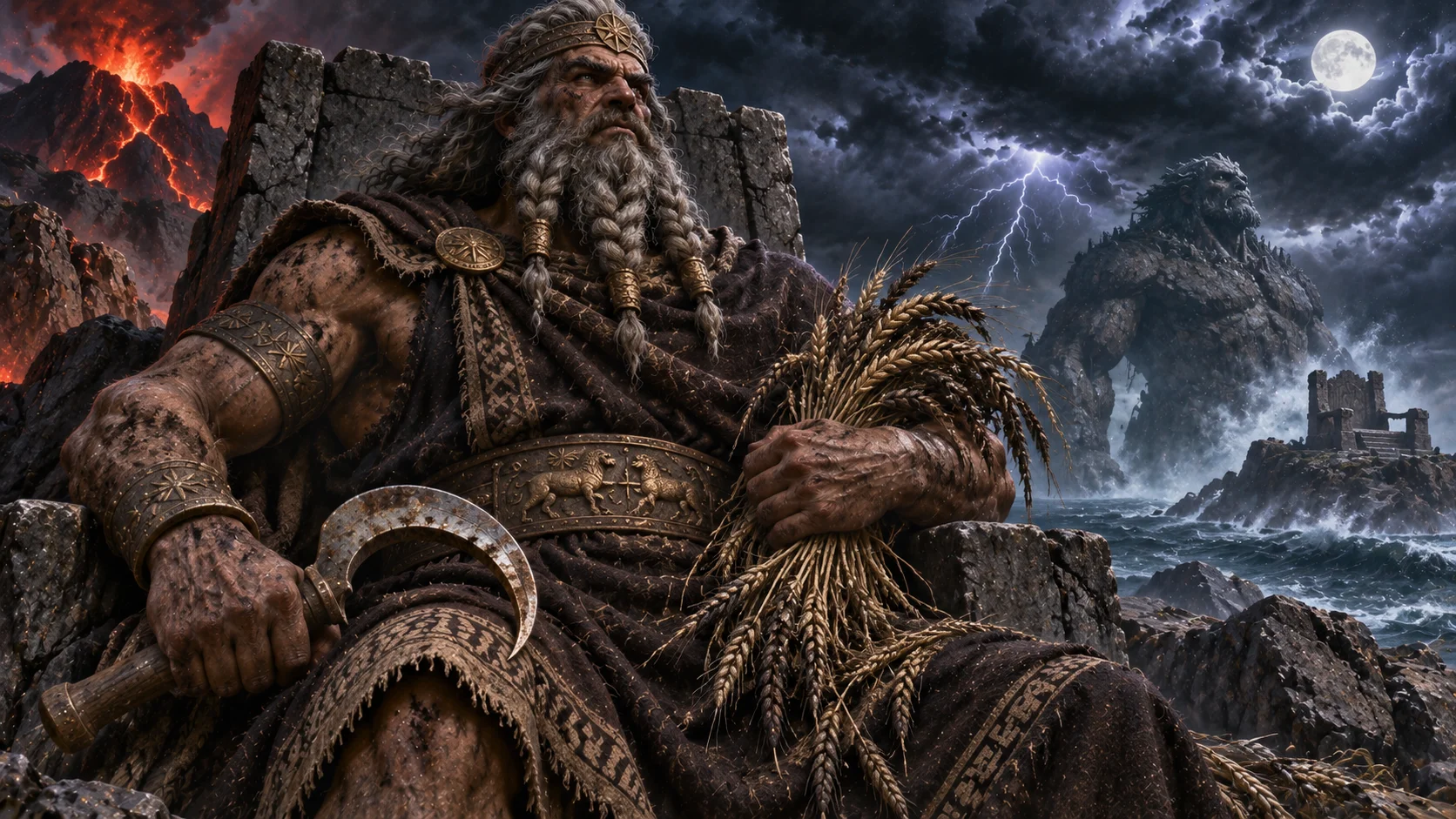
Was he a grain god? It is often stated as fact, and the evidence is thinner than the statement. It rests on the grain-goddess logogram and on an ear of grain held by a figure on the rock reliefs of Yazılıkaya, and some of the arguments are circular, borrowing the farming character of Dagan and assuming it passes to Kumarbi. Archi noted that the ear symbol appears nowhere else, and Lluís Feliu observed that the direct evidence amounts to these two points only. Dagan himself is better described as a god of general prosperity, and in first-millennium Luwian inscriptions Kumarbi is invoked for prosperity too. The honest summary is that a link with grain is possible but unproven.
The Song of Kumarbi: the kings in heaven
The opening text of the cycle is preserved mainly on a poorly kept tablet, and only a fraction of it survives. Modern editors have called it by many names: Kingship in Heaven, Theogony, Song of Kumarbi, and, since a colophon was identified in 2007 (Carlo Corti’s reading), Song of Emergence, which is now often the preferred title. Gary Beckman has described these texts as the best-known literary work found in the Hittite archives.
The story, as far as it can be read, tells of three kings in heaven in succession. Alalu reigns first, for nine years; in the ninth year his cupbearer Anu overthrows him and Alalu goes down into the dark earth. Anu in turn is served for nine years by a cupbearer, Kumarbi, who then rebels; the text as preserved gives no separate reign length for Kumarbi. The repeated nine has been taken as possibly symbolic, perhaps an allusion to the nine months of pregnancy, but that is a suggestion, not something the tablet says. Kumarbi pursues Anu, who flies upward toward the sky, seizes him by the feet, drags him down, and bites off and swallows his genitals.
The aftermath is the strangest part of the story. Anu answers in words that modern readers often take as taunting: do not rejoice over your belly, for he has placed a burden in it, and Kumarbi is now pregnant with three gods: the Storm-god, the river Tigris (Aranzah), and Tašmišu. Kumarbi spits out some of the seed, and it falls on the mountain Kanzura and impregnates it, so that Tašmišu is born from the mountain. The remaining children must be born by other means. Kumarbi goes to Nippur, the city of the Mesopotamian god Enlil, and the fragmentary text has the goddesses of fate split his skull to release the Storm-god and then mend the head; the Tigris leaves by another route that is not clearly preserved. Kumarbi then seems to try to devour the newborn Teshub, but is given a stone instead and breaks his teeth on it. The end of the song is lost. Teshub seems to prevail, but the surviving lines do not allow certainty about how or when he takes the kingship.
Two features deserve notice. The castration is performed with the teeth, not a blade, so the sky-god is made the unwilling parent of his supplanters through Kumarbi’s body. And Teshub has, in effect, two fathers, Anu and Kumarbi, a doubling that Noga Ayali-Darshan discussed in connection with Baal being called “son of Dagan” at Ugarit.
Kumarbi’s schemes: the later songs
Scholars conventionally group five narrative songs around Kumarbi: the Song of Kumarbi, the Song of LAMMA, the Song of Silver, the Song of Hedammu and the Song of Ullikummi. The name of the group is itself debated: “Kumarbi cycle,” van Dongen’s “Kingship in Heaven cycle,” or “Teshub cycle,” as Corti and Taracha have suggested. The songs after the first describe Kumarbi’s attempts to regain the throne by producing rivals to Teshub. Each seems to succeed briefly, and each is overcome. Harry Hoffner contrasted the two sides: Kumarbi is aided by underworld figures, Alalu, the deified Sea and the stone giant himself, while Teshub is assisted by heavenly deities.
- Song of LAMMA. The god LAMMA briefly defeats Teshub and Šauška and is made king by Kumarbi and Ea, but ignores the advice of Kubaba and is subdued by Teshub. Hoffner thought it not impossible that LAMMA was regarded as a son of Kumarbi.
- Song of Silver. A boy, Silver, the son of Kumarbi and a mortal woman, is mocked for having no father and is told by his mother to go to Urkesh to a god styled “father of Urkesh,” presumed to be Kumarbi, but finds on arrival that the house is empty. The song is poorly preserved and its place in the cycle is not accepted by everyone.
- Song of Hedammu. Kumarbi fathers the sea-serpent Hedammu on his own daughter, Šertapšuruhi, child of the deified Sea. Ea rebukes both sides for endangering humankind, who supply the gods with sacrifice and grain. The ending is lost.
- Song of Ullikummi. The best preserved of the group, treated below.
Ullikummi, the stone that grew
The name Ullikummi has been interpreted as “Destroy Kumme!” Kumme (Kummiya) is the city of Teshub, so the intention of the monster is stated in its name. Kumarbi impregnates a great cliff beside a cold spring; the Sea invites him to a feast; the stone child is born and presented to him by the fate goddesses. The Irshirra deities hide the child in the underworld and set him on the shoulder of Upelluri, a giant who bears up earth and heaven like the Greek Atlas. Enlil, observing, recognises the plot.
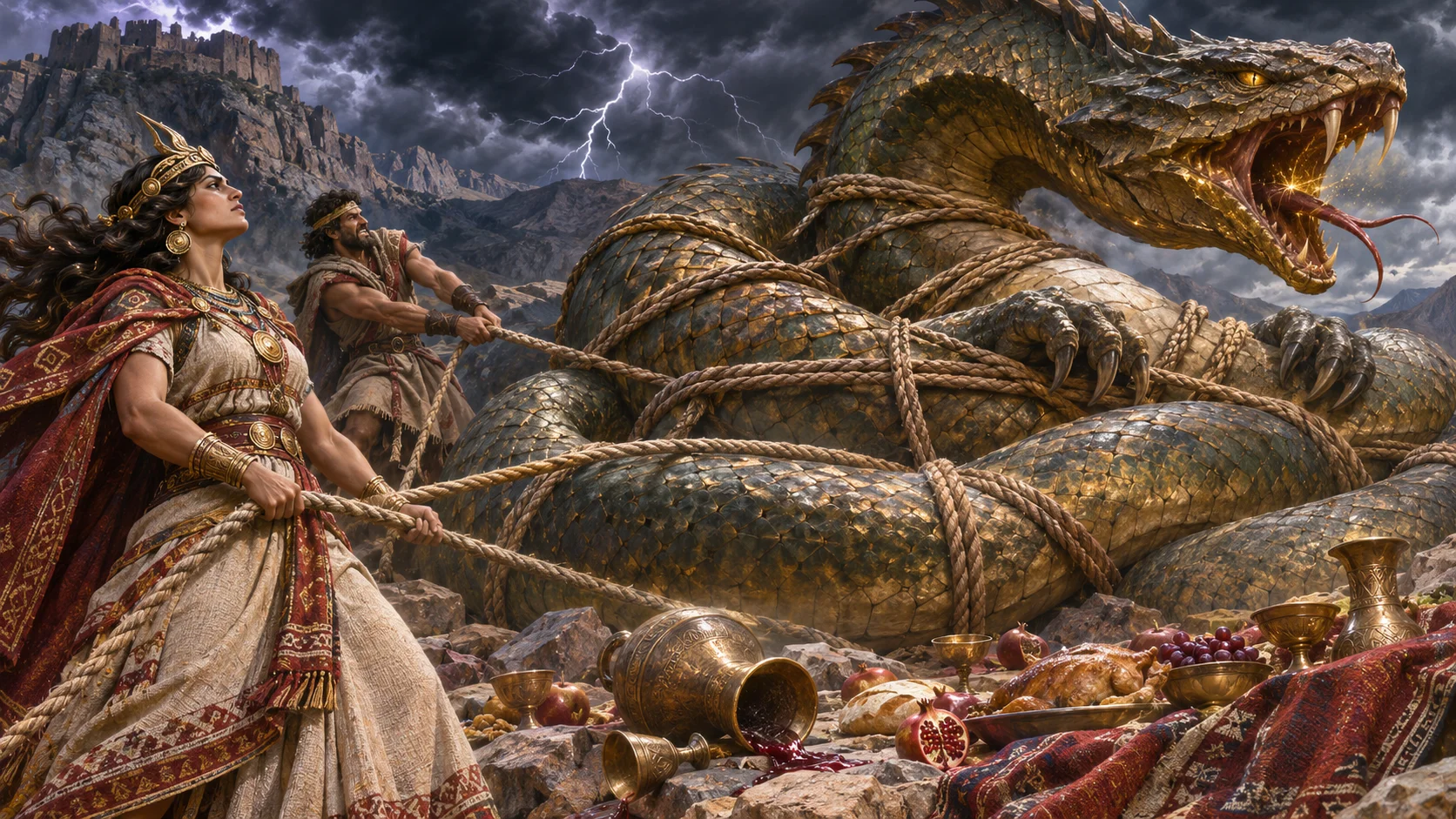
The monster grows until he reaches the heavens, defeats Teshub’s allies, and blocks the temple of Hebat. Teshub’s thunder and rain do not harm him. Ea, on the advice of Tašmišu, recovers from the netherworld the ancient tool that once cut earth from heaven, and with it Ullikummi is severed from Upelluri’s shoulder and his power is lost. The ending is broken, and a final victory for Teshub is assumed rather than read. The tale incidentally preserves a Hittite-Hurrian cosmogony in which heaven and earth were once joined and then separated, and its scene of a storm-god battling a monster that outgrows him has been compared with the Greek story of Zeus and Typhon.
Kinship, equations and kindred deities
Kumarbi stood in a web of equations with other Near Eastern fathers of gods. Beginning in the eighteenth century BCE he was closely associated with Dagan; Emmanuel Laroche first noticed the identification. They are both “fathers of the gods,” both linked to Shalash and Enlil, and Tuttul, Dagan’s cult centre, is called a city of Kumarbi in the Song of Hedammu. But the evidence has limits: no known god list directly equates the two, and one reading of an inscription from Terqa as “Dagan of the Hurrians” rests on a single text and has been contested.
From the sixteenth century BCE he was equated with the Mesopotamian Enlil, again as father of the gods, and the tradition may go back to the late third millennium. Archi described this as translation between similar roles in different pantheons, not syncretism, and he thought the Hittites did not know the equation, since in the myths Enlil and Kumarbi usually appear as separate characters: Enlil listens in the Song of Kumarbi and comments on Ullikummi. A trilingual god list from Ugarit equates Kumarbi with El.
His consort is a matter of dispute. Shalash, originally tied to Dagan at Ebla, came to be linked with Kumarbi, but in the myths Kumarbi has no wife, and the “wife of Kumarbi” of one Ugaritic list has been questioned. Šauška is usually the sister of Teshub, not Kumarbi’s partner. A text calls Kumarbi a descendant of Alalu, though Zgoll suggested Anu may have stood between them, which is hard to prove.
Cult and regional variation
As a deity of worship Kumarbi was spread widely but modestly. His cult is attested across Hurrian lands, from south-eastern Anatolia to the Zagros, and scholars generally judge his cult importance relatively minor, whatever his mythological rank. Haas suggested an origin in the Khabur area. The oldest certain reference, dated by Wilhelm to about 1700 BCE, is a toothache incantation from Mari that calls on “father Kumarbi” together with “mother Pidenhi,” an epithet of Shalash; why they should govern teeth is unclear.
At Urkesh a temple of his has been conjectured, though the divine sign in the inscription of Tiš-atal normally means Nergal and the reading is disputed. A priest of his is named at Alalakh, though no temple is known, and in the pantheon of Azuhinnu he stands paired with Šauška at its head, while Nuzi offering lists place him after Kurwe. In Hatti he entered with the Hurrian circle of Teshub, probably through Kizzuwatna; he is probably relief number 40 at Yazılıkaya, and treaties name him only twice. In the first millennium BCE hieroglyphic Luwian inscriptions from south of the Taurus name a deity Kumarma, presumed to be a late form of Kumarbi, in connection with prosperity; he is distinct from the wine god Tipariya, whom a Carchemish inscription names beside “the good god.”
Reception and comparative debate
The idea that these songs stand behind the opening of Hesiod’s Theogony goes back to the 1940s, and especially to Hans Gustav Güterbock in 1948 and 1983. The succession from Ouranos to Kronos to Zeus resembles that of Anu, Kumarbi and Teshub, the sky-god is mutilated, and both stories involve swallowing: Kronos swallows his children, Kumarbi swallows Anu’s seed and tries to swallow Teshub. Zgoll records that a relationship of some kind is now widely accepted. Erik van Dongen has argued that the closest and most numerous parallels to Hesiod are found in this song, and that Hesiod’s poet may have known a version of it, while the differences show that the Greek account was shaped to exalt Zeus above his predecessors.
But the debate is about details and routes, and the differences are real. Hesiod’s Kronos castrates his father with a sickle, not with his teeth; in the Hittite song the genital seed is spat out onto a mountain, in the Greek it falls on earth and sea; and if Alalu and Kumarbi are not related to Anu, kingship does not pass from father to son in the older story. Carolina López-Ruiz argued that the Greeks received the castration of a sky-god and the swallowing of a stone in place of a deity. She also drew attention to an Orphic theogony in the Derveni papyrus in which Zeus himself castrates Ouranos, swallows the genitals and becomes pregnant with the cosmos, which she took as an even closer match for Kumarbi’s act, with Kumarbi and Kronos originally more alike. Gary Beckman, by contrast, was cautious about direct borrowing, though he called the birth of Teshub from Kumarbi’s split skull a “template” for Athena’s birth from the head of Zeus, a view Ian Rutherford found plausible.
The Phoenician side is similarly unsettled. Philo of Byblos wrote a Phoenician History that he claimed to have translated from an ancient writer, Sanchuniathon, containing a succession of Elyon, Ouranos, El and Dagon. Güterbock proposed that Philo’s source formed an intermediate stage between the Hurrian songs and Hesiod. Albert Baumgarten rejected this: Philo lacks a son’s challenge to his father in the Hurrian manner and has no monster battles, so the three works are separate takes on a shared motif. Other comparisons have been drawn with the Mesopotamian Theogony of Dunnu (Wilfred Lambert) and the Ugaritic Baal cycle (Mark Smith, with Daniel Schwemer cautioning that El is passive where Kumarbi is the instigator), and Piotr Taracha saw in Teshub’s victory an instance of the chaos-battle motif. A variety of readings, and none yet decisive.
Closing reflection
Kumarbi is best understood as a figure who lived in two places at once: in a literary tradition of astonishing violence and invention, and in a quiet record of offering lists, incantations and divine names stretching from Mari to Carchemish. The first made him famous; the second shows a god who was venerated unspectacularly for many centuries and across many peoples. The title “the Anatolian Kronos,” popular today, is a modern convenience that flatters both gods and should not hide the oddities of the Hurrian original: a sky-god brought down by his own cupbearer, a father who bears his sons through his body, a king whose defeat is only the start of his plotting. What survives is half a story, and a Greek poem that may or may not remember it.
Sources & traditions
- EncyclopediaWikipedia — Kumarbi
- TraditionHittite texts, inscriptions and later retellings (Anatolia)
Myths change from area to area and from time to time. This chronicle follows the most widely told versions; tellings in other villages, regions and eras may differ.