Tiamat is the primordial goddess of the salt sea and the dragon of chaos in Babylonian myth: the great mother of the gods, who, enraged by the slaying of her consort Apsu, raised a monstrous army to destroy the gods and was slain by Marduk, her vast body split to form the heavens and the earth.
The Primordial Salt Sea
Before there was heaven, before there was earth, before there was even a name for anything, there was Tiamat. In the great Babylonian creation epic known as the Enûma Eliš — composed by the twelfth century BCE but drawing on far older Sumero-Akkadian traditions — Tiamat is one of only two beings present at the very beginning of existence. She is the salt sea itself, boundless and bitter, and her counterpart is Apsu, the god of sweet fresh water (Stephanie Dalley, Myths from Mesopotamia, Oxford, 1989). Her very name is bound to water: Tiamat is cognate with the Akkadian word tâmtu, "sea." Scholars have also long noted a linguistic kinship with the Hebrew tehom, "the deep," the churning abyss named in the opening lines of Genesis — a connection first argued at length by Alexander Heidel (The Babylonian Genesis, University of Chicago Press, 1951) and one that remains a documented topic of debate in comparative Semitic scholarship rather than a settled fact. Before Babylon, before its temples and its kings, there was only the mingling of these two waters — salt and fresh, Tiamat and Apsu — indistinguishable from one another, undivided, at rest.
It was from this mingling of waters that creation itself began. Tiamat and Apsu came together and from their union the first generation of gods was born: Lahmu and Lahamu, then Anshar and Kishar, the primeval pairs (Tablet I). Tiamat was not merely a body of water but a womb, the mother from whom every subsequent god, force, and shape in the universe would eventually descend, whether by direct birth or by the violent transformations that followed.
A Body Not Yet Named
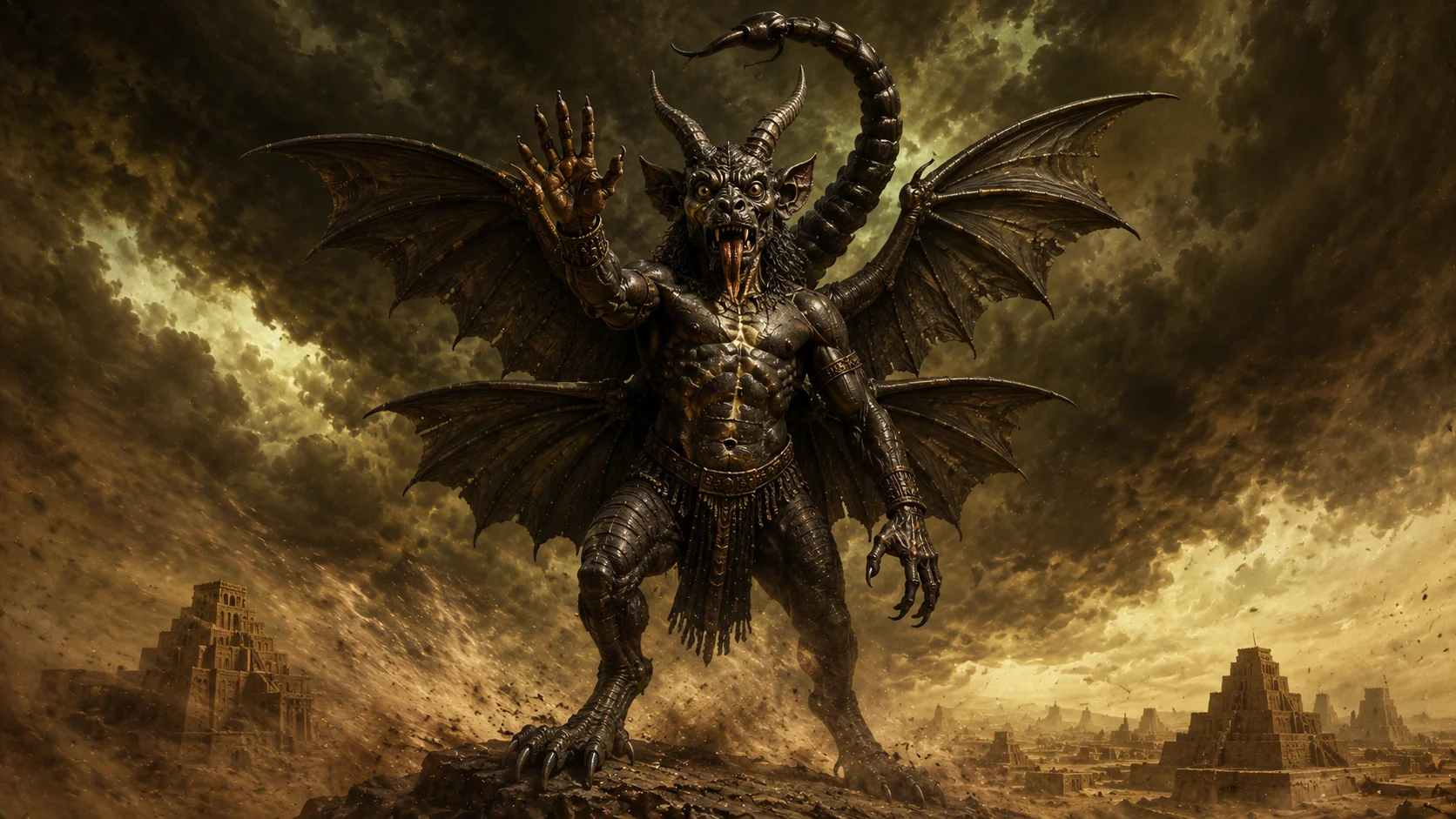
Later Babylonian and Neo-Assyrian artists gave Tiamat a form suited to her cosmic role: a monstrous, serpentine or dragon-like body, sometimes rendered with wings, horns, and scales, a creature associated with chaos and the untamed sea (W.G. Lambert, Babylonian Creation Myths, Eisenbrauns, 2013). She was not evil in a simple sense — she was formlessness itself, the raw and undifferentiated potential that had not yet been shaped into a cosmos. Scholars such as Thorkild Jacobsen have read Tiamat as the embodiment of a primordial feminine chaos-principle, a force that must be confronted and overcome before ordered kingship, hierarchy, and civilization itself could take root in the world (Jacobsen, The Treasures of Darkness, Yale University Press, 1976).
The Noise of the Younger Gods
As generations passed, the descendants born of Tiamat and Apsu multiplied and grew restless. The younger gods were loud, active, quarrelsome — filling the primeval quiet with movement and clamor. Apsu, who had once delighted in his offspring, found their noise intolerable and could no longer rest by day or sleep by night. He resolved to destroy them and end the disturbance for good, and Tiamat, still bound to him as consort and equal creative force, at first joined in his rage. Yet when the moment came to act, it was Apsu alone who moved against the younger gods — and Apsu alone who was undone.
The Slaying of Apsu
Among the younger gods was Ea, called also Enki, wise beyond his kin and quick to sense the danger gathering against them. Learning of Apsu's plan, Ea acted first: through cunning and powerful spells he overcame Apsu, killed him, and built his own dwelling directly upon the god's stilled waters. Where Apsu's turbulence had once flowed, Ea now established a place of order and habitation. It was here, in this new abode founded on the body of the slain primeval god, that Marduk — Ea's son and the god who would one day be Babylon's supreme deity — was born (Tablet I).
The Fury of the Mother
Tiamat's grief and rage at the death of her consort transformed her utterly. She, who had once mingled peacefully with Apsu's waters and given quiet birth to the first gods, now became something else entirely: an avenger, the mother of monsters, determined to destroy the very children she had helped bring into being. Where before she had represented undifferentiated potential, she now became active, purposeful chaos, marshaling every terrible power at her command against the gods who had killed her husband.
An Army Born of Vengeance
To wage her war, Tiamat brought forth an army of monstrous beings the likes of which the young cosmos had never seen, among them the fearsome Mušḫuššu dragon, the venomous Bašmu serpent, scorpion-men, and other hybrid horrors born specifically to terrify and overwhelm the gods who opposed her (Tablet I–II). These were not creatures that had existed before; Tiamat generated them herself, from her own primordial substance, giving physical shape to the full force of her fury. Where the younger gods represented order still finding its footing, Tiamat's monster-army represented chaos deliberately weaponized, unleashed with singular purpose against creation's newest and most vulnerable inhabitants.
Kingu and the Tablet of Destinies
To lead this terrible host, Tiamat elevated a god named Kingu, raising him above all others and taking him as her new consort and the commander of her monster army. To cement his authority, she placed upon him the Tablet of Destinies — the very object that determined the fates of gods and the order of the universe itself (Tablet I). Whoever held the Tablet held ultimate cosmic authority, and by giving it to Kingu, Tiamat made him not merely a general but a sovereign, second only to herself in the coming war.
The Gods in Council
Faced with an army led by Kingu and empowered by the Tablet of Destinies, the assembly of gods despaired. One by one, the elder and established deities proved unable or unwilling to face Tiamat directly; her power, magnified by grief and by the authority she had transferred to her champion, seemed beyond any of their strength. It was Marduk, still young among the gods, who stepped forward and offered to meet her in battle — but only on one condition. He demanded that if he succeeded, the assembly would grant him supremacy over all the gods, unquestioned kingship, his word made law before all others (Tablet II–III). Desperate, the gods agreed, and armed him for war.
The Battle Between Marduk and Tiamat
Marduk prepared for the confrontation with weapons suited to a battle against the sea itself: a great net to snare her, the winds as his allies, a bow and arrow, lightning, and a fearsome countenance. When he finally advanced upon Tiamat, she came to meet him in her full monstrous form, and for a moment the outcome of the cosmos hung in the balance. But Marduk cast his net wide and caught her within it, trapping the vast bulk of her body. As she opened her mouth to devour him, he drove an evil wind into her, forcing it down her throat and through her body, so that she could not close her jaws and her belly swelled unbearably beneath the pressure. In that instant of her helplessness, Marduk loosed his arrow, and it split her distended belly (Tablet IV). The great primordial sea, mother of the first gods, fell silent and still.
The World Made From Her Body
With Tiamat slain, Marduk did not simply discard her vast corpse — he transformed it into the very fabric of the ordered universe. Standing over her remains, he split her body in two, like a shellfish, and raised one half aloft to form the vault of the heavens, while the other half he laid out to become the earth beneath the sky (Tablet IV, lines 137–140). From her eyes he caused the Tigris and the Euphrates to flow, the two great rivers upon which all Mesopotamian civilization would come to depend, and from other parts of her body — her breasts and the remainder of her frame — he raised the mountains and set the cosmos in order using her remains (Tablet V).
The Fate of Kingu and the First Humans
Tiamat's champion did not long survive her. Kingu, stripped of the Tablet of Destinies, which Marduk claimed for himself as proof and instrument of his new supremacy, was captured and put to death by the gods for having led the rebellion against them. From his spilled blood, Ea fashioned humankind, according to the Enûma Eliš (Tablet VI) — so that, in the Babylonian telling, human beings are made from the blood of the very general who had commanded chaos against the gods.
Recited at the Turning of the Year
The story of Tiamat's defeat was not simply a tale told for entertainment; it was recited annually at Babylon during the Akitu festival, the great New Year celebration in which Tiamat's defeat by Marduk symbolized the triumph of cosmic order over chaos (Dalley, 1989). As priests intoned the verses of the Enûma Eliš before the city, the ritual reenactment of Marduk's triumph renewed, year after year, the community's confidence that order could and would continue to triumph over the chaos that always threatened at creation's edges.
Sarpanit, Lady of Babylon
During this same festival, the statue of Sarpanit — also spelled Sarpanitu, Zarpanitu, or Zerpanitum — Marduk's consort and wife, processed alongside her husband's image along the city's great Processional Way toward the Akitu temple outside the walls (A.R. George, House Most High: The Temples of Ancient Mesopotamia, Eisenbrauns, 1993). Sarpanit was closely associated with Babylon itself, and her name has been etymologized by ancient and modern scholars alike as deriving from the Akkadian zēr-bānītu, "creatress of seed/offspring," linking her to fertility and childbirth (Jeremy Black & Anthony Green, Gods, Demons and Symbols of Ancient Mesopotamia, British Museum Press, 1992). In some Babylonian texts she is invoked directly as a goddess of pregnancy and safe delivery, at times equated or syncretized with the birth goddess Ninmah/Belet-ili, and in certain first-millennium astral-theological traditions she was identified with the planet Venus, sharing attributes of love and fertility comparable to Ishtar (Black & Green, 1992). She was worshipped alongside Marduk at the Esagila temple complex, Babylon's principal temple dedicated to the city's patron god (George, 1993), and is invoked in hymns as "Lady of Babylon" (Bēlet Bābili), underscoring her role as the city's divine matron (Black & Green, 1992). Neo-Babylonian royal inscriptions of Nebuchadnezzar II (6th century BCE) describe the king rebuilding and beautifying shrines to both Marduk and Sarpanit in Babylon (Stephen Langdon, Building Inscriptions of the Neo-Babylonian Empire, 1905). Her pairing with Marduk as divine husband and wife mirrors a broader Mesopotamian pattern of a chief city god paired with a consort goddess of fertility and civic protection — a structural parallel scholars have traced back to Tiamat and Apsu themselves as the primordial divine pair (Jacobsen, 1976).
An Echo in the Deep
Tiamat's legacy did not end with her death within the myth. Her name and her watery, chaotic character resonated across the ancient Near East for centuries, studied by generations of scribes who copied and recopied the Enûma Eliš onto clay tablets, and later recognized by modern scholars as one of the clearest ancient articulations of a theme that would recur across many cultures: the struggle between the ordered world and the untamed waters that both preceded and threaten to reclaim it. She remains, in the surviving tablets of Babylon, both an ending and a beginning — the vanquished chaos-dragon of the old order, and, quite literally, the raw material from which the heavens, the earth, and the rivers of the ordered world were shaped.