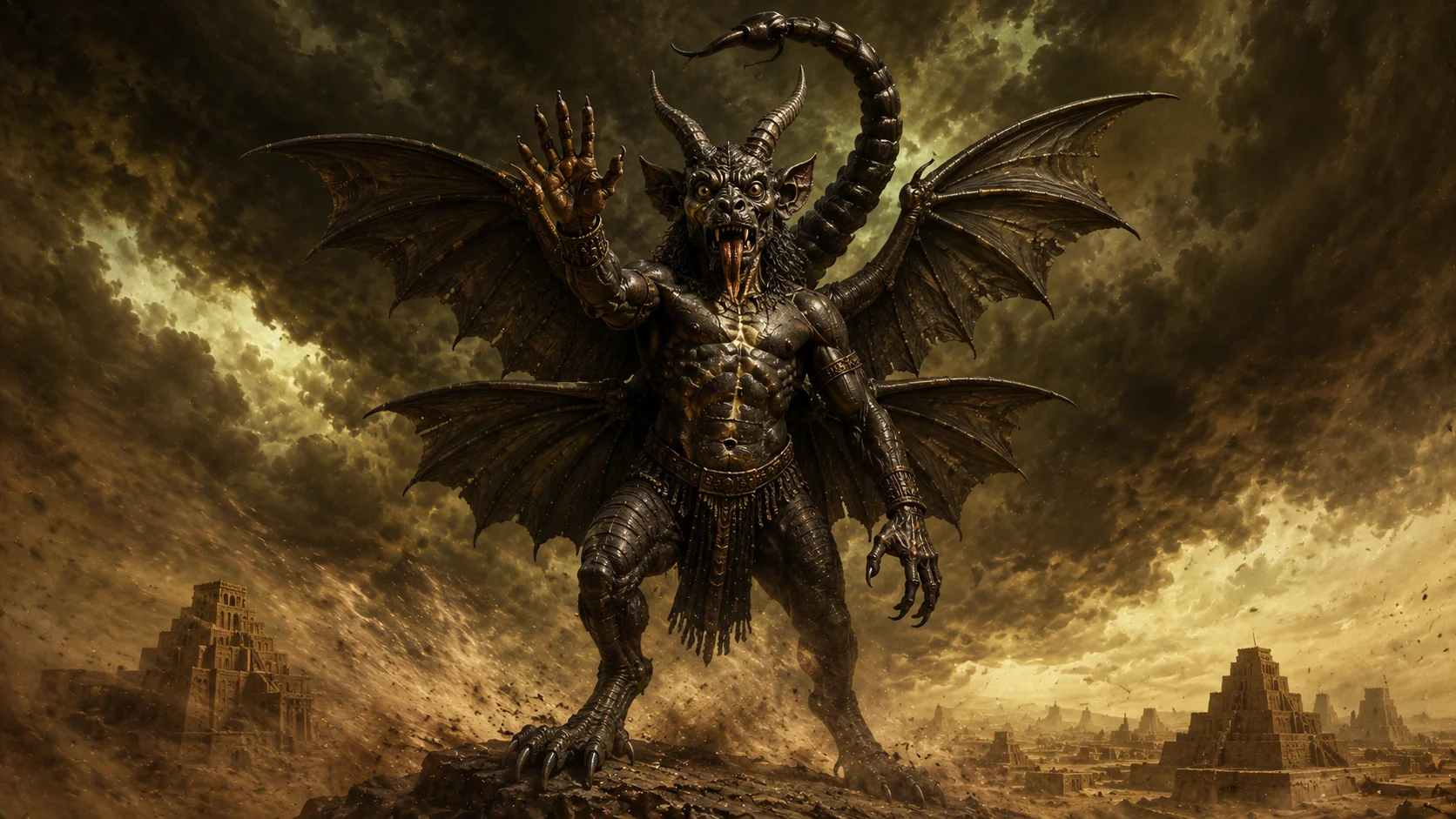
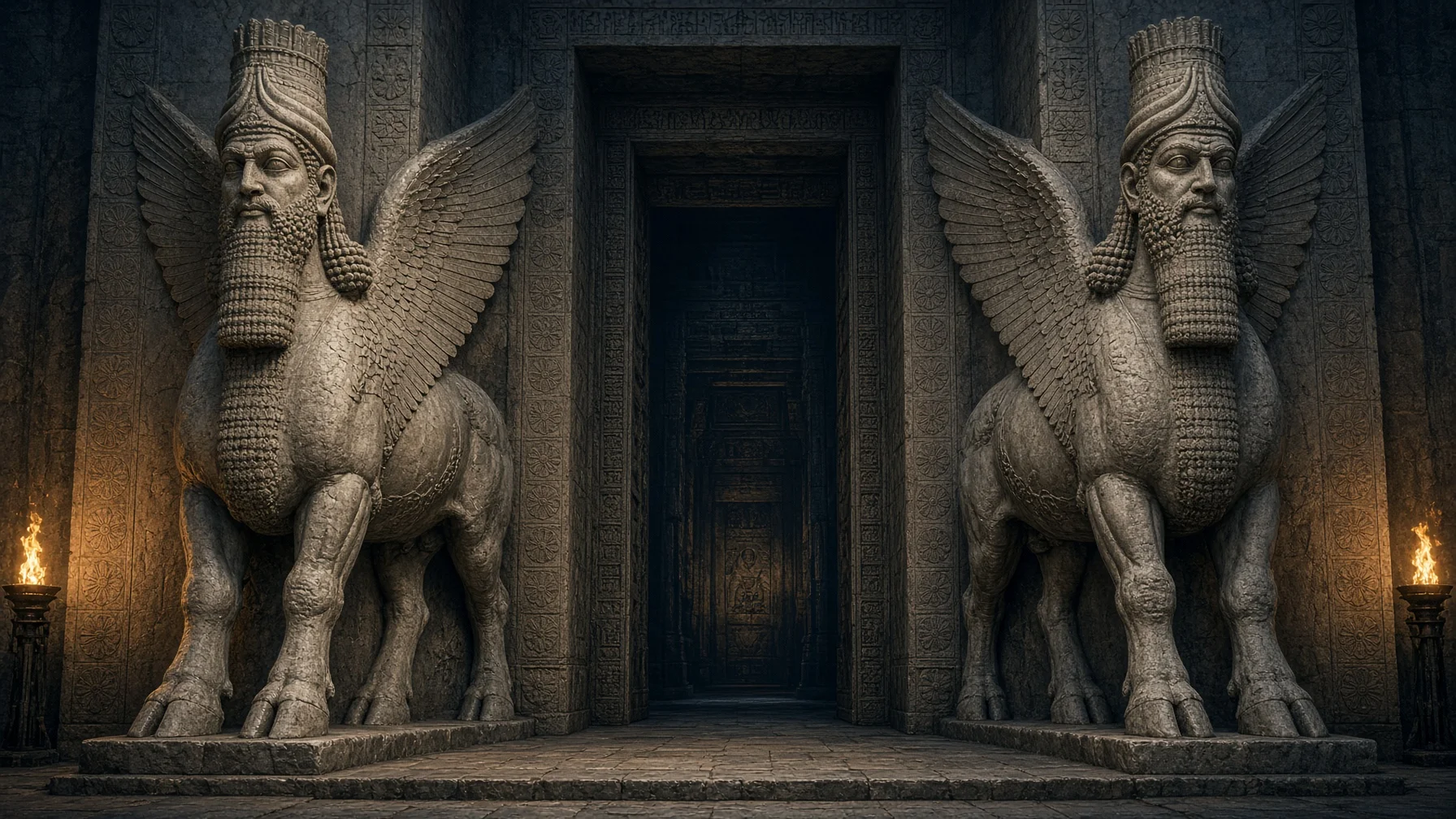
Marduk (Bel, Merodach) is the supreme god and champion of Babylon: the mighty warrior-god who slew the primordial dragon of chaos Tiamat, split her body to make the heavens and the earth, ordered the cosmos, created humankind, and was exalted as king of the gods.
The Champion of the Gods
Marduk — later invoked by the reverent title Bel, meaning "Lord" — is the supreme deity of the city of Babylon. He began as a comparatively minor local patron-god, one voice among many in the crowded Mesopotamian pantheon, but as Babylon itself rose to political dominance under the dynasty of Hammurabi, so too did the god whose name was bound to the city's fortunes. His ascent to kingship over all the gods is proclaimed at length in the Enuma Elish, the great Babylonian creation epic. The poem is not simply cosmology; it is theology written in service of a city's ambitions, composed to explain why Babylon's god now sat where older, more venerable gods once sat. The surviving text of the epic reaches us chiefly through cuneiform tablets recovered from the library of King Ashurbanipal at Nineveh, dating to the seventh century BCE, though scholars generally agree the composition itself is considerably older, likely reaching back to the Old Babylonian or Kassite period.
Waters Before the World
Before Marduk, before Babylon, before even the younger gods, there was only water. The Enuma Elish describes two primeval oceans commingling: Apsu, the sweet, still freshwater deep, and Tiamat, the restless salt sea. Their name is telling — Tiamat is linguistically kin to the Akkadian word for sea, tâmtu, and cognate with the Hebrew tehom, "the deep," that appears in the opening lines of Genesis. From the union of these two primordial waters came the first generation of gods, and from them further generations still, each new tier of divinity younger, louder, and more restless than the last.
The Silencing of Apsu
The clamor of these younger gods disturbed Apsu's ancient rest, and he resolved to destroy them outright, plotting their annihilation with his vizier Mummu, sometimes remembered as a personification of the primordial mist itself, or of chaotic, unformed craftsmanship. But the god Ea — wise, cunning, and forewarned — struck first. He killed Apsu and, in an act heavy with symbolic finality, built his own dwelling directly atop the slain god's body. Ea then captured Mummu, binding him and fitting him with a nose-rope, a humiliating tether that neutralized the vizier as any further threat.
Tiamat's Grief and Fury
The death of her consort transformed Tiamat into an avenger. She fashioned an army unlike anything the young cosmos had seen: eleven classes of monstrous warriors, serpents dripping venom instead of blood, and among them the mušḫuššu, a scaled, horned dragon-serpent that would become forever bound to the iconography of Babylon itself. To command this host she elevated a new consort, Kingu, naming him supreme general and, more significantly, fastening upon his chest the Tablet of Destinies — the very instrument that determined the fates of gods and the shape of the future.
The Bargain of Kingship
Terror spread through the assembly of the gods. None among the elder deities felt equal to facing Tiamat's fury or her monstrous host. It was Marduk who stepped forward, and Marduk who set his price: absolute kingship, unquestioned and permanent, should he prevail. The god Anshar and the gathered divine assembly consented, and in that consent the epic locates the mythological root of Babylon's own claim to supreme political and religious authority on earth — a divine mandate mirrored, the Babylonians believed, in the very structure of the heavens.
Single Combat with the Dragon of Chaos
Marduk rode out against Tiamat, described in the epic as a monstrous sea-dragon embodying primeval chaos itself, and defeated her in single combat. The battle, so long dreaded by the assembled gods, ended in her death at his hands.
Splitting the Cosmos in Two
Victory alone was not Marduk's purpose. Standing over the vast corpse of the dragon, he split her body in two, raising half of her aloft to form the vault of the sky and setting the other half beneath as the foundation of the earth. From her eyes, the epic recounts, flowed the sources of the Tigris and the Euphrates, the twin rivers that would nourish Mesopotamian civilization itself. Where Apsu's death had ended one threat, Tiamat's dismemberment became the very architecture of the world the Babylonians walked upon.
Capturing Kingu and the Tablet of Destinies
With Tiamat slain, her monstrous army broke and scattered. Marduk turned to Kingu, her general, and stripped him of the Tablet of Destinies that had marked him as commander. That tablet, symbol of ultimate cosmic authority, passed into Marduk's own hands, cementing in a single object the kingship the gods had already promised him. Kingu himself did not long survive his defeat.
The Making of Humankind
At Marduk's direction, Ea took up the task of fashioning a new kind of being. Kingu was slain, and his blood was mixed with clay to form humankind — a race created explicitly to labor in service of the gods, freeing the divine assembly from toil. It is a sobering origin, one that ties human existence directly to the punishment of a defeated rebel, and it reflects a broader Mesopotamian conviction that humanity's purpose was fundamentally one of service and maintenance of divine order, not autonomy.
Ordering the Heavens and the Calendar
Kingship secured and the world's basic shape established, Marduk turned to the finer architecture of the cosmos. He set the stars in their places, organized the constellations, and established the calendar by which time itself would be measured — a fitting labor for the god who had imposed order on primordial chaos, translated now into the practical rhythms of seasons, festivals, and agricultural life.
Esagila and the Ziggurat of Heaven and Earth
In gratitude and reverence, the Babylonians raised Marduk's principal sanctuary, the Esagila temple complex, at the heart of the city, alongside it the towering ziggurat known as Etemenanki. Together these structures formed the religious core of Babylon, a monumental architectural counterpart to Marduk's own claim of having ordered heaven and earth. Each year the Akitu, or New Year festival, unfolded around Marduk's cult, and it was during this festival that the Enuma Elish itself was ritually recited — the community reenacting, in liturgy, the very cosmic drama that had installed their god as king.
Fifty Names for a Sovereign God
At the epic's close, the assembled gods honor Marduk with fifty names, each one capturing a different facet of his power, from his mastery over water and storm to his role as creator, judge, and sustainer. The naming is not mere ornament; in Mesopotamian thought, a name carried the essence of the thing it described, so that to enumerate fifty names for Marduk was to declare, exhaustively, that every attribute of divine sovereignty had converged in him alone.
Sarpanit, Consort of the Temple
Beside Marduk at the Esagila stood his consort Sarpanit, also rendered Zarpanit or Sarpanitum, worshipped in tandem with her husband and associated with fertility, and by some interpretations with the planet Venus. Her name has been linked by scholars to the Akkadian phrase zēr banītu, "creatress of seed," an etymology that binds her closely to themes of generation and renewal — a fitting partner to a god whose own myth was so preoccupied with the making of a habitable, fertile world out of primordial water.
Nabu, Son and Keeper of the Tablets
In later Babylonian religion, Marduk and Sarpanit were given a son: Nabu, god of writing, wisdom, and the scribal arts, whose cult center stood at Borsippa near Babylon, centered on his own temple, Ezida. Nabu's symbol, the stylus and clay tablet, marked him as keeper of the Tablets of Destiny in later tradition, and by the Neo-Babylonian period his worship had grown so prominent that it rivaled his father's own cult in importance — a scribe-god's quiet ascent running parallel, generations later, to the warrior-king's own rise recounted in the Enuma Elish.
The Dragon on the Gate
Marduk's presence in Babylon was not confined to temple ritual; it was woven into the city's very fabric. The mušḫuššu, the composite dragon-serpent first raised by Tiamat against the gods and later claimed as Marduk's own symbolic animal, was depicted in glazed relief upon the great Ishtar Gate of Babylon. Marduk's own emblem, the spade or hoe known as the marru, was a quieter but no less recognized sign of the god who had shaped the world and now watched over its order, city, and king.