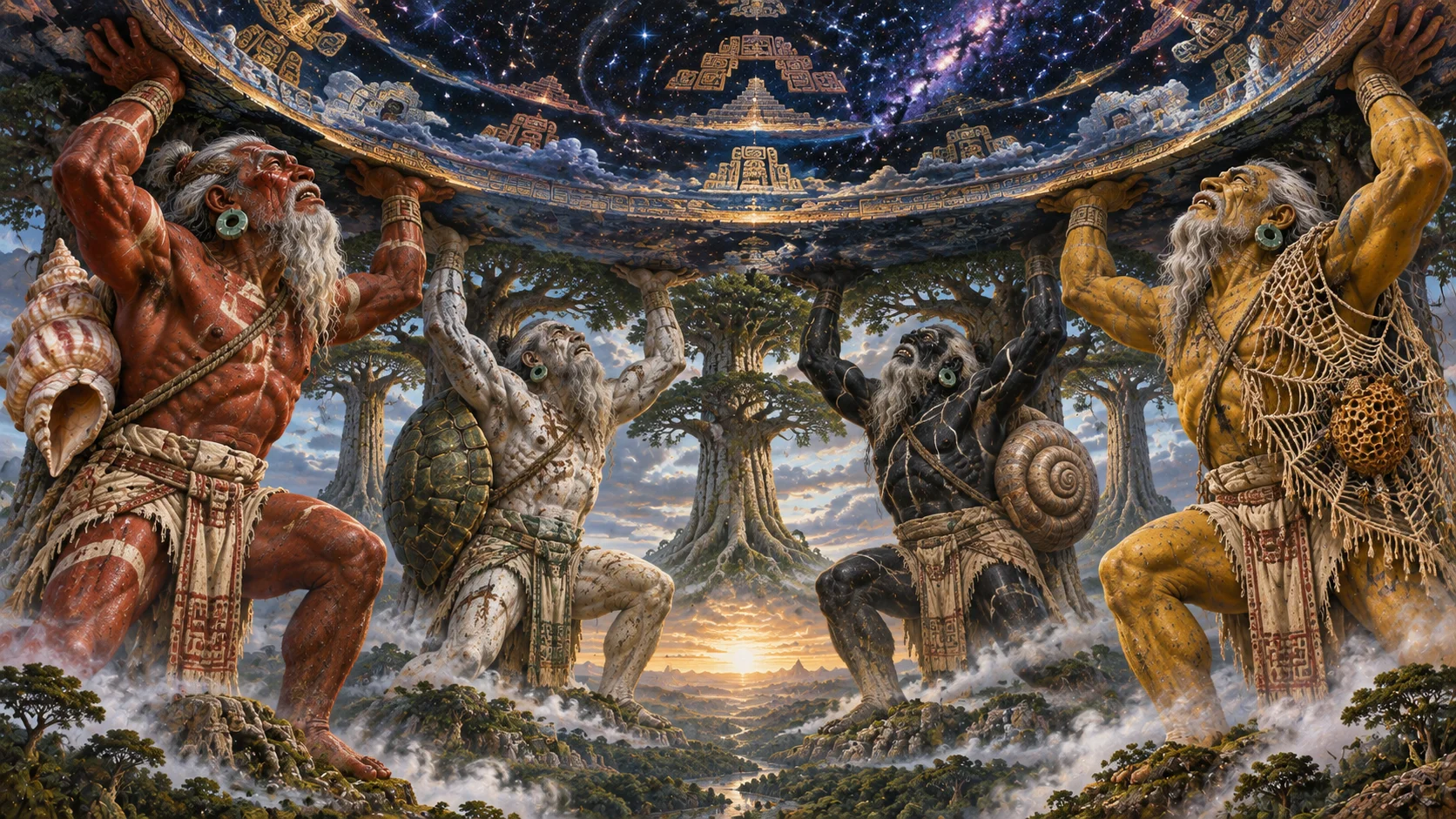
The Bacabs were four Yucatec Maya gods who together held up the four corners of the sky, preventing it from collapsing down onto the earth — a cosmological function that made them, despite receiving less individual narrative attention than gods like Chaac or Itzamná, structurally indispensable to the Maya understanding of how the world was physically held together. Each Bacab was linked to one cardinal direction, one color, and one of the four "year bearer" days that governed the start of the Maya solar year, making the four of them, collectively, a working model of Maya cosmic and calendrical space.
Four Brothers, Four Corners
According to several colonial-era sources, the four Bacabs — sometimes individually named Hobnil, Cantzicnal, Ho'Chan Ek, and Zac-Cimi in the ethnohistoric record, though naming conventions vary somewhat between sources — were understood as brothers, the offspring of the great creator god Itzamná and, in some tellings, the goddess Ixchel. Each brother was stationed at one of the four cardinal points and physically supported the sky above his corner of the earth, a cosmological image found in comparable form across a number of other Mesoamerican traditions, where the sky is imagined not as an abstract vault but as a physical structure requiring active, ongoing support to keep it from falling.
Directions, Colors, and Year Bearers
Maya cosmology organized the four cardinal directions with an associated color for each: red for east, white for north, black for west, and yellow for south, with a fifth, "green" or central position sometimes added to complete the model. The Bacabs' individual associations, as recorded in colonial sources such as the Books of Chilam Balam, generally follow this scheme, with the Bacab of the east linked to red and to the year-bearer day Kan, the Bacab of the north linked to white and the year-bearer Muluc, the Bacab of the west linked to black and the year-bearer Kawaq (sometimes rendered Cauac), and the Bacab of the south linked to yellow and the year-bearer Ix. It is worth being direct about the fact that these specific direction-color-year-bearer pairings are not perfectly consistent across every surviving source: different colonial manuscripts and different modern scholarly reconstructions present variant orderings and occasional disagreements about which Bacab governs which specific combination, reflecting both genuine regional variation in Precolumbian practice and the imperfect, sometimes contradictory nature of the colonial-era records through which this material survives. Presented honestly, the four-direction/four-color/four-year-bearer framework is solid and well attested; the exact one-to-one mapping of each named Bacab onto each specific triad is less firmly settled.
The Bacabs and World Trees
Each cardinal direction in Maya cosmology was associated not only with a Bacab and a color but with its own world tree, a specific sacred tree species understood to grow at that corner of the cosmos and to physically connect the earth, sky, and underworld along a vertical axis at that point. The ceiba tree, for instance, is associated with the eastern direction and, correspondingly, with the red Bacab of the east. This layering of Bacab, color, direction, and tree onto a single cardinal point illustrates how densely symbolic Maya cosmological space was: no single direction was ever just a direction, but a nexus of divine personality, color symbolism, botanical association, and calendrical function all operating together.
Role in the Calendar and in Divination
Because each Bacab was tied to a specific year-bearer day, the four gods played a central role in the Maya solar calendar's New Year ceremonies, with the ritual observances marking the transition from one year to the next varying according to which of the four year-bearer days, and therefore which Bacab, presided over the incoming year. This calendrical importance extended naturally into divination: the Bacabs, along with their meteorological associations, were consulted or invoked in connection with questions about the coming year's crops, weather, and even the health of beehives, reflecting how thoroughly Maya timekeeping, agriculture, and religious practice were woven into a single integrated system rather than existing as separate spheres of life.
Relationship to Pauahtun and to Itzamná
The Bacabs are closely associated with, and in some sources effectively identified with, the deity or deity-group known as Pauahtun, itself sometimes described as an aged incarnation or aspect of the great creator god Itzamná, who is credited in various colonial accounts with having brought the universe itself into being. Some sources also link the Bacabs to the Chacs, the plural, directionally organized manifestation of the rain god Chaac, given that both groups of deities share the same fundamental structure of one singular divine function — sky-bearing in the Bacabs' case, rain-bringing in Chaac's — expressed as four separate, direction-bound beings rather than as one undivided god. Taken together, the Bacabs, Pauahtun, and the directional Chacs illustrate a recurring and distinctively Maya theological pattern: fundamental cosmic functions were rarely assigned to a single deity alone, but were instead distributed across the four cardinal directions, each with its own color, its own calendrical association, and its own name, while still being understood as expressions of one coherent underlying cosmic order.
Depiction in Codex and Sculpture
In the surviving codices, the Bacabs are sometimes shown as aged, wrinkled figures, consistent with their association with Pauahtun and with the general Mesoamerican pattern of depicting foundational, load-bearing cosmic forces as elderly rather than youthful, evoking endurance and long-suffering support rather than vigor. In Classic-period architectural sculpture, particularly at sites in the northern Yucatán, aged, wizened faces at building corners have been interpreted by some archaeologists as representations of the Bacabs or of closely related corner-supporting deities, physically positioned at the architectural corners of temples in the same way the gods themselves were understood to be positioned at the corners of the cosmos — a direct visual mapping of sacred cosmology onto the built environment that recurs throughout Maya architecture more broadly.
The Books of Chilam Balam
Much of what survives about the Bacabs' specific directional, chromatic, and calendrical assignments comes from the Books of Chilam Balam, a set of colonial-era Yucatec Maya manuscripts written in Maya using the Latin alphabet after the conquest, blending Precolumbian religious and calendrical material with Christian and colonial-era content in ways that scholars must carefully disentangle. These books, compiled and recopied across different Yucatec towns over generations, are themselves not perfectly uniform, which helps explain why the exact Bacab-direction-color-year-bearer correspondences show some variation between manuscripts. Rather than a flaw in the sources, this variation is better understood as a genuine reflection of how Yucatec Maya religious knowledge, already regionally diverse before the conquest, continued to be locally maintained, recorded, and occasionally reshaped by individual scribes working in different towns under colonial pressure.
The Ritual of the Bacabs
One of the most important sources on the Bacabs is a colonial Yucatec Maya manuscript known as the Ritual of the Bacabs, a collection of incantations and medical-magical texts copied in the eighteenth century from older material. The scholar Ralph Roys translated it in the 1960s.
The incantations call on the Bacabs by name and color alongside other powers to cure illnesses, and they show that these cosmic figures were drawn into everyday healing. The text is valuable because it preserves the voice of Maya practitioners rather than the description of an outside observer.
The Maya Cosmogram
Maya cosmology organized the world into four directions around a center, a pattern sometimes called the quincunx or cosmogram. Each direction had a color and a set of associations, and the Bacabs as supporters of the four corners fit naturally into it.
The same layout shapes ritual and architecture, with plazas and temples arranged to reflect the four-part world. In this sense the Bacabs are not only figures of myth but part of a spatial and ritual map used in daily life.
The Five Unlucky Days
The Maya solar calendar had eighteen months of twenty days, followed by a period of five days, the Wayeb in Classic terminology, regarded as unlucky. Colonial sources describe elaborate rituals at the turn of the year, and the Bacabs appear in connection with the year-bearing days.
This calendar structure explains the association of the Bacabs with time as well as space. The sky-bearers also bore the years, so that the support of the heavens and the passage of time were conceived together.
Why the Bacabs Matter to Historians
Even though the Bacabs lack extensive myths, they are valuable evidence for Maya cosmology. They show how ideas of structure and balance were expressed through deities and how those deities were integrated into ritual and medicine.
They also illustrate the continuity between Classic and Postclassic belief, since sky-bearing figures appear across several periods. Historians treat them as an important link in tracing the development of Maya religion.
The Bacabs in Later Memory
The concept of sky-bearers did not disappear after the conquest. Colonial Yucatec texts, such as the Books of Chilam Balam, continued to refer to them, and their names appear in prophecy and ritual language.
This persistence shows how Maya authors adapted old ideas in new settings, preserving them in books written in the Latin alphabet.
Sky-Bearers in Comparative Mesoamerican Thought
The image of the sky as a physical structure requiring active support from four corner-positioned beings is not unique to the Maya; comparable sky-bearer concepts appear, in varying forms, among other Mesoamerican peoples, suggesting either a very old shared cosmological inheritance across the region or a case of independently convergent religious imagination responding to the same basic observational problem — namely, why the visible dome of the sky does not fall. What is distinctively Maya about the Bacabs specifically is the tightness of their integration into the calendar: rather than existing as a separate, free-standing cosmological concept, the four sky-bearers are woven directly into the year-bearer system that governed the practical business of dating every day, month, and year, making them inseparable from the everyday operation of Maya timekeeping rather than a purely abstract creation myth detail.
Sources & traditions
- EncyclopediaWikipedia — Bacab
- TraditionMaya texts, oral tradition and village tellings (Mesoamerica)
Myths change from area to area and from time to time. This chronicle follows the most widely told versions; tellings in other villages, regions and eras may differ.