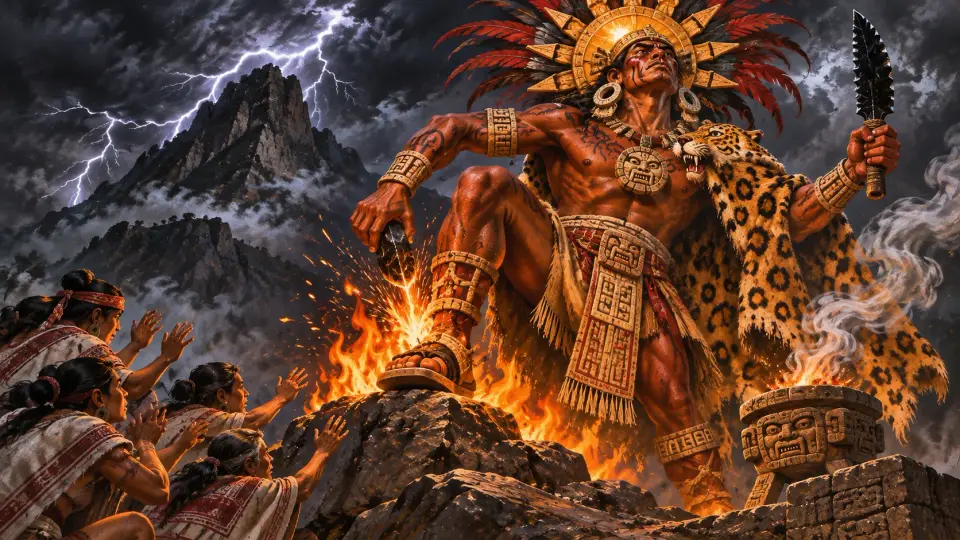
Jacawitz was a mountain and fire deity of the Postclassic K'iche' Maya of highland Guatemala, one of the three principal patron gods — together with Tohil and Awilix — received by the founding K'iche' lineages in the origin narrative told in the Popol Vuh. His name is bound directly to the sacred mountain where the K'iche' ancestors are said to have first settled and built their earliest citadel after their long migration.
A Name Rooted in Mountain and Fire
The etymology of "Jacawitz" carries several overlapping meanings across different Mayan languages, and this layered meaning is itself informative about the deity's character. In lowland Maya languages, jacawitz can be read simply as "mountain," directly naming the deity's most basic association. In highland Mayan languages, a closely related form, q'aq'awitz, means "fire mountain," a reading that ties Jacawitz closely to his fellow patron deity Tohil, who is likewise fundamentally a fire god, suggesting the two shared or overlapping domains at some level even as the Popol Vuh presents them as separate figures. In the Cholan languages, the name has additionally been read as "first mountain," linking Jacawitz to the primordial mountain of creation itself, a recurring and important image throughout Mesoamerican cosmology in which mountains are frequently understood as the places where the world was first stabilized and where humanity's ancestors first emerged or settled.
Multiple Readings, One Deity
It is worth pausing on how unusual it is for a single deity's name to carry three distinct, only partially overlapping meanings depending on which Mayan language tradition is consulted — "mountain," "fire mountain," and "first mountain." Rather than treating this as a problem to be resolved into one single correct translation, specialists generally read it as evidence of how the K'iche' pantheon itself developed at the intersection of multiple regional Maya language traditions during the Postclassic period, absorbing and reconciling vocabulary and religious concepts from lowland, highland, and Cholan-speaking neighbors alike. Jacawitz's layered name is, in this sense, a small linguistic fossil of the broader cultural mixing that shaped K'iche' religious identity in the centuries before the Spanish conquest.
Patron of the Ajaw K'iche' Lineage
Jacawitz served as the specific patron deity of the Ajaw K'iche' lineage, one of the ruling houses of the K'iche' confederation, paralleling the way Awilix patronized the Nija'ib lineage and Tohil patronized the Kaweq. In the Popol Vuh's founding narrative, the K'iche' lord Mahucutah is described as the ancestor who received Jacawitz when the assembled peoples gathered at the mythical place called Tollan to be given their languages and their respective gods — a formative scene in which the distribution of patron deities among the different founding lineages establishes the religious and political structure that the K'iche' confederation would carry forward into the highlands.
The Sacred Mountain and the First Citadel
Jacawitz is closely tied to the specific highland site where the K'iche' ancestors, after their long and difficult migration described at length in the Popol Vuh, first settled and constructed their earliest fortified citadel. This mountain, understood as both a literal geographic location and the physical embodiment of the god himself, functioned as a place of refuge, defense, and religious observance in the K'iche's earliest highland history, before the confederation later moved its capital to Q'umarkaj. The naming of the mountain after the god, or the god after the mountain, reflects a broader Maya pattern in which specific sacred landscape features were themselves treated as living, named divine beings rather than as mere backdrops to human and divine activity.
Jacawitz Compared to Chaac's Fourfold Structure
It is worth noting a structural contrast between Jacawitz and deities like Chaac or the Bacabs, who are understood as singular divine functions distributed across all four cardinal directions simultaneously. Jacawitz, by contrast, is tied to one specific mountain and one specific founding lineage, illustrating a different, more localized mode of Maya religious organization in which a deity's authority was rooted in a particular place and a particular kin-group's claim to that place, rather than in an abstract, universally distributed cosmic principle. Both modes of religious organization — the universal-directional and the local-lineage-based — operated simultaneously within Maya religious thought, without one being considered more fundamentally "true" than the other. Jacawitz's cult exemplifies how deeply Maya religion could be embedded in the specific, named topography of a single community's home territory, rather than floating free as a purely abstract set of cosmic principles detached from any particular place on the ground.
Companion to Tohil
Jacawitz is repeatedly described as a close companion of Tohil, the K'iche's primary fire, rain, and patron deity, and the overlapping "fire mountain" reading of his own name reinforces just how closely the two gods' domains were understood to interlock. Some sources describe the triad of Tohil, Awilix, and Jacawitz as at times collectively referred to under the single name Tohil, treating that deity as the principal or leading member of the group whose name could, in certain contexts, stand in for all three together — evidence of how fluid the boundaries between individually named deities could be within a tightly bound divine set that the K'iche' themselves understood as fundamentally one origin, one migration, and one covenant of protection in exchange for offerings.
Turning to Stone and Continued Veneration
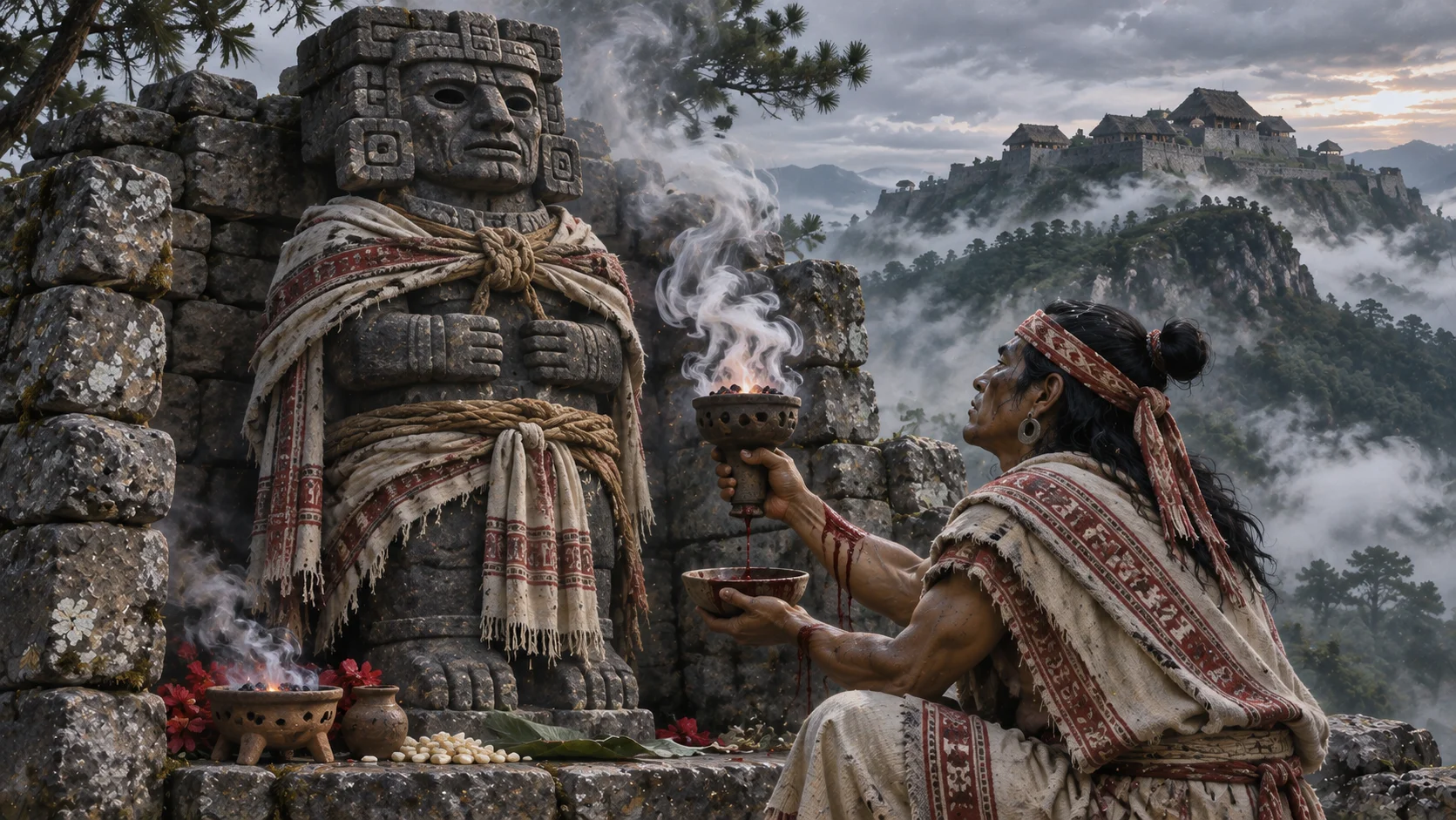
Like Tohil and Awilix, Jacawitz is described in the Popol Vuh as turning to stone with the arrival of the first dawn, at the end of the long age of darkness that dominates the middle portion of the text. This transformation fixed his presence into a stone effigy that continued to receive offerings and worship from the Ajaw K'iche' lineage at his dedicated shrine, sustaining a cult that endured, in some transformed and much-reduced form, into the Postclassic period immediately preceding Spanish contact.
Mountains as Living Ancestors
The K'iche' understanding of Jacawitz as simultaneously a named god and an actual, physically present mountain reflects a broader Mesoamerican pattern in which prominent landscape features were rarely treated as inert geography. Mountains in particular were widely understood across highland Guatemala as containing or embodying ancestral and divine presence, sources of water, caves leading to the underworld, and places where lineage founders had first emerged or settled. Jacawitz's specific identity as "first mountain" in at least one etymological reading connects him directly to the broader Mesoamerican creation-mountain motif, in which the world's stabilization after a period of chaos or flood is frequently marked by the emergence or naming of a primordial mountain — making Jacawitz not simply a local highland guardian but a figure carrying echoes of the deepest layer of Mesoamerican cosmogonic thought.
The Mountain as Sacred Place: Witz in Maya Thought
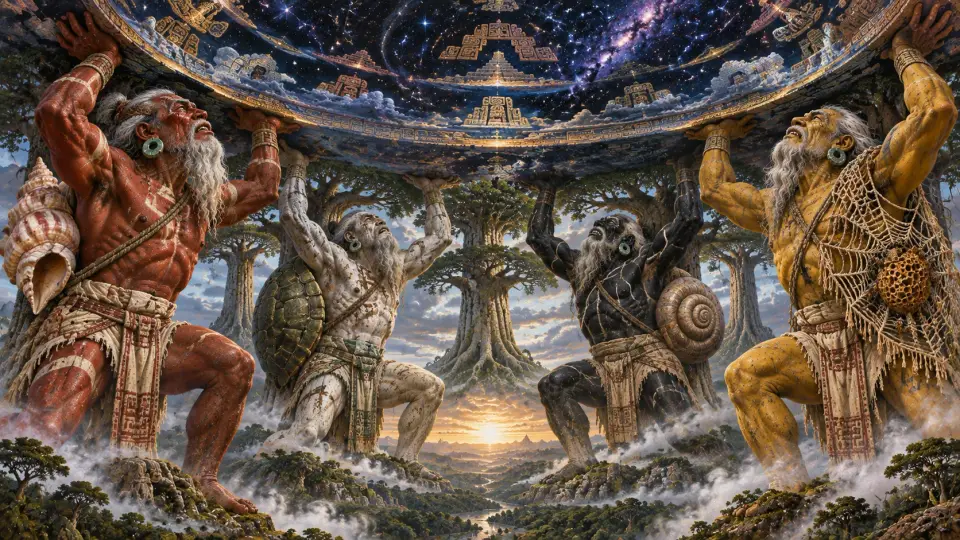
In many Mayan languages the word witz means mountain, and in Classic Maya art a mountain could be shown as a creature, the witz monster, with a cleft forehead and gaping mouth. Pyramids were built as artificial mountains, and some temple façades, such as one at Copán, are carved as mountain-creature faces.
Against this background, a deity whose name is tied to a sacred mountain fits a long tradition. Mountains were homes of ancestors and sources of rain and fertility, so a god who bore the name of one was a powerful presence tied to a specific place.
Fire Ceremonies Today
Among contemporary Maya communities in Guatemala, spiritual guides known as ajq'ij conduct fire ceremonies in which offerings are burned and the days of the sacred calendar are invoked. The ceremonies often take place on hills, at ancient sites or in sacred caves.
The use of fire in these rites resonates with the fire-associated deities of the K'iche' past, though it would be wrong to assume that modern ceremonies are identical to ancient ones. They combine inherited elements with changes shaped by history, including Catholic influence.
Stone and Memory in the Highlands
The Popol Vuh's account of the patron gods turning to stone fits a landscape in which rock formations and ancient ruins are everywhere. Highland peoples read their surroundings as carrying the memory of ancestors and founding events.
This habit of reading landscape as history is characteristic of many Indigenous peoples, and it gives sites such as sacred hills their continuing importance. For the K'iche', Jacawitz is part of that sense of place.
The Name in Modern Guatemala
Names drawn from the Popol Vuh and from K'iche' tradition are used in modern Guatemala for places, organizations and people. The text is widely regarded as a national cultural treasure, studied in schools and discussed by writers and artists.
This public presence has helped sustain interest in deities such as Jacawitz even among people who do not follow traditional religion. It also shows how sacred literature can serve as a foundation for contemporary cultural identity.
Jacawitz and the Idea of Place
The tie between a god and a particular mountain illustrates a central feature of Maya religion, in which divinity was often attached to specific places in the landscape. Caves, hills, springs and rock formations could each be homes of powerful beings.
For the K'iche', Jacawitz expresses this attachment to place in a particularly clear way, since his name and the name of the mountain are the same.
Legacy in Highland Guatemalan Memory
Though the organized temple cult centered on Jacawitz did not survive Spanish conquest and colonization, the specific mountain or mountains identified with him in K'iche' oral tradition have continued to be recognized as significant sacred sites within highland Guatemalan Maya communities into the modern period, with some contemporary K'iche' and other Maya communities maintaining forms of ritual observance at mountain shrines that carry forward, in adapted and often syncretic form, the older reverence for named, ancestrally significant peaks. This continuity, while distinct from and less thoroughly documented than the living Ch'a Cháak rain ceremonies of the Yucatán, points to the same underlying pattern: Maya sacred geography did not simply vanish with the conquest but persisted, transformed, wherever the physical landscape itself remained a living point of reference for descendant communities.
Sources & traditions
- EncyclopediaWikipedia — Jacawitz
- TraditionMaya texts, oral tradition and village tellings (Mesoamerica)
Myths change from area to area and from time to time. This chronicle follows the most widely told versions; tellings in other villages, regions and eras may differ.