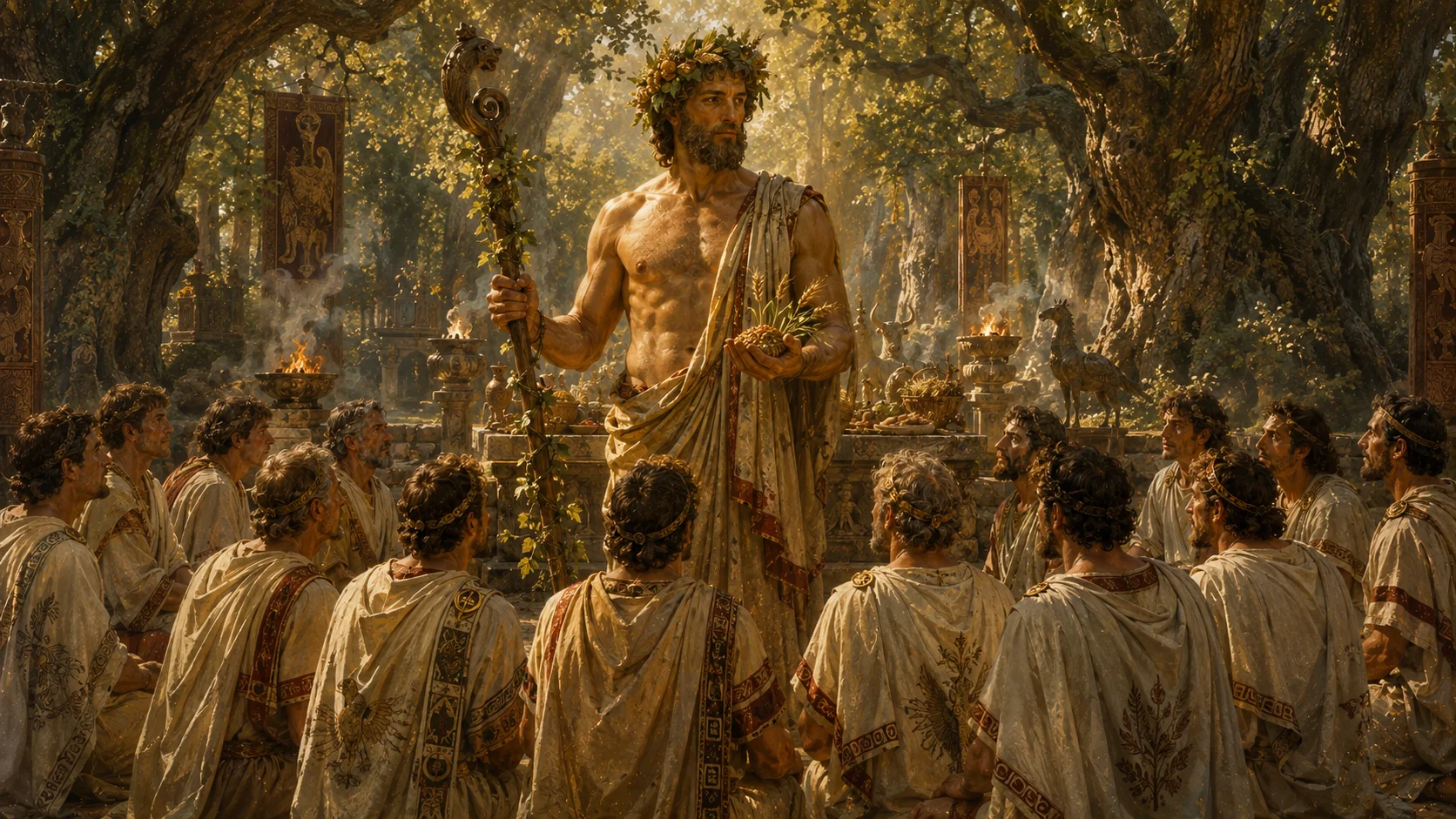
Voltumna, Veltha, Vertumnus, is the chief national god of the Etruscan league: the supreme deity at whose great sanctuary, the Fanum Voltumnae, the twelve cities of the Etruscan confederation gathered for their councils, festivals, and games, a god of the earth, the seasons, change, and the land.
A Title Resting on a Single Roman Pen
Everything the wider world thinks it knows about Voltumna's supremacy comes down to one sentence from one Roman writer. Varro, in his De Lingua Latina, calls him "deus Etruriae princeps" — the principal god of Etruria. It is a striking claim, and it is essentially our only literary testimony to it. No parallel Etruscan-language inscription survives to confirm that the god's own people ranked him above Tinia, Uni, Menrva, or any of the other named powers of their pantheon. The title "chief god of Etruria," repeated so often that it reads as settled fact, is in truth the judgment of a single outside source, and it deserves to be handled with that caveat attached rather than recited as certainty.
The Federal Shrine Beyond the City Walls
What is not in doubt is the role Voltumna's sanctuary played in Etruscan public life. The Fanum Voltumnae was the federal shrine of the Etruscan League, the duodecim populi Etruriae, the twelve peoples of Etruria. Representatives of the member cities travelled there to meet, and what happened at those meetings was never purely devotional. Religious festival, political council, and communal gathering were bound together at a single site in a way that has no true equivalent among the city-bound cults of individual Etruscan towns. Voltumna was not a local patron competing with Tinia or Uni for a city's loyalty; he was the deity in whose name the confederation itself assembled, a god of pan-Etruscan unity rather than of any one hearth.
Somewhere Near Orvieto, and Nowhere Certain
For all its importance, the Fanum Voltumnae has never been pinned to a confirmed location. Scholarly opinion most often places it in the area near ancient Volsinii, modern Orvieto, largely on the strength of Livy's references to it in his account of the Roman-Etruscan wars. Livy mentions the site repeatedly — among other passages, at 4.23, 4.25, and 5.17 — describing it as the place the League convened, but he does not hand later readers a map. The uncertainty is not a minor footnote; it means that for centuries, the physical seat of the god regarded as Etruria's principal deity has been a matter of inference from a Roman historian's prose rather than a fixed point on the ground.
Games, Councils, and the Business of Survival
Livy's narrative gives some sense of what actually happened at the shrine. Ludi, games, were held there, woven into the same gathering as the political business of the League. And that political business was not abstract: during the fourth-century-BCE wars between Rome and the Etruscan cities, the Fanum Voltumnae was where Roman diplomatic pressure and interference reached the assembled Etruscan representatives. The sanctuary's importance, in other words, did not fade as an antiquarian curiosity — it remained a live diplomatic and military pressure point deep into the period of Roman conquest, a place where the fate of the confederation was actually being argued over even as that confederation's independence was ending.
A Name That May, or May Not, Survive in Stone
Behind the Latin form Voltumna, scholars have looked for an Etruscan original, and the search has not produced a clean answer. The name is thought to correspond to Etruscan Veltha, and some link it to a god called Veltune known from inscriptions. But the identification of the Latin Voltumna with a securely attested Etruscan inscriptional deity is not settled — it remains probable rather than certain. This is the recurring shape of Voltumna's evidence: a Roman source states something with confidence, and the Etruscan material, when it exists at all, only partially and ambiguously backs it up.
Earth, Season, or Something Else Entirely
Ask what kind of god Voltumna actually was, and the honest answer is that nobody is sure. Some Roman sources and modern scholars, working from comparative religion and etymology, associate him with vegetation, the earth, or a chthonic, fertility-linked character — a power tied to what grows and what lies beneath. Others go further and treat the god as possibly androgynous or of shifting gender, since certain ancient sources imply a female or dual-natured deity behind the name. This is a genuinely contested point among those who study the evidence, not a settled fact dressed up as one, and any confident single-sentence description of "what Voltumna was" is doing more tidying than the sources allow.
The Roman Cousin, Claimed but Not Confirmed
The most familiar face put on Voltumna in the modern imagination is that of Vertumnus, the Roman god of the seasons, of change, and of gardens. The two names are often linked etymologically and functionally, and the equation is repeated so readily that it has hardened into something like common knowledge. But it is worth remembering what it actually is: a Roman-era interpretatio, an ancient act of translation between cultures, and the underlying linguistic derivation is itself debated by philologists. A probable, likely connection is not the same thing as a proven identity, and the two gods should be held at that careful distance even while acknowledging how naturally later tradition drew them together.
A God With No Story Attached
Unlike the Greek deities, whose lives are strung together in cycles of birth, conflict, and consequence, Voltumna comes down to us with no narrative mythology at all — no episodes, no birth story, no genealogy of the kind that gives other gods a shape beyond their cult function. The surviving Etruscan corpus preserves cult and political function for this figure, not myth. That absence is itself a documented feature of the evidence rather than a gap waiting to be filled by invention: Voltumna is known through what was done in his name at his sanctuary, not through anything he was ever said to have done himself.
A Supremacy Without a Family Tree
Because no narrative survives, Voltumna also sits outside any clear genealogical structure connecting him to the other named Etruscan gods. He is not placed, in the sources that remain, into a family relationship with Tinia, Uni, Menrva, or the rest of the pantheon. His supremacy, insofar as Varro's testimony can be trusted, is functional and political — head of the League's pantheon in a ritual and federal sense — rather than genealogical. He rules, if he rules at all, by the office his sanctuary held for the confederation, not by any recorded lineage of divine parentage.
A Face That Was Never Fixed
Other major Etruscan gods carry recognizable attributes into their surviving art: Tinia with his thunderbolt, Menrva helmeted for war. Voltumna has no such securely identified, universally agreed cult image or iconographic type. Scholars attribute this gap to the near-total loss of material recovered directly from the Fanum Voltumnae itself — the site that would have held whatever image or attribute set once defined him in Etruscan eyes has not yielded that evidence, leaving the god's visual identity essentially blank in the archaeological record.
Digging Toward Campo della Fiera
The search for the sanctuary itself has not stood still. Since the 2000s, excavations at Campo della Fiera, outside Orvieto, directed by Simonetta Stopponi, have proposed identifying that site with the Fanum Voltumnae, based on votive deposits found there and what may be a sacred processional way. It is a serious and sustained piece of archaeological work, and it has shifted the conversation about where the shrine stood. But it remains a scholarly hypothesis rather than a certainty — no inscription naming Voltumna has been found on-site to confirm the identification outright, and the case rests on circumstantial and contextual evidence rather than a signed dedication.
Chasing a Root Through an Isolate Tongue
Even the god's name resists final explanation. Some linguists have connected it to an Etruscan or Italic root associated with turning, or with a wheel or vault, a thread that feeds directly into the proposed link with Vertumnus, whose own name carries the sense of turning or changing. But Etruscan is a language isolate, unrelated to its Indo-European neighbors in any confirmed way, and its etymology is notoriously difficult to pin down. The "turning" root behind Voltumna's name should be read as a speculative, if suggestive, proposal — one more piece of a puzzle where almost every piece arrives with a qualifier attached.
What the Silence Itself Says
Taken together, the record of Voltumna is less a portrait than an outline traced from the outside: a single Roman author's claim to supremacy, a federal shrine whose location is inferred rather than confirmed, a name whose Etruscan original is probable but not proven, a nature debated between earth-god and shifting-gendered figure, a Roman counterpart linked by resemblance rather than certainty, and no myth at all to fill in the rest. That pattern of qualification is not a failure of scholarship so much as an honest reflection of what eighteen centuries have left behind. Voltumna presided, by Roman account, over the one occasion each year when the whole Etruscan nation stood in one place — and it is that federal, gathering role, more than any fixed image or story, that the evidence actually allows us to hold onto with confidence.
Sources & traditions
- EncyclopediaWikipedia — Voltumna
- TraditionEtruscan texts, inscriptions and later retellings (Etruria)
Myths change from area to area and from time to time. This chronicle follows the most widely told versions; tellings in other villages, regions and eras may differ.