Tinia, called also Tin, Tins, Tinh in the variant spellings the inscriptions preserve, is the chief sky deity of the Etruscan pantheon, lord of thunder and lightning, occupying the supreme position among the gods of Etruria in a manner structurally comparable to Zeus among the Greeks and Jupiter among the Romans. He forms the head of the great triad with Uni, his consort, later equated with Juno, and Menrva, goddess of wisdom, later equated with Minerva. Etruscan religion did not necessarily construct him as a single omnipotent ruling monarch of a divine court in the same narrative sense as Greek myth; rather, the Etrusca disciplina, the formal religious-divinatory system of the haruspices, emphasized his role as wielder and sender of distinct classes of thunderbolt, each bearing its own meaning for the reading of omens.
The God Named on the Bronze Liver
Among the clearest physical attestations of Tinia's supreme standing is his name inscribed on the Piacenza Liver, the bronze model of a sheep's liver divided into sixteen regions, each assigned to a deity, that the haruspices used in training and in the practice of extispicy. Tinia occupies a central and prominent celestial region among those sixteen divisions, a placement that mirrors and confirms, in a durable material form, the supremacy that his cult and his iconography elsewhere claim for him. The Piacenza Liver is not myth or later commentary; it is a working instrument of Etruscan religious practice, and Tinia's position on it is direct evidence of how the Etruscans themselves ranked their gods within the architecture of divination.
Three Bolts, Three Meanings
The most distinctly Etruscan piece of theology attached to Tinia concerns the lightning itself. Roman sources transmitting Etruscan religious lore describe him as controlling three distinct types, or manifestations, of thunderbolt, each carrying a different meaning and a different severity for the diviner reading the sky. This threefold doctrine of fulgural omens, the art of interpreting lightning, was elaborated in far greater technical detail among the Etruscans than anything paralleled in Greek Zeus-lore, and it stands as one of the better-attested genuinely Etruscan religious ideas, rather than a borrowing dressed in native language. Some bolts, tradition held, Tinia could hurl on his own authority; the most destructive and consequential he could loose only with the consent of higher, veiled powers standing behind even him. To read which bolt had fallen, and from what quarter of the sky, was to read a specific message about the fate of the community, not a generalized sign of divine anger.
The Veiled Powers Behind the Throne
This detail, that even the chief thunder-god required the consent of other, more hidden powers before loosing his gravest bolts, is one of the features that most sharply distinguishes Etruscan theology from the Greek model it is so often compared against. Where Zeus rules as an unchallenged sovereign in the developed Greek tradition, Tinia's authority over the most severe class of lightning appears to have been bounded, checked by a further tier of divine consent. It is a glimpse of a cosmological structure in which supremacy in the pantheon did not mean supremacy over the whole architecture of fate, a structure the surviving evidence lets us see only in outline.
Consort and Companion in the Chief Triad
Tinia stood at the head of the great triad with Uni, his consort, and Menrva. The precise nature of these pairings, whether framed as marriage in a narrative sense or as a familial hierarchy understood some other way, is inferred mainly from the later continuity of Roman practice, in the Capitoline Triad of Jupiter, Juno, and Minerva, and from the evidence of joint temple worship at Etruscan sanctuaries, rather than from any surviving native Etruscan narrative that describes the relationships explicitly. What can be said with confidence is that the three were worshipped together, that their cult carried real civic weight, and that the Romans, recognizing the same three-part structure, carried it forward wholesale into their own state religion.
The Bearded King in Bronze and Terracotta
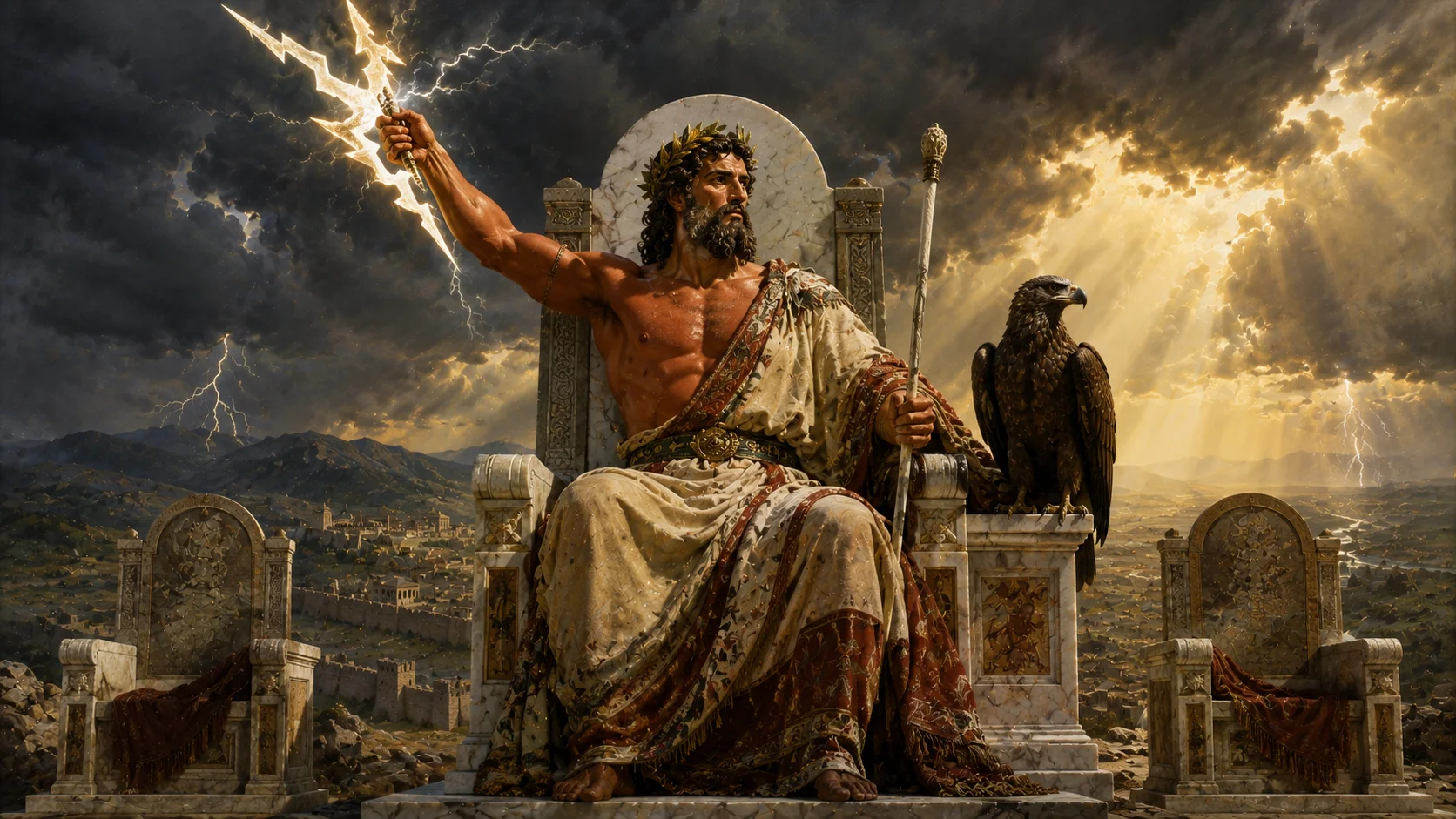
In surviving art, Tinia appears as a mature, bearded, enthroned or standing male figure, often nude or partly draped, holding a thunderbolt, a scepter, or both. This visual language closely parallels the standard Greek Zeus and Roman Jupiter type, and Etruscan artists adopted it extensively through sustained contact with Greek art from the Archaic period onward. The image is instantly recognizable across media, from small bronze votive statuettes to the decoration of temple roofs, and it is through this shared iconographic vocabulary, as much as through the Roman equation of the two gods, that Tinia's identity as a Zeus-type sky sovereign was fixed in the ancient world and has remained legible ever since.
A Seat Among the Assembled Gods
Etruscan bronze mirrors, a favored medium for mythological and religious scenes, show Tinia in divine council or gathering scenes alongside other major deities, including Menrva, Uni, and figures such as Hercle, the Etruscan Herakles, and Turan, the Etruscan Aphrodite. These mirror scenes indicate that Tinia was imagined as presiding over, or at least participating in, an assembly of the gods, a motif that parallels the Greek Olympian council. It is worth being precise about what this evidence shows and does not show: the mirrors depict a gathering, a visual convention of divine company, but they are not a surviving epic or narrative cycle describing what was said or decided in that assembly. The scene exists; the story behind it, if the Etruscans ever told one in their own words, has not come down to us.
An Honest Silence Where Myth Should Be
It must be stated plainly, because it shapes everything else that can honestly be said about this god: no extended native-language narrative myths about Tinia's deeds survive. Virtually everything beyond his name, his epithets, the evidence of his cult, and his iconography, any account of conflict, succession, or specific mythic acts, is either later material filtered through Roman antiquarian writers or an inference drawn from comparative Greek mythology and projected onto the figure the Romans recognized as their Jupiter's equivalent. Where later tradition or modern retelling supplies Tinia with the dramatic biography of Zeus, that biography is reconstruction, not attested Etruscan narrative, and should be received as such rather than as native Etruscan storytelling.
Votive Offerings at the Sanctuaries
What is not reconstruction is the cult itself. Votive inscriptions invoking Tinia, and dedications made in his name, have been recovered from multiple Etruscan sanctuary sites, attesting to an active, widespread public cult rather than a figure known only from comparative theology or later literary description. Worshippers brought offerings and inscribed his name in real sanctuaries in real Etruscan cities, a form of evidence that stands independently of, and gives weight to, everything the art and the Roman sources report about his supremacy.
The Name Across the Cities
The name itself appears in inscriptions in variant forms, Tin, Tinia, and genitive-type forms rendered as Tins, a pattern consistent with the normal variation of Etruscan naming across different sites and periods rather than evidence of separate figures. The underlying etymology of the name is not securely established, and it should not be presented as settled; what the variant spellings do confirm is a cult broad enough, and old enough, to have generated the ordinary drift of a name across a civilization's many city-states and centuries.
Temples Built in a Triple Pattern
Sites with triple-cella temples built in the Capitolium style, among them Veii and the Belvedere temple at Orvieto, are associated with the worship pattern of the chief triad, Tinia included. As with Menrva, however, assigning a specific temple unambiguously to Tinia by name is often provisional, resting on architectural pattern and comparison with other known triadic sanctuaries rather than on an on-site dedicatory inscription that names him directly at that particular building. The architecture argues strongly for his presence; it does not, by itself, prove it at any single named site.
Lightning as an Instrument of the State
As supreme sky and thunder god, Tinia stood at the center of Etruscan state religion, and the practice of divination by lightning was, alongside haruspicy and the reading of sacrificial livers, one of the core disciplines of the Etrusca disciplina. This was not a private or merely literary form of piety. Interpreting which bolt Tinia had sent, from which direction, and under what circumstances, carried direct civic and political consequence, shaping decisions of state in a civilization that took the sky's verdicts as seriously as any council vote. His cult, in this sense, was inseparable from the machinery of Etruscan governance itself.
Passing Into Jupiter
The Greco-Roman correspondence is explicit and well documented: Tinia was identified with Greek Zeus and Roman Jupiter, an equivalence stated directly in Roman-era antiquarian tradition describing the Etruscan religious system, and reflected structurally in the direct continuity from the Tinia-Uni-Menrva triad to the Capitoline triad of Jupiter, Juno, and Minerva that Rome itself adopted. Through that continuity, the sky-king of Etruria did not vanish with Etruscan independence; his triad became, in nearly unaltered form, the state religion of Rome's own hilltop temple, the clearest surviving proof of how deeply Etruscan religious structure shaped the civilization that absorbed it.
Sources & traditions
- EncyclopediaWikipedia — Tinia
- TraditionEtruscan texts, inscriptions and later retellings (Etruria)
Myths change from area to area and from time to time. This chronicle follows the most widely told versions; tellings in other villages, regions and eras may differ.