Menrva, Menerva, is the Etruscan goddess of wisdom, war, arts, crafts, and healing: the armed maiden-goddess of intelligence and skill, member of the great triad with Tinia and Uni, patroness of artisans, healers, and warriors, born, in the Etruscan telling too, from the head of the sky-god, the counterpart of the Greek Athena and the Roman Minerva.
The Helmeted Figure on Bronze and Liver
What survives of Menrva survives almost entirely in metal and image rather than in story. Her name, spelled Menrva or Menerva in the surviving inscriptions, appears engraved across a wide body of Etruscan bronze mirrors, the polished hand-mirrors that carried mythological scenes on their reverse sides and that stand as one of the primary sources for Etruscan divine imagery. She also appears, more strikingly, on the Piacenza Liver, a bronze model of a sheep's liver used by haruspices in the practice of divination, its surface divided into sixteen outer regions each inscribed with the name of a deity assigned to that portion of the sky. Menrva occupies one of those sixteen regions, a placement that confirms, independent of any mirror or any later Roman account, that she held a formal and fixed position within the structured Etruscan pantheon and its cosmological map of the heavens. Votive inscriptions and dedicatory objects bearing her name have also turned up at multiple Etruscan sites, evidence that hers was a genuine, widespread cult carried in local practice and not a figure known only from imported art or literary borrowing.
Third of the Triad
Menrva is counted among the three principal deities of Etruscan state religion, grouped with Tinia, the chief sky god, and Uni, his consort, in a cultic pairing attested archaeologically through the triple-cella temples built at sites such as Veii and Orvieto, where three side-by-side inner chambers gave each of the three deities a separate cult space within the same sanctuary. The precise theology binding the three together is not spelled out in any surviving text; what is attested is the physical, architectural fact of their shared worship. This Etruscan grouping of Tinia, Uni, and Menrva is the direct ancestor of the Roman Capitoline Triad of Jupiter, Juno, and Minerva, an equivalence made explicit by Roman antiquarian writers drawing on the body of Etruscan religious learning later known as the Etrusca disciplina, and carried forward through the direct continuity of cult practice from the Etruscan temples to the Roman Capitoline sanctuary itself.
A Name Rooted in Mind
The name Menrva is widely thought to descend from an Italic root shared with the Latin word mens, meaning mind, by way of a reconstructed common Italic form, *Menerwā, which is also the ancestor of the Latin name Minerva. Most scholars accept this etymology in broad outline, though the exact path of derivation between the Etruscan and Latin forms remains debated among specialists. If the connection holds, it means that the goddess's very name, in both her Etruscan and Roman forms, carried the sense of mind or intellect built into it from the start, a fitting root for a figure whose attested associations run so consistently toward wisdom, strategy, and skilled craft rather than raw force alone.
The Aegis and the Spear
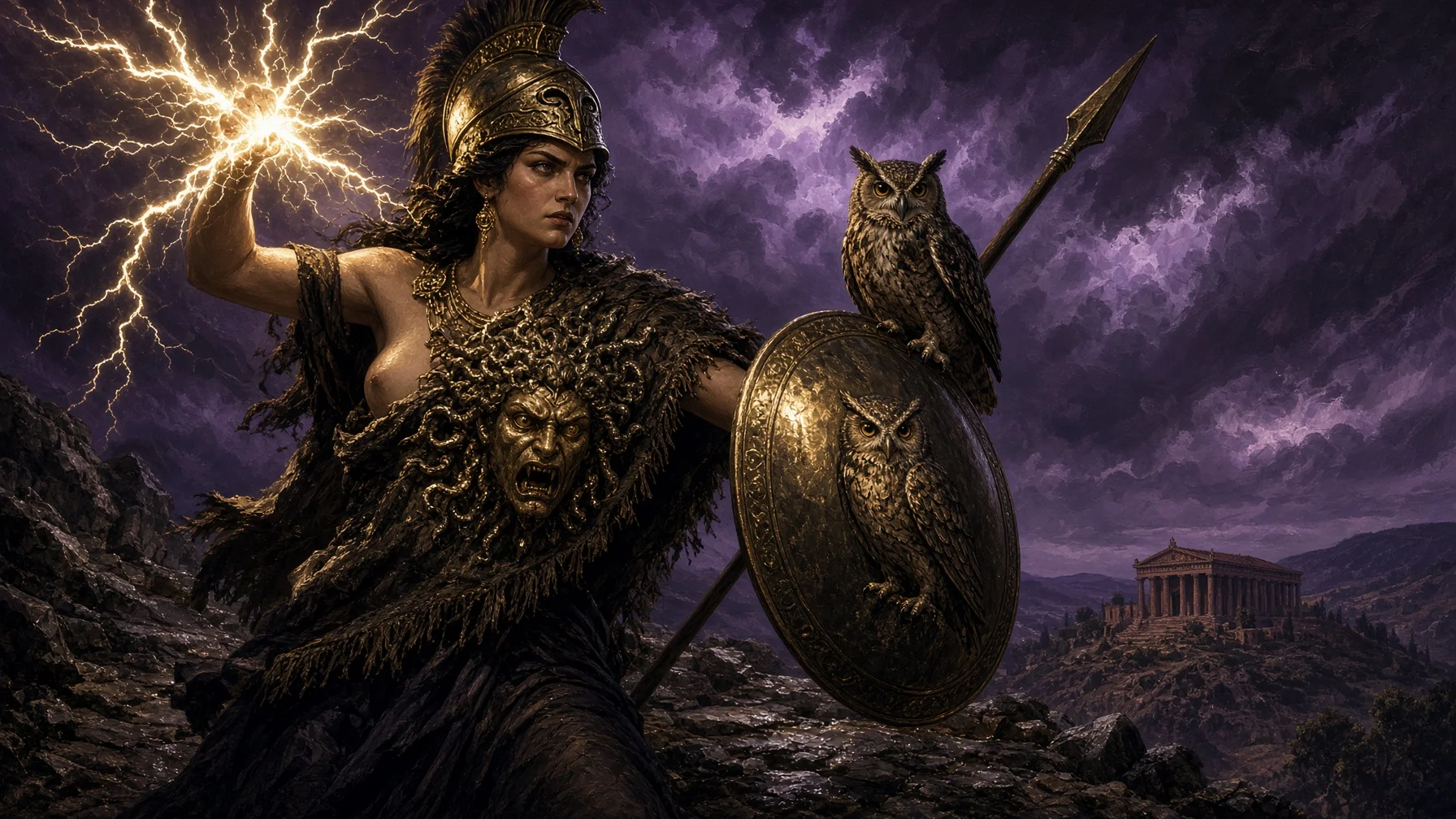
Where Menrva can be seen at all, she is seen armed. Etruscan artists depicted her as a helmeted figure, often bearing a spear, a shield, and at times the aegis, the goat-skin or scaled garment marked with a Gorgon-head motif that in Greek art belonged to Athena. This iconography closely parallels that of Athena, and the parallel is not accidental: Greek imports and sustained artistic contact from the Archaic period onward exerted a strong and well-documented influence on how Etruscan artisans rendered Menrva, so that her visual identity as an armed goddess in helmet and aegis owes a real debt to Greek pattern-books even as it took root in a genuinely Etruscan cult. The extent of this borrowing is best read as religious syncretism and artistic influence operating on an image, rather than proof that the Etruscans possessed, or needed, an identical underlying myth to explain it.
Born of the Sky God's Head
Among the mirror engravings that carry Menrva's name, a number depict a birth scene: a divine child emerging from the head of Tinia, with Menrva present or assisting in the scene. This is, on its face, an adaptation of the Greek myth of Athena's birth from the head of Zeus, carried into Etruscan visual narrative through the same channel of artistic contact that shaped her armor and aegis. But the scene resists a single confident reading. Scholars are divided on who the child figure in these mirror images actually represents, some identifying it as Menrva herself in the act of being born, others as a distinct figure altogether. No Etruscan text spells out which reading is correct, and it should be stated plainly that any narrative built from these images beyond what the bronze itself shows is an inference from iconography and from the closer Greek comparison, not a direct transcription of an Etruscan story.
Wisdom Without a Single Fixed Shape
It would be a mistake to assume Menrva's relationship to Tinia, or her standing as an eternally unmarried virgin goddess in the manner so often emphasized for the Greek Athena, was fixed the same way across all Etruscan sources. Some Etruscan scenes present more fluid divine relationships than the tidy Greek and Roman versions suggest, and her exact kinship to Tinia, whether daughter, independent power, or something the surviving material simply does not pin down, is not textually fixed in what has come down to us. The armed, helmeted, wisdom-bearing figure is consistent; the family story wrapped around her, less so.
Patroness of Craft and Cure
In cultic and cultural terms, Menrva's reach extended across war, wisdom, craft, and strategic skill, a combination that placed her firmly among the major sky-linked deities of the Etruscan state pantheon. In some contexts she was further associated with the divinatory authority connected to thunder and lightning, an association consistent with her place beside Tinia, whose own domain centered on the sky and its portents. Her connection to skilled work, in the general sense of craft, extends the same figure who appears in war gear on the mirrors into the domain of makers and healers, though it is the martial, strategic, and wisdom-bearing aspects that the surviving inscriptions and images most directly confirm.
Veii and the Provisional Cult Map
A significant cult site associated with Menrva is thought to lie at Veii, where the Portonaccio sanctuary has been linked in scholarship to Minerva-type worship on the strength of its votive terracottas. That attribution, like much of the effort to match specific Etruscan temples to specific deities, rests on votive finds rather than an inscribed dedication naming the goddess outright, and it remains provisional rather than settled. It sits alongside the triple-cella temple pattern at Veii and Orvieto as part of the same broader, still-developing archaeological picture of where and how Menrva was actually worshipped on the ground, beyond what the mirrors and the Piacenza Liver can tell on their own.
Reading a Goddess Without Her Own Voice
No extended Etruscan mythological narrative survives to tell Menrva's story in her own words. The Etruscan corpus that has come down to the present consists almost entirely of short inscriptions, fragments of ritual and liturgical text such as the Liber Linteus, and the pictorial scenes carried on mirrors and bronzes. Everything beyond those attested scenes, any fuller story of her birth, her relationships, or her deeds, is necessarily built by inference, drawn from iconography and from comparison with the far better documented Greek Athena. That comparison is instructive and, given the extensive borrowing visible in her armor and her birth scene, clearly relevant. But it is a scholarly reconstruction laid over a gap, not a recovered Etruscan text, and the distinction is worth holding onto for anyone reading her story today.
Into the Capitoline Triad
Menrva's clearest legacy lies in what came after her. The equivalence between Menrva and the Roman Minerva is made explicit by Roman-era authors, and the continuity runs deeper than a shared name: the temple grouping of Tinia, Uni, and Menrva passed directly into the Roman Capitoline Triad of Jupiter, Juno, and Minerva, carrying the Etruscan pattern of a shared, triple-celled state cult into the center of Roman civic religion. Through that transmission, and through the Greek equation with Athena that shaped her image from the Archaic period onward, Menrva stands at the meeting point of three related but distinct traditions, Etruscan, Greek, and Roman, each contributing a piece of the armed, wise, sky-linked goddess whose fullest form survives only in bronze.
The Wise Warrior of Etruria
In Menrva, the Etruscans gave form to a goddess of wisdom and war, the armed maiden of intelligence, skill, craft, and healing, member of the great triad and patroness of artisans, healers, and heroes, the wise warrior-goddess of ancient Etruria, known now chiefly through helmeted bronze reflections of a story never fully written down.
Sources & traditions
- EncyclopediaWikipedia — Menrva
- TraditionEtruscan texts, inscriptions and later retellings (Etruria)
Myths change from area to area and from time to time. This chronicle follows the most widely told versions; tellings in other villages, regions and eras may differ.