The Herald Who Wears Hermes' Wings
On the polished bronze backs of Etruscan mirrors, a youthful winged figure moves through scenes of divine business with a herald's staff in hand. This is Turms, the messenger of the Etruscan gods, shown with the winged sandals and winged petasos-cap that mark him as kin to the Greek Hermes in almost every visual particular. The resemblance is not superficial. Scholars generally think his very name descends from a borrowing of "Hermes," reshaped as it passed through Etruscan phonology — though the exact linguistic path remains debated, and the etymology should be understood as reconstruction rather than settled fact. What is far less disputed is the equivalence itself: ancient interpretation and modern scholarship agree, with unusual confidence for the Etruscan pantheon, that Turms is Hermes, and by extension the Roman Mercury, transplanted into Etruria's own visual and religious vocabulary.
Wings, Staff, and the Grammar of a Messenger's Body
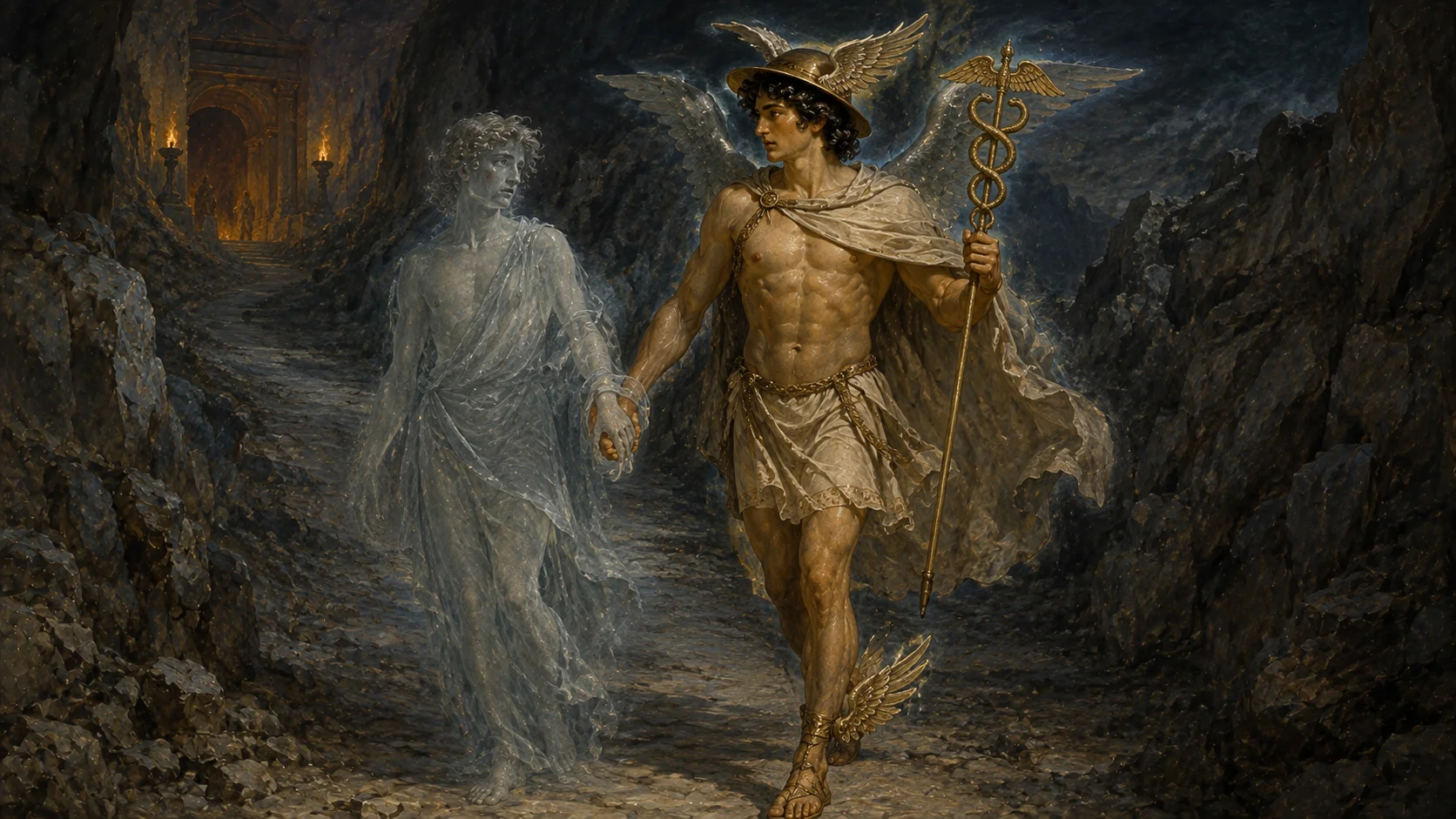
Turms's iconography speaks before any inscription does. He is rendered young, often winged, carrying the herald's kerykeion — the caduceus-type staff that announces his office at a glance. The winged talaria at his ankles or the winged cap on his head do the same work twice over, in case the staff alone were not enough. This layered visual shorthand — youth, wings, staff — is how Etruscan engravers signaled "messenger" the way a modern viewer reads a uniform. It is a borrowed grammar, lifted wholesale from Greek representations of Hermes, and it is precisely because the borrowing is so thorough that identifying Turms across dozens of mirror fragments is possible even where his name label has worn away or was never inscribed at all.
A Bronze Courtroom: Turms at the Judgement of Paris
The best-documented narrative scene in which Turms appears is the Judgement of Paris, rendered repeatedly on engraved mirror backs alongside Turan, the Etruscan Aphrodite-equivalent, Menrva, and other deities, with the Trojan prince Paris appearing under his Etruscan name Elcsntre. In these scenes Turms performs exactly the role his iconography promises: he is not a contestant in the judgement but its facilitator, the divine functionary who conducts the goddesses into the presence of the mortal judge. It is his most securely attested mythological appearance, and it is worth noting what it does not do — nowhere in this scene, or in any other surviving depiction, does Turms receive a fixed genealogy or a personal motive beyond the errand at hand. He arrives, he functions, and the scene moves around him.
Company Kept: Tinia, Uni, and the Divine Household
Because his role is to move between gods, Turms is pictured in the company of the pantheon's senior figures — Tinia, the chief sky-god and Zeus-equivalent, and Uni, his consort and the Hera-equivalent, appear alongside him in mirror scenes, as do Turan and Menrva. This recurring company tells us how Etruscan artists understood his place in the divine order: present at the center of affairs, trusted to carry word between the great gods, but never depicted as their offspring or kin. No Etruscan source epigraphically establishes parent deities for Turms. Whatever family he might once have had in popular imagination did not survive into the archaeological record, and nothing should be invented to fill that gap.
Turms Aitas: The Name That Marks a Second Office
A distinct inscribed form, Turms Aitas, appears on a number of mirrors and marks a second and darker function layered onto the messenger role. The epithet pairs him explicitly with Aita, the Etruscan lord of the dead — the name means, roughly, "Turms of Aita" or "Turms of the underworld." This is not decorative; it is a specific epigraphic label distinguishing the psychopomp from the herald, the guide of souls from the errand-runner of Olympian business. Where plain "Turms" moves between gods and mortals, "Turms Aitas" moves between the living and the dead, and Etruscan engravers seem to have felt the distinction was worth writing down.
Escort of the Dead, on Mirrors and Tomb Walls
On engraved mirrors and in tomb paintings from the fourth through second centuries BCE, Turms appears escorting or interacting with the deceased, a role that places him inside Etruria's dense funerary imagery. But this psychopomp function overlaps only functionally, not iconographically, with the native Etruscan death-demons Charun and Vanth, who carry their own distinct attributes and appearances and are not variations on the Hermes-derived winged-herald type. The two traditions sit side by side in the tomb without merging: Charun and Vanth are native to Etruscan funerary imagination in a way Turms, with his borrowed Greek costume, is not.
A Genuinely Open Question: Native Belief or Hellenizing Overlay
How much of Turms's underworld association reflects an indigenous Etruscan idea, as opposed to a later Hellenizing addition grafted onto an imported messenger-god, is a real and unresolved question among scholars, and it deserves to be stated as such rather than smoothed over. The evidence itself is ambiguous by nature: mirror engravings and tomb paintings show Turms present at the threshold of death, but they cannot say whether Etruscans always understood their messenger-god this way or whether the role accreted as Greek Hermes-as-psychopomp imagery became more familiar. Honesty about this gap matters more than a tidy narrative would.
Absent from the State's Own Sacred Texts
For all his presence on mirror backs, Turms is not confirmed as a named deity in the major surviving liturgical epigraphic corpora — not in the Liber Linteus, the linen text preserved by chance on Egyptian mummy wrappings, and not among the divine regions inscribed on the bronze Piacenza Liver, the model used in the discipline of extispicy. Deities such as Tinia, Uni, and Menrva appear in that formal, state-facing religious record; Turms, so far as the evidence shows, does not. His prominence in Etruscan religious life, as distinct from Etruscan funerary and mythological art, is correspondingly harder to document, and that gap should be reported plainly rather than papered over with assumption.
No Birth, No Origin Tale — Only a Slot in the Pantheon
Unlike a figure such as Tages, who has something resembling an origin narrative in Etruscan tradition, no source gives Turms a birth story or an origin myth of his own. His "origin," insofar as scholarship can describe one, is functional and comparative rather than narrative: he exists because the pantheon needed a Hermes-shaped figure, and Turms fills that slot. This is a meaningful distinction. It means that everything known about him as a character — his role, his company, his attributes — is read out of iconography and short inscribed name-labels, never out of a preserved story, and any fuller narrative would be invention rather than record.
Vulci and the Workshop Origins of an Image
Turms depictions cluster heavily in the output of Etruscan mirror-production centers, Vulci prominent among them, a major hub for the engraved bronze mirrors that make up the bulk of the evidence for his cult. This concentration is a fact about manufacture and trade in luxury funerary and toilette goods as much as it is a fact about religion. Temple-specific attestations for a cult of Turms are comparatively sparse next to his sheer visual popularity in the portable mirror record, and that distinction matters: a god can be everywhere in the workshops and burial goods of one artistic tradition without occupying a correspondingly central place in formal cult practice, and the two should not be read as the same kind of evidence.
A God Made of Thresholds
Every strand of evidence for Turms points toward the same underlying idea: a deity defined by the act of crossing rather than by dwelling in any one place. He crosses between gods and mortals as herald, between the temple of divine judgement and the private world of the Judgement of Paris, and — in his Aitas aspect — between the living and Aita's realm of the dead. That preoccupation with liminality sits comfortably within the broader Etruscan religious imagination, visible also in the elaborate discipline of haruspicy and in the vivid presence of death-demons in tomb art. Turms's boundary-crossing is not incidental to Etruscan religion; it is one expression of a culture that thought carefully, and often, about the thresholds between worlds.
Reading a God Through Silence as Much as Image
What survives of Turms is almost entirely pictorial: engraved mirrors, a smaller body of vase and tomb paintings, and brief inscribed labels — no continuous Etruscan literary myth cycle for him has come down to us. That means the plot details a modern reader might want, motives, relationships, a fuller story arc, are simply not available and should not be supplied. What can be said with confidence is narrower and, in its way, more solid: a swift, winged, staff-bearing figure who moves through the company of the great gods on their errands, who in his Aitas form leads the newly dead toward Aita, and whose closest kin, by nearly universal agreement, is the Greek Hermes wearing Etruscan bronze.
Sources & traditions
- EncyclopediaWikipedia — Turms
- TraditionEtruscan texts, inscriptions and later retellings (Etruria)
Myths change from area to area and from time to time. This chronicle follows the most widely told versions; tellings in other villages, regions and eras may differ.