Vanth is a winged spirit of the Etruscan underworld, one of the death-demons who attend the dying and the dead. She is not a goddess of death in the manner of a Greek or Roman deity ruling a domain from a throne; she is a chthonic attendant, a presence who appears at the threshold moment when a mortal life ends, and who is understood to accompany the departing soul on its passage below. Her name survives in Etruscan inscriptions on tomb paintings and mirrors, confirming that Vanth was her genuine name and not a label supplied by later scholarship. Beyond that, almost nothing about her comes down to us in words. No continuous mythological narrative naming her has survived from Etruscan literature. What is known of Vanth is read entirely from paint on tomb walls and from the carved reliefs of funerary urns, and that fact should be held in mind through everything that follows: her portrait is complete, but her story is not.
A Presence Painted, Not a Story Told
The Etruscans left no surviving epic or scripture describing Vanth's origins, her birth, or her place in a divine household. What they left instead is image after image: on the walls of painted tombs at Orvieto and Vulci, and carved into the stone and terracotta of cinerary urns produced by the hundreds at Volterra and Chiusi in the third and second centuries BCE, Vanth appears again and again at the same kind of moment — the moment a person dies. This is an unusual survival pattern for a religious figure. It means Vanth is known to us with unusual visual precision and unusual narrative silence at the same time. Scholars can describe exactly what she wore and carried; they cannot say with confidence what the Etruscans believed she felt, wanted, or intended. Any account of her must respect that boundary, and treat the gaps as gaps rather than filling them with borrowed stories from other cultures.
The Winged Woman at the Threshold
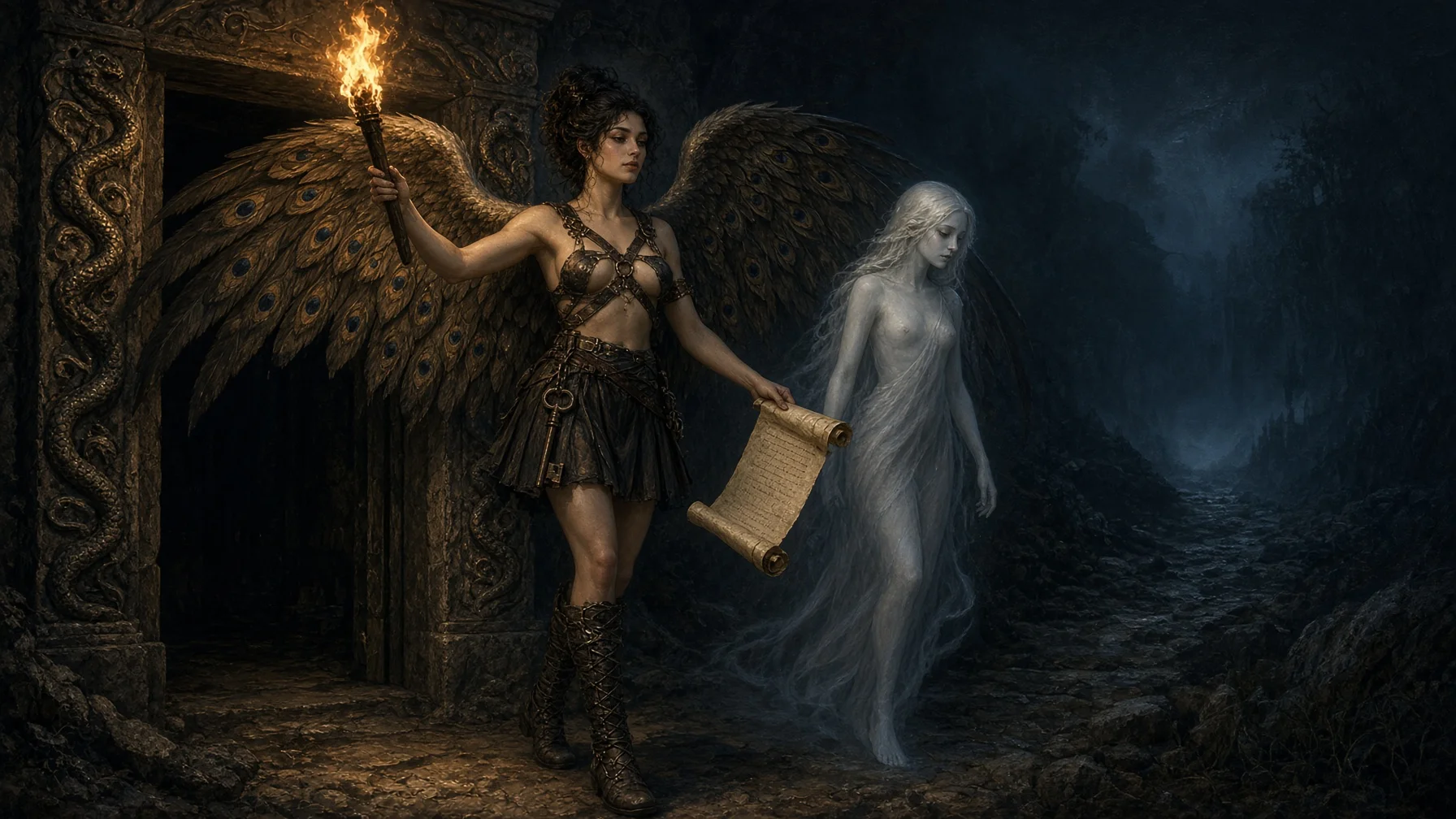
In her surviving depictions, Vanth is shown as a young woman with large wings, often bare-breasted or dressed in a short chiton, her chest crossed by a baldric — a strap worn diagonally like a hunter's or messenger's harness rather than the drapery of a seated deity. She wears high boots, suited to a figure who travels rather than one who presides from a fixed seat. This is a costume of motion and errand, not of enthroned authority, and it matches the role scholars infer for her: she is not shown ruling the dead, but moving among the living and dying, arriving at the moment she is needed.
Torch, Key, Scroll, and Serpent
Four attributes recur with her across the tomb paintings and urn reliefs. She carries a torch, at times shown lowered, which has been read as a gesture marking the extinguishing of a life. She carries or is associated with a key, understood as the key that opens the door of the tomb or the passage into the underworld itself. She is shown with a scroll or tablet, read by scholars as a record — of the deceased's fate, or of their deeds — though what exactly was believed to be written there is not preserved in any text. And she is shown with a snake, which she may hold or which may coil around her arms. Together these attributes build a figure who announces, opens, records, and marks the crossing from life into death, without any single attribute reducing her to one simple function.
Set Beside Charun, and Distinct From Him
Vanth very often appears in the same tomb scenes as Charun, the male Etruscan demon of death who carries a hammer. The two are frequently paired, flanking a scene of death or standing to either side of the dead, and this pairing is one of the most consistent patterns in Etruscan funerary art. It is worth stating plainly that Charun is not simply the Etruscan version of the Greek ferryman Charon under a similar-sounding name; he is his own figure, with his own iconography and his own hammer, and the resemblance of the names should not be read as identity. Vanth and Charun are partners in these scenes but not duplicates of each other — where Charun's presence is often read as more overtly menacing, Vanth is consistently rendered as calm, youthful, and composed even at scenes of violent death.
Witness at the Sacrifice of the Trojan Prisoners
Among the most striking appearances of Vanth is in the François Tomb at Vulci, in the painted scene depicting the sacrifice of Trojan prisoners by Achilles. Vanth appears there not as a participant in the killing and not as an aggressor, but as a witness and attendant to the violent death taking place — present at the threshold, marking the moment, but not enacting it herself. This distinction matters: across her surviving appearances, Vanth is consistently a figure who attends and marks death rather than one who causes it.
Present at the Deaths of Eteocles and Polynices
Vanth is also shown at other scenes of sudden and violent death drawn into Etruscan funerary art, including depictions of the mutual killing of the Theban brothers Eteocles and Polynices. Her presence at this scene follows the same pattern as at Vulci: she stands as a witness-figure at the instant of death, marking the transition from life to its end. Etruscologists read this recurring role — presiding over the moment of passage rather than over what comes after — as one of the core symbolic functions assigned to her across the surviving art, even though no text tells us in her own culture's words what that presence was understood to mean.
A Guide More Merciful Than Menacing
Where some Etruscan underworld demons, such as Tuchulcha, are rendered with grotesque or overtly threatening features suited to tormenting the dead, Vanth is not. She is generally understood by scholars as benevolent or neutral in character — a figure who announces and guides death rather than one who punishes or torments after it. This reading rests on interpretation of her calm, youthful iconography rather than on any surviving statement of Etruscan belief, and it should be offered with that qualification rather than as settled doctrine. Still, the consistency of her composed bearing across so many separate tombs and urns, made by different hands over centuries, is itself a kind of evidence — an artistic convention repeated too often to be accidental.
One Figure, or a Whole Order of Spirits
A genuine puzzle remains open among those who study her: in a number of scenes, more than one Vanth-type winged female figure appears together, flanking a single death scene from both sides. This has led some Etruscologists to propose that "Vanth" may name not a single unique individual but a category or class of underworld spirits — that any winged, torch-bearing, key-and-scroll-carrying female death-demon might properly be called a Vanth, much as more than one Charun could appear in a single scene. This question is genuinely unresolved, and it touches directly on how her name should be understood: as a proper name belonging to one being, or as a term for a kind of being. Both readings currently have scholarly support, and neither has been settled.
Her Place Among the Underworld's Retinue
Some scholars place Vanth within a broader Etruscan underworld household that includes Aita, an underworld god whose name and iconography were adapted from the Greek Hades through South Italian and Etruscan contact, and his consort Phersipnai, the Etruscan rendering of Persephone. Vanth's frequent appearance in the same tomb contexts as these figures supports the idea that she belonged to their retinue in some sense. It is important to be exact about what is and is not known here: no surviving Etruscan text states a genealogical or familial relationship binding Vanth to Aita or Phersipnai. Any such connection is an inference drawn from shared tomb settings, not a documented relationship, and should be presented as such rather than as established kinship.
A Name That Did Not Cross Into Rome
Unlike some Etruscan religious figures who were absorbed, renamed, or echoed within later Roman religion, Vanth had no continuous cult life carried forward under her own name into Roman practice. She does not reappear as a named Roman deity with an altar or a feast day. Her afterlife has been almost entirely a scholarly one: nearly everything known about her today comes from archaeological recovery of Etruscan tombs during the nineteenth and twentieth centuries, when painted chambers at sites such as Orvieto were opened and documented, and cinerary urns from Volterra and Chiusi were catalogued and studied in quantity. Vanth's modern presence is, in a real sense, the product of the spade and the notebook rather than of an unbroken thread of worship.
The Comparisons Scholars Draw, and Their Limits
Modern scholars have sometimes compared Vanth, in a functional rather than genealogical sense, to Greek Thanatos, the personification of death, or to the Furies — the Erinyes — who pursue and mark those touched by violent death. These comparisons are offered as ways of describing what Vanth seems to do, not as claims that the Etruscans themselves equated her with these Greek figures, and not as evidence of any shared origin. They are interpretive scaffolding built by later interpreters trying to describe an image-only figure in familiar terms, and they should be read as such — useful for orientation, but not as ancient testimony about who the Etruscans understood Vanth to be.
An Identity Still Argued Over
Even her exact theological status remains disputed. Etruscologists differ on whether Vanth is best understood as a minor goddess, a demon or daimon in the technical sense, or a class-name for an order of spirits rather than a single personal being. Her name's deeper etymology is likewise unsettled. None of this uncertainty diminishes what the surviving art makes clear: across centuries of Etruscan tomb-painting and urn-carving, from Vulci to Orvieto to Volterra and Chiusi, artisans returned again and again to the same winged, torch-bearing, key-and-scroll-carrying young woman standing calmly at the edge of death — a figure whose task, however her precise nature is finally settled, was to be present exactly when a life ended, and to mark that passage with a steadiness the Etruscans clearly wished to carry with their dead into the tomb.
Sources & traditions
- EncyclopediaWikipedia — Vanth
- TraditionEtruscan texts, inscriptions and later retellings (Etruria)
Myths change from area to area and from time to time. This chronicle follows the most widely told versions; tellings in other villages, regions and eras may differ.