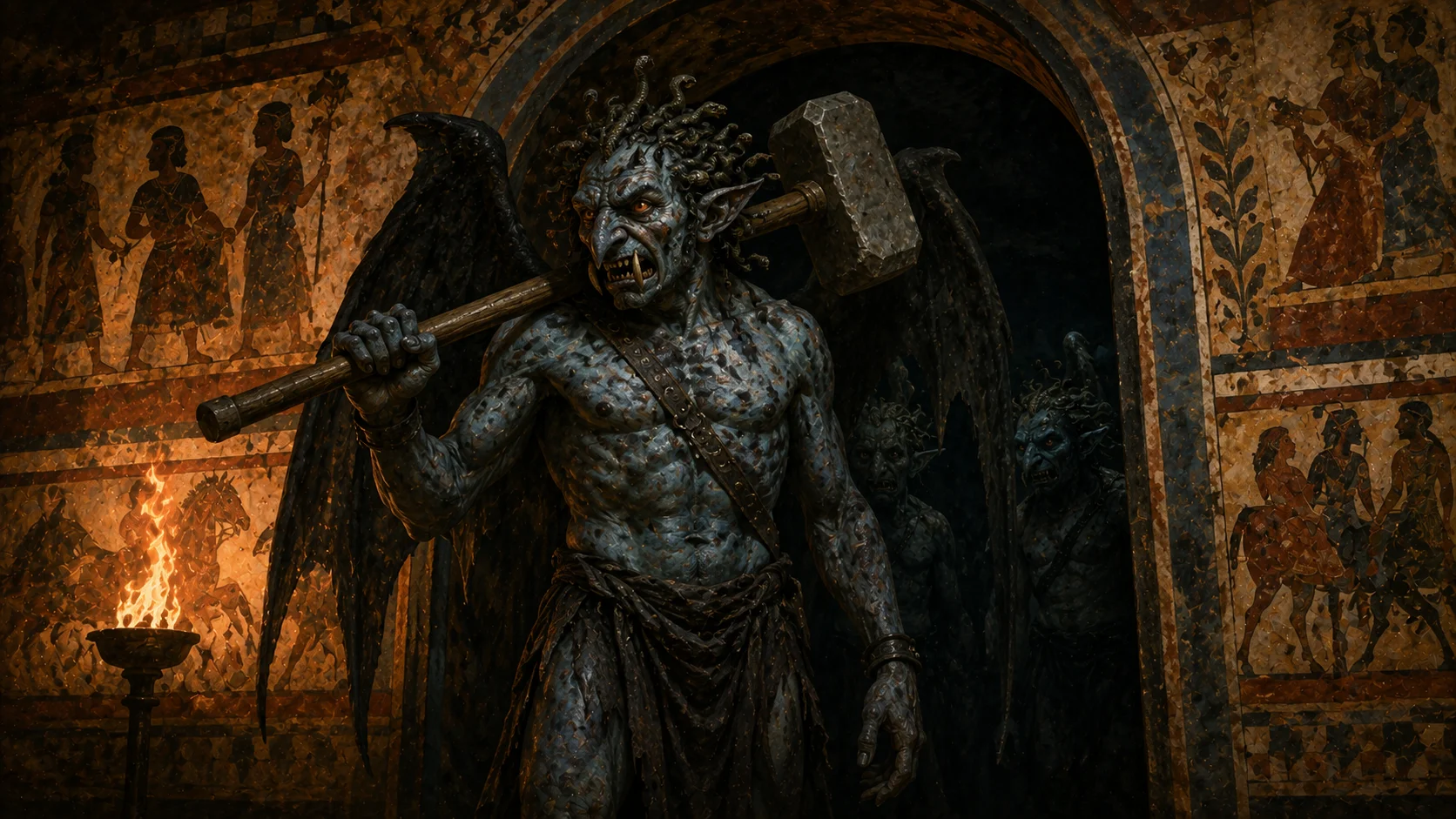
Charun, also spelled Charu or, in the plural, Charuns, is a demon of death in Etruscan religion — a fearsome, blue-grey-skinned, hook-nosed figure who appears at the moment of death and in underworld scenes across Etruscan tomb art. He is not the ruler of the dead; that role belongs to Aita, the Etruscan Hades. Charun is instead an attendant and guardian figure, a presence that marks a painted scene as being about death and transition rather than ordinary life, most often shown wielding a great two-handled mallet, wreathed in serpents, and standing watch at the threshold between the living world and the underworld.
A Name Borrowed, a Nature Diverged
Charun's name is clearly drawn from or cognate with Charon, the ferryman of Greek myth who rows the dead across the river of the underworld. But the resemblance stops close to the surface. Where the Greek Charon is defined by his boat and his oar, the Etruscan Charun is almost never primarily a ferryman — boat and ferry imagery, where it appears at all in the Etruscan material, is not the dominant type associated with him. Etruscan artists took a name and left the function behind, building around it a different figure entirely: not a boatman paid to carry souls across water, but a monstrous presence who meets the dying at the point of death itself. Scholars treat this divergence as well documented and are careful not to collapse the two figures into "the same being wearing two names" — Charun should be read as a distinctly Etruscan invention that merely borrowed a Greek word.
A Face Not Meant to Reassure
Where Greek funerary art tends toward the naturalistic — Charon is often shown as an unlovely but human ferryman — Charun's appearance in Etruscan tomb painting is deliberately monstrous. His skin is rendered in blue-grey, bluish, or greenish tones, the color of a corpse rather than a living body. His nose is hooked and vulture-like, a beak more than a human feature. His ears are pointed and animal in shape. Fangs or tusks appear in many depictions, and snakes are frequently shown twined around his arms or through his hair, so that the serpents become part of his silhouette rather than an accessory he carries. Taken together, these traits form one of the more consistent and recognizable demonic types in Etruscan art — a figure built to be immediately legible as death itself, not as a psychopomp who happens to look severe.
The Mallet at the Threshold
Charun's single most diagnostic attribute is his hammer: a heavy, two-handled mallet carried across scene after scene in the tomb corpus. Its meaning has been read two ways by those who study the imagery, and the readings are not mutually exclusive. In one interpretation, the mallet is an instrument of the death-blow itself, the tool that seals a mortal's fate at the instant of dying. In the other, it is a door-breaker, fitting Charun's frequent placement at gates and doorways — the mallet as the means by which the boundary between the living world and the underworld is forced open. Either reading keeps the object at the center of who Charun is: an attendant defined by an implement of violence and passage rather than by a genealogy or a cult narrative.
Standing Where the Living World Ends
In the paintings that survive, Charun does not appear in scenes of ordinary life. He is a marker: his presence signals that a scene concerns death, sacrifice, or the transition to the underworld. He is shown escorting the dead as they proceed toward the afterlife, menacing figures at the moment of dying, standing at gates and doorways consistent with the mallet-as-door-breaker reading, and flanking scenes of violence and sacrifice. He does not initiate these events so much as preside over their threshold — a fixture of the passage itself, present wherever Etruscan artists needed to mark that a boundary was being crossed.
Not One, But Many
Unlike a single individuated god with one settled identity, Etruscan tomb art shows multiple Charun figures appearing together within the same underworld scene — a plurality of Charuns rather than one unique personage. These figures are sometimes distinguished from one another by differing skin colors or varying attributes, suggesting that Charun names less an individual than a class or type of death-demon, with several instances of the type populating a single composition. This is a feature with no real counterpart in the Greek Charon tradition, where there is only ever the one ferryman. It reinforces the sense that Charun functions in Etruscan religious imagery more as a category of underworld attendant than as a mythological personality with a fixed biography.
Beside Vanth at the Gate
Charun is best attested not alone but in the company of Vanth, a winged female death-demon and psychopomp figure who appears alongside him in several of the same tombs, including the François Tomb at Vulci and the second chamber of the Tomba dell'Orco. The two are the best-documented pairing among Etruscan death-demons, and they are visually distinct: Vanth is winged and typically shown carrying a torch or a scroll or key, while Charun carries his mallet and bears the monstrous features described above. It is worth being precise about what the sources do and do not show — Charun and Vanth are not depicted as a couple, and no genealogical or marital relationship between them survives in the record. They are, rather, two separate figures from the same underworld visual universe who are repeatedly painted attending the same scenes of death.
An Attendant, Not a Sovereign
The Etruscan underworld had its own ruling pair, Aita and his consort Phersipnai, shown presiding over banquet scenes in the manner of an underworld court. Charun does not appear identified with or ruling over the dead in the way Aita and Phersipnai do. He belongs instead to the subordinate tier of that same underworld — an attendant demon rather than its sovereign, present at the edges and thresholds of the afterlife rather than at its center. This distinction matters for reading the tomb paintings correctly: a figure with a mallet and monstrous features is not competing with Aita for the underworld's throne, but performing a different, narrower function within it.
Named in Stone at Vulci
Most Etruscan religious figures are identified by scholars through iconographic pattern-matching rather than by their own testimony. Charun is an exception at one notable site: the François Tomb at Vulci, painted in the fourth century BCE, includes a figure explicitly labeled "Charun" within an inscribed underworld scene, alongside Vanth. This inscribed attestation is one of the more securely captioned appearances of the figure in the entire corpus, anchoring the iconographic type to a confirmed name rather than leaving it as an inference built solely from recurring visual traits.
A Figure of the Hellenistic Tombs
Charun imagery becomes especially prominent in Etruscan tomb painting and in funerary reliefs and urns from the fourth century BCE onward, placing his visual heyday within the Hellenistic period of Etruscan culture rather than at the earliest layers of Etruscan funerary art. This chronological pattern is documented in the surviving corpus itself — it describes when the imagery flourishes and is not, on its own, evidence that Charun originated as an early cult figure whose worship simply left no earlier trace. The timing situates him within a specific, later phase of how the Etruscans chose to picture death, alongside the broader visual and cultural exchange with the Greek world that characterized that period.
A Grimmer Reckoning With Death — Debated, Not Settled
Because Charun's monstrous, non-Hellenic appearance contrasts so sharply with the comparatively naturalistic Greek Charon, some scholars have read this iconographic choice as evidence of a distinctly Etruscan, more fearsome conception of death itself — one less interested in softening mortality's edges than the Greek visual tradition tended to be. This is a real and citable interpretive line, but it remains a scholarly reading rather than settled fact, and Etruscologists continue to debate how much weight the imagery alone can bear as evidence about Etruscan attitudes toward death more broadly. The honest account keeps this distinction in view: the monstrous appearance is documented; what it says about Etruscan feeling toward mortality is argued.
A Gap Where a Roman Counterpart Should Be
Many major Etruscan deities map cleanly onto Roman equivalents — Tinia onto Jupiter, Uni onto Juno — through a well-attested process of interpretatio Romana. Charun has no such counterpart. No direct Roman-era equivalent or systematic Roman reinterpretation of Charun is well attested, and he appears to have remained a distinctly Etruscan iconographic figure without ever acquiring a clean Roman replacement deity. This absence is itself notable and worth stating plainly rather than passing over: where other Etruscan gods were absorbed and renamed as Rome's religious world expanded, the death-demon with the mallet and the serpents seems to have stayed, in the surviving record, exactly where the Etruscans had painted him.
Sources & traditions
- EncyclopediaWikipedia — Charun
- TraditionEtruscan texts, inscriptions and later retellings (Etruria)
Myths change from area to area and from time to time. This chronicle follows the most widely told versions; tellings in other villages, regions and eras may differ.