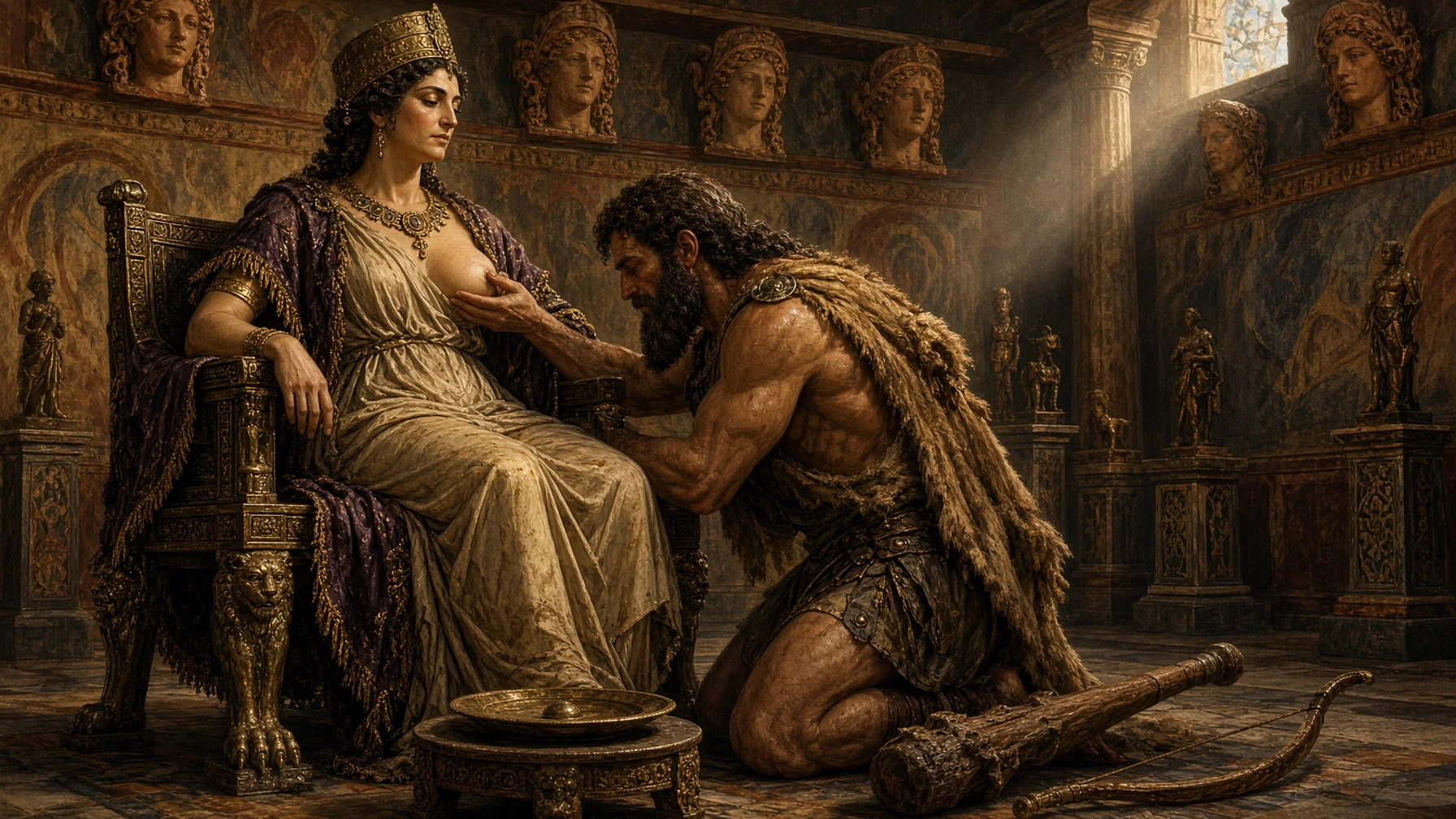
Uni is one of the chief goddesses of the Etruscan pantheon, a sky and sovereignty deity bound up with queenship, marriage, and the protection of the state. She stands as consort to Tinia, the supreme sky-and-thunder god, and is remembered above all through one extraordinary primary text — the Pyrgi Gold Tablets — which give her a documentary weight few Etruscan deities can claim.
A Goddess Known Mostly by Her Own Words
Much of what can be said about Uni with real confidence does not come from narrative myth but from votive and dedicatory inscriptions. This is worth stating plainly at the outset, because it shapes everything that follows: no extended mythological cycle survives for her in the fragmentary Etruscan corpus — no jealousy stories, no punishment tales, none of the narrative material that fills out a figure like the Greek Hera. What survives instead is epigraphy: her name inscribed on gold, on votive offerings, on temple dedications. That absence of narrative is itself an honest and notable gap in the evidence, not proof that such stories never existed — simply that they have not come down to us.
The Gold Tablets of Pyrgi
The single most important document bearing Uni's name is the set of gold tablets recovered from the sanctuary at Pyrgi, near the Etruscan city of Caere, dated to around 500 BCE. One tablet, written in Etruscan, records a dedication made by the ruler Thefarie Velianas to Uni. It was paired with a second tablet, written in Phoenician, dedicating the very same shrine to the goddess Astarte. Together these two texts form a bilingual dedication — a rare and precious case in which an Etruscan deity's identity is fixed not by later Roman commentary or by guesswork from iconography, but by a contemporary primary source that equates her, in the dedicators' own words, with a specific goddess of the Phoenician and Punic world.
Legitimacy Written in Gold
The Pyrgi tablets do more than record an act of piety. They frame Uni as a goddess who legitimizes a ruler's authority — Thefarie Velianas dedicates the shrine to her in terms that read as a claim on divine sanction for his rule. This suggests that Uni's cult carried a strong political-religious dimension that reached well beyond a purely domestic role as protector of marriage and the hearth. She was invoked, at least at Pyrgi, as a guarantor of sovereignty itself, the goddess whose favor underwrote a ruler's standing.
A Shrine Built for Two Audiences
What makes the Pyrgi dedication unusual among Etruscan religious remains is its evident intent to be legible on both sides of the Mediterranean. An Etruscan ruler dedicated a shrine in a form that a Carthaginian or Phoenician audience could read and recognize, via the equation of Uni with Astarte. This is unique among Etruscan deities in having this level of direct textual, cross-cultural documentation, and it demonstrates a formal diplomatic and religious linkage between Etruscan Caere and the Phoenician and Punic world — Uni's sanctuary functioning, in effect, as a point of contact between two religious systems rather than a purely local shrine.
Consort of the Sky-King
Uni is widely identified as the wife of Tinia, the chief sky-and-thunder god of the Etruscan pantheon, whose position functionally parallels that of Zeus or Jupiter. This makes her the senior goddess-consort of the pantheon's head. It should be said honestly that this pairing is inferred primarily from her later equivalence with the Roman Juno and from the comparative structure of Etruscan religion, rather than from any single surviving Etruscan text that states the relationship outright. The inference is a reasonable and widely accepted one, but it rests on comparison and structure rather than an explicit genealogical record.
A Contested Triad
At a number of Etruscan and Etrusco-Roman sites, Uni appears grouped with Tinia and with Menrva, the goddess of wisdom and craft, in what scholars often describe as a triad. The clearest archaeological support for this grouping comes from the tripartite temple plan — three cellae side by side — that the Roman architectural writer Vitruvius describes as characteristic of Etruscan temple architecture, a layout associated with the worship of triads of major deities. This structure was carried forward into Roman religion as the Capitoline Triad of Jupiter, Juno, and Minerva, itself derived substantially from Etruscan practice. That said, the existence of a single fixed Etruscan triad at every site is debated among specialists, and it would overstate the evidence to treat it as universal dogma rather than a pattern attested at some, though not all, Etruscan sanctuaries.
Protectress at Veii
Beyond Pyrgi, Uni held an important cult at the city of Veii, attested epigraphically through votive inscriptions and dedications that name her directly. This matters for how her role should be understood: rather than a single-city goddess tied to one sanctuary, Uni functioned as a poliad, or city-protecting, deity across multiple Etruscan city-states. Each city's dedications to her stand as independent evidence of a cult that was regional in reach rather than confined to Pyrgi alone.
Queen, Marriage, and the Body Politic
Uni's symbolic and cultural role centers on sovereignty, marital union, and the protection of ruling authority and the state, closely paralleling the functions later attached to the Roman Juno — Juno Regina, queen of the gods, and Juno as protector of the Roman state itself. The Pyrgi tablets, in framing her cult around a ruler's legitimacy, suggest that this political dimension was not a later Roman overlay grafted onto a simpler Etruscan marriage goddess, but something present in her cult from an early date. Marriage and sovereignty, in other words, were not separate domains for Uni but two faces of the same protective, ordering power.
An Image Harder to Pin Down
Securely identifiable images of Uni are less abundant, and less iconographically distinctive, than those of some other Etruscan deities. Where she does appear, it is sometimes in a matronly, draped pose, seated or standing, consistent with a queen-of-the-gods type, and sometimes accompanied by a diadem or crown marking her sovereignty. But individual attributions on mirrors and statuettes are frequently debated among specialists, because dedicatory inscriptions that name her directly are rarer for her than for some other figures in the pantheon. Any iconographic identification of Uni should be treated with appropriate caution rather than stated as settled fact.
A Name Reaching Toward Juno
The name Uni is generally thought to be related to, or to converge with, the root behind the Latin and Italic name Juno, and possibly connected more broadly to an Italic root associated with youthful or vital female divine power — a proposed etymology that has also been suggested for Juno itself. As with other Etruscan divine names, no native Etruscan text explains the origin of the word, so this connection remains a comparative-linguistic hypothesis rather than an established certainty. It is a reasonable thread to follow, but it should be presented as such, not as settled etymology.
Reaching Across the Mediterranean
Uni's identifications with other pantheons form one of the better-documented threads in Etruscan religion. She corresponds to the Roman Juno, queen of the gods and goddess of marriage and the state, and — through the bilingual pairing of the Pyrgi tablets — to the Phoenician and Punic Astarte. The Astarte equation is unusually well evidenced for an Etruscan deity precisely because it survives in a primary bilingual text rather than being reconstructed solely from iconography or later commentary, which is the more common and more fragile basis for such identifications elsewhere in Etruscan religion.
What the Evidence Allows Us to Say
Taken together, the record for Uni is unusual in Etruscan religion for being genuinely documentary rather than largely inferential. Where many Etruscan deities are known chiefly through iconography and comparison with Greek and Roman counterparts, Uni is anchored by a dated, bilingual, primary-source dedication naming her directly and equating her with a specific foreign goddess in the words of the people who made the dedication. Around that anchor sit further layers of reasonable inference — her marriage to Tinia, her place in a triad with Menrva, her identification with Juno — each well supported but resting more on structural comparison than on explicit statement. The honest picture of Uni is therefore a goddess of sovereignty and the state whose central attestation is political and diplomatic in nature, surrounded by a wider cult, at Veii and elsewhere, whose narrative dimension has simply not survived to be read.
Sources & traditions
- EncyclopediaWikipedia — Uni (mythology)
- TraditionEtruscan texts, inscriptions and later retellings (Etruria)
Myths change from area to area and from time to time. This chronicle follows the most widely told versions; tellings in other villages, regions and eras may differ.