Laran is the Etruscan god of war, one of the principal deities of the Etruscan pantheon: a divine warrior invoked in the context of battle, conflict, and the defence of the community, generally understood by modern scholars as functionally comparable to — though not simply identical to — the Greek Ares and the Roman Mars.
A Youthful Figure Armed for Battle
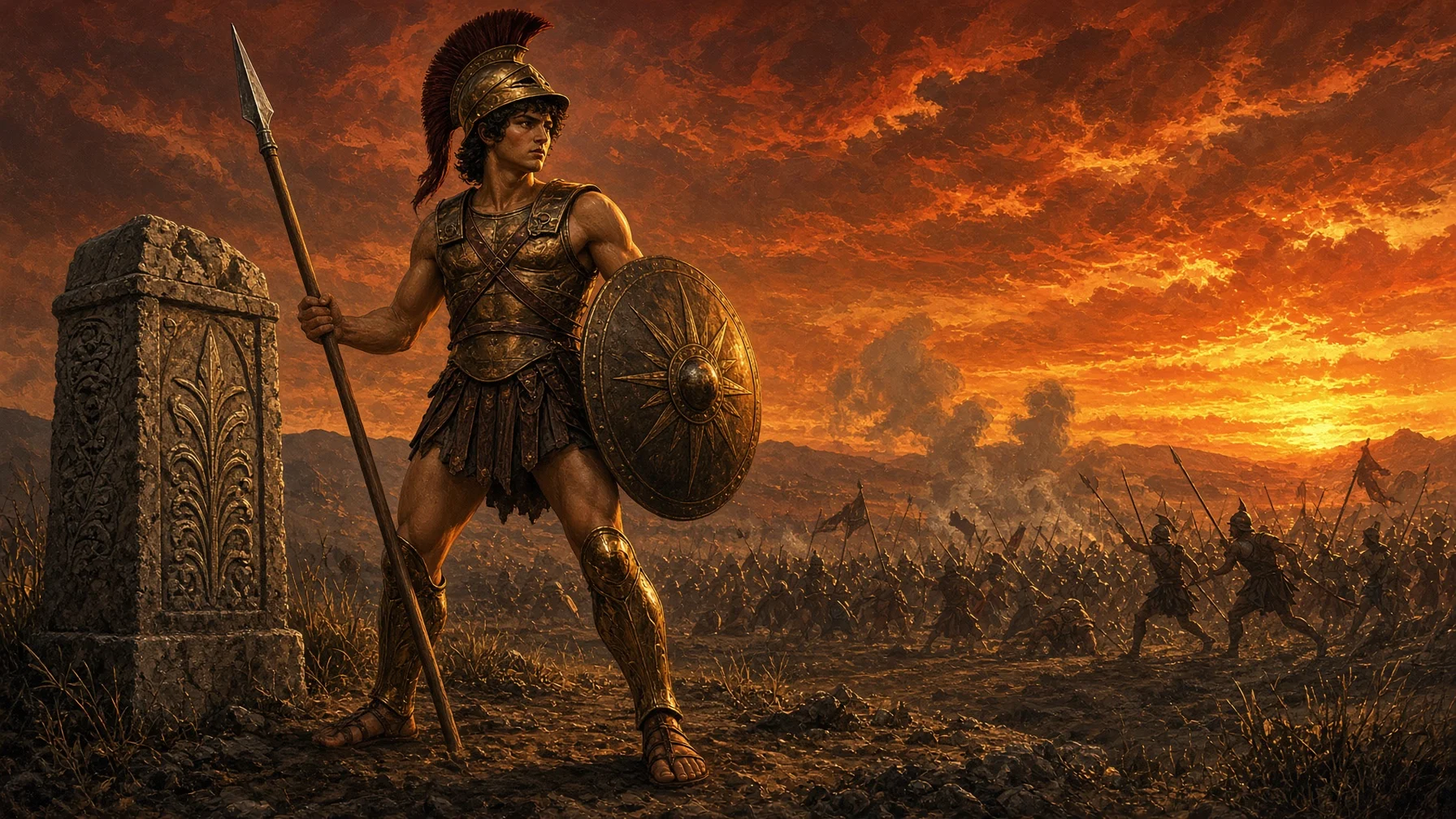
Across the surviving depictions of Laran, one image recurs with striking consistency: a youthful warrior, often shown nude or only lightly armored, wearing a helmet and carrying a spear and, in many scenes, a shield. This youthful-nude-warrior type is the most reliable identifying feature by which Etruscologists recognize Laran across the corpus of surviving art — the single most consistent thread running through the mirror engravings that preserve his image.
Mirrors as a Window into a Vanished Religion
Almost everything known of Laran comes not from any surviving myth-text but from a single, remarkable medium: the engraved bronze mirrors that were a major and distinctive form of Etruscan art. On these mirrors, mythological figures are frequently labeled beside their images with their names in Etruscan script, a convention that has allowed scholars to identify Laran with confidence even though no extended narrative literature about him survives. Alongside the mirrors, inscribed dedications naming Laran provide further, if sparse, evidence of his worship. This narrow evidentiary base is not unique to Laran — it reflects a broader and important limitation on everything known of the Etruscan pantheon as a whole, since Etruscan is only partially deciphered as a language and Etruscan literature is almost entirely lost. What survives is testimony in bronze and stone, not in story.
Laran and Turan, Paired in Bronze
Among the mirror scenes that preserve Laran's image, his appearance alongside Turan — the Etruscan goddess of love, the counterpart-type to Aphrodite and Venus — is especially well attested. This pairing of the war god with the goddess of love has drawn a natural comparison from scholars to the Ares–Aphrodite association familiar from Greek myth, and the parallel is a reasonable one to draw. It is worth being precise about what the evidence actually shows, however: no Etruscan narrative text describing a relationship between Laran and Turan survives. What is attested is the recurring presence of the two figures together in mirror iconography — an art-historical pattern, read by scholars as meaningful, rather than a preserved myth with a plot. The pairing tells us how the Etruscans pictured these two powers in relation to one another; it does not hand down a story about what passed between them.
A Tentative Association with Menrva
In some war-related iconographic contexts, scholarship has also associated Laran with Menrva, the Etruscan goddess who corresponds to Athena and Minerva and who carries her own associations with both war and wisdom in the Etruscan pantheon. This pairing is considerably less firmly attested than the Laran–Turan association and should be understood as more tentative — a secondary thread in the iconographic record rather than a confirmed feature of Etruscan religious thought. Where the Laran–Turan pairing recurs with some consistency across mirrors, the Laran–Menrva association rests on a thinner and more uncertain body of evidence, and any account of Laran should hold it with a correspondingly lighter hand.
A Place Among the Sixteen Regions of the Sky
Etruscan religious practice, the disciplina Etrusca, understood the sky as divided into sixteen celestial regions, each associated with particular deities — a system known chiefly through later Roman sources, notably Martianus Capella's account of Etruscan celestial-divinatory correspondences. Within material of this kind, Laran is sometimes associated with the planet Mars in the sense of these celestial correspondences. This is a genuinely interesting thread linking the war god to the wider architecture of Etruscan sky-divination, but it needs to be flagged honestly: the correspondence comes down largely through a Roman intermediary rather than through a purely Etruscan primary text, and it should be read as evidence of how later observers understood Etruscan celestial religion rather than as an unmediated Etruscan statement in Laran's own voice.
Invoked for the Defence of the Community
As a war deity, Laran is understood to have held a role in Etruscan military and civic religion broadly analogous to that of war gods elsewhere in the ancient Italic and Mediterranean world: a power invoked in the context of conflict, and one bound up with the protection of the community, its people, and its land. It is important to be clear about how this functional role is known. Direct Etruscan ritual-text evidence naming Laran specifically in this connection is sparse; the picture of Laran as protector of the community is inferred from his identification as a war god taken together with general patterns of ancient Mediterranean war-cult, not drawn from a surviving Etruscan liturgy addressed to him by name. The inference is a reasonable and widely shared one among Etruscologists, but it remains an inference, built from comparison rather than from a preserved Etruscan text that spells out his cultic role in detail.
A Warlike People and Their City-States
The Etruscans were organized into a network of independent city-states, a civilization that was warlike as well as richly cultured, and one whose cities fought one another, their neighbours, and — in the centuries that mattered most for their eventual fate — Rome. In a world structured around conflict between city-states, a god whose province was war and the defence of community held a natural and central place in civic religious life. Laran's presence on mirrors, and the dedications that name him, are consistent with a deity whose worship mattered wherever Etruscan arms were raised — though, again, the specifics of how his cult was organized in any one city are not preserved in the kind of ritual detail that survives for some other ancient religions.
The Name as It Appears in Inscription
"Laran" is the standard form of the god's name as it appears in the Etruscan inscriptional record — on mirrors, where his image is sometimes labeled beside him in the same convention used to identify other mythological figures, and in dedicatory texts. No widely attested secondary epithet or byname for Laran is firmly documented in the surviving corpus. The comparatively thin and narrow evidentiary record for Laran preserves only the one name, consistently applied — a reminder, again, of how much of Etruscan religion has simply not come down to the present day.
One Figure Within a Larger Divine Company
Laran belongs within a wider Etruscan pantheon whose principal figures included Tinia, the chief sky god and counterpart-type to Zeus and Jupiter, and Uni, counterpart-type to Hera and Juno, alongside Turan and Menrva as already described. Etruscan mirror art frequently depicted these and other deities together in shared mythological scenes, often drawing on Greek mythological iconography that was adapted, reinterpreted, and given new meaning within Etruscan religious visual culture — a hallmark of Etruscan art more broadly, and the same process by which Greek visual vocabulary came to serve genuinely Etruscan religious purposes. Laran's appearances in the company of other gods on these mirrors should be read within that pattern: an Etruscan pantheon in conversation with Greek imagery, but organized by its own theological logic.
Not Simply Mars by Another Name
It is tempting, given the functional comparison to Mars, to treat Laran as though he were simply an Etruscan name pasted onto a Roman god. The comparison is useful, but it should not be taken as identity. The Etruscan pantheon predates the heavy syncretism that came with Roman absorption of Etruria, and Etruscan religion possessed its own theological architecture — the sixteen celestial regions already described, and a broader concept of fate-bound ages governing the life of the Etruscan people and its cities — within which Laran operated as a native figure with his own standing, not as a borrowed one. The equation with Mars that later became commonplace was made afterward, first by Romans interpreting Etruscan religion through their own categories, and later by modern scholars drawing comparisons across traditions for the sake of clarity. Both are acts of comparison performed from outside Laran's own religious world, not statements that world made about itself.
What the Silence of the Sources Means
Because no extended Etruscan mythological narrative involving Laran survives, most specific claims about his "stories" beyond the mirror-pairings and his general function as a war god are reconstructions, built by scholars from comparative Mediterranean mythology rather than recovered from an attested Etruscan text. This is worth stating plainly rather than smoothing over: there is no preserved Etruscan account of a particular exploit or episode belonging to Laran. What can be said with confidence is limited and specific — a youthful, armed warrior figure, recognizable by helmet, spear, and shield, appearing on mirrors, at times labeled with his name, at times shown in the company of Turan and, more tentatively, in association with Menrva. Anything offered beyond that boundary belongs to the realm of informed inference, and should be presented as such rather than as recovered myth.
A God Without a Later Life
Unlike Mars, whose worship and mythology carried forward through Rome and then through centuries of later European art, literature, and culture, Laran received no significant independent afterlife once Etruscan civilization was absorbed into Rome. Etruscan religion did not survive as a living, practiced tradition beyond that absorption, and so Laran's presence in the modern world is essentially confined to academic Etruscology and to reference works reconstructing the Etruscan pantheon from the mirrors and inscriptions that are, in the end, nearly all that remains of him. He is not a figure who was reinterpreted by later poets or painters across the centuries in the way Ares and Mars were; his afterlife is scholarly rather than popular, a matter of careful reconstruction rather than continuous cultural memory.
The Shape of What Remains
Taken together, the evidence leaves a precise but limited portrait: Laran, the war god of the Etruscan pantheon, known chiefly through bronze mirrors and a handful of inscriptions, pictured always as a youthful armed warrior, associated in art most firmly with Turan and more tentatively with Menrva, linked in later transmitted material to a place among the sixteen celestial regions, and functionally comparable to — but theologically distinct from — the Ares and Mars of neighbouring traditions. What has not survived is any narrative voice in which the Etruscans themselves told his story. The image endures where the story does not: a helmeted young warrior, spear and shield in hand, engraved into bronze by a civilization whose own account of him has otherwise gone silent.
Sources & traditions
- EncyclopediaWikipedia — Laran
- TraditionEtruscan texts, inscriptions and later retellings (Etruria)
Myths change from area to area and from time to time. This chronicle follows the most widely told versions; tellings in other villages, regions and eras may differ.