Sethlans is the Etruscan god of fire, the forge, and metalworking: the divine smith and craftsman who works the fire and the metals, maker of the gods' weapons and wonders, the Etruscan counterpart of the Greek Hephaistos and the Roman Vulcan.
The God Who Bends Fire to Craft
Sethlans is the Etruscan god of fire, the forge, the smithy, and the craft of metalworking, corresponding to the Greek Hephaistos and the Roman Vulcan. He is the divine artisan, the master of the forge-fire and the worker of metals, who fashions with his craft the weapons, the armour, the tools, and the wondrous works of the gods. The equation with Hephaistos and Vulcan is not a loose or speculative guess of the kind that troubles much of Etruscan comparative religion; it is treated by scholars of Etruscan studies as one of the more secure god-correspondences to survive from antiquity, resting on the standard tradition of interpretatio etrusca reflected in later Latin authors. Where many Etruscan-Greek-Roman equivalences remain contested and provisional, the identity of Sethlans as smith-god sits on comparatively firm ground.
A Name the Language Itself Will Not Explain
The name Sethlans, rendered also as Sethlanl in some inscriptions, resists easy etymology. Its derivation is not securely Indo-European, and specialists have proposed that it may descend from a pre-Etruscan, native Tyrrhenian layer of language — one of the substrate elements that make Etruscan itself, a language isolate, so difficult to fully unlock. The spelling variation between Sethlans and Sethlanl is not evidence of two gods or a shifting identity; philologists treat it as ordinary orthographic variation of the kind common across Etruscan epigraphy, the same god written slightly differently by different hands and in different periods.
A Seat Among the Sixteen Houses of Heaven
The clearest and most consequential evidence for Sethlans comes not from myth but from ritual science. The Piacenza Liver, a bronze model of a sheep's liver made for the practice of haruspicy in the second or first century BCE, divides the heavens into sixteen inscribed regions, each assigned to a god in the ordered cosmology that Etruscan diviners used to read the will of the gods in the organs of sacrificed animals. Sethlans is named in one of these regions. This is a different kind of testimony than a mirror or a statue: it places Sethlans formally within the structured pantheon that governed Etruscan state religion and divinatory practice, confirming that he was not a peripheral or folk figure but a god with a designated house in the ordered sky, consulted and reckoned with in the most solemn rites of Etruscan religious life.
Hammer, Tongs, and the Pointed Cap
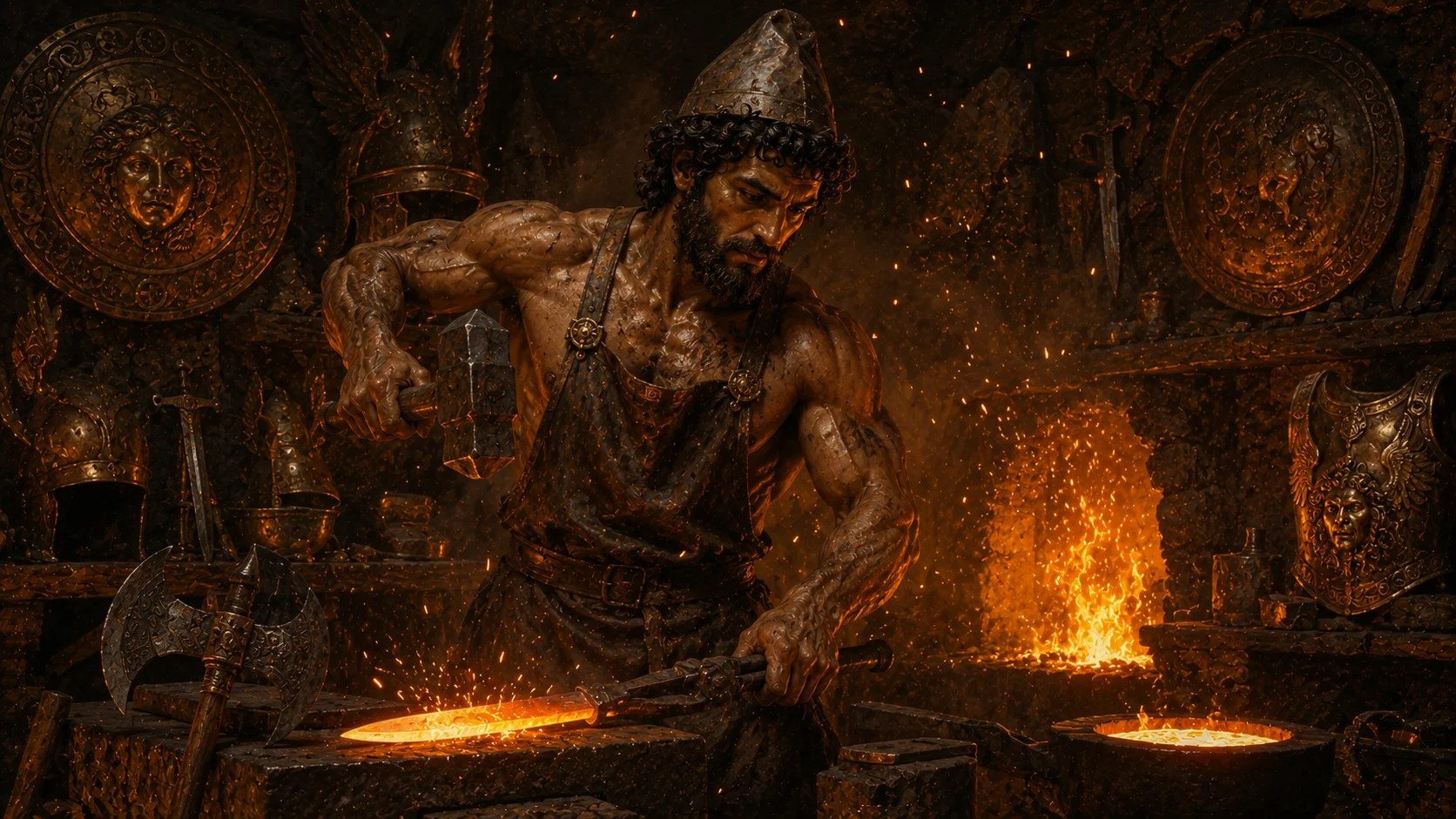
In the surviving Etruscan art that depicts him, Sethlans is shown in a manner that closely parallels the Greek and Roman smith-gods: bearing the tools of his trade, the hammer and tongs, and at times wearing a conical or pointed cap, the mark of the craftsman set apart from the warriors and sky-gods around him. These attributes are not incidental decoration; they are the visual language by which Etruscan artists made unmistakable which god among the crowded pantheon they intended, in the same way that a thunderbolt marks Tinia or a helmet marks a war-god. A well-known Etruscan bronze mirror from Vulci shows a bearded figure identified by inscription as Sethlans, wielding an axe within a mythological scene — the inscription is what removes any doubt of identity, anchoring the iconography to the name.
The Mirror From Vulci and the Birth of Menrva
That same axe-bearing scene is the single most important narrative image of Sethlans to survive. On a engraved bronze mirror from Vulci, dated to the fourth century BCE, Sethlans is shown using his axe to split open the head of Tinia, the supreme sky and thunder god of the Etruscan pantheon, the counterpart of Zeus and Jupiter. From the opened head, Menrva — the Etruscan goddess who corresponds to Athena and Minerva — is born. The scene is a direct and unmistakable Etruscan parallel to the Greek myth in which Hephaistos frees Athena from the head of Zeus with a blow of his axe. It is worth pausing on how rare this is: this mirror is one of the very few surviving Etruscan images that gives Sethlans an actual episode, a moment of action within a story, rather than simply a static attribute-bearing presence. Most of what is known of him is not narrative at all.
Craftsman in Attendance on the Sky-Father
The birth-of-Menrva scene also fixes something important about how Sethlans stood in relation to the highest power in the Etruscan pantheon. He appears there not as a rival or an equal to Tinia but as a subordinate craftsman-god, one whose skill is placed in service of the sky-father's household and its great events. It is Sethlans's tool, and Sethlans's hand, that performs the act that brings Menrva into being, but the act itself unfolds around Tinia, at Tinia's head, within the drama of the chief god's own body. The relationship recorded here is one of service and attendance: the divine smith summoned to do, with fire-forged skill, what even a sky-god's power alone could not accomplish unaided.
A God Without a Storybook
It would be a mistake to read into Sethlans the full biography that later ages built around Hephaistos — the fall from Olympus, the marriage to Aphrodite, the long chain of Greek myths that turned the smith-god into a character with a continuous life story. Nothing of that kind survives for Sethlans, and nothing of that kind should be assumed to transfer to him. The Etruscan corpus itself is almost entirely epigraphic and ritual in character: inscriptions on mirrors, liver models, tomb walls, and votive objects, not the extended mythographic literature that Greek culture produced in such abundance. Etruscan religion was practiced and recorded far more than it was narrated, and Sethlans is a vivid example of that imbalance — a god whose place in the formal order of the heavens is unusually well attested, while his personal story is almost entirely missing.
No Consort, No Household Recorded
For the same reason, no securely attested wife or consort is documented for Sethlans in Etruscan evidence — no figure standing to him as Aphrodite stands to Hephaistos or Venus to Vulcan. Where such a pairing appears in secondary or popular accounts, it is best understood as an unwarranted retrojection, a detail imported wholesale from the Greek tradition and pressed onto the Etruscan god without independent support. The honest state of the evidence is silence on this point, and that silence is itself informative: it marks the boundary between what the Etruscans themselves recorded of Sethlans and what later interpreters, working from the Greek analogy, have been tempted to fill in.
Iron and Copper Country
As a god whose whole domain is fire and the working of metal, Sethlans is generally understood to belong, in spirit if not always in explicit inscription, to the metalworking heartlands of Etruria — regions such as Populonia and the island of Elba, both major centers of Etruscan iron and copper production and among the most important metallurgical sites of the ancient Mediterranean world. Direct cult dedications naming Sethlans at these sites are sparse, and the connection between the god and these places rests substantially on inference from his functional domain rather than on a dense record of temple inscriptions. It is, even so, a natural and widely accepted inference: a civilization whose bronze-casting, gold-work, and iron production were famed throughout the ancient world would reasonably have honored, at its centers of metal production, the god who governed the forge-fire itself.
The Fire That Wells Up From Beneath the Earth
Beyond the smithy, some scholars extend Sethlans's domain functionally toward the volcanic and subterranean fire of Etruria and neighboring Campania, regions within the broader Etruscan-influenced sphere where fire breaks through the earth's surface on its own terms, unforged and untamed by any craftsman's hand. This connection should be understood for what it is: a plausible interpretive extension drawn from his identity as a fire-god, not a directly attested cultic link recorded in the surviving inscriptions. It mirrors the way Vulcan came to be associated with volcanoes in the Roman imagination, and it is a reasonable inference — but it remains inference, resting on the logic of his domain rather than on a specific dedication naming him at any volcanic site.
Craftsmen Among a Nation of Craftsmen
The Etruscans were themselves renowned metalworkers, masters of bronze-casting and the working of gold and other metals; their mirrors, vessels, and statuary, along with their goldsmithing, were famed throughout the ancient Mediterranean. In a culture that prized this skill so highly and traded on it so widely, the god who presided over fire and the forge held a place of real and practical honor, his craft mirroring the craft that gave Etruria much of its wealth and its renown among its neighbors. Sethlans appears in Etruscan art, including on the engraved mirrors that were themselves products of the very metalworking tradition he governed, recognizable always by the tools of the forge — a fitting closeness between the god and the medium through which his own image has survived.
What the Liver and the Mirror Together Preserve
Taken together, the Piacenza Liver and the Vulci mirror give Sethlans a double kind of survival, formal and narrative, that few Etruscan deities receive so evenly. The liver places him within the structured, sixteen-fold order of the heavens consulted by haruspices in the gravest matters of state and ritual; the mirror gives him, in a single arresting image, an act — the axe-blow that opens Tinia's head and brings Menrva into the world. Between the two, a divine smith emerges who was reckoned with formally in the ordered cosmology of Etruscan religion and remembered, if only in one surviving scene, as the craftsman whose fire-forged skill served even the sky-father himself.
Sources & traditions
- EncyclopediaWikipedia — Sethlans
- TraditionEtruscan texts, inscriptions and later retellings (Etruria)
Myths change from area to area and from time to time. This chronicle follows the most widely told versions; tellings in other villages, regions and eras may differ.