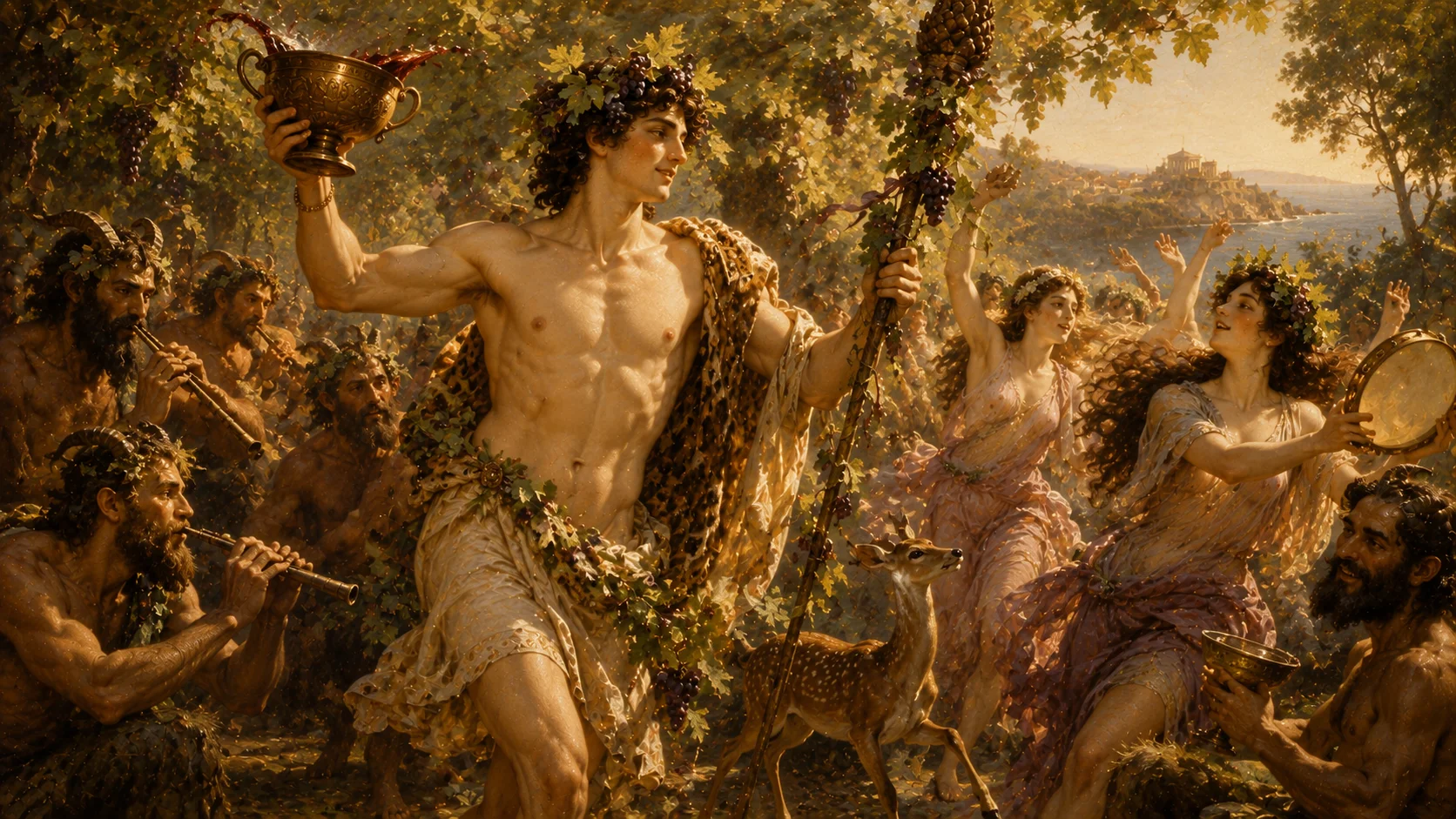
Fufluns is the Etruscan god of wine, vegetation, growth, and ecstatic revelry: the deity of the vine and the natural fertility of growing things, of wine and its joys and frenzies, patron of the city of Populonia, and the Etruscan counterpart of the Greek Dionysos and the Roman Bacchus, or Liber.
A Native Name for a Hellenized God
Fufluns, also rendered Puphluns, presents Etruscan religion with a genuine puzzle. His counterpart Turms carries a name plainly borrowed from the Greek herald-god Hermes, but Fufluns does not: the name appears to be authentically Etruscan, with no Greek root behind it. And yet almost everything documented about the god's function and appearance is thoroughly Hellenized, wine, ecstatic cult, the youthful vine-crowned body, all drawn from the Dionysiac sphere. Fufluns is therefore that unusual case, a native Etruscan divine name wrapped almost entirely in imported Greek clothing, and the mismatch is itself informative: it suggests a wine and growth deity of real antiquity in Etruria, onto whom Greek Dionysos was mapped so completely that the earlier, undocumented character underneath cannot now be recovered.
Fufluns Pacha: A Name Fused in Stone
Nowhere is that layering clearer than in the compound epigraphic form Fufluns Pacha, sometimes given as Pachies, in which the native Etruscan name is bound directly to a form derived from the Greek Bakchos, Bacchus. A single inscribed phrase thus carries both halves of the god's identity at once, the home-grown name and the borrowed epithet, standing side by side rather than one simply replacing the other. Few Etruscan deities offer so tidy and so literal a record of religious syncretism in progress, a god addressed, in effect, by both his old name and his new one in the same breath.
The Vine, the Sprout, and the Turning Year
Fufluns presides over vegetation and growth as much as over the vine specifically, the sprouting of plants, the fertility and renewal of the natural world, the seasonal rhythm by which the vine appears to die back and spring anew. It is this vegetative dimension that connects him to Populonia, Etruscan Pupluna or Fufluna, a coastal Etruscan city whose name scholars have long linked etymologically to the god's own. That link is a scholarly association rather than a settled fact, and which way the naming actually ran, city honoring god, or god's cult reinforced by a city that already bore a kindred name, remains debated. What is not in doubt is that the connection marks Populonia as a significant center of his cult, wherever the etymology ultimately points.
Wine, Frenzy, and the Etruscan Banquet
As with Dionysos, wine in every aspect belongs to Fufluns, the tending of the vine, the making of the wine, and above all the pleasure, the revelry, the intoxication, and the ecstatic, liberating frenzy that wine was understood to bring. The Etruscans were celebrated lovers of the banquet, and their tomb paintings preserve vivid scenes of feasting, drinking, music, and dance, the same joyous excess that Fufluns' cult is thought to have channeled into ritual celebration. Direct documentation of how that ritual was actually practiced is thin, the sparse and imagistic Etruscan sources say far more about how Fufluns was depicted than about what worshippers did in his name, but the iconography leaves no doubt that his was a cult of festive, communal, and mystery-tinged intensity, analogous to the ecstatic religion the Greeks associated with Dionysos.
Semla: A Mother Named but Barely Told
An Etruscan inscription associates Fufluns with a figure named Semla, understood as the Etruscan rendering of Semele, the mortal mother of Dionysos in Greek myth. The connection is genuine and epigraphically attested, but it is a single, limited trace rather than a developed Etruscan narrative, there is no surviving Etruscan story of Semla's fate, her death, or her son's birth, only the naming itself. Fufluns as "son of Semla" should be understood in that light, an attested relationship rather than a fleshed-out myth, a name paired with a name and little more.
Areatha at His Side
On a number of Etruscan mirrors and painted vases, Fufluns appears in the company of a female figure identified as Areatha, understood as the local equivalent of Ariadne, Dionysos's consort in Greek myth. As with Semla, this is a real but limited attestation, the pairing mirrors the Greek relationship rather than reflecting any independently developed Etruscan storyline about the two of them. Areatha belongs to Fufluns alone among the Etruscan gods, her appearances confined to his company and to no other figure's cycle.
Among Turan and the Company of the Mirrors
Fufluns also turns up in mirror scenes alongside Turan, the Etruscan goddess of love and beauty, and other deities, arranged in symposium-like or processional compositions well suited to a god who presides over wine and revelry. These groupings read as convivial or ceremonial tableaux rather than as pieces of a connected genealogy, and, as with Turms, no securely attested full family tree survives for Fufluns beyond the Semla connection, no confirmed father, no extended divine household. What can be said with confidence is which company he keeps in art, Semla, Areatha, Turan, and the general Dionysiac retinue, not a settled place in a larger Etruscan family of gods.
The Youthful, Ivy-Crowned Figure
In Etruscan art Fufluns is shown as a youthful male figure, often nude or lightly draped, at times garlanded with ivy or vine leaves, iconography drawn directly from Dionysiac convention. This visual language entered Etruria through imported Greek objects and through Greek-influenced local production, and it survives above all on two kinds of object, engraved bronze mirrors and painted vases, including Etruscan adaptations of Greek mythological scenes rendered in black-figure and red-figure style. It is from this small, image-heavy body of evidence, supplemented by a handful of dedicatory or votive inscriptions naming him, that nearly everything known about Fufluns is drawn. As with most Etruscan deities, no connected narrative literature about him survives, so anything resembling a continuous "story" of Fufluns beyond these scattered fragments is modern reconstruction, not preserved Etruscan myth.
A God Set Apart from Turms
Fufluns and Turms occupy entirely separate spheres of Etruscan religion, wine and ecstatic cult against messenger and psychopomp, and the two are never attested together in any known joint scene. Their iconographies do not overlap, no wings or herald's staff belong to Fufluns, no vine or ivy belong to Turms, and their divine circles are likewise distinct: Semla and Areatha belong to Fufluns alone, just as the underworld association with Aita and Aitas belongs to Turms alone. The two gods, though roughly contemporary figures in the same pantheon, simply do not meet in the surviving record.
An Equivalence Etruria Left in Little Doubt
Among the many interpretatio pairings that link Etruscan deities to Greek and Roman counterparts, the identification of Fufluns with Dionysos, and by extension with Roman Bacchus or Liber, is one of the more securely established. The Pacha epithet fuses the two names directly, and the iconographic parallels, vine imagery, ecstatic companionship, youthful nudity, are consistent rather than incidental, reinforcing a correspondence that ancient viewers and modern scholars alike have had little reason to question.
An Older God Beneath the Hellenized Image
Much of the surviving imagery of Fufluns dates to the period of intensified Greek cultural contact with Etruria, roughly the sixth through fourth centuries BCE and after, the very centuries in which Greek imports and Greek-trained artisans reshaped so much of Etruscan visual culture. That timing raises the strong possibility that the Dionysian character documented in this art is a Hellenized elaboration laid over an older, far less well-recorded native Etruscan god of wine and vegetation. What that earlier, pre-Hellenized Fufluns looked like, or whether his character differed meaningfully from the ivy-crowned youth of the mirrors, is simply not recoverable from the evidence that has survived. The god known today is, in large part, the god the Greek-influenced centuries chose to preserve.
The Vine's Enduring Return
What remains of Fufluns across mirror, vase, and inscription is a god defined by cycles, the vine's yearly death and renewal, the intoxication and release of the banquet, the mixing of a native Etruscan name with a Greek one in a single votive phrase. Patron of Populonia by long-standing association, companion to Semla and Areatha in fragments too brief to call a myth, and one of the more confidently drawn equivalences to Dionysos in the whole Etruscan pantheon, Fufluns survives less as a told story than as a consistent picture, returned to again and again on bronze and painted clay, of youth, vine leaves, and the ecstatic promise wine was understood to carry.
Sources & traditions
- EncyclopediaWikipedia — Fufluns
- TraditionEtruscan texts, inscriptions and later retellings (Etruria)
Myths change from area to area and from time to time. This chronicle follows the most widely told versions; tellings in other villages, regions and eras may differ.