Turan is the principal Etruscan goddess of love, beauty, vitality, and fertility, a divine figure whose name and image recur across mirrors, votive offerings, and inscribed vessels from at least the 6th century BCE onward, and whose visual language was so thoroughly woven into the shared artistic vocabulary of the ancient Mediterranean that Etruscan craftsmen rendered her in scenes borrowed directly from the mythology of Aphrodite.
A Name Rooted in Giving
Scholars generally connect Turan's name to the Etruscan root tur-, meaning "to give," suggesting an original sense of "the giver" or "gift-bringer." No surviving ancient text glosses the name outright, so the etymology remains a scholarly reconstruction rather than a settled certainty, but it fits well with the goddess's character as understood from her iconography: a divine power connected not only to erotic love but to the wider giving-forth of life, vitality, and wellbeing. If this reading is correct, Turan's domain reached beyond desire and courtship into a broader sense of fecundity and the sustaining of life itself, though this extension is drawn from her name and imagery rather than from any explicit native theological statement.
A Name Carved Into Bronze
Turan's name is attested with unusual frequency in the Etruscan epigraphic record. It appears on mirror captions, on votive dedications, and on bucchero vessels from at least the 6th century BCE forward, a span of inscriptional evidence that marks her as one of the most consistently named deities in Etruscan religious life. Among Etruscan bronze mirrors of the 5th through 3rd centuries BCE, her name and image occur more often than almost any other deity except Turms, the Etruscan counterpart of Hermes, a pattern that speaks to real and sustained popular devotion rather than a passing or marginal cult.
Votive Offerings at the Harbor of Tarquinia
At Gravisca, the port sanctuary serving the Etruscan city of Tarquinia, archaeologists have recovered votive graffiti reading "Turan" among dedications made to a female deity associated with fertility and protection. The presence of her name at a harbor sanctuary fits a broader Mediterranean pattern in which Aphrodite-type goddesses were closely linked to ports and maritime trade, and it has led some scholars to propose a syncretism between the cult at Gravisca and the figure of the Greek Aphrodite. That specific identification, however, is a scholarly inference built from the pattern of the evidence rather than something stated outright on the offerings themselves, and it should be held with appropriate caution rather than treated as settled fact.
Not the Goddess of Pyrgi
It bears stating plainly, given how easily port-sanctuary evidence can blur together: no direct textual proof establishes that Turan herself was venerated at the nearby sanctuary of Pyrgi. The deities confirmed by the famous Pyrgi tablets are Uni and Astarte, not Turan, and the two cult contexts should not be conflated simply because both sit on the coast and both involve a female deity linked to fertility. Turan's own attested coastal presence belongs to Gravisca.
The Youth Beloved of the Goddess
On numerous mirrors, Turan is shown in the company of a youth named Atunis, the Etruscan rendering of the Greek Adonis. Several of these scenes depict her mourning over him or attending to him, echoing the dying-consort motif at the heart of the Aphrodite and Adonis myth in Greek tradition. This pairing represents the clearest and most consistently repeated mythological relationship associated with Turan in the surviving material, and it shows how thoroughly Etruscan artists absorbed and reproduced a Greek narrative pattern around their own goddess of love, without the record preserving any independent, uniquely Etruscan story that departs from that borrowed frame.
Winged Attendants of Beauty and Grace
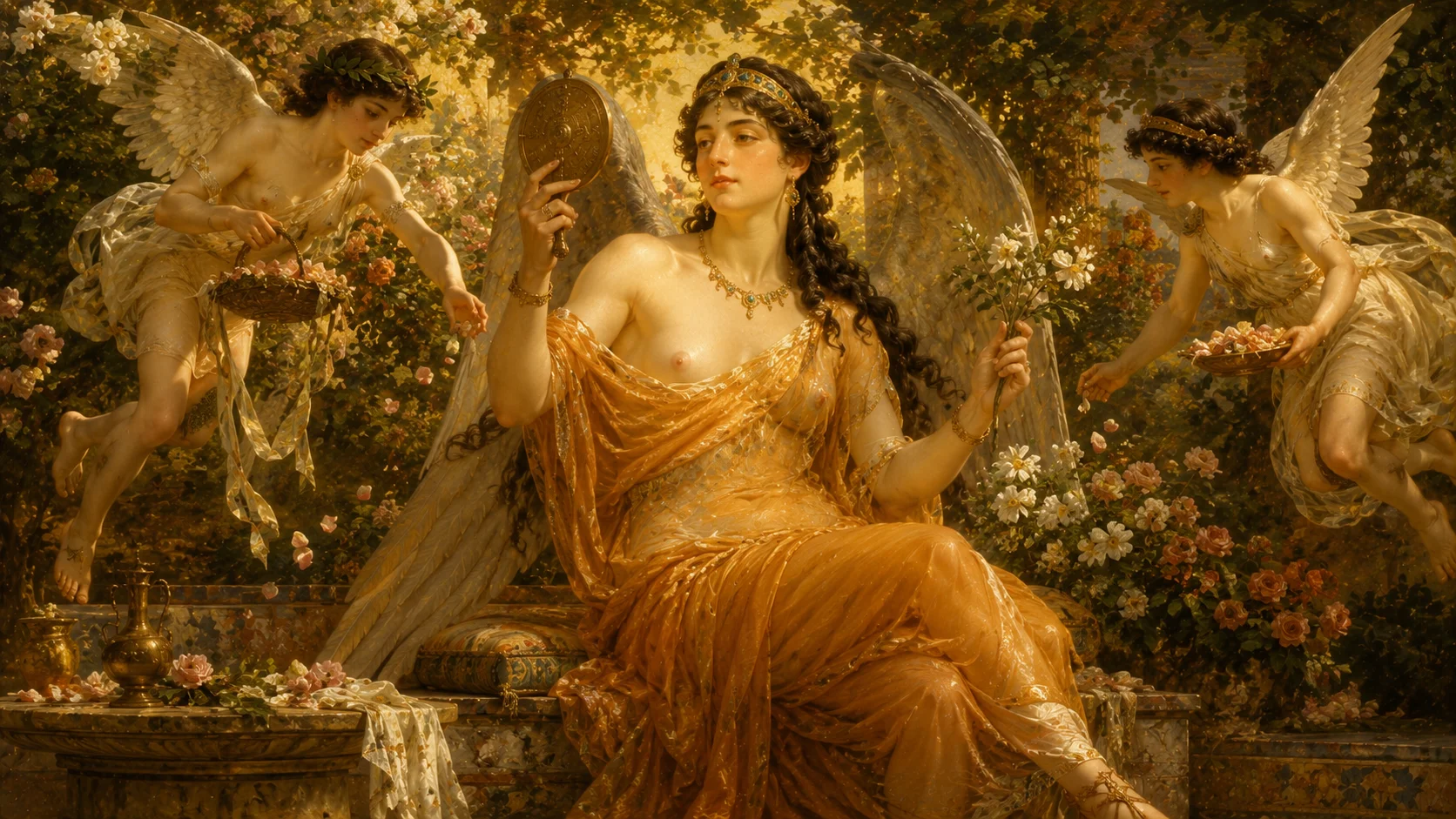
Turan is frequently shown flanked by winged female attendants known as Lasas, minor spirits associated with beauty, grace, and the erotic and marital sphere of life. Some of these figures carry individual names in the inscriptional record, such as Lasa Vecuvia, while others appear unnamed within her retinue. Functionally, the Lasas occupy a role in Turan's circle comparable to the Erotes or Charites who surround Aphrodite in Greek art, small attendant powers who elaborate and extend the goddess's own qualities of charm and allure. Their precise theology, what exactly they were understood to do or to be beyond this attendant role, remains only partly understood from the surviving evidence.
Doves, Swans, and the Toilette of the Goddess
In Etruscan art, Turan typically appears as a young woman, often nude or semi-nude, sometimes crowned with a diadem, and frequently shown winged, though not always: enough unwinged depictions survive that "winged goddess" should not be treated as a universal trait of her iconography. She is commonly accompanied by a dove or a swan, birds strongly and repeatedly associated with her across the mirror corpus. A recurring scene type shows her in a "toilette of the goddess" composition, being dressed or adorned by her attendants, a standard element of Aphrodite-type iconography that Etruscan artists adopted into their own visual repertoire for Turan.
A Presence Beside Turms
Beyond the Atunis pairing, Turan also appears in mirror scenes alongside Turms, the Etruscan adaptation of the Greek Hermes. These scenes, like the toilette compositions, belong to a general iconographic scheme rather than to a documented independent narrative unique to Etruscan tradition. Across the whole of the surviving evidence, no wholly native myth of Turan, one that does not simply parallel a Greek original, has come down to us; what survives is a consistent visual language built from Greek mythic material and applied to an Etruscan divine figure.
Uncertain Words in the Mirror Corpus
Some mirror inscriptions preserve extended or compound forms of Turan's name, and secondary literature has proposed formulas such as a pairing with "Turan Ati." These readings are not uniformly accepted among epigraphers, and the compound or expanded forms should be understood as proposed and debated rather than as an established part of her fixed cultic titulature. As with the etymology of her name itself, the epigraphic record here rewards caution over confident restatement.
A Goddess in a Shared Visual Language
Several mirrors and engraved gems show Turan in scenes that are direct iconographic borrowings from the Judgment of Paris and other episodes properly belonging to the mythology of Aphrodite. This is itself a form of internal evidence: by the Classical and Hellenistic periods, Etruscan artists treated Turan as functionally equivalent to the Greek goddess within a Mediterranean visual culture that circulated shared mythic imagery across different peoples and languages. There is no native Etruscan literary text that states this equivalence in words. The identification rests instead on the consistent pattern of attributes, mythic scenes, and epithet structures shared between the two figures, which is the standard and widely accepted method by which scholars reconstruct Etruscan theology in the absence of a native literary corpus.
Heir to Aphrodite, Ancestor of Venus
Turan is consistently identified by modern scholarship, and implicitly by the Etruscan artists who painted and engraved her, with the Greek Aphrodite, and by further extension with the Roman Venus who would come after. This chain of correspondence, Turan to Aphrodite to Venus, situates her within a long continuity of Mediterranean love-goddesses even as her own name, her own attendant Lasas, and her own cult sites at places like Gravisca mark her as a distinctly Etruscan figure with her own regional identity rather than a mere copy of a foreign import.
The Giver of Life's Vital Force
Taken together, the evidence for Turan describes a goddess whose reach extended from the intimate territory of erotic love and physical beauty outward into a broader vitality understood as the animating force behind fertility and wellbeing. She was clearly a major and popularly venerated figure in Etruscan religious life, attested across centuries of inscriptions and honored in the imagery of countless bronze mirrors, a goddess whose winged attendants, dove and swan companions, and mourned young consort together sketch the portrait of a deity fully at home within, and fully expressive of, the wider Mediterranean world's devotion to the powers of love and life.
Sources & traditions
- EncyclopediaWikipedia — Turan (mythology)
- TraditionEtruscan texts, inscriptions and later retellings (Etruria)
Myths change from area to area and from time to time. This chronicle follows the most widely told versions; tellings in other villages, regions and eras may differ.