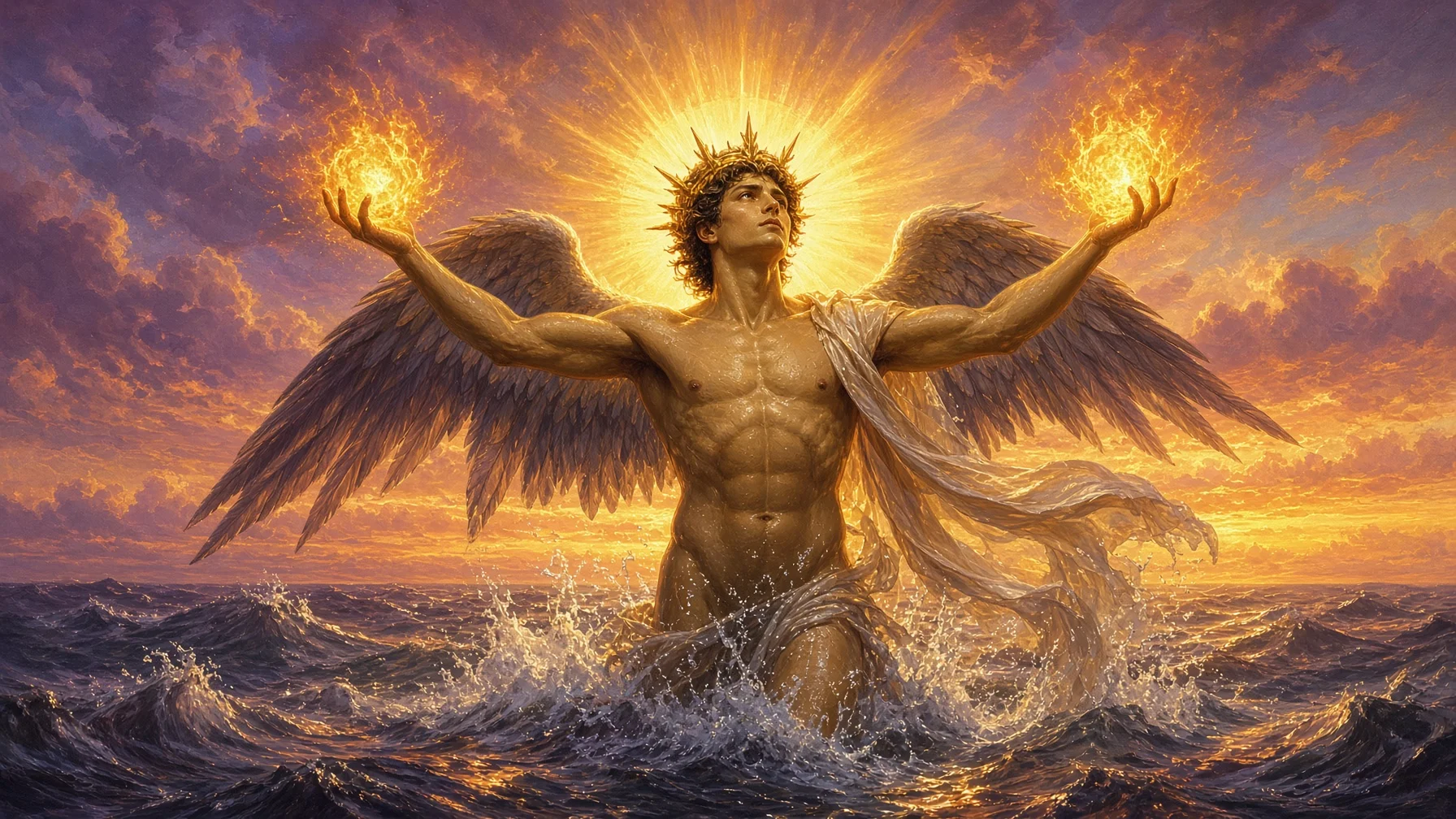
Usil is the Etruscan solar deity — the divine power of the sun, attested by name on the bronze Piacenza Liver and depicted on engraved mirrors as a youthful, often winged figure rising over water in a blaze of light. Usil's place in the formal Etruscan pantheon is secure; almost everything else about him survives only as image and label, not story.
A Name Written on Bronze
The clearest proof of Usil's standing among the Etruscan gods is epigraphic rather than literary: his name appears inscribed on the Piacenza Liver, a bronze model of a sheep's liver made around 100 BC and used in the practice of haruspicy, the reading of the liver of a sacrificed animal for divine signs. The Liver is divided into a formal scheme of outer-rim regions, each assigned to a deity or divine power, and Usil occupies a region in that scheme associated with the eastern sky and with dawn. His presence there is not decorative — it places him inside the structured, working theology that Etruscan diviners actually consulted, the disciplina etrusca, rather than in the realm of literary myth. Few Etruscan deities are attested this precisely; Usil is one of the names haruspices needed to know.
A Root Meaning Sun
Etruscan is a fragmentary language, known mostly from short inscriptions rather than continuous prose, and etymologies must be handled carefully. Even so, scholars generally connect the word 'usil' to a root meaning 'sun', a reading supported by comparison with related Etruscan vocabulary and by the place-name and month-name 'Usiliae', which appears to share the same root. Usil functions, it seems, as both a proper divine name and a common word for the sun itself — a doubling found elsewhere in Etruscan religious vocabulary, where the name of a power and the name of the phenomenon it governs are not always distinct. The derivation is linguistically reasonable, but given how little of Etruscan survives, it should be held as probable rather than certain.
Rising Between the Waves
The single best-known image of Usil comes from a bronze mirror of the mid-5th century BC, sometimes called the 'Sunrise mirror'. On it, a winged male figure labelled USIL is shown running or rising, caught between two horse-drawn elements or waves, in a scene scholars read as a sunrise over the sea. Other figures appear in the composition, including Nethuns, the Etruscan sea god, and, in some interpretations, Thesan, the goddess of dawn — though the identification of every figure on that mirror remains debated among specialists, and the full cast should be treated as a scholarly reconstruction rather than a settled fact. What the mirror does show clearly is the essential mythic image the Etruscans attached to Usil: the sun breaking free of the sea at the edge of the world, climbing into the sky in a burst of motion and light.
The Youthful, Radiant Figure
Beyond the Sunrise mirror, Usil appears on other engraved mirrors in a broadly consistent visual type: a youthful male figure, sometimes winged, often shown rising from or moving across water, with rays or a radiate quality indicated around him. This iconography is not a wholly unique Etruscan invention — it parallels solar imagery found elsewhere in the ancient Mediterranean world, where gods of the sun are frequently rendered young, radiant, and airborne. What can be said with confidence is the pattern itself: motion, light, water, and youth recur wherever Usil is pictured, even though no single fixed 'canonical' image of him was ever settled on by Etruscan artists.
Set Against the Moon
Modern scholarship regularly discusses Usil together with Tivr, the Etruscan deity of the moon, as a natural day-and-night, sun-and-moon pairing that reflects the Etruscans' broader preoccupation with celestial order. This pairing is a reasonable thematic grouping, visible in how the two are treated in the study of Etruscan religion, but it should not be mistaken for an attested mythic relationship. No surviving source describes Usil and Tivr as siblings, consorts, or any other specific kin — the connection between them is one of function and cosmic symmetry, sun answering moon, not a documented family bond. Where the sources are silent, the honest position is silence in turn.
A Place in the Mapped Heavens
The Piacenza Liver did not place Usil at random. Etruscan religious practice divided the heavens into a structured scheme of regions — commonly described as a sixteen-fold division, or one organised along similarly formal lines — each governed by a particular power, and each significant for the reading of omens depending on where in the sky a sign, such as lightning, appeared. Usil's assignment to the eastern, dawn-associated region situates him inside this working cosmology: not as a hero with a story, but as a fixed coordinate in a system diviners used to interpret the world. His importance, in other words, was cosmological and calendrical before it was ever narrative — a god who mattered because the sky itself was organised around where and when he appeared.
No Deeds, Only a Presence
Unlike the Greek Helios, who drives a chariot through a cycle of stories touching other gods and mortals, Usil has left no surviving narrative of his own. No Etruscan text recounts anything Usil did, said, or caused. What remains is entirely epigraphic and iconographic — a name on a bronze liver, a labelled figure on a handful of mirrors — and nothing resembling myth in the sense of connected episodes or deeds. This absence is worth stating plainly rather than filled in: it marks a real limit of the evidence, not an incidental gap waiting to be explained away.
Reflected Through Roman Report
Almost everything modern readers can infer about Usil's theological meaning beyond his direct attestations comes filtered through later hands. The Etruscans' own religious literature — texts such as the libri Tagetici and the libri fulgurales, which governed prophecy and the interpretation of lightning — does not survive in the original. It is known only through paraphrase and quotation by later Roman writers, including Cicero and Seneca, and through fragments preserved by still later antiquarians. Any claim about what Usil 'meant' theologically to the Etruscans, beyond what the mirrors and the Liver directly show, is therefore an inference built on secondhand Roman transmission, and should be weighed as such.
The Sun Without a Shrine
For a deity confirmed in the formal pantheon and pictured on multiple surviving mirrors, Usil is strikingly absent from the archaeological record in one respect: no temple, cult inscription, or votive dedication naming Usil specifically has been identified with certainty. His attestation is, in effect, confined to the mirror corpus and to the Piacenza Liver. This is a genuine gap in the evidence rather than a minor curiosity, and it is worth stating directly instead of glossed over — a widely recognised solar power whose worship, if organised worship existed in any distinct form, has left no confirmed physical trace of its own.
An Equation Drawn by Later Eyes
Usil is conventionally equated by modern scholars with the Greek Helios, and more loosely with the Roman Sol, on the strength of shared solar function and comparable iconography — the radiate, sometimes winged solar figure common to both traditions. This equation is a tool of comparative religion, useful for placing Usil within a wider Mediterranean picture of sun-gods, but it is an interpretive bridge built by later scholarship rather than a correspondence the Etruscans themselves are known to have drawn. Usil should be read on his own terms first: an Etruscan power with his own name, his own fixed place on the Liver, and his own visual language, who happens to resemble neighbouring solar deities rather than being a simple copy of them.
Only One Name Known
Where many ancient deities accumulate a cluster of epithets and alternate titles across their surviving inscriptions, Usil has none securely attested. 'Usil' stands alone in the corpus as both the god's name and, apparently, the ordinary word for the sun — with no other confirmed alternate name or title recorded. This spareness is itself informative: it suggests a deity known and invoked in a fairly fixed, formal way, consistent with his role as a coordinate in the mapped heavens of the disciplina etrusca rather than as the subject of an elaborated personal cult with many names.
What the Evidence Actually Allows
Taken together, the record permits a precise but narrow picture: Usil is the Etruscan sun, confirmed by name in the formal religious geography of the Piacenza Liver, pictured rising over the sea on at least one well-known mirror and echoed in a broader type across others, thematically paired with the moon-deity Tivr, and conventionally set beside Helios and Sol by later interpreters. Every claim beyond that — motive, relationship, deed, cult practice — sits outside what the surviving evidence can support. Usil endures not as a character in a story but as a fixed point of light in the Etruscans' own map of the sky, known by name to the diviners who once read it.
Sources & traditions
- EncyclopediaWikipedia — Usil
- TraditionEtruscan texts, inscriptions and later retellings (Etruria)
Myths change from area to area and from time to time. This chronicle follows the most widely told versions; tellings in other villages, regions and eras may differ.