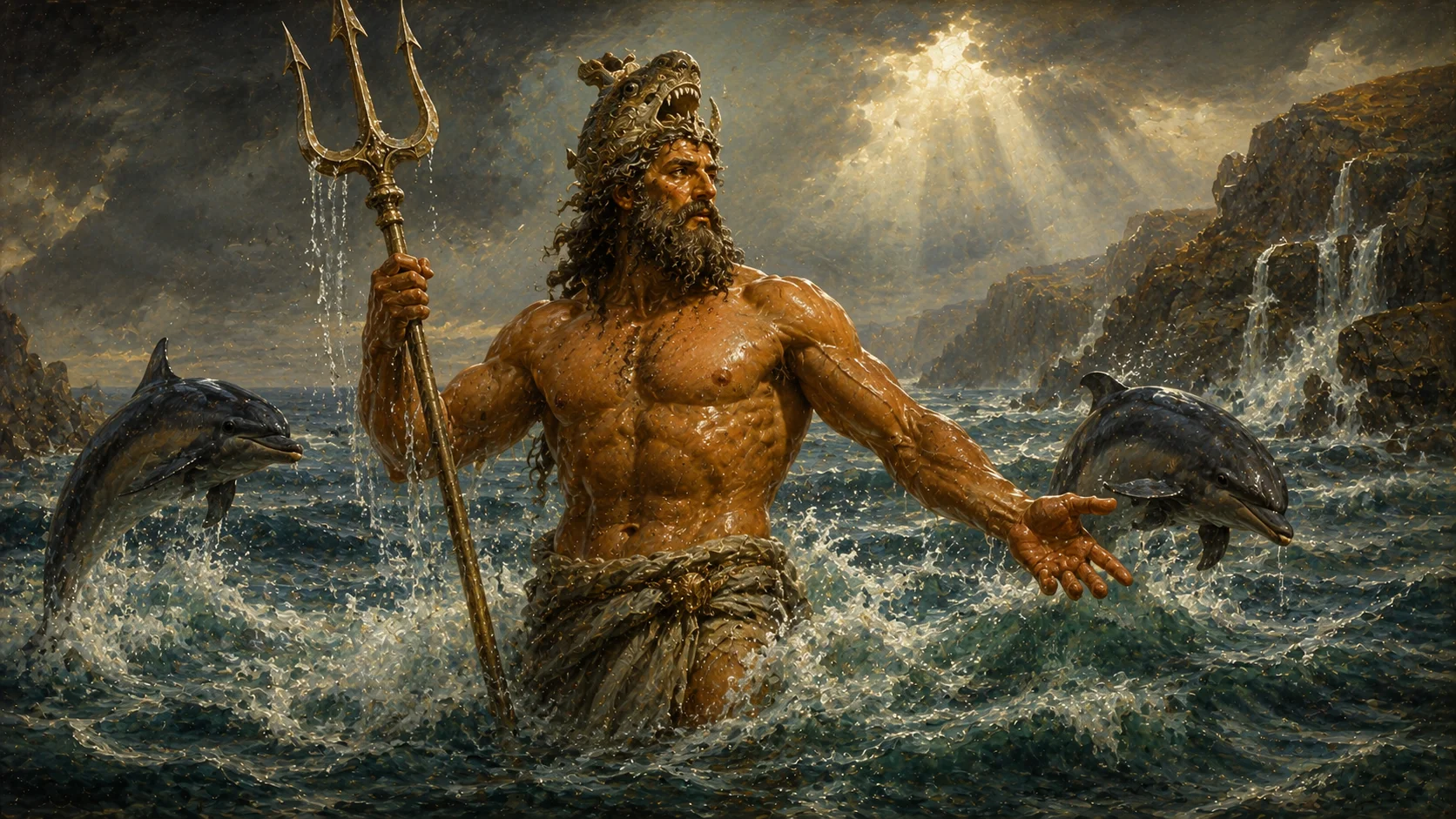
Nethuns is the Etruscan god of water in all its forms — springs, wells, rivers, and the sea — the deity whose name is formally inscribed on the Piacenza Liver, the bronze model used in the practice of haruspicy, confirming his structured place within the Etruscan pantheon. He is the accepted Etruscan counterpart of the Roman Neptune and, more loosely, the Greek Poseidon, an equation scholars treat as unusually secure because it rests on a shared etymological root and not on iconography alone.
A Name Cast in Bronze
What is known of Nethuns begins, almost entirely, with two kinds of physical evidence: a small corpus of engraved mirrors and a single extraordinary object, the Piacenza Liver. The Liver is a bronze model of a sheep's liver, its surface divided into named regions, each corresponding to a portion of the Etruscan sky and to a specific god. Nethuns occupies a designated region of that model. This is not a decorative or incidental appearance — it places him formally within the disciplina etrusca, the structured theological system that underpinned Etruscan divination. To be named on the Liver was to be recognised as one of the gods whose favour or displeasure the haruspex needed to read correctly.
A Word Older Than Rome
The name Nethuns is philologically significant in its own right. It shares an Indo-European root with the Latin Neptunus, and linguists generally treat the two as cognate terms rather than assuming one was simply borrowed from the other. This points toward a shared prehistoric layer of Italic and Etruscan religious vocabulary, predating the historical contact between Etruscan and Roman culture, rather than a late loanword picked up by one people from the other. The exact direction and depth of that relationship remains debated among specialists, but the cognate status itself is one of the more solid threads connecting Etruscan religion to the wider Italic world.
Fresh Water Before Salt
Nethuns's domain is best understood as beginning close to home rather than out at sea. As a god of water broadly conceived, his authority extended over springs and wells — the fresh-water sources on which any Etruscan settlement depended for daily survival — before extending, by association, to the sea itself. This functional breadth, from spring to ocean, is consistent with how many ancient water deities were conceived, and it gives Nethuns a plausible everyday relevance to communities that never saw a coastline, as well as to those that lived by one.
Trident and Tide
On surviving Etruscan bronze mirrors, Nethuns is shown as a mature, often bearded male figure, at times holding a trident-like implement or set within a maritime or aquatic scene. This trident motif reinforces the parallel with Neptune and Poseidon, both of whom carry the same weapon in Greek and Roman art. It is worth noting, however, that the surviving mirror corpus that names Nethuns explicitly is small — his iconography is recognisable and consistent where it appears, but it does not represent a large or widely reproduced tradition of images in the way some other figures do.
The Sunrise Mirror
Among the most discussed objects associated with Nethuns is a bronze mirror of the fifth century BC, sometimes referred to by scholars as the 'Sunrise' mirror, on which Nethuns appears alongside Usil, the Etruscan sun. The composition has been read as a maritime dawn scene, the sea-god and the sun-god sharing a single frame in a way that suggests an associative link between sea and sunrise in Etruscan visual religion. It is important to hold this reading at the right distance from certainty: the pairing of figures on the bronze is real and inscribed, but the narrative sense of 'sunrise over the sea' is a modern interpretive reading of the composition, not a story spelled out by any accompanying Etruscan text.
A God for a Seafaring People
Etruria's major city-states — Populonia, Vulci, and Caere among them — were coastal centres deeply engaged in maritime trade across the Tyrrhenian world. A god governing both the fresh water that sustained inland life and the sea that carried Etruscan goods and ships would have carried genuine practical weight for such a civilization. This functional importance is a reasonable inference from what Nethuns represents and from the shape of Etruscan society itself, though it should be held as inference rather than documented fact: the specific rites, offerings, or cult practices associated with Nethuns are not well preserved in the archaeological record, and no detailed liturgy or temple protocol tied to his worship survives.
The Etruscan Neptune
The identification of Nethuns with Roman Neptune, and by extension with Greek Poseidon, is treated by scholars as one of the more dependable god-equations to survive from Etruscan religion. Most cross-cultural equations of this kind in the ancient Mediterranean rest solely on shared function or resembling imagery — a fragile basis, since many gods overlapped in role without being 'the same' god in any theological sense. Nethuns is different because the linguistic cognate between his name and Neptunus sits alongside the iconographic and functional overlap, giving the equation two independent lines of support rather than one.
No Story Survives Him
It is worth stating plainly what does not exist in the record: no surviving Etruscan narrative recounts specific deeds or episodes involving Nethuns. There is no flood myth, no sea-battle, no rescue or wrath attributed to him in any text that has come down to us. This is not unusual for Etruscan religion as a whole — the overwhelming majority of Etruscan deities are known through name-labels on mirrors and through their place in systems like the Piacenza Liver, rather than through literature. Nethuns's case simply makes this general pattern visible: a god fully integrated into the formal structure of Etruscan theology, and almost entirely silent as a character.
Standing Alone in the Record
For the same reason, no genealogical relationships for Nethuns survive in the Etruscan evidence. There is no attested parent, spouse, or child linked to him in the surviving corpus. What can be shown is structural rather than familial: his appearance alongside other named gods in contexts such as the Piacenza Liver's regional divisions, and his shared appearance with Usil on the mirror scene discussed above. These are associations of place and composition, not statements of kinship, and any claim of a family relationship for Nethuns would be an invention unsupported by the material that has survived.
A Name Without Titles
Unlike some ancient sea-gods who accumulate a range of epithets describing particular powers or moods, no alternate titles for Nethuns are securely attested beyond his base name. Scholars are explicit in cautioning against importing Poseidon's Greek epithets — such as the 'Earth-shaker' title — onto Nethuns simply because the two share a functional role. Functional overlap between two gods from different cultures does not guarantee that their surrounding theology matched, and Etruscan religion should not be filled in with Greek details for the sake of a fuller-sounding picture.
Reading Him Through Roman Eyes
A further layer of caution applies to nearly everything claimed about Nethuns's larger theological significance. The disciplina etrusca — the body of Etruscan religious teaching that would have explained figures like Nethuns in full — survives only in fragments and paraphrase, filtered through later Roman writers describing a tradition that was, by their own time, already partly lost. Any modern statement about Nethuns's fuller role, a broader 'cult of the sea,' or specific rites performed in his honour should be understood as inferential reconstruction built on scattered clues, not as something directly sourced from an Etruscan text speaking in its own voice.
A Debated Deeper Current
One further line of scholarly speculation deserves mention precisely because it remains speculation. Some researchers working in comparative religion have proposed that Nethuns may have carried a broader chthonic or underworld-adjacent association through his connection to springs and boundary waters, paralleling the liminal roles that water deities occupy in other Mediterranean traditions, where the point at which water rises from or vanishes into the earth was often treated as a threshold to something beneath. This idea is a comparative hypothesis, not something directly attested in Etruscan material, and it should be presented as disputed rather than established whenever it is raised.
What the Bronze Confirms
Set against how little narrative material survives for most Etruscan gods, Nethuns is, in a sense, better attested than many of his peers — not through stories, but through the two most durable forms of Etruscan religious evidence: a formal position on the instrument used to read the will of the gods, and a recognisable presence, trident in hand, on the mirrors carried by the living. Between the Piacenza Liver's structured theology and the sunrise mirror's quiet pairing with Usil, Nethuns endures as a figure defined by his place in a system rather than by any tale told about him — the water-god of a seafaring people, known by name, function, and position, and asking nothing more of the record than that.
Sources & traditions
- EncyclopediaWikipedia — Nethuns
- TraditionEtruscan texts, inscriptions and later retellings (Etruria)
Myths change from area to area and from time to time. This chronicle follows the most widely told versions; tellings in other villages, regions and eras may differ.