Aita, also rendered Eita, is the Etruscan god of the underworld and the dead: the dread lord of the realm below, ruler of the land of the dead alongside his consort Phersipnai, depicted as a grim, bearded figure crowned or capped with the head and pelt of a wolf. Roman-era interpretation treated him as broadly equivalent to Greek Hades/Plouton and to Roman Dis Pater, but the figure that survives in Etruscan tomb art keeps a visual identity distinctly its own.
A Name Borrowed from the Greeks
Scholars now generally recognize Aita's name itself as a direct borrowing and adaptation of the Greek theonym Hades, part of a broader Etruscan pattern of taking over Greek divine names in adapted form — the god Aplu, drawn from Apollo, is another well-known example of the same process. Aita is considered one of the clearer, more legible cases of this kind of theonymic borrowing anywhere in the Etruscan pantheon. Earlier scholarship debated whether what was borrowed was the name alone, grafted onto an existing native figure, or whether the full mythological package — name, consort, and iconographic type together — arrived wholesale from Greek models during the Hellenizing period of Etruscan art in the fifth and fourth centuries BCE. That question remains genuinely unresolved: it is not settled whether Aita represents an older native death-god who was simply re-labeled with a fashionable Greek name, or whether the figure was substantially an import. Both readings remain live in current scholarship, and neither should be presented as the final word.
Enthroned in the Tomb of Orcus
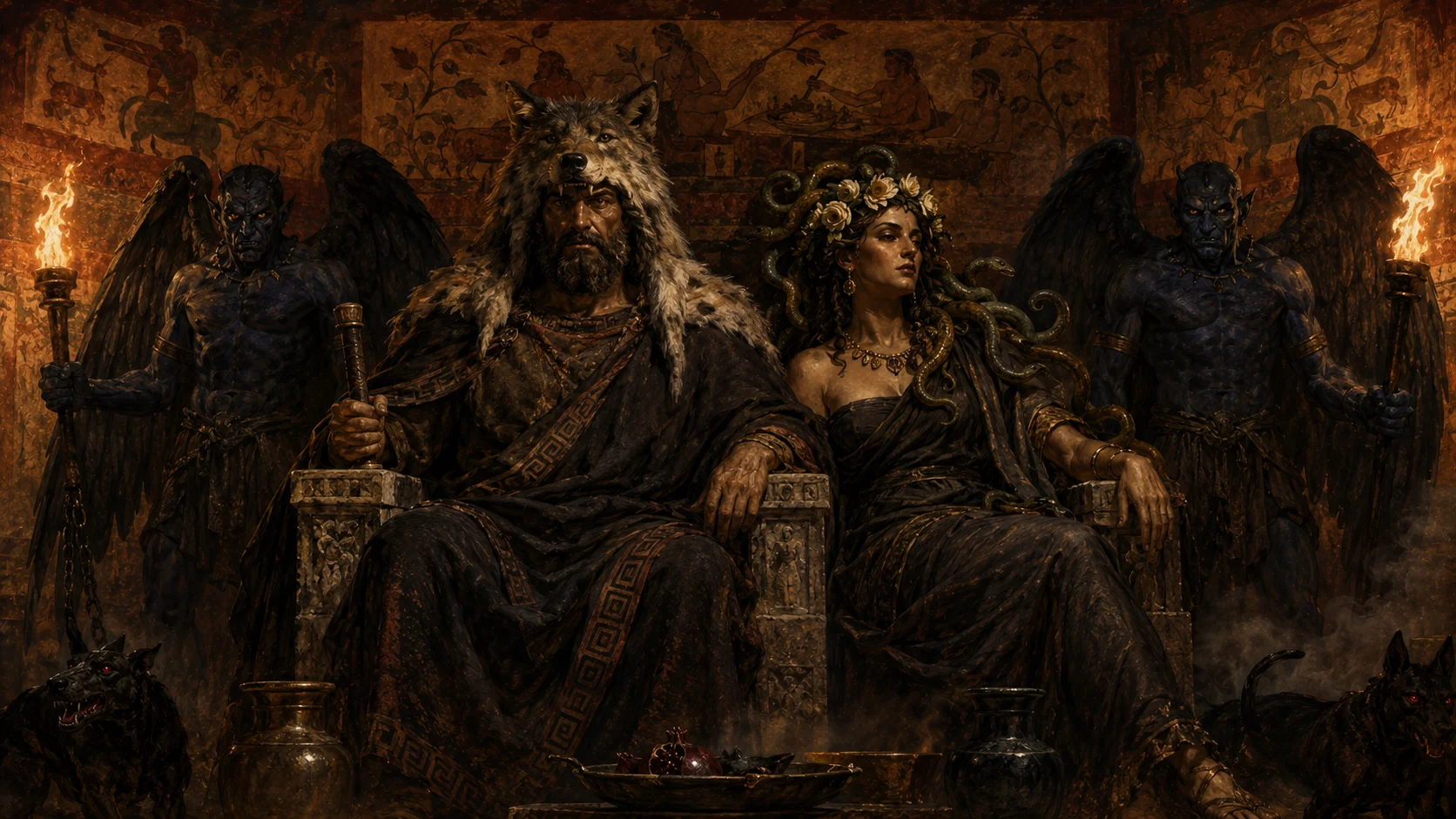
The best-known and most secure attestation of Aita comes from the Tomb of Orcus II (Tomba dell'Orco II) at Tarquinia, a painted chamber tomb of the fourth century BCE. There, Aita appears as a bearded, wolf-cap-wearing figure seated on a throne in the underworld, enthroned beside his consort Phersipnai. The tomb's modern name is itself a later archaeological label, borrowed from Orcus, an underworld figure associated with the site only after antiquity — it is not an ancient Etruscan designation for the tomb or for Aita himself, and should not be mistaken for one.
The Wolf-Skin Crown
Aita's most distinctive and most consistently attested iconographic marker is his headdress: a cap or hood made from the head and pelt of a wolf, worn drawn up over his skull. This detail is what most reliably identifies him as Aita rather than simply borrowing Greek Hades' image wholesale, since Hades himself, in Greek art, does not wear this attribute. Art historians regard the wolf-cap as a genuinely native Etruscan iconographic invention layered onto an otherwise Greek-derived figure, rather than a straightforward copy of anything in Greek painting or sculpture. It is this cap, more than any other single feature, that lets the enthroned figure in the Tomb of Orcus be identified as Aita with confidence.
Phersipnai, Queen of the Dead
Aita's consort is Phersipnai, also transliterated Persipnei, a figure directly modeled on and equated with the Greek Persephone. In the Tomb of Orcus the two are shown enthroned together, a pairing that visually parallels the Hades–Persephone dyad familiar from Greek myth, though the Etruscan pair is attested independently, through its own tomb painting, rather than as a mere copy of a Greek scene. Their joint enthronement, both figures seated and crowned or capped, is generally read by art historians as expressing a conception of the underworld ruled by a "royal couple of the dead" — a shared sovereignty over the realm below, visually distinguished from the Greek model chiefly through Aita's wolf-cap.
What Is Not Known
Despite the vividness of the Tomb of Orcus scene, there is no securely attested independent Etruscan myth-narrative starring Aita in the way that the Rape of Persephone survives as a narrative in Greek tradition. Beyond the iconographic pairing of Aita and Phersipnai enthroned together, no story of abduction, journey, or divine conflict involving Aita is preserved. Any account that goes further than the enthronement scene itself should be treated as unattested rather than assumed, and caution is warranted before attributing to Aita any specific ritual role beyond "lord of the dead" paired with his queen. Because the Etruscans' own religious writings, the Etrusca disciplina, survive only through Roman-era paraphrase and fragments, almost everything known about Aita's cult function, as distinct from his appearance in funerary art, is inferential rather than directly documented.
Absent from the Piacenza Liver
Unlike Sethlans, Aita is not confirmed among the gods listed on the Piacenza Liver, the bronze model used in Etruscan divinatory practice to map the sky into divine regions. This absence is consistent with his nature: the Liver's schema catalogues celestial and haruspical regions, the domains read in the sky for omens, not the underworld realm that Aita governs. His cultic-administrative attestation is accordingly weaker, and different in kind, from that of sky gods who appear by name on formal ritual instruments.
A God Without a Known Temple
No securely attested cult sites or temple dedications specifically to Aita have been documented. Nearly all the evidence for him is funerary and iconographic in character — tomb paintings, along with some imagery on mirrors and vases — rather than epigraphic or cultic in the sense of formal ritual inscriptions or dedicated shrines. This stands in notable contrast to gods attested on formal ritual objects such as the Piacenza Liver, and it reinforces how much of what is known about Aita comes specifically from how the Etruscans pictured death, rather than from how they worshipped him in any documented institutional sense.
Presiding Over a Crowded Underworld
The scene of Aita and Phersipnai enthroned belongs to a broader trend in Etruscan funerary art of the fourth through second centuries BCE, a period in which painted tombs increasingly populated the underworld with vivid, demon-filled imagery. Among the figures who share this painted world with Aita are Vanth, a winged female death-demon, and Tuchulcha, a composite-animal underworld demon. Aita presides over this realm as its king, but Vanth and Tuchulcha are independent figures in their own right within Etruscan belief, not aspects, servants folded into, or extensions of Aita himself, and they should be understood as distinct entities that happen to inhabit the same painted underworld.
Charun, a Separate Power of Death
The same painted program in the Tomb of Orcus that shows Aita enthroned also includes Charun, a demonic Etruscan underworld figure who functions as a death-demon and psychopomp, related to but distinct from the Greek ferryman Charon. Charun is independently and separately attested in Etruscan art and belief, appearing across numerous tombs beyond the Tomb of Orcus, and he should not be conflated with Aita himself. Where Aita is the enthroned king of the dead, Charun belongs to the retinue of demonic figures who populate and enforce the passage into that realm — a distinct power operating within Aita's domain rather than a form or title of Aita.
Reading the Enthronement Scene
Taken as a whole, the Tomb of Orcus imagery of Aita and Phersipnai is the anchor point for nearly everything that can be said about this god with confidence. The pairing of a crowned, wolf-capped king with his enthroned queen communicates sovereignty and permanence: two rulers seated in judgment or repose over the dead who come before them. That the scene reads so clearly as royal, rather than as a courtroom or a battlefield, is part of why scholars describe the pair as a "royal couple of the dead" — a formulation drawn directly from what the painting shows, rather than from any surviving narrative text, since no such text about Aita survives.
An Open Question in Etruscan Religion
Aita remains, in a real sense, a figure defined more by what can be securely seen than by what can be confidently narrated. His borrowed Greek name, his uniquely Etruscan wolf-cap, his queen Phersipnai, and his absence from the sky-god records of the Piacenza Liver together sketch a god whose authority was total within his own painted realm and whose documentation outside it is thin. Whether that realm's ruler began as a native Etruscan power renamed in a Greek idiom, or arrived as part of a broader wave of Hellenizing underworld imagery, is a question current scholarship leaves open rather than answered — and Aita's chronicle is, appropriately, a chronicle of a throne more clearly seen than explained.
Sources & traditions
- EncyclopediaWikipedia — Aita
- TraditionEtruscan texts, inscriptions and later retellings (Etruria)
Myths change from area to area and from time to time. This chronicle follows the most widely told versions; tellings in other villages, regions and eras may differ.