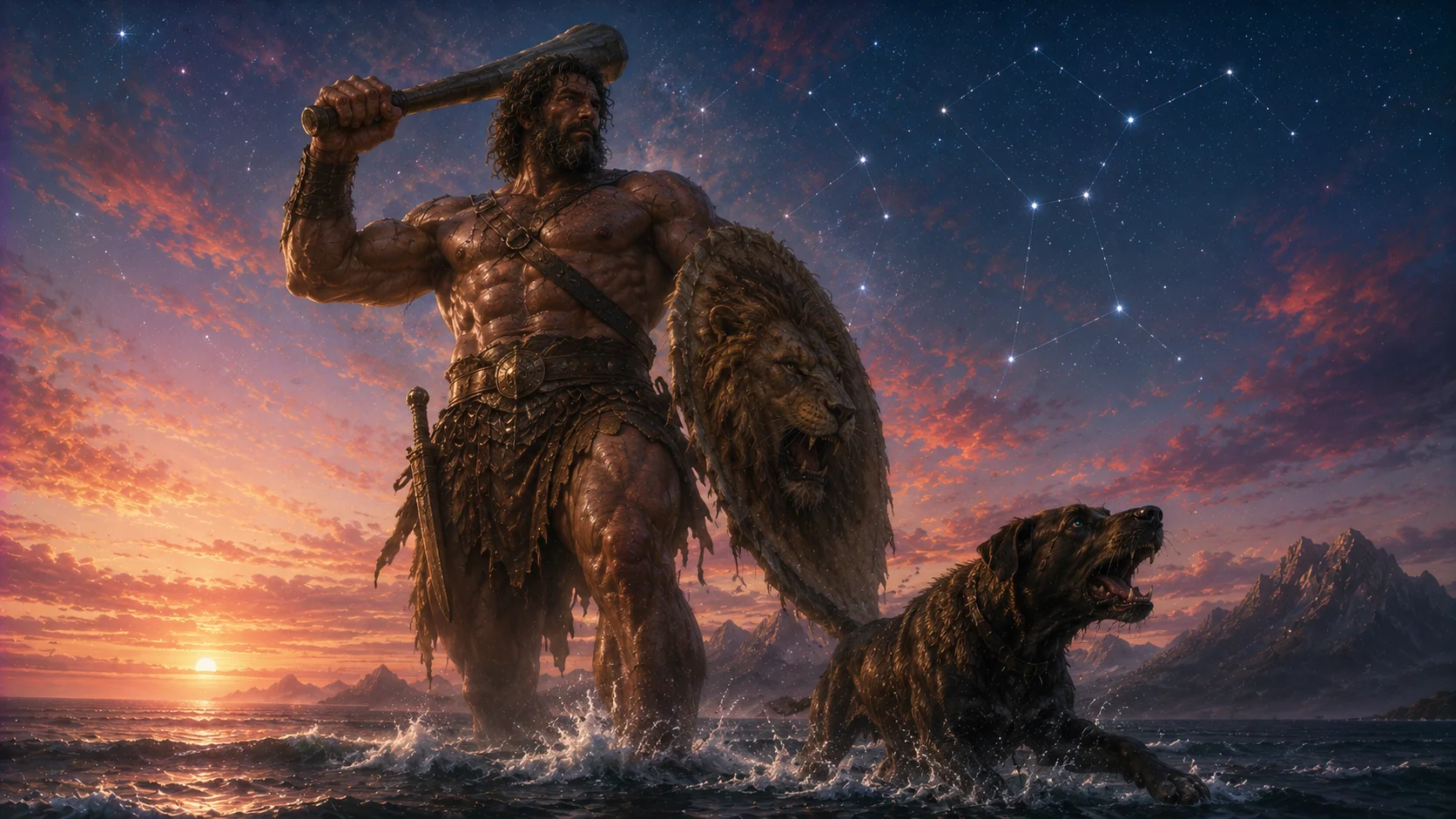
Tityos was a gigantic earth-born son of Zeus who attempted to violate the goddess Leto and was struck down for his crime — condemned to one of the most famous eternal punishments in the underworld, his ever-regrowing liver torn out forever by vultures. He stands beside Tantalus, Sisyphus and Ixion as one of the great sinners whose torments fill the Greek vision of Hades.
The Giant Son of the Earth
Tityos was a giant of enormous size, said to be a son of Zeus by a mortal woman, Elara — whom Zeus, fearing Hera's jealousy, hid beneath the earth, so that their son was born from the ground itself and reckoned an earth-born giant. When he grew, he covered, by some accounts, nine acres of ground when stretched out, a being of monstrous bulk.
Last updated .
The Crime Against Leto
Tityos's doom came when, incited by the ever-jealous Hera, he attempted to rape the Titaness Leto — the mother of Apollo and Artemis — as she traveled to the sacred site of Delphi. But Leto's divine children rushed to her defense, and the twin archer-gods Apollo and Artemis slew the giant with a hail of arrows. To assault the mother of two great gods was among the gravest of crimes, and the punishment was correspondingly eternal.
The Eternal Torment
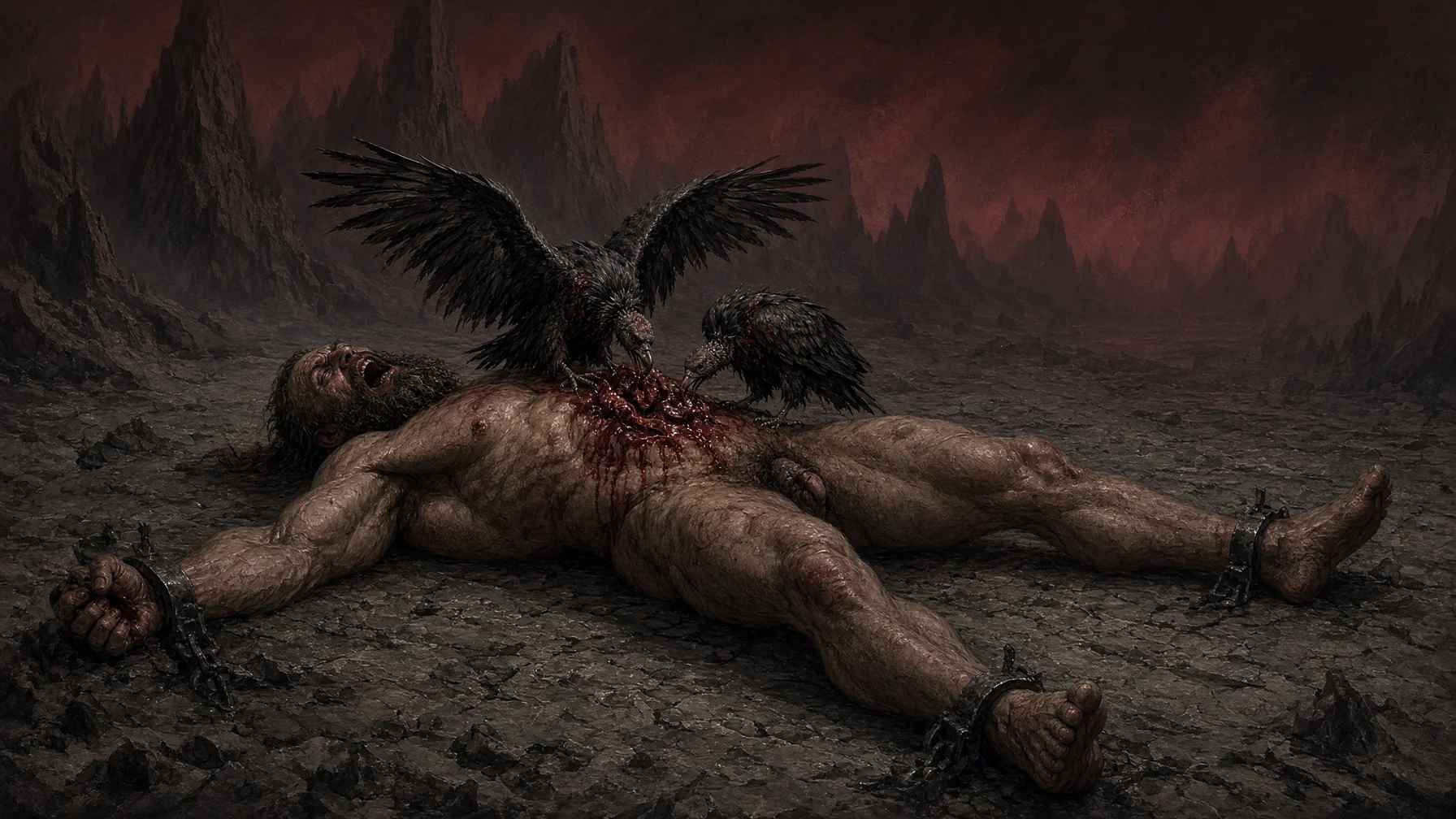
Cast down into Tartarus, Tityos was stretched out across the ground and bound, and there two vultures (or serpents) were set to feast forever upon his liver — the organ the ancients believed to be the seat of the passions and desires. Each day the birds tore out the liver; each night it grew whole again, so that the torment could never end. His was a punishment fitted to his crime: the giant whose lust had assailed a goddess had that very seat of lust devoured for all eternity. Both Odysseus and Aeneas were said to glimpse him in the underworld, the vast giant pinned and gnawed forever.
The Sinner of the Underworld
Tityos endures as one of the archetypal damned of Greek myth — his unending, self-renewing torment a vivid emblem of divine justice and of appetite punished by appetite. He embodies the Greek conviction that the gravest crimes against the gods earn not death, which ends, but an eternity of suffering that renews itself forever, the liver torn out each day only to grow again for tomorrow's agony.
The giant's lust assailed a goddess once; for that, his liver is torn out and regrown, every day, forever.
The Oldest Version: Homer's Nekyia
The earliest surviving account of Tityos's punishment is also the barest. He appears in the eleventh book of the Odyssey — the Nekyia, Odysseus's summoning of the dead — in the same short procession of sufferers as Tantalus and Sisyphus, in what is very likely the oldest surviving text to show any of them tormented forever. Homer gives him six lines. He lies stretched on the ground across nine pelethra; two vultures sit one on either side, digging in and tearing at his liver; and he cannot beat them off with his hands. The crime is disposed of in a single clause: he had laid hands on Leto, the honoured consort of Zeus, as she went towards Pytho through Panopeus.
What is missing is as telling as what is there. Apollo and Artemis are not named — nobody shoots him in this version, and the poet never says who brought him down. Hera is absent too; there is no jealous queen of heaven whispering him into the crime. And there is no Tartarus, no wall and no gate: Tityos simply lies among the other dead in the house of Hades, where Odysseus can walk past and look at him. Almost everything later writers made famous about him is carpentry laid over a very plain and very old image — a huge body pinned to the ground, and birds at work on it.
The Euboean Tityos
Four books earlier, in a passage with nothing to do with the underworld, Homer lets slip a second and much stranger Tityos. King Alcinous is boasting to Odysseus about the speed of Phaeacian ships, and offers as proof that his people once carried the hero Rhadamanthys across the water to Euboea — the long island lying off the coast of Boeotia and Attica — so that he could go and see Tityos, son of Gaia. It is mentioned in passing, as an ordinary errand to an ordinary destination. No crime is referred to and no punishment; this Tityos is somebody a hero might sail out to visit.
So the same poem holds two Tityoses that do not sit comfortably together: a landmark somewhere across the sea, and a giant pinned in Hades for an assault committed on a Phocian road. Both passages, notably, call him a son of the Earth. Neither calls him a son of Zeus.
Two Fathers, One Giant
That became a problem for the mythographers who came after. Homer's Tityos is the Earth's son with no father named at all, while the tradition that makes him a son of Zeus by the mortal Elara arrives later — and rather than replacing Homer, it was bolted onto him. Zeus hides the pregnant Elara underground out of Hera's reach, she dies there, and the Earth takes delivery of the child and brings him up into the light. The result satisfies both stories at once and neither of them cleanly, which is why ancient writers can call Tityos an earth-born giant and a son of Zeus almost interchangeably, sometimes within a single sentence.
He is also worth separating from a group he tends to be filed with silently. Tityos is not one of the Gigantes who stormed Olympus in the Gigantomachy, for all that he shares their monstrous scale and their birth from the Earth; the surviving accounts of that war do not count him among the combatants. His giant-hood is private. He is not a rebel crushed in a war against the gods but one criminal punished for one act, and everything memorable about him — the size, the sprawl, the birds — belongs to the aftermath rather than to any battle.
The Tomb at Panopeus
Panopeus, the small Phocian town Homer names as the scene of the crime, still had something to show visitors the better part of a millennium later. When the traveller Pausanias came through, the townspeople pointed him to a burial mound they called the tomb of Tityos — a mound, he records, of no great size.
More interesting than the grave is the argument attached to it. The Panopeans told Pausanias that Homer's celebrated nine pelethra did not describe how much ground the giant's body covered at all: Nine Pelethra was simply the name of the field where he lay. It is a small, quietly deflationary piece of local scholarship — a town explaining away the most spectacular detail of its own legend in order to keep the rest of it credible — and one of the few surviving moments where we can hear ordinary Greeks arguing with Homer about a monster instead of repeating him.
Why the Liver
The choice of organ was not decoration. For the Greeks the liver was where the appetitive part of the soul actually lived — not a metaphor for desire but its seat, the place where cravings and dreads were felt. Plato gives the fullest version of the idea in the Timaeus: the liver is smooth and dense and bright, a kind of internal mirror, and the reasoning mind — which cannot argue with an appetite that cannot argue back — governs the lower soul by throwing images onto that surface to frighten or to soothe it. On that physiology, tearing out a rapist's liver is not a random cruelty but a precisely aimed one, and the regrowth carries its own argument: an appetite is not extinguished by being fed.
The same device is used on an entirely different kind of offender. Prometheus, chained to his rock, has his own ever-renewing liver eaten out by an eagle — and the two cases sit awkwardly beside each other, because Prometheus suffers for a gift made to humanity and Tityos for an assault on a goddess. One is punished for generosity and the other for appetite, by the identical mechanism. Whatever the liver meant to the physicians, to the poets the regrowing liver had become a portable image for any offence grave enough to deserve a punishment with no end in it.
Tartarus Systematised: Virgil's Underworld
Homer never places Tityos in Tartarus. In the earliest layer of Greek thought, Tartarus is a prison for defeated Titans and rebel gods, sunk as far beneath Hades as the earth lies beneath the sky, and not a torture-chamber for wicked mortals — so Tityos lies out in the open with the ordinary dead. The notion of a walled quarter of the afterlife set aside for punishing human sinners hardened over the following centuries, and it reached its most influential form not in Greek but in Latin, in the sixth book of Virgil's Aeneid.
There, Aeneas reaches the cliff and the iron gates of Tartarus but does not go in. The Sibyl, who has been shown the interior, describes it to him instead, and Tityos is on her list. Her version is sharper than Homer's and slightly different: the body is stretched across nine iugera, and where Homer gave two vultures Virgil gives one enormous hook-beaked bird, quarrying in a chest it has made its home. The phrase coined for the organ has outlived the passage — immortale iecur, the immortal liver, the thing that can never be finished off because it will not stop growing. What Homer offered as a glimpse, Virgil delivers as an itinerary: a hell with architecture, an authority narrating it, and the sinners arranged inside as exhibits.
What the Painters Chose
Greek vase painters had the whole story available to them and almost never chose the punishment. What they painted, repeatedly from the archaic period on, is the crime being interrupted: a huge, often bearded figure striding away with Leto or seizing her by the wrist, her robe dragged out of line, while the twin archers close in from either side with bows drawn. It is a picture of arrest rather than of judgement — the half-second before the arrows land.
The preference says something about what the story was for. The underworld tableau is static by definition: a body that cannot move, birds that never finish. The abduction is its opposite, all running figures and raised bows and an outcome still hanging, and it puts on the pot the part a viewer could feel in the stomach — that the giant is already, at the moment we are looking at him, out of time.