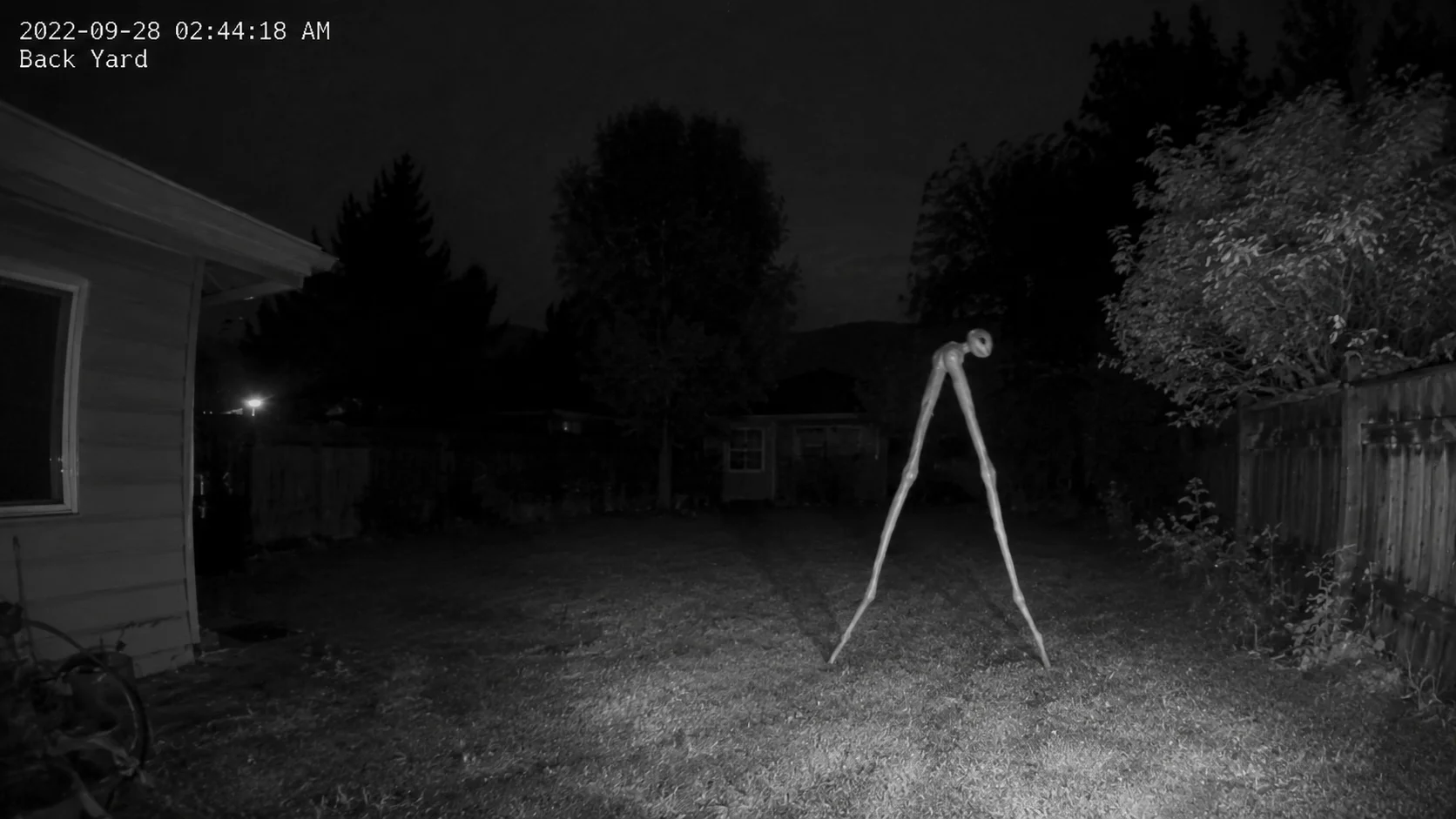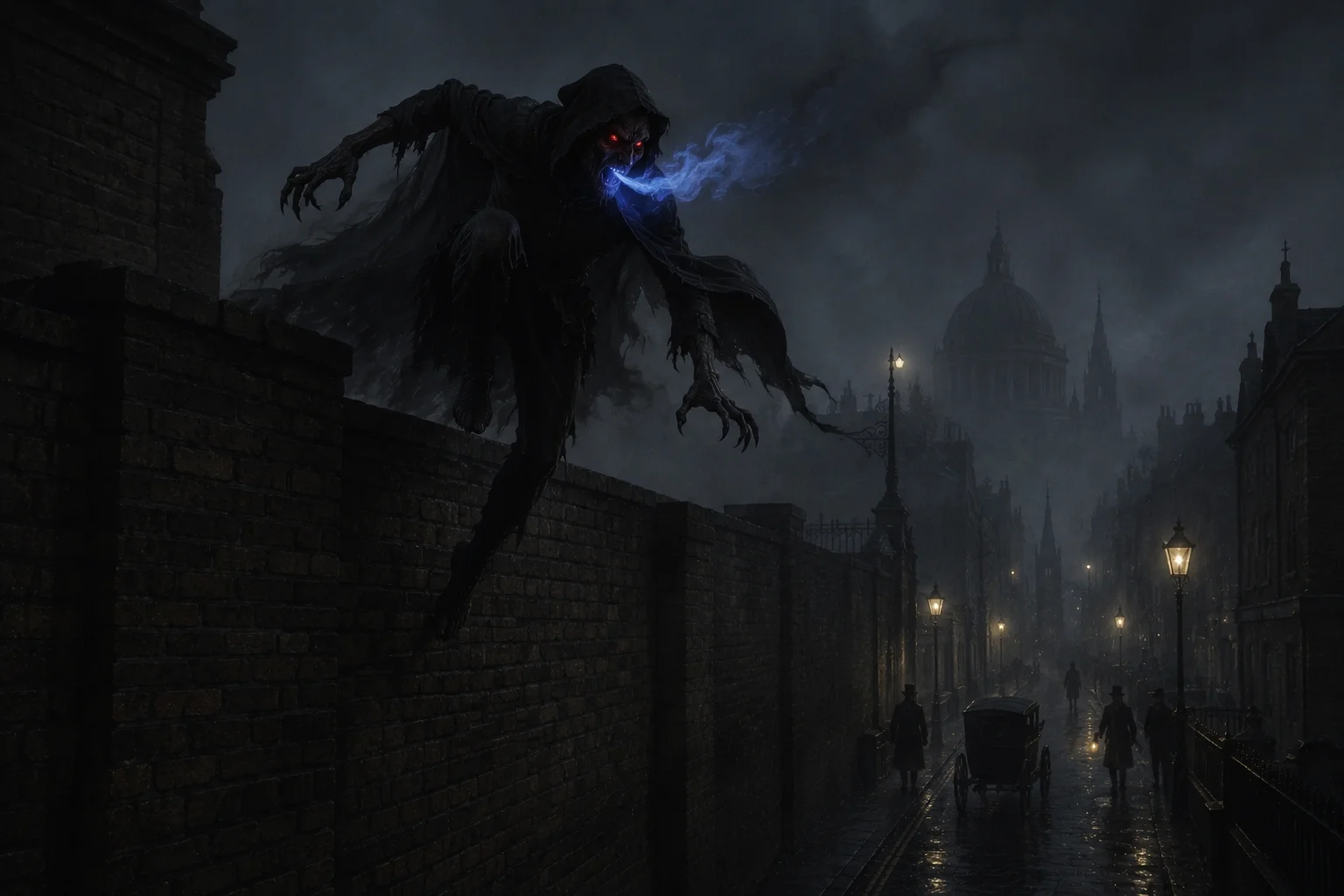
Spring-heeled Jack was a figure of Victorian English urban legend, a strange, leaping, fire-breathing assailant said to stalk London and its surrounding counties from the late 1830s onward. Described by witnesses as a tall, thin figure capable of extraordinary leaps, sometimes with clawed hands, eyes like burning coals, and a mouth that spat blue and white flame, he became one of the most widely reported and best-documented urban panics of the nineteenth century -- so widely reported that the Lord Mayor of London himself was compelled to publicly acknowledge the case.
A Fright on Clapham Common
Among the earliest cases cited in later retellings of the legend is an alleged 1837 attack on a woman named Mary Stevens as she crossed Clapham Common. She reported being seized by a strange figure who then bounded away with extraordinary leaps, vanishing into the darkness before help could arrive. The following night, it was said, the same or a similar figure leapt directly into the path of a passing carriage nearby, causing it to crash. This episode is one of the most frequently repeated in popular accounts of Spring-heeled Jack's origins, though it should be noted plainly that its sourcing rests chiefly on later popular retellings rather than on the stronger contemporary newspaper record that would soon follow -- it belongs to the softer, earlier edge of the legend rather than its documented core.
The Mansion House Is Told
By January 1838 reports of a mysterious assailant loose in and around London had grown frequent and alarming enough to reach the highest civic authority in the city. At a meeting held at Mansion House, the Lord Mayor of London, Sir John Cowan, publicly acknowledged that reports of such an attacker had reached him. That acknowledgment, made by a sitting Lord Mayor before an assembled public meeting, is a remarkable thing for an urban legend to have earned, and it is a large part of why the Spring-heeled Jack panic is remembered today as one of the better-documented outbreaks of its kind -- not merely gossip passed door to door, but a matter formally raised and addressed in a civic setting, with contemporary newspapers on hand to record it.
What Was Seen, In the Witnesses' Own Words
No single fixed description of Spring-heeled Jack survives from the period, and that inconsistency is itself part of the historical record. Across the various contemporary accounts he is described as tall and unnervingly thin, capable of leaps that defied ordinary explanation -- over walls, over hedges, clean out of reach of any pursuer. Some witnesses spoke of an oilskin cloak wrapped close about him; others described something closer to a devil, with pointed ears and a pointed nose jutting from a face that inspired instant dread. Many accounts agreed on clawed or metallic-seeming hands, and on eyes that glowed or burned red, and on a mouth from which he was said to breathe or spit flame in shades of blue and white. Rather than treating these as pieces of one fixed portrait, they are better understood as the product of frightened people, in the dark, each supplying details a startled mind reaches for -- consistent in their general shape, inconsistent in nearly everything else.
The Attack on Jane Alsop
The case that did more than any other to fix Spring-heeled Jack in the public record occurred in Bow, London, in February 1838. Jane Alsop reported that a figure had come to her door claiming to be a policeman, telling her that Spring-heeled Jack himself had been caught in the lane outside and asking for a candle to help secure him. When she brought the light, the figure seized her, tore at her clothing, and cut her before she managed to break free. She later described him as breathing blue flame and having eyes like red balls of fire. Because this account was reported in the contemporary newspapers of the time, close to the event itself, it is treated by those who have studied the case as one of the most credible pieces of period testimony to survive -- the firmest single thread connecting the wider panic to an actual, dated, named encounter.
Limehouse, Days Later
A second case, reported within the same month and treated alongside the Alsop attack as one of the twin pillars of the 1838 panic, involved a young woman named Lucy Scales in Limehouse. She reported being approached by a similarly caped, fire-breathing figure whose sudden appearance frightened her so severely that she was thrown into a fit. Together, the Alsop and Scales cases, coming in such close succession and both carried in the newspapers of the day, are what drove the panic to its height. London's response was not merely gossip and nervous glances over the shoulder -- in some districts it produced organized vigilante patrols and armed citizen groups, ordinary residents banding together to watch the streets against a threat the authorities themselves had already acknowledged.
A Long Tail of Sightings
The initial 1838 panic did not mark the end of the legend. Reports and copycat incidents continued intermittently across England for decades afterward, surfacing through the 1840s and into the 1870s in various locations. One notable cluster of reports came from Aldershot in the 1870s, a town closely associated with British Army barracks, where soldiers themselves were said to have encountered the leaping figure. A further and quite distinct wave of reports emerged in Liverpool in 1888. It is important to hold these later sightings at the proper distance from the original case: folklorists generally treat them as separate copycat incidents or unrelated "flaps" -- clusters of similar reports arising independently -- rather than as continuous evidence of one single figure stalking England for half a century.
A Name Never Confirmed
No suspect behind Spring-heeled Jack has ever been established with any confidence. Popular speculation of the period fixed on one particular figure: Henry de La Poer Beresford, 3rd Marquess of Waterford, an eccentric aristocrat notorious for violent pranks and reckless behavior, whose reputation made him an obvious target for rumor. But this identification was never proven, and it is explicitly disputed by historians who have examined the case since. It belongs on the record as a piece of period gossip about who might have been responsible, not as a settled answer -- the true nature of the figure, whether a single prankster, several unconnected pranksters, criminal opportunists, or simple mass panic feeding on itself, remains open.
A Figure Without Kin
Spring-heeled Jack has no confirmed relationship to any other named figure of English legend. He is sometimes discussed by folklorists in the same breath as later nineteenth-century urban panics involving phantom attackers, such as the "Halifax Slasher" scares that followed decades afterward, but these are separate and later traditions in their own right, arising from their own circumstances, and ought not to be folded into the Spring-heeled Jack case as though they were chapters of one continuous story. He is, in the record as it stands, very much his own case.
The Terror of the Penny Press
As the initial panic subsided, Spring-heeled Jack did not disappear from public life -- he migrated into fiction. He became a stock figure of the penny dreadfuls, the cheap, sensational serial literature that flourished across the mid-to-late nineteenth century, most famously in the serial "Spring-Heeled Jack, the Terror of London," which appeared in various editions from the 1860s through the 1900s. These serials took the bones of the original newspaper reports and embellished them freely for the sake of a thrilling read, and it is in this fictional afterlife rather than the earlier newspaper accounts that his most extravagant feats appear -- leaps over walls and hedges of extraordinary height, physical exploits pitched well beyond what the more restrained 1837-1838 reports had described. The two layers, the documented contemporary case and the sensationalized fiction that followed it, are worth keeping distinct in the mind of anyone examining the legend.
A Bogeyman for a Changing City
Beneath the leaping and the flame, Spring-heeled Jack served a recognizable cultural function. He was a Victorian urban bogeyman, a figure who gave shape to the anxieties of a city and a country changing faster than its people could quite absorb -- fears about crime in the growing metropolis, about class and the strangers rapid urbanization threw into unfamiliar proximity, and about the supernatural persisting stubbornly at the edges of an age that liked to think of itself as modern and rational. That he could terrify with equal ease the readers of respectable newspapers and the readers of cheap serial fiction says something about how widely those anxieties were shared.
What the Epithets Preserve
Period sources and the folklore that grew from them recorded more than one name for the figure. "The Terror of London" is the epithet most closely tied to his fictional afterlife in the penny dreadfuls, while other period characterizations leaned on his leaping, devil-like appearance to cast him as a kind of urban demon. No single epithet was used consistently across every primary source, and that variation is itself consistent with everything else about the case -- a legend assembled, name and all, from many hands and many frightened or entertained imaginations rather than from one settled account.
Studied Long After the Fact
Spring-heeled Jack has outlived the century that produced him, taken up as a recurring figure in Victorian-set fiction, in comics, and in the steampunk genre that delights in refitting the nineteenth century with brass and imagination. He is also invoked repeatedly in paranormal compendiums and folklore studies as an early and unusually well-documented example of a "flap" -- a geographically clustered wave of similar reports feeding on itself and on the press coverage it generates. The standard modern scholarly treatment of the case is Mike Dash's 1996 essay, "Spring-Heeled Jack: To Victorian Bugaboo from Suburban Ghost," which remains the reference point for anyone attempting to separate the documented 1837-1838 reports from everything that was built on top of them in the decades since.
Sources & traditions
- EncyclopediaWikipedia — Spring-heeled Jack
- TraditionLocal sightings, press reports and regional folklore (England)
Myths change from area to area and from time to time. This chronicle follows the most widely told versions; tellings in other villages, regions and eras may differ.