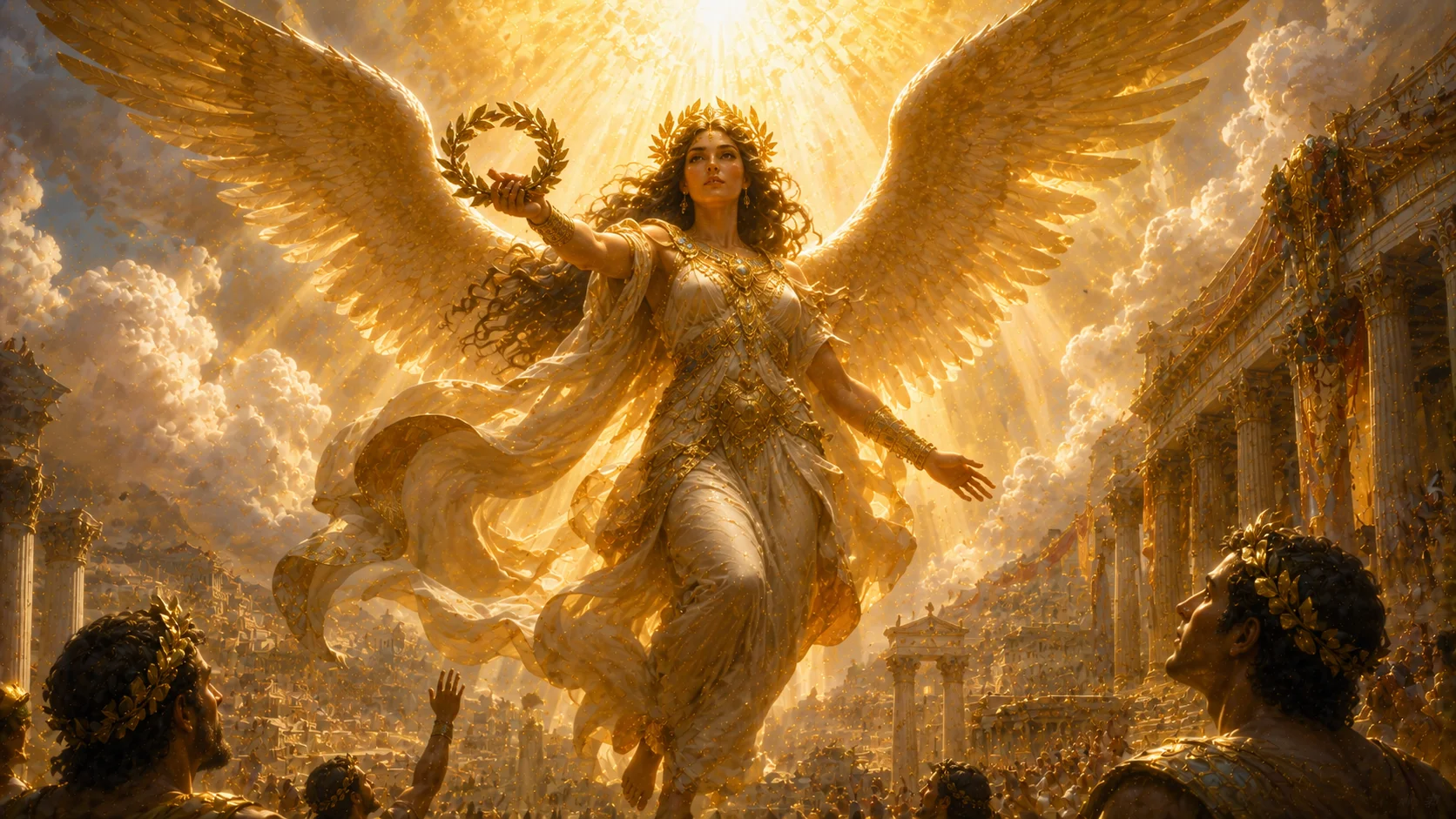
Nike was Victory made divine — the swift, winged goddess who descended to crown the triumphant in war and in games, and whose name and image have outlived almost every other figure in Greek myth. She is the soaring winged woman of countless statues and trophies, and today, the swoosh on a billion shoes.
Daughter of the River Styx
Hesiod's Theogony gives Nike a lineage of striking gravity for a figure so often treated as pure ornament. She was born to the Titan Pallas and the river-goddess Styx. It is a fitting parentage: victory, like Nike's own mother, belongs to the oldest layer of the divine order, present at the cosmos's foundational struggles rather than arriving after the fact. Nike personified victory in all its forms — success in battle, triumph in athletic contest, prevailing in any struggle where one side must lose so the other can win.
Four Siblings Who Were Never Apart
Nike did not come into the world alone. Styx bore Pallas four children together — Nike, and her siblings Kratos (Might), Bia (Force), and Zelos (Rivalry, sometimes rendered Emulation). Hesiod describes the four as inseparable companions, a single unit that moved together rather than four gods with four separate careers. They are named as dwelling together at the side of Zeus, not scattered across Olympus with individual domains to tend — an unusual arrangement among the Theogony's crowded genealogies, where most of Zeus's kin go on to rule a mountain, a sea, or a season. Their constant pairing with Nike suggests the Greeks understood victory as something that traveled with strength and force rather than existing apart from them.
The Reward for Choosing a Side
The occasion that bound this family of four to Zeus permanently was the Titanomachy — the great war between the Olympians and the elder Titans for control of the cosmos. Styx, according to Hesiod, brought her four children to Zeus's side to fight for him against the Titans. It was a decisive alliance at a moment when the war's outcome was not yet settled, and Zeus did not forget it. As reward for their support, he made Nike, Kratos, Bia, and Zelos his permanent attendants, seated beside him rather than sent off to govern some separate corner of creation. Nike's place in later Greek religion — the goddess who is always near power rather than a power unto herself — traces directly back to this single act of support at the war's turning point.
Wings Over the Battlefield and the Stadium
The winged-victory image is Nike's most consistent attested attribute, appearing across Greek art with a uniformity few other deities share. She is shown flying, often depicted as a charioteer or attendant figure alongside Zeus or Athena, descending to place a wreath or fillet on the head of whoever had won — a general after a battle, an athlete after a race, a chorus after a competition. She frequently carries a palm branch, a wreath, or a trophy in these depictions, the visual shorthand for victory that Greek and later Roman artists reached for again and again. Unlike gods whose iconography shifted across centuries and regions, Nike's wings and her gesture of crowning remained remarkably stable — which is itself telling. She was less a character with a personality to render than a moment made visible: the instant a contest ends and one side has won.
A Goddess Without a Story of Her Own
It is worth stating plainly what the sources do not give Nike, because it marks her out from deities like Athena or Hecate. She is not the subject of a substantial independent narrative myth cycle — there is no sequence of adventures, no cycle of trials, no drawn-out relationships that later poets embellished across generations. Her attested role is almost entirely iconographic and cultic: she is victory personified, invoked and depicted at the moment of triumph, rather than a protagonist moving through a plot of her own. This is not a gap in the record so much as a description of what kind of goddess she was understood to be — an attendant presence at the side of greater powers, appearing precisely when needed and vanishing from the narrative once the crowning was done.
Seated Beside the Wisdom of War
In Athenian religious life, Nike's closest and most enduring association was with Athena, goddess of strategic warfare. The pairing produced the cult epithet Athena Nike — Athena as bringer of victory — honored in her own temple on the Athenian Acropolis, the Temple of Athena Nike. The conjoined aspect made theological sense to Athenian worshippers: Athena supplied the strategy and discipline that made victory possible, while Nike was the moment of triumph that strategy was meant to produce. Yet the two were not simply collapsed into one figure. Nike continued to be worshipped and depicted as a goddess distinct from Athena in her own right, appearing independently in art and cult even as her Acropolis temple bound the two together in the city's civic memory.
Sanctuaries Built for Winning
Nike's worship was not confined to Athens. She was honored at Olympia and at other sanctuaries devoted to athletic and military contest, reflecting the dual arena of her power — she governed victory whether it was won on a battlefield or in a footrace at the games. This pairing of war and athletics under a single goddess reflects how closely the Greeks linked the two pursuits: both were tested in public, both produced a clear winner, and both called for a divine witness who could confirm that the outcome was earned rather than merely claimed.
The Winged Woman of Samothrace
Among all the surviving images of Nike, none has shaped the modern imagination more than the Nike of Samothrace, also known as the Winged Victory — a Hellenistic marble sculpture carved around the 2nd century BCE. Even without her head or arms, the statue captures the goddess mid-flight, her wings thrown back and her drapery caught as if by real wind, alighting to announce a triumph. Scholars continue to debate exactly which victory the statue was carved to commemorate, and that uncertainty has done nothing to diminish its power — if anything, it has let the sculpture stand for victory in the abstract rather than for any single battle. It remains one of the most reproduced and recognized works to survive from the ancient world.
Crossing into Rome as Victoria
When Roman religion absorbed the Greek pantheon, Nike was equated with Victoria, and the winged-goddess imagery that had crowned Greek generals and athletes was carried directly into Roman visual culture. Victoria appeared on coins, standards, and monuments across the Roman world, the same wings and the same gesture of crowning transplanted into a new empire's iconography of conquest. The continuity between Nike and Victoria is one of the clearer examples of how thoroughly Roman religious art borrowed the Greek visual vocabulary of divinity, adapting a goddess's form to a new state's ambitions without altering what she fundamentally represented.
A Name That Escaped the Myth
Nike's afterlife outside religion is unusual among Greek deities, and it belongs to a separate register from the myths above — a matter of later cultural reception rather than ancient story. Her name is the direct etymological source of the modern athletic brand name Nike, and by extension has become bound up in English with the broader imagery of athletic victory itself. Few figures from Greek religion have had their name detached so completely from worship and carried into everyday commercial language, a testament less to any myth told about her than to how immediately legible her core meaning has always been — you did not need a story to understand what Nike stood for.
What Nike Represents
Nike's record is thin on incident and thick on meaning. She has no long myth cycle, no drawn-out trials, no web of love affairs and rivalries — only a clear parentage, a single decisive act of support during the Titanomachy, a permanent seat beside Zeus, a close bond with Athena at Athens, and an iconography of wings and wreaths that carried her image across a thousand years of art from the Greek mainland to Samothrace to Rome. What she offers instead of narrative is presence: the goddess who appears exactly once a contest is decided, confirms that a victory is real, and then, having crowned the winner, is gone again — ready to alight on the next battlefield, the next stadium, wherever a contest is about to end.
Sources & traditions
- EncyclopediaWikipedia — Nike (mythology)
- TraditionGreek texts, inscriptions and later retellings (Greece)
Myths change from area to area and from time to time. This chronicle follows the most widely told versions; tellings in other villages, regions and eras may differ.