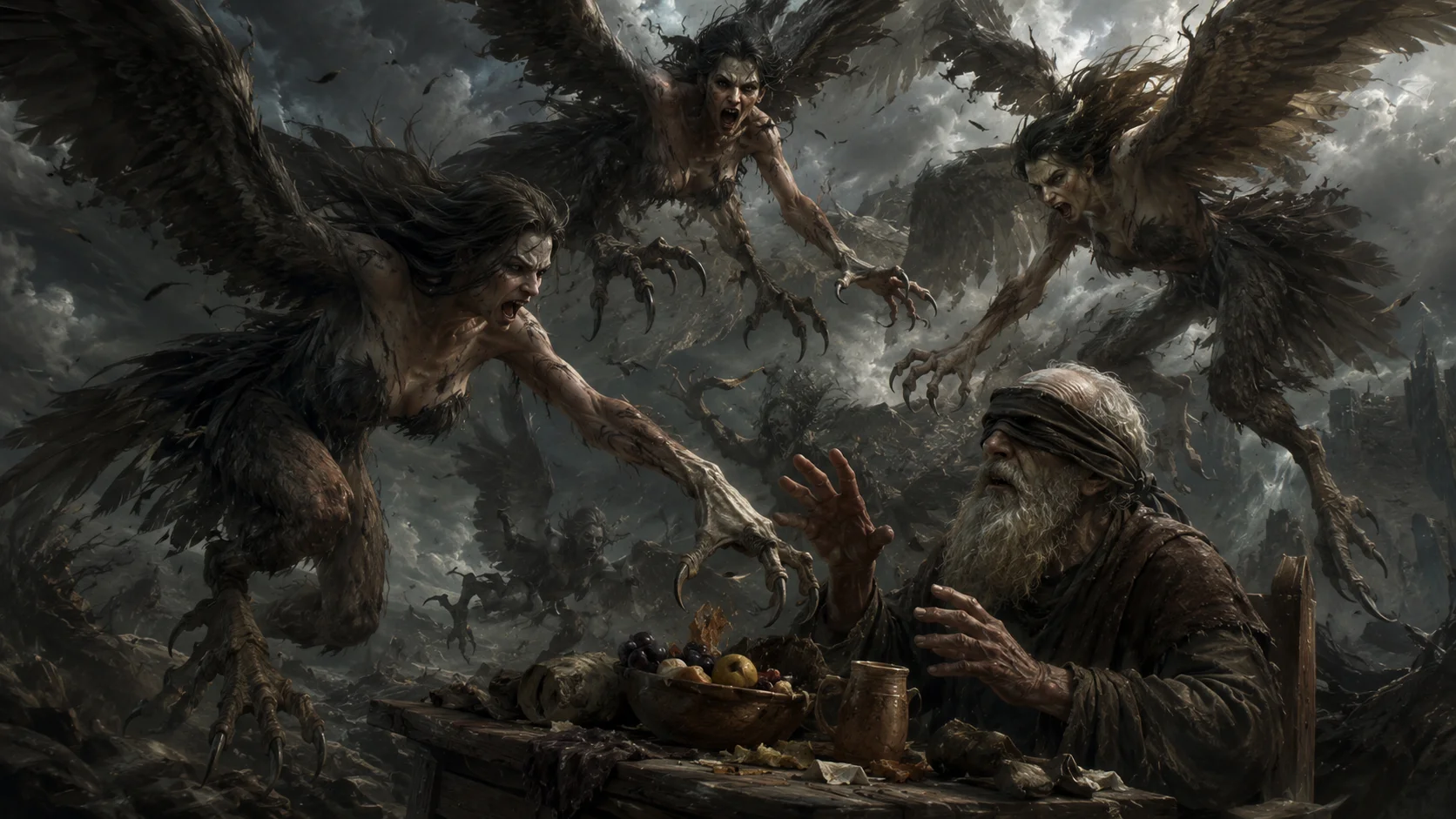
A table is set. A blind man reaches for the bread. And before his fingers close on it, the air above him fills with wings — filthy, fast, wrong — and the food is gone, and what is left behind smells of something that should not be near food at all. He will try again tomorrow. He has been trying for years. The Greeks had a word for what took the bread, and it is the same word they reached for whenever anything else vanished with no explanation at all: a face, a flock, a life. They said the Harpies had it.
The Meaning Written Into the Name
The Harpies — Harpyiai in Greek — carry their nature in their name: it means "snatchers," or "swift robbers." This was not a poetic flourish added later. It was the plain, working meaning of the word, and it did double duty as an explanation. When something disappeared without a trace — food from a table, a person from the roadside, a ship from the sea — the Greeks said the Harpies had carried it off. The name was the myth's entire function compressed into a single word: theft with wings, theft as weather.
Daughters of Wonder and the Sea
In Hesiod's Theogony, the foundational genealogy of the Greek gods, the Harpies are named as daughters of Thaumas, a sea-god, and Electra, one of the Oceanids — the daughters of the Titans Oceanus and Tethys. Thaumas was himself a son of the earth goddess Gaia, and his own name is related to the Greek word for "wonder," thauma. It is a lineage of sea and marvel: a father born of wonder and salt water, a mother born of the endless generative ocean, and daughters born of both who took to the sky instead.
That same parentage gives the Harpies an unexpected relative. Iris, the goddess of the rainbow and the messenger of the Olympian gods, is — by Hesiod's account — their full sister, also a daughter of Thaumas and Electra. It is worth sitting with that for a moment: the gentle arc that carries the gods' word to mortals, and the storm-spirits that carry mortals' food and bodies away, sprang from the very same union. Wonder, it seems, could produce a messenger or a monster with equal ease.
Storm Given a Body
Before they were monsters, the Harpies were weather. They began as personifications of storm-winds — the sudden violent gusts that could snatch a hat, a ship's sail, a life, and leave no trace of where it went. Hesiod's own description of them is strikingly unlike the vulture-women of later imagination: he calls them "lovely-haired," swift as winds and as birds, closer to beautiful winged maidens than to monsters. The grotesque, filthy, vulture-bodied Harpy familiar from later art and poetry is a development — the original figures in the earliest Greek sources are swift and fair, which makes their cruelty, when it comes, feel less like an animal's hunger and more like a punishment handed down with a straight face.
The Blind King's Endless Hunger
Their most enduring story belongs to Phineus, a blind prophet and king of Thrace. Phineus had been punished by the gods for revealing the future too freely — in the myth, this offense is what brought the Harpies down on him specifically, rather than any other victim. His punishment was exact and merciless: whenever food was set before him, the Harpies swept down from the sky, snatched away most of it before he could eat, and fouled whatever scraps they left behind with their stench, so that even the remainder was inedible. He could never eat, and he was slowly starving — a punishment that worked not through a single blow but through repetition, arriving at the exact moment relief seemed possible and taking it away again.
This is the myth's clearest statement of what the Harpies represent: not death by violence, but loss by theft, repeated forever. A single Harpy raid would be misfortune. An endless one, timed to arrive at the exact moment of relief, is torment with intention behind it.
Two Sons of the North Wind
Phineus's ordeal ends only when the Argonauts arrive at his household on their voyage. Among their crew were Zetes and Calais, the winged sons of the North Wind, Boreas — themselves creatures of storm and speed, and so the only pursuers fast enough for the job. When the Harpies came for Phineus's food as they always had, Zetes and Calais rose after them and chased them across the sky, driving them off for good and freeing the starving prophet to eat at last. It is a fitting resolution: the wind-born tormentors were beaten only by wind-born rescuers, speed answered with speed.
A Roster That Never Quite Agrees
Ask how many Harpies there were, or what their names were, and ancient sources will not give you the same answer twice. Hesiod's Theogony names only two: Aello, meaning "rainstorm" or "whirlwind," and Ocypete (also rendered Okypete), meaning "swift-flier." Centuries later, the Roman poet Virgil, writing the Aeneid, introduces a third named Harpy — Celaeno, "the dark one" or "storm cloud" — who acts as their leader and prophetess. Other names surface here and there across scattered ancient sources: Aellopus, Nicothoe, Ocythoe, Ocypode, Acholoe. None of this ever settles into one fixed, agreed list. The Harpies were never a tidy trio with a canonical roster; they were a loose company of wind-spirits whose names varied by which poet was doing the naming.
The Islands Where They Made Their Home
Driven from Phineus's house, the Harpies do not disappear from myth. In Virgil's Aeneid, Book 3, they have relocated to the Strophades, a group of islands in the Ionian Sea — the text is explicit that this is where they settled after their defeat at Phineus's hands. It is here that Aeneas and his fleeing Trojan crew land during their long voyage after the fall of Troy. Finding cattle on the islands, the Trojans kill them for a feast — and the Harpies, led by Celaeno, descend on the meal exactly as they once descended on Phineus's, fouling and plundering the food.
A Curse Set at the Table
Celaeno answers the Trojans' feast not with a further raid but with a prophecy. She curses the travelers: they will not find their promised home and found their city until hunger forces them to eat their own tables. It is a strange, riddling curse — and one that the epic later resolves in a mild, non-literal way rather than a literal catastrophe. The moment matters because it shows the Harpies acting not only as thieves but as instruments of prophecy, able to shape the fate of a hero's entire voyage with a single sentence spoken over a ruined meal.
From Winged Maiden to Vulture-Bodied Hag
The Harpies' appearance did not stay fixed across the centuries any more than their names did. Hesiod's earliest account, as noted, describes lovely-haired, swift winged maidens — figures closer to Iris than to any monster. It is in later literature, particularly Roman and medieval retellings, that the Harpies harden into the image most people carry today: filthy, vulture-bodied creatures with the faces of women, foul-smelling and repellent rather than beautiful and swift. The myth's cruelty stayed constant while its imagery inverted — from something you might not fear to look at, to something you would not want to look at at all.
Nesting in the Wood of the Suicides
The Harpies' most famous afterlife belongs not to Greek myth at all but to a much later Christian poet. In Dante's Inferno, written in the early fourteenth century, the Harpies are relocated to the Seventh Circle of Hell, in the Wood of the Suicides. There, the souls of those who took their own lives have been transformed into gnarled trees and shrubs, and it is the Harpies who nest among them — feeding on the branches and breaking them, an act that causes the trees pain and, in breaking, lets them speak through the wound. It is a striking image precisely because it repurposes the Harpies' oldest function — tearing and consuming without mercy — and gives it a new, deliberately horrifying home, one entirely of Dante's own literary invention rather than anything found in the ancient Greek sources.
Agents of a Quiet Justice
Running underneath every one of these stories is the same idea: the Harpies act as agents of divine punishment, dispatched to torment those who had offended the gods, and their raids are never random cruelty but retribution with a cause behind it — Phineus for his over-revealing prophecies, the Trojans for the slaughter of the Strophades cattle. But the Harpies also served an everyday, explanatory purpose that had nothing to do with grand myth at all. When something disappeared without a trace — a person, an animal, an object, gone with no sign of where or how — the ordinary explanation reached for was that the Harpies had snatched it. The myth was not only a story told about a prophet's ordeal; it was a working phrase for the unexplained, the vocabulary people used for loss that offered no evidence and no closure.
What the Word Still Carries
The word survived long after belief in the winged sisters themselves faded. "Harpy" remains in use today as a pejorative term for a grasping, shrewish, or predatory woman — a distant, worn-down echo of storm-winds that once snatched a starving king's bread from under his hand. It is a small thing next to the Strophades curse or the wood of the suicides, but it is the version of the myth that has traveled furthest: no genealogy, no Argonauts, no islands — just the bare accusation of taking what was not offered, tormenting rather than simply stealing.
Why the Snatchers Still Matter
The Harpies never had a single fixed shape, a single agreed name, or even a single home — they moved from Thrace to the Strophades to, eventually, Dante's Hell, changing from lovely-haired maidens into filthy hags along the way, gathering and shedding names as different poets told the story differently. What never changed was the function: they are what a culture calls the thing that takes without warning and leaves nothing behind to explain itself. Storm-winds first, then punishers, then a curse-bearing prophetess, then a fixture of the afterlife, then finally just a word for a certain kind of person — the Harpies are, across all of it, the shape the Greeks gave to sudden, unaccountable loss. When something vanishes and no one can say where it went, the instinct to name an invisible thief is very old, and it still has a name.
Sources & traditions
- EncyclopediaWikipedia — Harpy
- TraditionGreek texts, inscriptions and later retellings (Greece)
Myths change from area to area and from time to time. This chronicle follows the most widely told versions; tellings in other villages, regions and eras may differ.