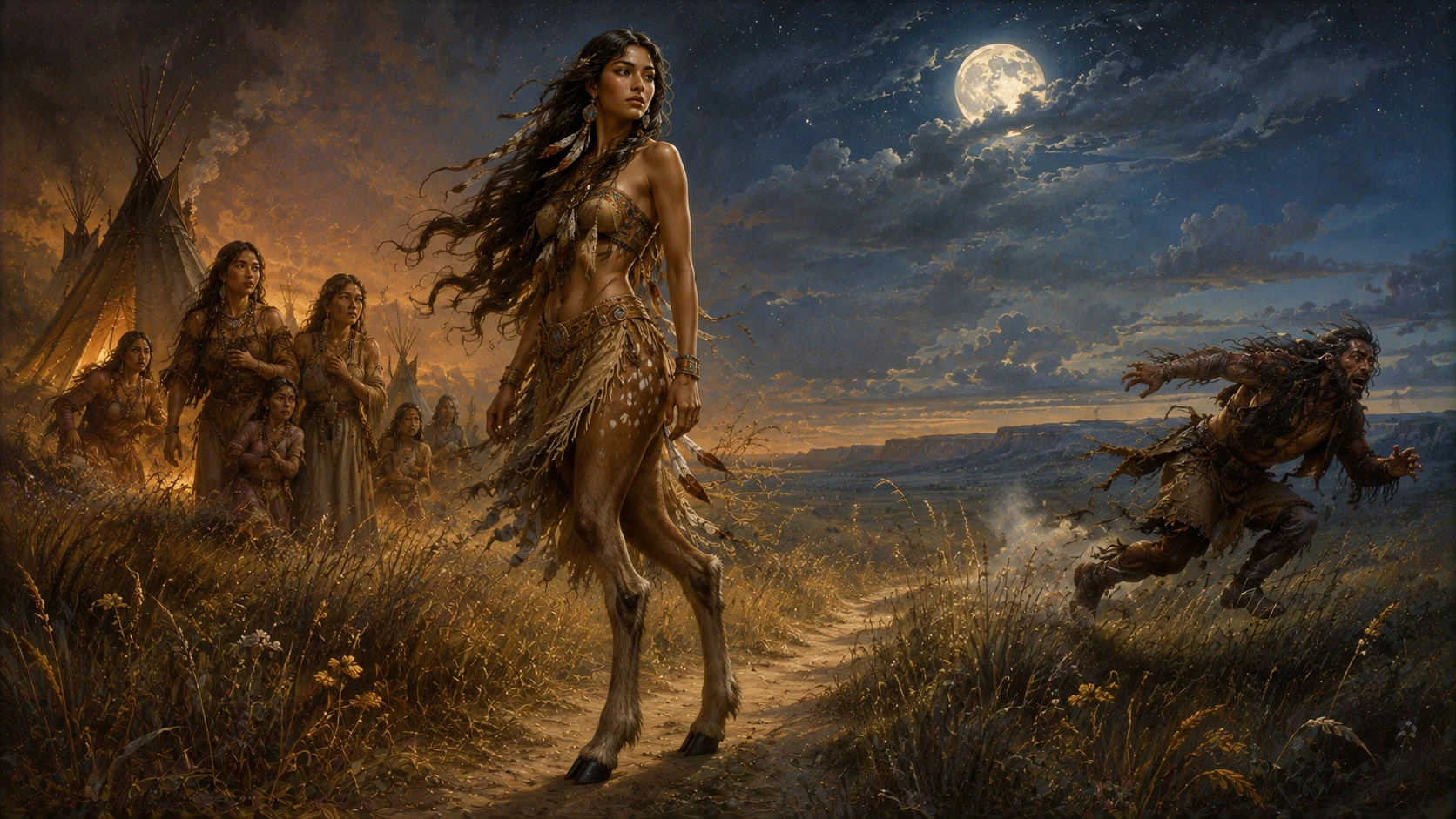
Deer Woman — also called the Deer Lady — is a shapeshifting spirit-being told of by many distinct Native American nations of the Plains, the Southeast, and the Great Lakes, appearing as a beautiful young woman with the hooves or lower legs of a deer. At once an alluring lure and an avenger — punishing predatory and unfaithful men, yet protecting women, children, and the proper order of the people — Deer Woman is among the most striking and ambivalent of the spirit-beings of Native North America, and is treated here with respect for the living, contemporary traditions to which she belongs, and for the many nations who each tell her differently.
Not One Story, But Many
It is tempting, from the outside, to speak of "the" Deer Woman myth, as though a single account radiates outward from one origin point. The scholarly record — general Native American folklore surveys, among them the work of scholars such as William Bright, alongside decades of tribal folklore collection stretching back to at least the early-to-mid twentieth century — says otherwise. Deer Woman is documented independently among Plains nations including the Lakota, Ponca, Omaha, and Osage; among Southeastern nations including the Muscogee (Creek), Cherokee, and Choctaw; and among Great Lakes nations including the Potawatomi and Ojibwe. Each of these traditions holds its own name for her, its own telling, its own cultural frame. Many nations give her a name in their own language distinct from the English gloss "Deer Woman," names that are often kept within community context rather than published outward. No single "original" myth can be identified, and that multiplicity is not a gap in the record — it is itself the finding. To flatten these tellings into one composite account would misrepresent exactly what makes her significant: she is a figure many peoples arrived at, or have always held, each in their own right.
Last updated .
The Signs Beneath the Skirt
Across the many tellings, one motif recurs with striking consistency: she appears as a beautiful young woman, often encountered at a dance, a gathering, or along a roadside or trail, and she draws a man — typically one already behaving disrespectfully toward women — away from the safety of the group. What gives her away, in the moment before it is too late, differs by telling but circles the same idea: hooves or deer-legs glimpsed beneath the hem of her skirt, or hoofprints left in the earth where a woman's footprints should be. Some tellings add other signs by which the watchful may know her before it is too late — the sound of jingling bells or bracelets that accompany her step, or an unusual scent that clings to the air around her. These identifying details are not interchangeable set-dressing; which sign appears, and in what order it is revealed, varies from nation to nation and telling to telling, and belongs to the specific tradition that tells it.
Where the Trail Ends
In a great many tellings, particularly those emphasized in Plains tradition, Deer Woman is dangerous, and deliberately so. A man who follows her — drawn by her beauty, by the dance, by whatever appetite led him to leave the group in her company — does not return. He may be led to his death on some lonely stretch of ground, or trampled beneath the hooves she was concealing all along. This is not depicted as senseless violence. It is framed explicitly, within these tellings, as retribution: punishment for infidelity, for predatory conduct, for disrespect shown toward women. Some contemporary Lakota tellers draw this thread forward deliberately, treating her cautionary function as a living teaching about respectful conduct toward women and a warning against predatory behavior — a reading that carries the old story into present concerns without inventing anything new in the process.
The Other Face She Wears
It would be a serious misreading, though, to leave her only as a killer of men. Other tellings — documented especially among some Southeastern and Great Lakes nations — hold her as a far more ambiguous figure, and in places a benevolent one: a spirit bound up with fertility, with love-medicine, with the protection of women rather than with vengeance taken against men. These are not softened or partial versions of the punitive strand; they are their own documented tradition, standing alongside it rather than beneath it. Both strands are real, both are attested, and neither should be made to collapse into the other. A single figure who can be, in one nation's keeping, a fertility spirit invoked with reverence, and in another's, a deadly reckoning waiting on a dark road, is not a contradiction to be resolved — it is the honest shape of an oral tradition carried by many peoples across a wide country.
Deer Clans and the Southeastern Complex
Among the Muscogee (Creek) and neighboring Southeastern peoples, Deer Woman narratives do not stand alone; they sit within a broader complex of deer-clan and deer-spirit belief. Deer clans held — and hold — real significance in Southeastern tribal social organization, and the presence of a deer-woman figure within that world reflects a deeper cultural weight given to the deer as kin, clan-marker, and spiritual presence, not merely as an animal encountered in the woods. Reading her Southeastern tellings without that context strips them of the social and clan meaning they carry within the communities that hold them.
Kinship Among Plains Supernatural Women
In some Lakota and other Plains tellings, Deer Woman is spoken of alongside — sometimes compared to — other supernatural women of Plains tradition, while remaining a distinct figure in her own right, not an alternate name for another being. This positioning matters: it places her within a wider Plains cosmology of powerful, morally weighted female spirits, each with a defined role, rather than as an isolated curiosity. The comparison is instructive, not conflating — she is her own being, understood partly through her relation to others like her.
An Unrecorded Depth of Telling
How old is she? The honest answer resists a clean date. As an oral tradition, her stories predate written record by a length of time that is, at this point, simply unrecorded and unrecoverable — ethnographic documentation only reaches back to the early-to-mid twentieth century, capturing tellings that were almost certainly already old when they were first written down. It would be a fabrication to assign her a founding century or an "original" telling; what can honestly be said is that she was carried in memory and voice for an unknown span before any outside record touched her, and that this uncertainty is not a weakness in the record but an accurate description of how oral tradition works.
A Continent's Wider Reverence for Deer
Folklorists sometimes group Deer Woman alongside other "deer-being" figures found across North American traditions, including deer-spirit guardians of game animals documented in various hunting-culture traditions. This grouping reflects something real and continent-wide: the deer holds spiritual significance across an enormous range of Indigenous traditions, not only where Deer Woman herself is told. But the grouping should not be mistaken for identity. Deer Woman is specifically not one of the generic "Master" or "Mistress of Animals" guardian-spirit figures who watch over game; she is a distinct being, with her own moral logic centered on human conduct — particularly toward women — rather than on the hunt itself. The broader reverence for deer as spiritually significant animals is context for her; it is not her.
A Boundary Kept Between Human and Animal
What holds steady across the variation — Plains or Southeastern or Great Lakes, punitive or protective, ancient telling or contemporary retelling — is her position as a boundary figure, straddling the line between the human world and the animal or spirit world. She is never simply a woman, and never simply a deer; she is the being who moves in the space between, and it is that in-between status that gives her power to judge, to warn, or to protect. Her moral and symbolic role stays broadly consistent even as her plot details diverge sharply from nation to nation: she stands as an embodiment of consequence, most often for disrespect shown toward women, occupying a threshold that ordinary human and animal figures cannot cross.
A Story Still Being Told
Deer Woman is not archived history — she is an actively retold, actively invoked figure in present-day Indigenous communities. In late-twentieth and twenty-first century Native activism and storytelling, she has been widely taken up as a protective and warning figure within the Missing and Murdered Indigenous Women movement. It matters to be precise about what this represents: this contemporary invocation is a modern extension and reappropriation of the traditional cautionary-punitive strand of her story, not itself an ancient or newly discovered attestation of the myth. The distinction between the long-carried traditional tellings and this present-day symbolic use is one worth holding clearly, because collapsing the two would misdate a living act of contemporary meaning-making as something it is not, while also understating how directly today's use draws on real, old material. Both things are true at once: she is deeply traditional, and she is urgently present, and the second does not require inventing anything the first did not already provide.
Holding the Many Tellings Together
To speak of Deer Woman honestly is to resist the pull toward a single tidy account. She belongs to Lakota, Ponca, Omaha, and Osage tellers on the Plains; to Muscogee, Cherokee, and Choctaw tellers in the Southeast; to Potawatomi and Ojibwe tellers around the Great Lakes; and to others besides, each holding a telling that is theirs. She is a lure and a killer in some hands, a guardian of fertility and women's wellbeing in others, and in the present day, a rallying figure of grief and resistance. None of these is the "real" Deer Woman at the expense of the others. She is, in the fullest and most accurate sense available to an outside account, many related figures bound by a shared name in translation, a shared silhouette — a beautiful woman, a hidden hoof — and a shared insistence that the crossing between the human world and the wild carries consequence.