Coyote — in Navajo, Ma'ii — moves through Diné (Navajo) tradition and the wider storytelling world of the Southwest as a figure who resists any single, tidy account of himself. He is present at the emergence of the People into this world, he is blamed for the disordered scatter of the stars overhead, he is the subject of a ceremonial healing way still practiced to treat harms associated with him, and he is the hero of a vast, living cycle of winter tales in which his greed and impatience undo him again and again. This entry is scoped to Navajo and neighboring Southwestern (Pueblo, Apache) material specifically — Coyote figures recorded among the Hopi, the Zuni, and other Pueblo peoples belong to their own distinct traditions, told and owned separately, and are not folded into the Navajo Ma'ii described here.
A Name Spoken Only in Winter
Among the Navajo and many neighboring peoples, Coyote's stories are not told year-round. Traditional practice restricts them to the winter storytelling season; to tell a Coyote tale outside that season is held to be taboo, even dangerous. This is not incidental colour — it shapes how the figure is known at all. Ma'ii is, in a real sense, a seasonal presence: a being who enters the fireside circle when the nights are long and retreats again when they shorten, so that his stories keep something of their weight rather than becoming idle entertainment told at any hour. Any respectful account of Coyote has to acknowledge this restriction rather than treat his tales as freely available material.
Present at the Opening of the World
In the Navajo emergence narrative — the account of how the Diné climbed and moved through a sequence of underworlds before arriving in this, the present world — Coyote is a consistent presence. Exactly what he does at each stage is not fixed: different singers, working from different lineages of ceremonial knowledge, tell the emergence differently, and the specific underworld Coyote enters, or the precise nature of his act there, is genuinely disputed rather than standardized. What holds constant across these variations is his function: he is a disruptive agent, someone whose presence at the threshold between worlds unsettles whatever order was being established. No single version of this episode should be treated as the canonical one; the variation itself is part of the tradition, not a gap in the record.
The Scattering of the Stars
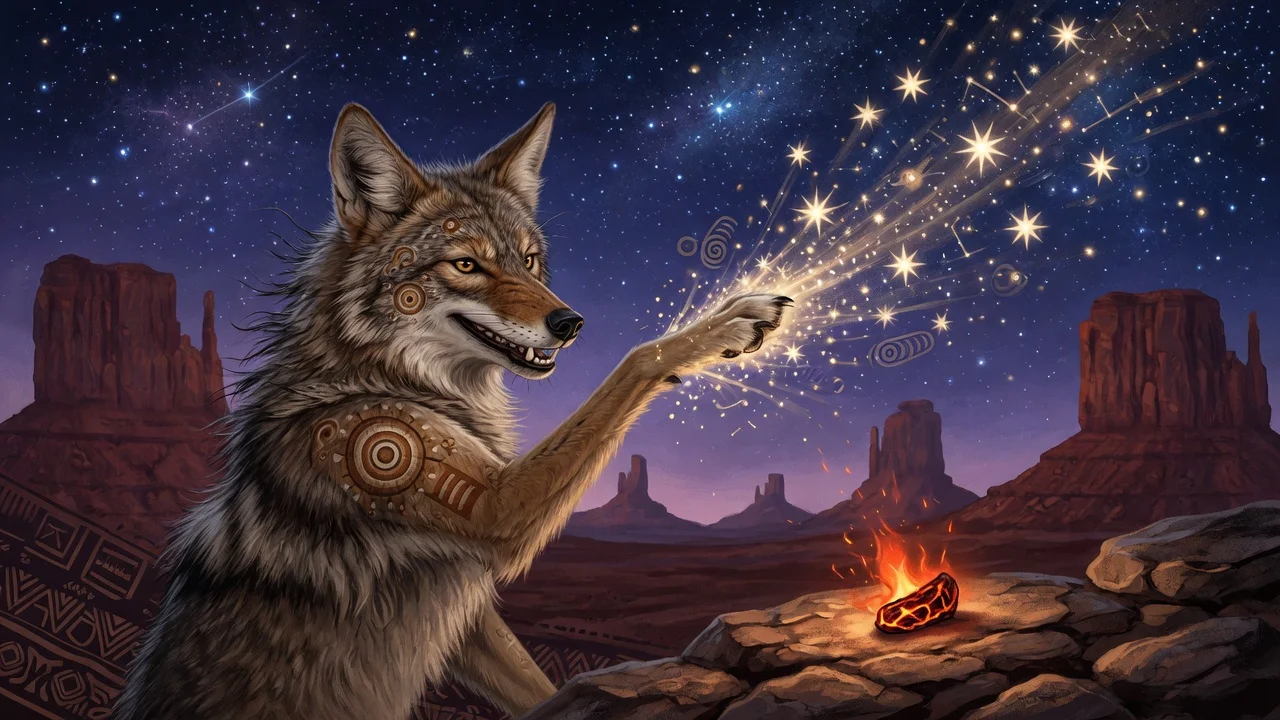
One of the most widely recorded episodes in Navajo star-lore concerns the night sky itself. First Man and First Woman are remembered as having begun the work of placing the constellations in careful, deliberate order — a methodical act of arranging the heavens. Coyote disrupts this. In the accounts gathered by ethnographers such as Washington Matthews, and examined further by later scholars including Trudy Griffin-Pierce, Coyote is credited — or blamed — with taking the remaining stars and flinging them into the sky without pattern, scattering them into the disordered field that fills the night beyond the ordered constellations. It is a small act with an immense visible result: every unpatterned star overhead is, in this telling, a mark of Coyote's impatience set permanently against First Man and First Woman's careful design. The precise sequence of the event — what exactly provoked him, how the scattering happened — varies between tellings, and no single fixed version should be presented as definitive.
The Necessary Disorder
Some ethnographic summaries describe Coyote as a "god of chaos" or a disorder-bringer, and set against the order-bringing Diyin Dine'é — the Holy People — he clearly plays that role. But it would flatten the tradition to read this as simple villainy. Coyote's disruptions are understood, in Navajo cosmology, as cosmologically necessary rather than merely destructive: the order established by First Man, First Woman, and the Holy People requires a counterpart, something that resists, tests, or unbalances it, for the world to take the shape it has. Coyote is that counterpart. He is dangerous and he is required — a distinction the tradition holds without resolving it into either "good" or "evil."
A Way to Heal What He Touches
Coyote's association with taboo-breaking is formalized in ceremonial practice. The Navajo Coyoteway — Ma'iitsoh, sometimes rendered as the Coyote Chant — is a healing ceremony used to treat illness understood to result from violations connected to Coyote: improper contact with coyotes as animals, or disrespect shown toward the dead. That such a ceremonial way exists at all indicates how seriously Ma'ii's taboos are held — not as folklore warnings but as a real category of harm requiring real ceremonial repair. The existence of Coyoteway also underscores that Coyote is not confined to storytelling: he has a place in the practice of healing itself, in the relationship between the living, the dead, and the animal world.
Wolf's Foil, First Man's Counterpart
Within certain story cycles, Coyote is set against or paired with Ma'iitsoh — Wolf — functioning as his foil. He also moves through the emergence-cycle narratives in company with, or in opposition to, First Man, First Woman, and other Diyin Dine'é. These relationships are not fixed alliances or enmities in any simple sense; they shift according to the story being told and the point it is making. What is consistent is that Coyote is defined relationally — his character emerges through contrast with the figures around him, whether the more measured, apex-predator bearing of Wolf or the deliberate order-making of First Man and First Woman.
The Trickster Who Tries to Fly
The trickster-tale genre recorded across Navajo, Apache, and Pueblo storytelling — captured by collectors including Franc Johnson Newcomb — returns again and again to a particular shape of story: Coyote sees another animal doing something he cannot do, and tries to imitate it. He tries to fly with the birds. He tries to run with the antelope. Every attempt ends in failure, and the failure is nearly always traceable to Coyote's own greed or impatience — he cannot wait for the birds to teach him properly, he cannot resist showing off before he has mastered the skill, he wants the reward without the discipline. These tales function as moral and etiological lessons at once: they explain why the world is arranged as it is, and they teach, through Coyote's humiliation, what patience and restraint actually cost when abandoned.
Fire, Help, and the Double Nature
Coyote's role is genuinely dual, and the tradition does not resolve the tension between its two halves. In some regional variants he is credited with helping bring fire or other useful knowledge to the people — acting, in these moments, as something closer to a culture hero. In others, his acts are purely selfish, driven by hunger or vanity, and any benefit that results is unintended, a byproduct of his own self-interest rather than generosity. The scattering of the stars belongs to this same pattern: a selfish or impatient act that produced a permanent, world-shaping change. Coyote is not a figure who can be sorted into "helper" or "harmer." Both are true of him, often within the same story.
The Question of Death
Among the more solemn threads attached to Coyote is his connection, in some Navajo tellings, to the origin of death itself. The core of the account is a dispute — a debate over whether the dead should be permitted to return to the living — in which Coyote's choice, or his trick, results in death becoming permanent rather than reversible. Who exactly stands on the other side of that debate varies: First Man is named in some versions, other figures in others, and the precise mechanism by which Coyote's decision takes effect is not fixed across sources. This should be treated as one of several attested variants of the story rather than a single, settled myth, and it is told with the gravity the subject deserves rather than as one more comic misadventure.
A Figure Shared, Not Singular
It bears repeating that Coyote as a trickster figure is attested across an extraordinary range of Native North American traditions, far beyond the Navajo and Southwestern material gathered here. Among the Pueblo peoples in particular — the Hopi, the Zuni — Coyote stories run in parallel to Navajo Ma'ii but are their own distinct traditions, with their own tellers, their own recorded histories, and their own integrity. Zuni Coyote tales, documented by Frank Hamilton Cushing and later by Dennis Tedlock, are not a regional variant of the Navajo figure; they belong to Zuni people and Zuni storytelling in their own right. Treating every Southwestern Coyote as interchangeable erases exactly the kind of tribal-specific detail — which lineage of singers tells which version, which ceremony surrounds which taboo — that gives these traditions their depth.
What the Variation Itself Preserves
Across every thread gathered here — the emergence, the stars, the ceremonial way, the failed flights, the debate over death — the same pattern holds: no single canonical version exists, and the disagreement between medicine-people, storytellers, and lineages is not a flaw in the record but a feature of how the tradition is carried. Coyote resists being pinned to one fixed account in the same way he resists, within the stories themselves, being pinned to any single role — hero, fool, destroyer, teacher. He remains, across Navajo and Southwestern tradition alike, a living presence bound to season, ceremony, and story, and a figure whose full shape only appears in the accumulation of many tellings rather than in any one of them alone.
Sources & traditions
- EncyclopediaWikipedia — Coyote (mythology)
- TraditionNative American (Navajo/Southwest) folk and village traditions (North America)
Myths change from area to area and from time to time. This chronicle follows the most widely told versions; tellings in other villages, regions and eras may differ.