Campe was a monstrous she-dragon of the underworld — the jailer Cronus set to guard the Cyclopes and the Hundred-Handed Giants imprisoned in the pit of Tartarus, and one of the most fearsome composite monsters in all of Greek myth. To win the war for the cosmos, Zeus first had to destroy her.
The Jailer of Tartarus
When Cronus ruled the cosmos in the age of the Titans, he kept his most dangerous prisoners — the one-eyed Cyclopes and the fifty-headed, hundred-handed Hecatoncheires — locked away in the deepest pit of Tartarus. And to guard them, he set a terrible warden: the monster Campe, who held the keys to their prison and ensured they could never escape.
A Monster of Many Parts
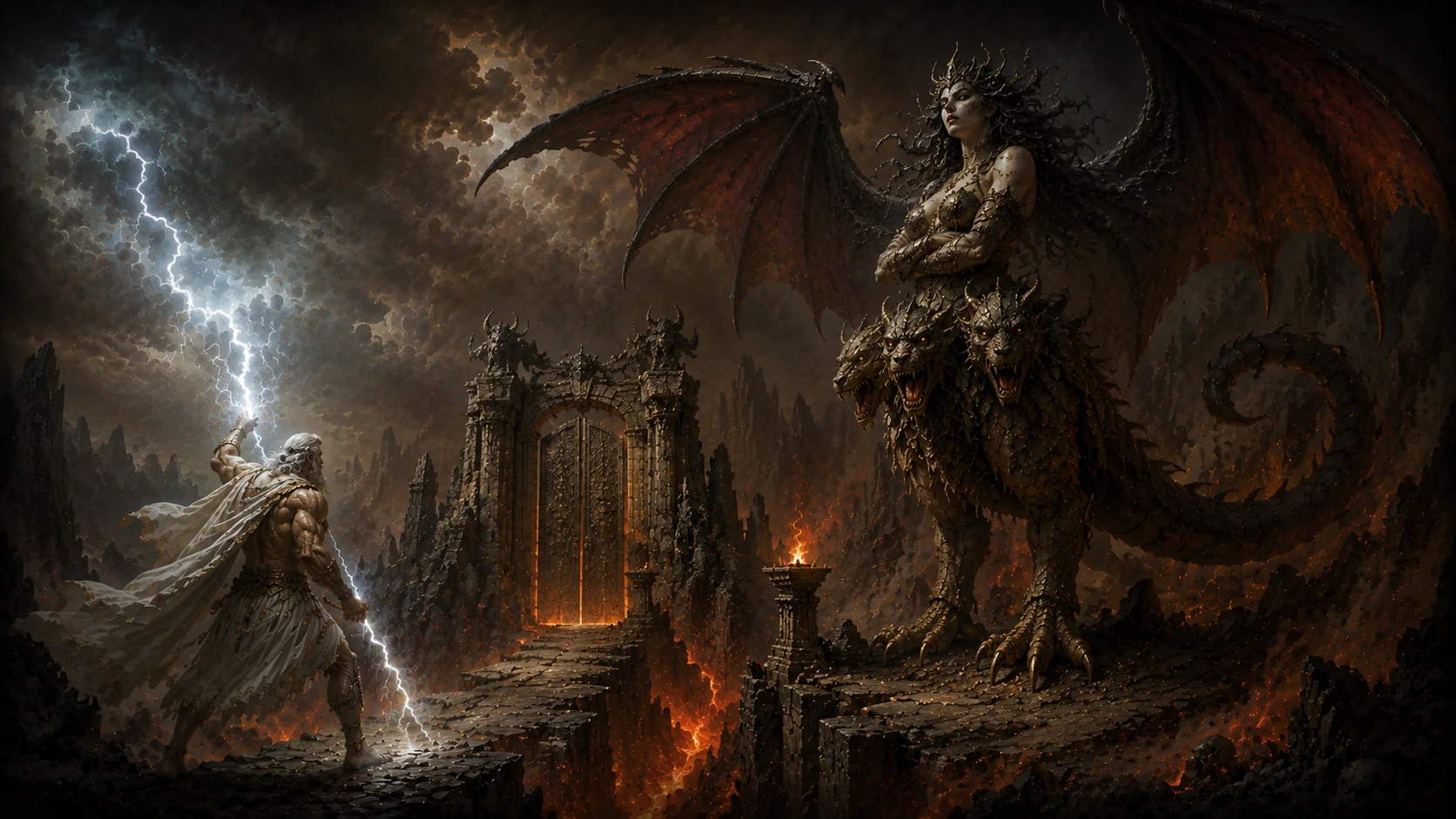
Campe was a horrifying composite creature, described in later sources as having the upper body of a woman, a vast serpentine or scorpion-like lower body bristling with the heads of fifty different beasts around her waist, dark wings, and a venomous scorpion's tail. She was a walking nightmare of combined monstrous features, a guardian as terrible as the prisoners she kept.
The Key to Victory
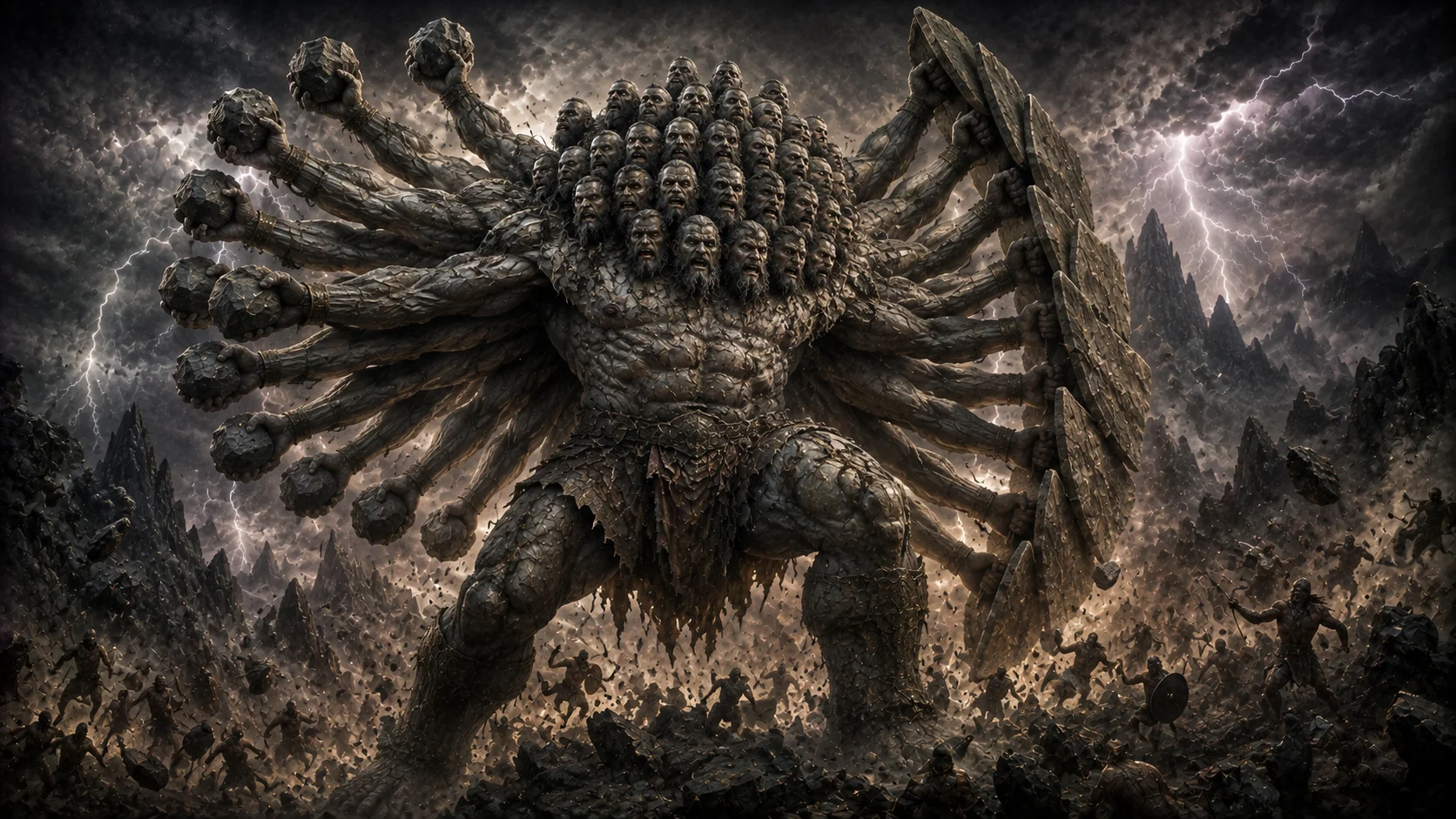
Here Campe becomes pivotal to the entire history of the cosmos. When Zeus rose to challenge the Titans, an oracle told him he could not win without the help of the mighty Cyclopes and Hundred-Handers imprisoned in Tartarus — the Cyclopes who would forge his thunderbolts, the Hundred-Handers whose hundred arms could hurl mountains. But to free them, Zeus first had to get past their jailer. He descended into Tartarus and slew Campe, then released the prisoners, who in gratitude gave him the weapons and strength that would win the Titanomachy and the rule of the cosmos. The killing of Campe was the hinge on which the whole war turned.
The Forgotten Gatekeeper
Campe endures as one of mythology's great composite monsters and as the crucial, often-forgotten obstacle in the founding war of the gods. She is the gatekeeper of the cosmic prison, the monster who had to fall before the imprisoned powers could be unleashed — proof that even the rise of Zeus himself required first the slaying of a dragon.
Before Zeus could rule the heavens, he had to descend to the deepest pit and kill the thing that guarded the key.
The Monster Hesiod Never Named
Open the oldest surviving account of the war for the cosmos and Campe is simply not in it. Hesiod's Theogony tells the Titanomachy at length — ten years of stalemate, the counsel of Gaia, the freeing of the Hundred-Handers, the thunderbolt, the sea boiling and the whole earth crying out — and it never mentions a jailer. The prisoners are bound; Zeus unbinds them. No monster stands in the doorway.
Campe arrives centuries afterwards, and she arrives almost silently. The Bibliotheca attributed to Apollodorus — a handbook of myth compiled long after the archaic poets, in the Roman imperial period — disposes of her in a single clause: Zeus killed their warder, Campe, and loosed the captives' bonds. That is the whole of it. No shape, no combat, no epithet. A name and a corpse.
Only in late antiquity does she acquire a body. Nonnus of Panopolis, writing the enormous Dionysiaca in Greek Egypt in the fifth century, stops the narrative to build her out of parts in a great catalogue of horror. Her whole literary life is therefore a kind of accretion: an unnamed gap in an archaic poem, filled first with a name and then, hundreds of years later, with a nightmare. Watching that happen is one of the few chances mythology gives us to see a monster being made rather than inherited.
What Her Name Means
Greek gives the name two readings, and they are separated by nothing more than an accent. Kámpē, stressed on the first syllable, is an ordinary and unlovely word: a caterpillar, a grub, the crawling larval thing found on a leaf. Kampē stressed on the last syllable is something else entirely — a bending, a crook, a turn; the swing a runner makes at the far post of the course before coming back.
Both suit her uncomfortably well. The first makes her a creeping, many-segmented thing, and a Greek listener would have heard the diminishment in it: the guardian of the world's deepest prison named after a garden pest. The second makes her the bend itself — the turning point, the place where the course reverses. Whether or not the poets intended the pun, the story enacts it. Campe is precisely where the war for the cosmos turns.
How Nonnus Built Her
Nonnus does not describe Campe so much as assemble her. The technique is late-antique to its bones: instead of one clear silhouette the reader is handed an inventory — head after head, coil after coil, the wings, the sting — that refuses to resolve into a single animal. Every part is precise and the whole is unimaginable, which is the point. The poet lingers over the venom the way a jeweller lingers over a setting.
There is a symmetry buried in the count that is easy to miss. Campe wears fifty beast heads; the Hecatoncheires she guards have fifty heads apiece. Jailer and prisoner are built to the same specification. Whatever a poet meant by that, the effect on a reader is exact: the pit does not contain one kind of horror guarded by another, but a single monstrous grammar repeated on both sides of the door. She is not the opposite of what she is keeping in. She is its reflection, wearing the keys.
Note too what she is not given. Campe has no genealogy worth the name. Greek monsters are usually born of somebody — Echidna and Typhon breed a whole dynasty of horrors, and the poets take care to say so. Campe has no listed parents, no mate, no offspring, no cult, no shrine, no festival. She is pure function: a lock with teeth.
The Other Campe, and the Mound in Libya
A second Campe walks through Greek writing, and she does not live in Tartarus at all. Diodorus Siculus, gathering local traditions for his universal history, places a monstrous creature of this name in Libya, at a place he calls Zabirna, where she had been killing many of the people of the region. The hero who destroys her is not Zeus but Dionysus, on his march through Africa, and Diodorus adds the detail that turns a story into a landscape: the god heaped an enormous mound of earth over the dead beast as a memorial of his own courage, and that mound, Diodorus says, was still standing until comparatively recent times.
That last part is the tell. It is how local legend works everywhere — a strange hill, a barrow, a heap nobody remembers building, and a monster invented to be buried under it. Whether the Libyan Campe and the Tartarean one were ever the same figure is unrecoverable. What is clear is that the name attached itself to a shape of story rather than to a single creature: something coiled, venomous and female that a young god must kill before he can be taken seriously.
The Prisoners Become the Wardens
The most under-told part of Campe's myth is what happens after she dies, and it is bleaker than her death.
Hesiod's Tartarus is not a metaphor. He measures it: a bronze anvil dropped from heaven would fall nine days and nights and strike the earth on the tenth, and an anvil dropped from the earth would fall nine days and nights more before it reached the pit. It is fenced in bronze, ringed three deep in night, and shut with gates. Into that place the defeated Titans are thrown when the war ends — and the guards set over them are Cottus, Gyges and Briareus, the Hundred-Handers themselves.
Read the sequence plainly. Zeus kills the jailer, frees the prisoners, wins the war with their help, and then stations those same prisoners at the same door to keep his enemies inside. The prison is never abolished. It only changes management. Campe is killed not because the cosmos has decided against cages, but because the wrong dynasty was holding the keys.
A Guild of Gatekeepers
Campe belongs to one of the oldest professions in myth. The Greeks stationed a monster at every threshold that mattered: Cerberus at the door of the dead, Ladon coiled round the golden apples, the sleepless serpent over the Fleece at Colchis, Python at the oracle of Delphi before Apollo took it. The pattern is always the same — the thing worth having is behind the thing worth fearing, and the hero is defined by which door he is willing to walk up to.
Her particular anatomy has neighbours further east. Gate-guardians with scorpion tails stand at the mountain pass in the Epic of Gilgamesh, watching the road the sun takes. And the shape of her story — the new sky god who must kill a coiling, venomous, female-figured monster before he can rule — is one the whole ancient Near East tells in its own dialects. That does not make Campe a borrowing; myths of this kind grow in more than one soil. It does mean her story was legible far beyond Greece the moment anyone told it.
Why the Monster Is a Woman
Almost every composite horror in Greek myth is female. Echidna, half beautiful woman and half speckled snake. Scylla, girl above and dogs below. Charybdis, the mouth in the water. The Sphinx, the Chimaera, the Hydra, the Gorgons, Keto who mothers half of them. The purely masculine monsters tend to be simple — a giant, a bull, a big man with one eye. It is the female ones who are made of mismatched parts.
Campe is the type in its most extreme form: a woman's face and torso above a chaos of animals, wings and venom. The Greek imagination reached for that combination whenever it wanted to picture a power that could not be reasoned with and could not be predicted — something that presents a human surface and is not human underneath. She is the gate of the underworld given a face you might, for one fatal moment, try to talk to.
The Return of the Forgotten Boss
After late antiquity Campe went quiet again, and for most of the fifteen hundred years that followed she stayed where the handbooks had left her: a clause, a name in a list. Unlike Typhon or Medusa she left no confident trace in surviving ancient art — no famous vase, no temple frieze that scholars can point to and name her with certainty. She survived as a word.
Modern fantasy has been kinder, largely because it has an appetite the ancient sources never satisfied. A monster with fifty heads, wings and a poisoned sting, guarding the most important prison in existence, defeated in one line — that is an unfinished fight, and unfinished fights are irresistible. Rick Riordan gave her an extended one in The Battle of the Labyrinth, reinstalling her as the warden of a modern island prison with Briares in her cells. Her modern appeal rests on exactly the thing that nearly erased her: the ancient texts left the encounter blank, and a blank invites filling.
The Fear Underneath
Strip the wings and the scorpion tail away and Campe is a very old, very sober idea. Every order that has ever existed keeps something locked up. The world runs on the assumption that the door holds, and somebody has been given the keys precisely because nobody wants to look at what is behind it.
The Greeks then told the most disquieting version of that thought available. The founding act of the reigning god — before the thunderbolt, before Olympus, before a single temple — is not creation. It is a jailbreak. Zeus goes down to the lowest place in existence, kills the warden, and takes into partnership the things an older power judged too dangerous to leave loose. The weapons that hold up the sky came out of the pit.
Campe is the answer to a question no myth likes being asked: who was keeping the door, and what was it costing to keep it shut.
Sources & traditions
- EncyclopediaWikipedia — Campe
- TraditionGreek texts, inscriptions and later retellings (Greece)
Myths change from area to area and from time to time. This chronicle follows the most widely told versions; tellings in other villages, regions and eras may differ.