Antaeus was a giant of Libya, a son of the Earth, who forced every traveler who passed through his land to wrestle him to the death — and always won, for as long as he touched his mother the Earth, his strength was endless. He was undefeated until he met Heracles, who discovered the secret of his power and conquered him in one of the most ingenious victories in all of Greek myth.
The Unbeatable Wrestler
Antaeus was a son of Poseidon and Gaia (the Earth), a giant of immense size and strength who dwelt in the deserts of Libya. He compelled all strangers who came his way to wrestle him, and as he was invincible, he killed them all — he was said to roof a temple to his father Poseidon with the skulls of his victims. His invincibility had a hidden source: because Gaia was his mother, every time Antaeus touched the earth, his strength was renewed and redoubled. No matter how hard he was thrown, contact with the ground only made him stronger, and so he could never be worn down or beaten.
Last updated .
The Cunning of Heracles
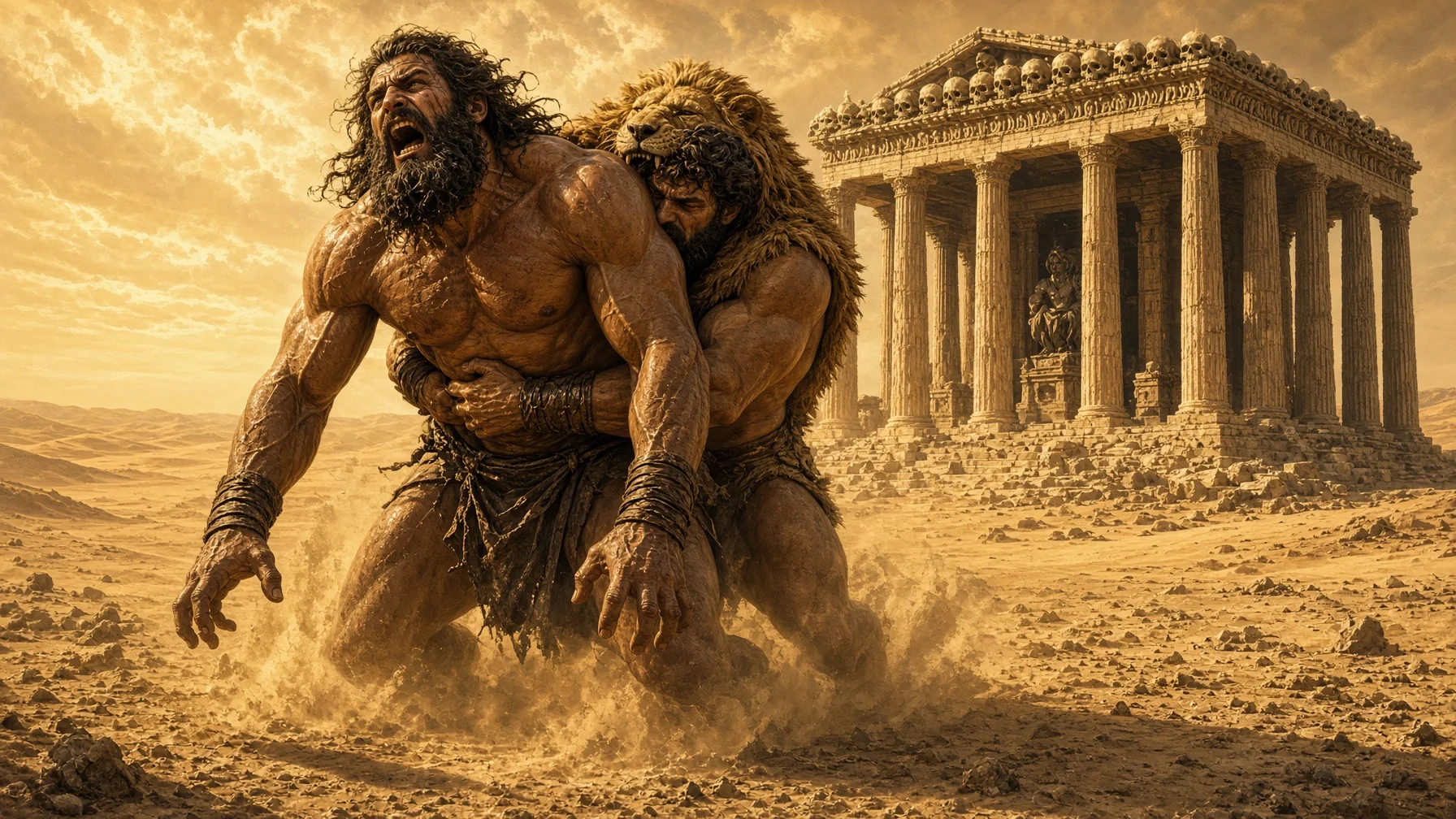
When Heracles passed through Libya (on his way to fetch the golden apples of the Hesperides), Antaeus challenged him as he had challenged all the rest. Again and again Heracles threw the giant to the ground — and again and again Antaeus rose stronger than before. But Heracles, mighty in mind as in body, perceived the secret: the giant drew his strength from the earth. So instead of throwing him down, Heracles seized Antaeus, hoisted him bodily off the ground, and held him aloft in a crushing bear-hug — high in the air, cut off from his mother Earth, the giant's strength drained away, and Heracles crushed the life from him.
The Meaning of the Lifting
The defeat of Antaeus became one of antiquity's most cherished symbols, endlessly retold and depicted, because it carried so rich a meaning. It was the triumph of intelligence over brute strength — the lesson that even an invincible foe has a hidden weakness, and that the wise fighter wins not by matching force with force but by understanding the source of his enemy's power and cutting him off from it. To “lift your opponent off the ground” became a metaphor for severing any strong thing from its roots.
The Giant Cut Off From the Earth
Antaeus endures as the archetype of the foe who is invincible only so long as he stays connected to his source — and of the hero who wins by severing that connection. He embodies the timeless wisdom that strength has a source, that to defeat the unbeatable one must find and cut the root of its power, and that the cleverest victory is often won not by greater force but by greater understanding.
Every throw made the giant stronger — until Heracles simply lifted him from the earth, and held the unbeatable wrestler helpless in the empty air.
Where the Story Actually Comes From
Antaeus is missing from the two poets who shaped almost everything else in Greek myth. Homer never names him; Hesiod never names him. The giant of Libya arrives late and from the edge of the map, and the earliest voice we still have for him is Pindar, writing victory odes in the fifth century BCE for athletes and kings. It is Pindar, in the fourth Isthmian, who gives us the grim detail of the roof built from the skulls of strangers — mentioned not as a horror story in its own right but almost in passing, as the kind of thing Heracles put a stop to. That is how the oldest surviving Antaeus reaches us: not as a monster with his own poem, but as a problem another hero solved.
The visual tradition is just as old, and in one respect older than any surviving text. An Attic red-figure calyx-krater painted by Euphronios around 515–510 BCE, now in the Louvre, shows the two of them locked together on the ground — and the painter's real subject is the contrast between the bodies. Heracles is the neatly coiffed Greek athlete, composed even under strain. Antaeus is shaggy-haired, his hair dragged on in coarse sweeps of thin slip, his eyes rolling back and his mouth open on his teeth as he dies — an animal thing in the grip of a man who trains. The prose accounts that most later readers know — the tidy summary in Apollodorus, the geographical retelling in Diodorus Siculus, the picture-gallery description in Philostratus — all come centuries after the vase. The image came first.
The Footrace at Irasa: Antaeus as a King
There is a second Antaeus in Pindar, and almost nobody knows him. In the ninth Pythian ode, the poet tells of a Libyan man named Antaeus at Irasa, near Cyrene, who had a daughter of famous beauty and no wish to choose among the crowd of men who wanted her. So he did what a Greek imagination expected a father to do: he set the girl at the finish line, told the suitors to run, and gave her to whoever reached her first. A young man of Cyrene, Alexidamus, outran the field, took her hand, and led her out through the ranks of the Nomad horsemen while they showered the couple with leaves and garlands. Pindar sets the episode beside the story of Danaus, who married off forty-eight daughters before midday by the same device.
Here Antaeus is not a killer at all. He is a father, a host, a local ruler with a court and a marriageable child, and the contest he stages ends in a wedding rather than a corpse. Pindar leaves the daughter unnamed; the ancient scholia on the ode supply Alceis, or Barce. Whether the poet thought this was the same being who crushed travellers is impossible to settle, and that ambiguity is itself the point — on the Libyan frontier of Greek knowledge, the strongman who makes strangers compete for their lives and the king who makes suitors compete for his daughter are two faces of one anxiety about what happens to a traveller who walks into someone else's country.
The Giant Who Kept Moving West
Watch where Antaeus lives across the centuries and you are watching a map being drawn. Pindar puts him at Irasa, in Cyrenaica — roughly eastern Libya, the part of Africa Greeks knew because they had a colony there. Later writers push him steadily further along the coast, until the Roman-era sources plant him at Tingis on the strait and Lixus on the Atlantic coast of what is now Morocco, at the very end of the known world beside the Pillars of Heracles.
Nothing in the story required the move. The giant travelled because the frontier travelled. “Libya” in Greek did not mean the modern country but the whole of Africa west of Egypt, and as ships and armies pushed further, the place where the ordinary world stopped and the monstrous began kept retreating ahead of them. Antaeus is a marker of that boundary, and he had to be relocated whenever the boundary was.
The Tomb, the Skeleton, and a Roman Who Dug
In the first century BCE the Roman general Sertorius, campaigning in North Africa, was told by the people of Tingis that Antaeus lay buried under a mound outside their city. Plutarch reports that he did not believe the size they claimed and had the tomb opened — and found, so the account runs, a body of sixty cubits. Sertorius was astonished, sacrificed, and had the mound heaped up again with honour. Strabo preserves a related notice, set at Lixus and credited to the Roman writer Gabinius, in which the figure is sixty feet rather than sixty cubits — and Strabo files it frankly among the marvel-tales he thinks Gabinius invented about Mauretania. The discrepancy is a useful reminder of how such measurements grew and shrank in transmission.
What matters is less the bones than the politics. The Tingitanians also told a story of what happened after the wrestling: that Antaeus's widow, Tinga, bore Heracles a son named Sophax, who became king of the country and named the city for his mother. Through Sophax's line, the local dynasty could trace itself to Heracles himself — and Plutarch says the story was told to gratify the learned Mauretanian king Juba, who claimed exactly that descent. This is myth doing the work myth usually does at the edges of an empire: a defeated native giant, a Greek hero who fathers the royal house, and a genealogy that lets a North African king speak to Rome in Rome's own mythological language.
Why a Fall Was the Worst Thing That Could Happen to Heracles
The story lands harder if you know how Greeks wrestled. In orthe pale, the upright wrestling of the gymnasium and the Olympic programme, the object was to put your opponent down on his back, hip or shoulder: three fair falls decided the bout. Every throw was a point scored, and the man on the ground was the man losing.
Now put Antaeus in that frame. He is a monster built precisely to break the scoring system of the sport. Heracles does everything an athlete is trained to do, and every success he wins is a gift to the enemy. The bout cannot be won by winning. That is the shape the ancients kept returning to: the hero has to stop competing correctly and start thinking, and the solution he finds is not a stronger throw but the refusal to complete one.
Lucan, retelling the fight in the fourth book of his civil-war epic, sharpens the physical detail beautifully. His Antaeus lives in a cave, eats the lions he kills, and scorns the athlete's oil — he dusts himself with warm sand instead, so that even the powder on his skin is his mother. Lucan's Heracles works it out slowly, and the tell is that the giant keeps choosing to go down. The Roman poet then does something characteristically Roman with the legend: he sets the campaign of his own century on the same ground, so that the place where the giant died and the place where Roman armies camped become one landscape. Old myth is used to give a new war a pedigree.
Antaios in Egypt
Greek-speakers in Egypt attached the name to a town in the Nile valley, Antaiopolis — Egyptian Tjebu, near modern Qaw el-Kebir. The local deity there was a falcon god whose name Egyptologists now read as Nemty, but which an older reading and Greek ears rendered close enough to Antaios for the identification to stick. It is a small thing, but it shows the ordinary mechanism of ancient syncretism at work: a name that sounds familiar, a foreign god who fights, and a Greek label fastened onto a cult that had nothing whatever to do with Libyan giants.
Dante Gives the Giant a Job
Antaeus has one of the strangest afterlives in European literature. In the thirty-first canto of the Inferno, Dante and Virgil come to the rim of the lowest pit and find the giants standing in it like towers — Nimrod babbling under his horn, Ephialtes and Briareus bound in chains for the war the sons of Earth made on heaven. Antaeus is unbound. He was not at that war, so he is not punished as a rebel; he is simply enormous, and available.
Virgil flatters him with the memory of his Libyan lion-hunting and promises that Dante can restore his fame on earth. And then the poet delivers the finest irony in the whole tradition: the giant who was destroyed by being lifted off the ground picks the two poets up, stooping so that he seems to lean like the Garisenda tower of Bologna, and sets them gently down on the ice of Cocytus. The move that killed him becomes the service he performs. Milton knew the older layer as well, and in Paradise Regained compares Satan's fall to the wrestling in “Irassa” — going straight back to Pindar's place-name rather than the popular one.
How the Lift Conquered the Picture
Early Greek art shows the two men grappling low, hands and knees in the dust, and the drama lies in the strain. Later art is interested in one instant only: the moment the giant's feet leave the earth. By the Renaissance that had become the whole subject. Antonio del Pollaiuolo's small bronze of Hercules and Antaeus, made in Florence around the 1470s, freezes the crush — the hero's back arched, the giant hoisted and bent backwards, one leg thrashing at nothing, his mouth open in a shout — and it is one of the most physically convincing small sculptures of the century, precisely because everything in it depends on the absence of the ground.
The shift is worth noticing. The archaic image asks who is stronger? The Renaissance image already knows the answer and asks instead what does it look like when a thing is separated from what feeds it? The subject stopped being a fight and became an idea.
Roots, and the People Who Pull Them Up
Modern readers have not been able to leave Antaeus alone, because the metaphor is too useful and too uncomfortable. In the twentieth century the Irish poet Seamus Heaney wrote him twice, in Antaeus and Hercules and Antaeus, and used the pair for something the Greeks never intended: Antaeus as the native, lying against his own dark ground and drawing everything he has from it, and Hercules as the arriving intelligence — rational, unattached, and lethal precisely because he owes the place nothing. In that reading the clever hero is not simply admirable. He is the coloniser, and his brilliant trick is what happens to a culture when it is prised loose from the earth that made it.
This is why the story refuses to become a fable and stay one. Cutting an enemy off from the source of his strength is a lesson in how to destroy something, and it works on more than giants. It works on a person separated from their language, a family moved off its land, a tradition kept alive only in a museum case. Antaeus is not frightening because he is huge. He is frightening because his weakness is the one every rooted thing has, and because the myth is honest enough to let the man who exploits it walk away a hero.