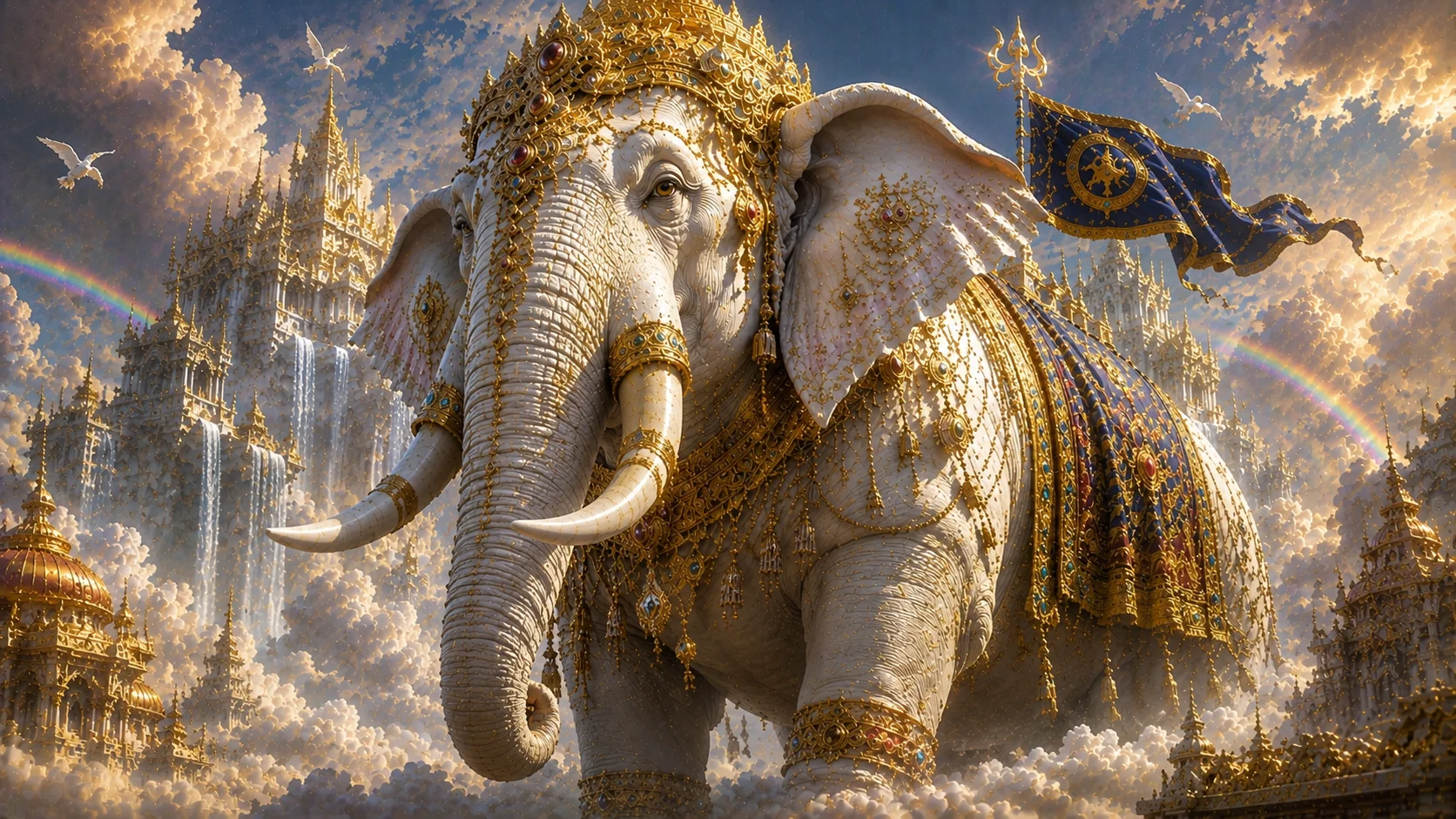
Airavata is the great white elephant of Hindu myth, the celestial mount (vahana) of Lord Indra, king of the devas. Born from the churning of the cosmic ocean and radiant with an otherworldly glow, he carries the storm-king across the heavens as chief among the mythic elephants who uphold the four quarters of the world.
The Mount of the Storm-King
Airavata (Sanskrit: Airāvata) is the divine white elephant who bears Lord Indra, king of the gods, upon his back. He is described across the Puranas and the Mahabharata as a being of immense size, pure white in color, and radiant with a brilliance that sets him apart from every ordinary elephant of the earthly world. Most accounts give him multiple heads — four is the most commonly cited number, though some texts describe more — and it is upon this many-headed, radiant creature that Indra rides in procession through the heavens, a vision of divine kingship made visible in a single animal. Where Indra goes in state, Airavata carries him, and the pairing of storm-god and elephant became one of the most recognizable images of royal and divine authority in the tradition.
Risen from the Churned Ocean
Airavata's origin is bound to one of Hindu mythology's most celebrated episodes: the Samudra Manthan, the Churning of the Ocean of Milk. As the devas and asuras churned the primordial ocean together in their search for the nectar of immortality (amrita), a succession of wondrous treasures and beings rose up out of the churned waters. Airavata was counted among them, emerging alongside other treasures of the churning such as the goddess Lakshmi and the amrita itself. Having arisen from the ocean in this way, the great white elephant passed into the service of Indra and became his mount — a treasure of the churning claimed by the king of heaven himself. The episode is recounted in the Puranas and in the Mahabharata, and it remains the account most consistently given for how Airavata came to be.
A Parentage the Texts Do Not Agree On
Alongside the churning-of-the-ocean account, the Puranic genealogies offer other, differing explanations of Airavata's descent. In some tellings he is numbered among the offspring of the sage Kashyapa and his wife Danu. In others, he is said to have been born from fragments of the shell of the cosmic egg — the same shell that, breaking apart, also gave rise to the other diggajas, the mythic elephants who came to guard the directions of the world. The traditional commentators do not settle on a single lineage, and the texts themselves vary in which account they favor. What they agree on is the outcome: whatever his precise origin, Airavata rose to become foremost among elephants and the chosen mount of Indra.
Chief Among the Guardians of the Directions
In the cosmological schemes of later Hindu tradition, eight mythical elephants — the diggajas, or ashtadiggajas — are said to stand at the eight cardinal and ordinal points of the world, bearing it up and guarding it from their respective quarters. Airavata is reckoned chief among them, and it is fitting that his particular station is the East — the direction that belongs to Indra himself. In this role Airavata is not merely a mount but a cosmological pillar, one of the beings whose steady presence at the edge of the world keeps it upright and defended. His primacy among the diggajas mirrors Indra's own primacy among the devas: king of the gods and king of elephants, standing together at the eastern gate of creation.
The Elephant Who Calls Down the Rain
Because he carries Indra, the god of storms and rain, Airavata is himself woven into Vedic-derived symbolism of rain and cloud. Elephants generally carry this association in Hindu cosmology, and Airavata, as the greatest of them, carries it most fully — a fitting companion to a god whose thunderbolt splits the clouds and whose favor decides whether the fields will drink or wither. To ride Airavata is, in this symbolic register, to ride the very principle of rain-bringing that Indra embodies, the white bulk of the elephant standing in for the banked white of monsoon cloud.
A Name That May Remember a River
The etymology of Airavata's name is not fully settled among traditional commentators, but one persistent explanation ties it to water all the same: some derive it from "Iravati," a name given to a river, while others connect it to the sage Iravat. Neither derivation is agreed upon as final, and the tradition preserves them as possibilities rather than certainties. Still, the pull toward water in every proposed reading of the name sits comfortably beside Airavata's broader character as a being bound up with rain, rivers, and the life-giving movement of water through the world — whether or not the etymology itself is the reason.
In the Court of Indra at Amaravati
The Mahabharata places Airavata within its descriptions of Indra's heavenly court, Amaravati, and of the processions that pass through it. He appears there as part of the visible splendor of Indra's kingship — the great elephant standing ready, or bearing his rider through the assembled ranks of heaven, a detail that helps the epic paint the sheer grandeur of the devas' capital. These are not narrative episodes centered on Airavata himself so much as glimpses of him within the wider tapestry of Indra's court, but they matter: they are the moments where the mount becomes inseparable from the majesty of the god he carries.
Beside Indra in the Wars of Heaven
Indra's long cosmic conflict with the asuras runs through many corners of Puranic literature, and in the episodes recounting his battles and exploits against these demon adversaries, Airavata appears at his side as the mount that carries him into the field. The great white elephant is not described as a combatant with a story of his own in these passages; rather, he is the platform of divine warfare, bearing the king of the gods wherever the battle against the asuras takes him. In this the elephant and the storm-god are inseparable — Indra's victories are, in their visual telling, Airavata's as well.
Not to Be Mistaken for Gajendra
Hindu cosmology holds more than one mythic elephant, and Airavata is sometimes conflated with them in popular retelling — most often with Gajendra, the elephant devotee of Vishnu at the center of the Gajendra Moksha episode. The two are distinct figures belonging to different threads of the same broader tradition: Airavata is Indra's mount and a child of the churned ocean or of the diggaja lineage, while Gajendra is a separate elephant whose story concerns devotion to Vishnu and his deliverance from a crocodile's grip. Keeping the two apart matters, since their stories, their divine associations, and their places in the tradition do not overlap.
Carried Onward into Southeast Asian Tradition
Airavata's iconography did not stay confined to the Sanskritic Hindu world. In later Hindu-Buddhist syncretic traditions of Southeast Asia — Thailand among them, where he was adapted into local myth as Erawan — the image of the great white, multi-headed elephant took on a life of its own within a distinct cultural reception. This regional afterlife stands apart from the core Sanskritic tradition even as it draws directly from it, a testament to how far the image of Indra's elephant traveled beyond the texts that first described him.
Named in Stone at the Gates of Kings
The association between Airavata and royal power did not remain confined to myth. Elephant statues raised at royal courts and temples across India have historically been named or modeled after Airavata, invoked as a symbol of auspiciousness and of the kind of sovereignty Indra himself represented. To place his name or his likeness at the gate of a court was to borrow, in stone, something of the majesty that the white elephant lent to the king of heaven — proof that Airavata's image carried weight far beyond the passages of the Puranas and the Mahabharata that first gave him form.
The White Elephant Who Bears the King of Heaven
Across every thread of his myth — the churning of the cosmic ocean, the uncertain lines of his parentage, his station as chief guardian of the East, his bond to rain and cloud, his place in Indra's court and in Indra's wars — Airavata endures as the definitive image of the divine elephant. He is the mount whose whiteness and radiance made him worthy to carry the king of the gods, the foremost of the diggajas holding up the world, and a figure whose likeness still stands watch at temple gates as a mark of royal and divine favor. In the many-headed white elephant beneath Indra, the tradition found its clearest picture of what it means for majesty to have a shape.
Sources & traditions
- EncyclopediaWikipedia — Airavata
- TraditionHindu texts, oral tradition and village tellings (South Asia)
Myths change from area to area and from time to time. This chronicle follows the most widely told versions; tellings in other villages, regions and eras may differ.